Within Mythcraft
Why Corrected Myths Still Linger
A myth can keep shaping judgement after correction when the debunking removes a story without replacing it.
On this page
- What the effect means
- Why gaps invite the old story back
- Replacement explanations that work
Page outline Jump by section
Introduction
Corrected myths can linger because a correction often removes a claim without repairing the story that claim helped people build. This is the continued influence effect: discredited information keeps shaping memory, judgement or explanation even when people remember that it was corrected. It matters because many myths are not stored as isolated facts. They become part of a causal account — why a fire spread, why a person acted, why a policy failed, why a health scare sounded plausible. When the false piece is pulled out, the mind still needs a workable account of what happened. If no better account is supplied, the old story can quietly return as the easiest explanation.[Center for Climate Change Communication]climatechangecommunication.orgCenter for Climate Change Communication Debunking HandbookCenter for Climate Change CommunicationDebunking HandbookOctober 11, 2020 — Continued influence effect: The continued reliance on inaccur…
The central lesson is not that corrections are useless. The evidence is more precise: corrections usually help, but they often do not fully erase the influence of the original misinformation. The most useful corrections therefore do two jobs at once. They clearly mark the myth as false, and they give people a simple, credible replacement explanation to use instead.[Sage Journals]journals.sagepub.comSage JournalsA Meta-Analytic Examination of the Continued Influence…by N Walter · 2020 · Cited by 649 — A meta-analysis was conducted…
What the effect means
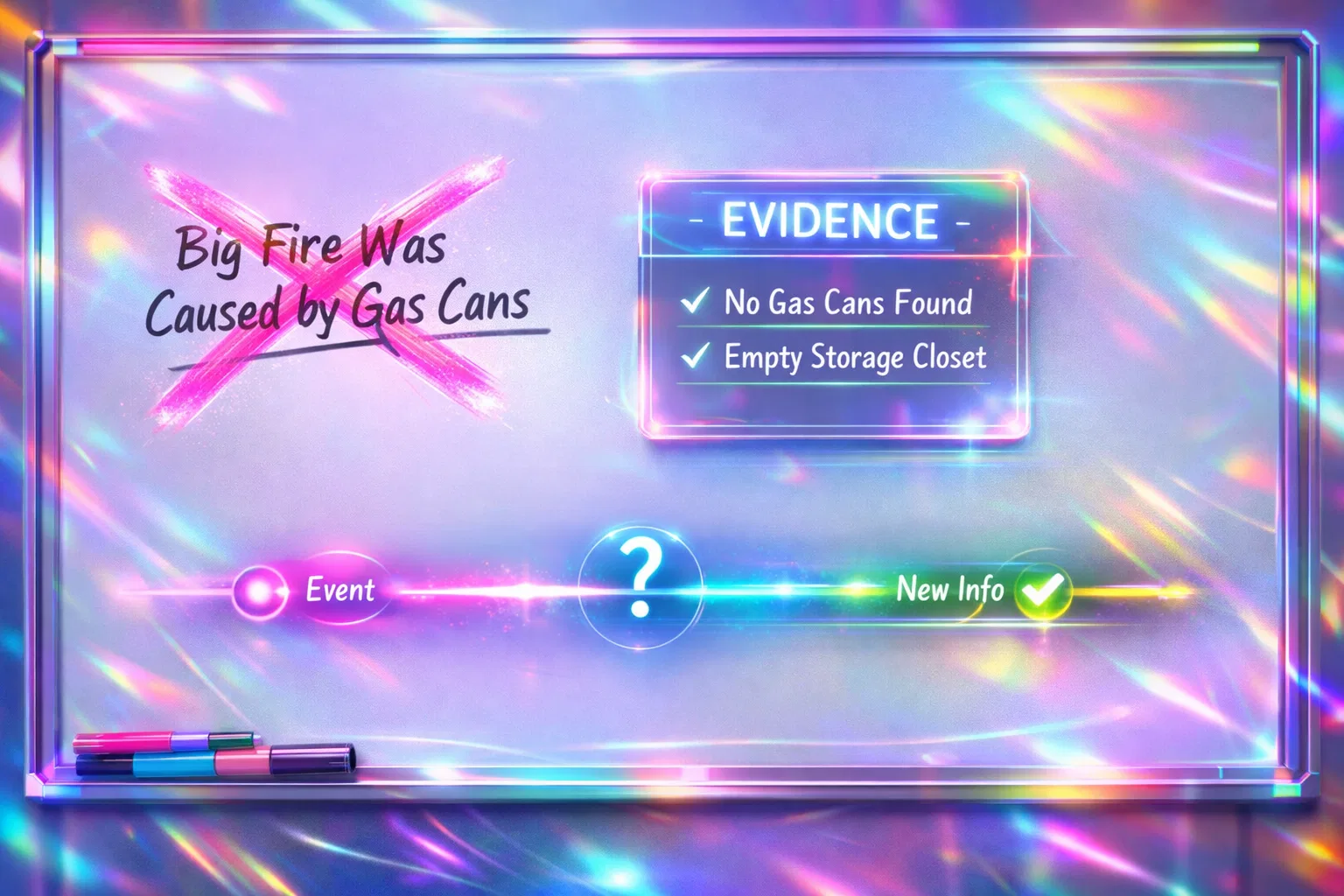
The continued influence effect is the tendency for retracted or corrected information to keep affecting later reasoning. A person may say, sincerely, “I know that claim was wrong,” yet still answer later questions as though the claim explained the event. The effect is especially visible when misinformation supplies a cause. If a false report says a warehouse fire was intensified by paint and gas canisters, and a later report says the cupboard was actually empty, people may still refer to the canisters when explaining the severity of the fire. The correction is remembered, but the earlier cause remains useful.[ScienceDirect]sciencedirect.comReview Effective correction of misinformationby T Prike · 2023 · Cited by 79 — However, recent studies from our lab have fou…
This is different from simple ignorance. In many experiments, participants do not merely fail to notice the correction. They can often identify that a retraction occurred, yet still draw inferences from the retracted information. That makes the effect awkward for communicators: the problem is not always that the audience never heard the correction, distrusted it, or forgot it entirely. Sometimes the correction is available in memory but loses the contest against a more complete story.[Springer]link.springer.comExplicit warnings reduce but do not eliminate the continued…by UKH Ecker · 2010 · Cited by 741 — The present study investigate…
A meta-analysis by Nathan Walter and Riva Tukachinsky found that corrections reduce misinformation’s impact, but do not entirely eliminate it across the studies reviewed. This is the practical middle ground often missed in public discussion. Debunking is neither magically cleansing nor usually self-defeating. It is partial repair. The myth’s influence weakens, but traces can remain in the way people explain, judge and remember.[Sage Journals]journals.sagepub.comSage JournalsA Meta-Analytic Examination of the Continued Influence…by N Walter · 2020 · Cited by 649 — A meta-analysis was conducted…
Why gaps invite the old story back
Myths often persist because they do explanatory work. They link events together, assign blame, identify motives or make uncertainty feel manageable. A correction that says only “that did not happen” may be factually accurate but cognitively incomplete. It creates a gap where the myth used to sit.
A useful way to think about this is the “mental model” account. People build a rough internal model of an event as they learn about it. If early information supplies a cause, that cause becomes part of the model. A later correction may tag the information as false, but unless the model is rebuilt, the original cause can still be retrieved when the person needs to explain the event. The old story survives not because it is believed in full, but because it remains the most accessible tool for reasoning.[Nature]nature.comSource details in endnotes.
The classic warehouse-fire example shows the mechanism clearly. If people hear that volatile materials were present at a fire, those materials explain explosions, toxic fumes and unusual intensity. Removing that detail leaves several questions unanswered. Why did the fire spread? Why were there explosions? Why were investigators concerned? Without an alternative cause, the discredited detail remains tempting because it still fits the rest of the story.[Shaping Tomorrows World]shapingtomorrowsworld.orgSource details in endnotes.
This is why “myth versus fact” formats can underperform when they stop at negation. A correction that says “No, the passengers were not elderly people” is weaker than one that says “No, they were not elderly people; they were college hockey players returning from a victory party.” The second version does more than deny the false claim. It supplies a replacement that can explain later inferences about noise, behaviour, injuries or alcohol.[classes.cs.uchicago.edu]classes.cs.uchicago.eduEcker2010 Article ExplicitWarningsReduceButDoNotEcker2010 Article ExplicitWarningsReduceButDoNot
Replacement explanations that work
The strongest corrections tend to be coherent, specific and easy to integrate into the reader’s existing understanding. They do not merely announce that the myth is false; they explain what should occupy the same explanatory slot.
A good replacement explanation usually has four features:
- It names the false claim clearly. People need to know which idea is being corrected, especially when several similar claims are circulating.
- It states the correction directly. Hedged or vague wording can leave the myth more fluent than the correction.
- It explains the source of the mistake when useful. A correction can become more satisfying when it tells the reader why the false claim arose: a misread document, an early report, a misleading image, a rumour, a statistical confusion or a deliberate fabrication.
- It offers a usable alternative account. The replacement should answer the same “why” or “what happened” question that made the myth attractive in the first place.[ScienceDirect]sciencedirect.comReview Effective correction of misinformationby T Prike · 2023 · Cited by 79 — However, recent studies from our lab have fou…
The alternative does not have to be elaborate. In fact, it often works best when it is simple enough to remember. If a health myth claims that a symptom is caused by one frightening ingredient, a correction that only says “there is no evidence for that” may leave the fear structure intact. A better correction explains the more likely causes, the actual risk level and why the misleading claim sounded plausible. The goal is not to bury the reader in detail, but to give them a new mental shortcut that is more accurate than the old one.
This also explains why corrections from credible sources matter, but are not always enough. Warnings can reduce continued reliance on misinformation, yet research has found that explicit warnings do not necessarily eliminate the effect. Source credibility, prior beliefs and the coherence of the replacement story all influence whether the correction becomes the new default explanation.[University of Bristol]research-information.bris.ac.ukexplicit warnings reduce but do not eliminate the continued influexplicit warnings reduce but do not eliminate the continued influ

The correction should rebuild the story, not just remove the myth
The continued influence effect changes what “successful debunking” means. A correction has not fully succeeded just because the audience can repeat the factual update. The harder test is whether they stop using the old claim when making judgements later.
This is why the best corrections often read less like a courtroom objection and more like a better account of events. They say, in effect: “Here is the claim you may have heard; here is why it is wrong; here is how the mistake arose; here is the explanation that better fits the evidence.” That structure gives the reader somewhere to put the correction. It replaces a broken story with a sturdier one.
For myths and misconceptions, the stakes are practical. In education, a student may abandon a false rule in a quiz but still use it when solving a problem. In public health, a person may accept that a viral claim was debunked but still feel its causal story when making a risk decision. In politics or social conflict, a corrected allegation can continue to colour impressions of a person or group even after the allegation is withdrawn. The mechanism is the same: once a myth has organised judgement, correction must reorganise judgement too.[PMC]pmc.ncbi.nlm.nih.govPMCThe role of discomfort in the continued influence effectPMCThe role of discomfort in the continued influence effect
The useful takeaway is therefore modest but powerful. Do not treat a myth as a stain that can be wiped off with “false”. Treat it as a piece of scaffolding inside someone’s explanation. If the scaffolding is removed and nothing replaces it, the mind may reach for the old support again. A correction that supplies a clear alternative gives the reader a better structure to stand on.
Amazon book picks
Further Reading
Books and field guides related to Why Corrected Myths Still Linger. Use these as the next step if you want deeper reading beyond the article.
Thinking, Fast and Slow
Provides cognitive foundations for continued influence effects.
Mistakes Were Made (but Not by Me) Third Edition
Explains belief persistence and self-justification.

Mistakes Were Made (But Not by Me)
First published 2007. Subjects: Fouten, Vergissingen, Cognitive dissonance, Self-deception, Rechtvaardiging.
eBay marketplace picks
Marketplace Samples
Example marketplace items related to this page. Use the search link to explore similar finds on eBay.

Endnotes
1.
Source: link.springer.com
Link:https://link.springer.com/article/10.3758/MC.38.8.1087
Source snippet
Explicit warnings reduce but do not eliminate the continued...by UKH Ecker · 2010 · Cited by 741 — The present study investigate...
2.
Source: sciencedirect.com
Link:https://www.sciencedirect.com/science/article/pii/S2352250X23001574
Source snippet
Review Effective correction of misinformationby T Prike · 2023 · Cited by 79 — However, recent studies from our lab have fou...
3.
Source: sciencedirect.com
Link:https://www.sciencedirect.com/science/article/pii/S0001691823002706
4.
Source: classes.cs.uchicago.edu
Title: Ecker2010 Article ExplicitWarningsReduceButDoNot
Link:https://www.classes.cs.uchicago.edu/archive/2020/spring/33231-1/readings/Ecker2010_Article_ExplicitWarningsReduceButDoNot.pdf
5.
Source: nature.com
Link:https://www.nature.com/articles/s44159-021-00006-y
6.
Source: sciencedirect.com
Link:https://www.sciencedirect.com/science/article/pii/S0010027724002865
7.
Source: pmc.ncbi.nlm.nih.gov
Title: PMCThe role of discomfort in the continued influence effect
Link:https://pmc.ncbi.nlm.nih.gov/articles/PMC8447889/
8.
Source: link.springer.com
Link:https://link.springer.com/article/10.3758/s13421-023-01402-w
9.
Source: link.springer.com
Link:https://link.springer.com/article/10.1186/s41235-021-00335-9
10.
Source: link.springer.com
Link:https://link.springer.com/article/10.1186/s41235-021-00346-6
11.
Source: research-repository.uwa.edu.au
Title: explicit warnings reduce but do not eliminate the continued influ
Link:https://research-repository.uwa.edu.au/en/publications/explicit-warnings-reduce-but-do-not-eliminate-the-continued-influ/
12.
Source: sciencedirect.com
Link:https://www.sciencedirect.com/science/article/abs/pii/S0010027720302729
13.
Source: youtube.com
Title: The Continued Influence Effect
Link:https://www.youtube.com/watch?v=eZ_hcf01EFw
Source snippet
The Continued Influence of Misinformation — Ullrich Ecker (CHDH Seminar Series 2020)...
14.
Source: youtube.com
Link:https://www.youtube.com/watch?v=H_dHJVH5hPU
Source snippet
Continued Influence Effect...
15.
Source: youtube.com
Title: Continued Influence Effect
Link:https://www.youtube.com/watch?v=LkCxRCpkyBs
Source snippet
What is Continued influence effect? [Definition and Example] - Understanding Cognitive Biases...
16.
Source: climatechangecommunication.org
Title: Center for Climate Change Communication Debunking Handbook
Link:https://www.climatechangecommunication.org/wp-content/uploads/2023/09/DebunkingHandbook2020.pdf
Source snippet
Center for Climate Change CommunicationDebunking HandbookOctober 11, 2020 — Continued influence effect: The continued reliance on inaccur...
Published: October 11, 2020
17.
Source: journals.sagepub.com
Link:https://journals.sagepub.com/doi/abs/10.1177/0093650219854600
Source snippet
Sage JournalsA Meta-Analytic Examination of the Continued Influence...by N Walter · 2020 · Cited by 649 — A meta-analysis was conducted...
18.
Source: shapingtomorrowsworld.org
Link:https://www.shapingtomorrowsworld.org/debunking-handbook-part-5-filling-gap-with-alternative-explanation.html
19.
Source: research-information.bris.ac.uk
Title: explicit warnings reduce but do not eliminate the continued influ
Link:https://research-information.bris.ac.uk/en/publications/explicit-warnings-reduce-but-do-not-eliminate-the-continued-influ/
20.
Source: frontiersin.org
Link:https://www.frontiersin.org/journals/psychology/articles/10.3389/fpsyg.2024.1487146/full
Additional References
21.
Source: youtube.com
Title: Misinformation Effect: How to Alter Memories
Link:https://www.youtube.com/watch?v=hrBesZu0k3o
Source snippet
Continued influence effect of misinformation The Continued Influence Effect - Why do memories of misinformation persist in our minds?...
22.
Source: youtube.com
Title: What is Continued influence effect? [Definition and Example]
Link:https://www.youtube.com/watch?v=EaEDkrYnKuI
Source snippet
Misinformation Effect: How to Alter Memories...
23.
Source: researchgate.net
Link:https://www.researchgate.net/publication/258180567_Misinformation_and_Its_Correction_Continued_Influence_and_Successful_Debiasing
24.
Source: emc-lab.org
Link:https://www.emc-lab.org/uploads/1/1/3/6/113627673/butler.2025.nhb.pdf
25.
Source: researchgate.net
Link:https://www.researchgate.net/publication/375867267_I_know_It%27s_false_but_I_keep_thinking_as_if_it_were_true_A_replication_study_of_Johnson_and_Seifert%27s_1994_continued_influence_effect
26.
Source: researchgate.net
Link:https://www.researchgate.net/publication/391015007To_be_continued_misinformation%27s_bizarre_adventure_beyond_memory_failures-_exploring_non-memory-based_mechanisms_driving_the_continued_influence_effect_CIE
27.
Source: researchgate.net
Link:https://www.researchgate.net/publication/333950695_A_Meta-Analytic_Examination_of_the_Continued_Influence_of_Misinformation_in_the_Face_of_Correction_How_Powerful_Is_It_Why_Does_It_Happen_and_How_to_Stop_It
28.
Source: semanticscholar.org
Link:https://www.semanticscholar.org/paper/A-Meta-Analytic-Examination-of-the-Continued-of-in-Walter-Tukachinsky/ef4e5a4009814a03adb47947ba57b559c2b8383a
29.
Source: socialactionlab.org
Link:https://socialactionlab.org/wp-content/uploads/2024/01/Chan_A-meta-analysis-of-correction-effects-in-science-relevant-misinformation_2023.pdf
30.
Source: emc-lab.org
Link:https://www.emc-lab.org/uploads/1/1/3/6/113627673/chapter_swireecker_revised.pdf
Topic Tree