Within Neuromyths
When movement breaks become brain myths
Movement breaks can help classrooms, but Brain Gym-style claims about hemispheric integration go beyond the evidence.
On this page
- What Brain Gym style programmes promise
- What ordinary movement breaks can still do
- How schools can keep activity without the pseudoscience
Page outline Jump by section
Introduction
Movement breaks are one of the clearest examples of how a useful classroom practice can become mixed with a misleading explanation. There is good evidence that children benefit from opportunities to move during the school day. Short bouts of physical activity can reduce sedentary time, improve alertness and sometimes support attention and classroom behaviour. What is far less supported is the claim that particular movements “integrate” the brain, activate underused neural pathways or unlock learning through specialised neurological mechanisms.[Frontiers]frontiersin.orgFrontiersReview on the Prevalence and Persistence of Neuromyths…by F Grospietsch · 2021 · Cited by 84 — Numerous empirical studies rev…
 Brain Gym sits at the centre of this distinction. The programme promotes structured movement routines and presents them as a way to improve learning through brain-based processes. Critics do not generally object to children stretching, standing up or moving around. The controversy concerns the neurological explanations attached to those activities and the educational claims built on them. Brain Gym has therefore become a common case study in discussions of neuromyths in teacher training and classroom practice. Taylor & Francis Online[ERIC]eric.ed.govERICIs Brain Gym[R] an Effective Educational Intervention?by LS Spaulding · 2010 · Cited by 164 — While BGI's claims are persuasive, to date there is little empirical evidence validating the…
What Brain Gym-style programmes promise
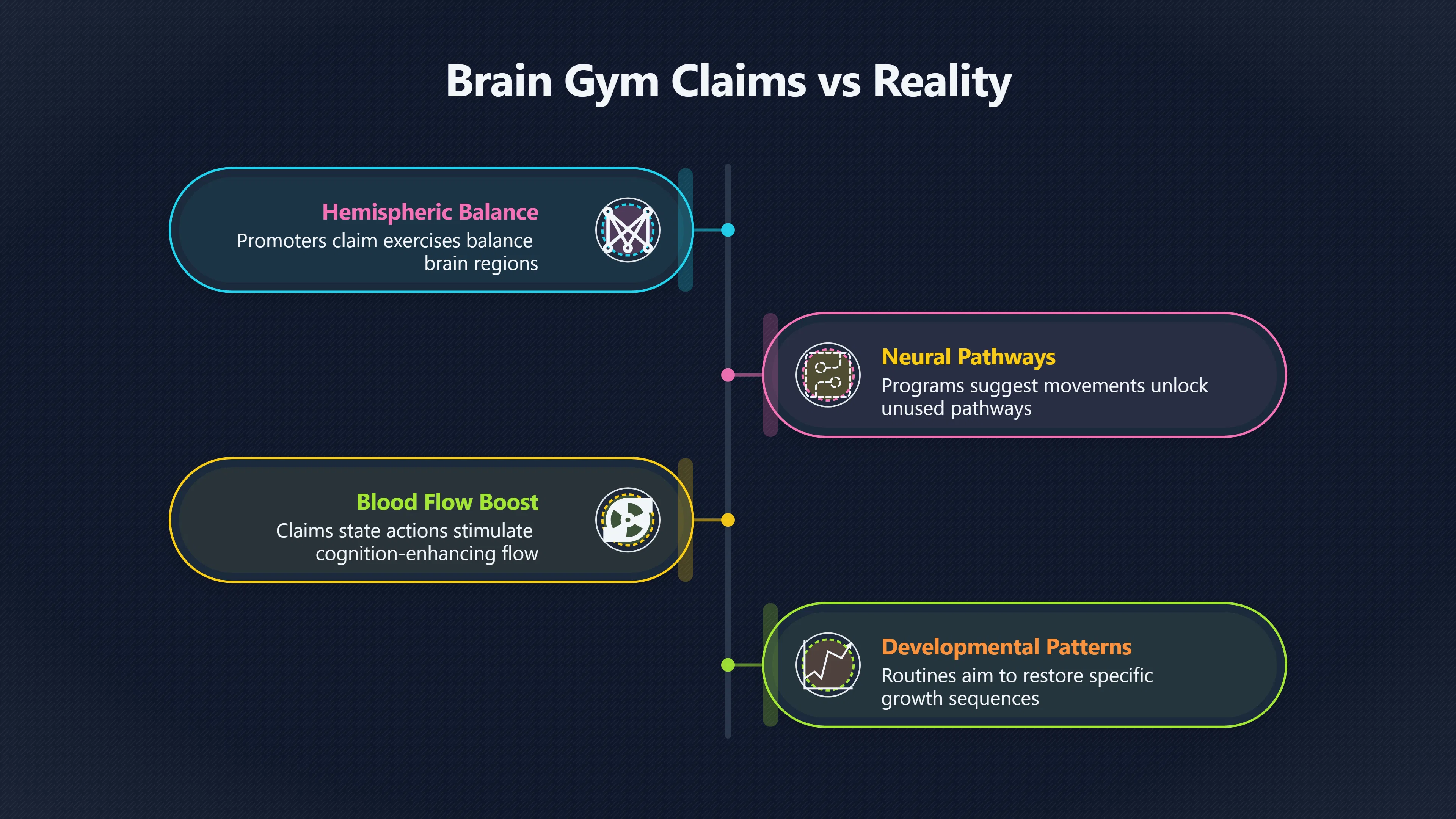
Brain Gym emerged from a broader approach called educational kinesiology, developed by Paul and Gail Dennison. The programme includes exercises such as cross-body movements, tracing shapes in the air, coordinated stretching routines, “brain buttons”, yawning exercises and other prescribed actions intended to prepare the brain for learning. Supporters have linked these activities to improvements in reading, concentration, memory, emotional regulation and academic performance.[breakthroughsinternational.org]breakthroughsinternational.orge. ♢ The full publication is…Read more…[SOUNDSORY]soundsory.comBrain Gym® Program: 26 Exercises to Boost Focus & MemoryThe program claims that specific physical movements and exercises can help indivi… The distinctive feature of Brain Gym is not movement itself but the explanation offered for why the movement works. Promotional and trainingmaterials have frequently claimed that specific exercises improve communication between brain hemispheres, balance different regions of the brain, stimulate blood flow in ways that enhance cognition or restore developmental patterns believed to be necessary for learning.[Wikipedia]WikipediaBrain Gym InternationalBrain Gym International
These claims sound scientific because they borrow language from neuroscience. Terms such as “brain integration”, “cross-lateral stimulation” and “hemispheric balancing” suggest a direct connection between a classroom exercise and a neurological mechanism. Yet modern neuroscience does not support the idea that pupils are failing academically because one hemisphere has not been sufficiently activated or because simple movement sequences reconnect neglected brain pathways. The two hemispheres are already in constant communication through established neural networks, and learning involves highly distributed brain systems rather than a simple left-right balance problem.[Johns Hopkins Medicine]hopkinsmedicine.orgJohns Hopkins MedicineBrain Anatomy and How the Brain WorksThe brain is a complex organ that controls thought, memory, emotion, touch, mo…
Part of the programme’s appeal comes from the fact that teachers often observe a genuine effect after movement. A restless class may become calmer after standing up and stretching. Pupils who have been sitting for a long period may appear more alert after physical activity. Brain Gym attributes these observations to specialised neurological processes, but the same observations can often be explained by ordinary changes in arousal, attention and physical comfort.[Frontiers]frontiersin.orgFrontiersReview on the Prevalence and Persistence of Neuromyths…by F Grospietsch · 2021 · Cited by 84 — Numerous empirical studies rev…
Why researchers remain sceptical
Academic criticism of Brain Gym has focused on two issues: weak theoretical foundations and limited evidence that the programme produces the educational benefits claimed for it.
A frequently cited review in Exceptionality concluded that Brain Gym makes extensive claims about intellectual and physical development but that there is little empirical evidence validating those claims. The authors argued that many of the programme’s underlying assumptions were inconsistent with established neuroscience and educational research.[Taylor & Francis Online]tandfonline.comTaylor & Francis OnlineIs Brain Gym® an Effective Educational Intervention?by LS Spaulding · 2010 · Cited by 165 — Making extravagant cla…[LU Faculty SHARE]facultyshare.liberty.eduLU Faculty SHAREIs Brain Gym an Effective Educational Intervention?Jan 1, 2010 — While BGI's claims are persuasive, to date there is litt…
Other reviews have raised similar concerns. Researchers have repeatedly noted problems such as small sample sizes, lack of proper control groups, inconsistent outcome measures and reliance on anecdotal reports. Even studies reporting positive outcomes often test different outcomes under different conditions, making it difficult to determine whether Brain Gym itself is responsible for observed changes.[AASEP]aasep.orgBrain Gym: Pseudoscientific Practiceby K Kroeze · 2016 · Cited by 16 — This paper will provide a brief review of Brain Gym which is…[ERIC]eric.ed.govERICIs Brain Gym[R] an Effective Educational Intervention?by LS Spaulding · 2010 · Cited by 164 — While BGI's claims are persuasive, to date there is little empirical evidence validating the…
A useful example comes from research comparing Brain Gym with ordinary physical activity. In one study involving children with developmental disabilities, Brain Gym was tested against an alternative intervention consisting of simple physical activity that did not follow Brain Gym principles. Neither approach consistently improved academic engagement, and the findings did not support claims that Brain Gym offered a distinctive advantage.[ERIC]eric.ed.govERICIs Brain Gym[R] an Effective Educational Intervention?by LS Spaulding · 2010 · Cited by 164 — While BGI's claims are persuasive, to date there is little empirical evidence validating the…
The criticism has extended beyond academic journals. In the United Kingdom, scientific organisations publicly challenged Brain Gym’s educational claims, arguing that the programme relied on pseudoscientific explanations and unsupported accounts of how the brain functions. The debate became notable because Brain Gym had already achieved substantial uptake in schools despite concerns from neuroscientists and science educators.[The Guardian]theguardian.comThe GuardianExperts dismiss educational claims of Brain Gym programme3 Apr 2008 — A programme of exercises being promoted to help child l…
Why some positive findings do not settle the debate
Supporters of Brain Gym often point to studies reporting improvements in attention, mathematical performance, wellbeing or stress-related measures following intervention programmes. Some recent studies continue to report positive outcomes in specific settings. Frontiers[RCS Development]rcsdevelopment.orgImproving Student Focus by Implementing Brain Gym…by A Prodyanatasari · 2025 · Cited by 2 — These findings indicate that Brain Gym is…
These findings do not automatically validate the programme’s central claims.
A key question is whether the benefit comes from the unique Brain Gym framework or from more general factors. Many interventions involve additional adult attention, novelty, structured breaks from classroom work, increased physical activity or greater student engagement. If a pupil benefits after moving, it does not follow that the improvement occurred because a movement integrated brain hemispheres or activated a specialised neurological pathway. Demonstrating that claim would require strong evidence showing that Brain Gym exercises outperform simpler alternatives that provide comparable movement and attention. Taylor & Francis Online[ERIC]eric.ed.govERICIs Brain Gym[R] an Effective Educational Intervention?by LS Spaulding · 2010 · Cited by 164 — While BGI's claims are persuasive, to date there is little empirical evidence validating the…
This distinction is important because educational interventions are judged not only by whether something changes, but by whether the proposed explanation is supported and whether the intervention offers benefits beyond less complicated alternatives.
What ordinary movement breaks can still do
Rejecting Brain Gym’s neurological explanations does not mean rejecting movement in schools. In fact, one reason Brain Gym became popular is that it attached itself to a practice that many teachers already find useful.
Children spend large portions of the school day sitting. Brief movement breaks can interrupt long periods of inactivity, help pupils reset attention and provide a change of pace between demanding tasks. Reviews of educational neuromyths often emphasise that movement and exercise can support learning-related conditions such as mood, alertness and engagement even when exaggerated brain-based explanations are removed.[Frontiers]frontiersin.orgFrontiersReview on the Prevalence and Persistence of Neuromyths…by F Grospietsch · 2021 · Cited by 84 — Numerous empirical studies rev…
The practical classroom benefits are usually straightforward:
- Pupils have an opportunity to release physical restlessness.
- Attention can recover after extended periods of seated work.
- Classroom transitions become easier to manage.
- Physical activity contributes to general health and wellbeing.
- Short activity breaks can increase enjoyment and participation.[Frontiers]frontiersin.orgFrontiersReview on the Prevalence and Persistence of Neuromyths…by F Grospietsch · 2021 · Cited by 84 — Numerous empirical studies rev…
None of these benefits requires a theory about hemispheric integration. They can be explained through ordinary behavioural, physiological and educational mechanisms that are already well understood.
This is a recurring pattern in neuromyths. A real phenomenon exists — in this case, movement can be helpful — but a much stronger claim is added without sufficient evidence. The practical success of the underlying activity can then make the unsupported explanation seem more credible than it really is.[Frontiers]frontiersin.orgFrontiersReview on the Prevalence and Persistence of Neuromyths…by F Grospietsch · 2021 · Cited by 84 — Numerous empirical studies rev…

How schools can keep activity without the pseudoscience
Schools do not face a choice between Brain Gym and inactivity. A more evidence-informed approach is to separate movement from unsupported neurological claims.
When evaluating programmes marketed as “brain-based”, teachers and school leaders can ask several practical questions:
- Does the programme demonstrate improved learning outcomes in rigorous comparative studies?
- Are the proposed neurological mechanisms accepted by mainstream neuroscience?
- Would similar benefits be expected from ordinary physical activity?
- Is the evidence based on independent research rather than promotional material?
- Are improvements measured through objective outcomes rather than testimonials alone? Taylor & Francis Online[ERIC]eric.ed.govERICIs Brain Gym[R] an Effective Educational Intervention?by LS Spaulding · 2010 · Cited by 164 — While BGI's claims are persuasive, to date there is little empirical evidence validating the…
In practice, many schools can achieve the benefits associated with movement by using simple activity breaks, classroom stretching, outdoor learning opportunities, active transitions or physical education without adopting claims about rewiring the brain. This allows educators to retain a potentially useful classroom tool while avoiding misleading scientific explanations.[Frontiers]frontiersin.orgFrontiersReview on the Prevalence and Persistence of Neuromyths…by F Grospietsch · 2021 · Cited by 84 — Numerous empirical studies rev…
For teacher training, the lesson is broader than Brain Gym itself. Educators do not have to choose between neuroscience and scepticism. The more useful distinction is between evidence-supported applications of research and programmes that borrow scientific language to make stronger claims than the evidence can justify. Brain Gym remains a prominent example because it combines a sensible idea — children often benefit from moving — with a set of neurological explanations that researchers have repeatedly found difficult to support.[efsupit.ro]efsupit.roneuromyth by the scientific community due to a lack of evidence to support its claims (Gleichgerrcht…Read more…[PMC]pmc.ncbi.nlm.nih.govby S Dekker · 2012 · Cited by 1291 — Results showed that on average, teachers believed 49% of the neuromyths, particularly myths relat…[Taylor & Francis Online]tandfonline.comTaylor & Francis OnlineIs Brain Gym® an Effective Educational Intervention?by LS Spaulding · 2010 · Cited by 165 — Making extravagant cla…
Amazon book picks
Further Reading
Books and field guides related to When movement breaks become brain myths. Use these as the next step if you want deeper reading beyond the article.
Why Don't Students Like School?
Helps educators separate evidence from appealing myths.
Make It Stick
Highlights proven learning strategies over pseudoscientific interventions.
Bad Science
Useful for assessing extraordinary claims attached to ordinary activities.
Spark
First published 2008. Subjects: Health & Fitness, Nonfiction, Psychology, Mind and body, Brain.
eBay marketplace picks
Marketplace Samples
Example marketplace items related to this page. Use the search link to explore similar finds on eBay.


Endnotes
1.
Source: pmc.ncbi.nlm.nih.gov
Link:https://pmc.ncbi.nlm.nih.gov/articles/PMC3475349/
Source snippet
by S Dekker · 2012 · Cited by 1291 — Results showed that on average, teachers believed 49% of the neuromyths, particularly myths relat...
2.
Source: eric.ed.gov
Title: ERICIs Brain Gym[R] an Effective Educational Intervention?
Link:https://eric.ed.gov/?id=EJ881037
Source snippet
by LS Spaulding · 2010 · Cited by 164 — While BGI's claims are persuasive, to date there is little empirical evidence validating the...
3.
Source: aasep.org
Link:https://www.aasep.org/article/view/308
Source snippet
Brain Gym: Pseudoscientific Practiceby K Kroeze · 2016 · Cited by 16 — This paper will provide a brief review of Brain Gym which is...
4.
Source: breakthroughsinternational.org
Link:https://breakthroughsinternational.org/wp-content/uploads/securepdfs/2022/11/bg_research.pdf
Source snippet
e. ♢ The full publication is...Read more...
5.
Source: soundsory.com
Link:https://soundsory.com/brain-gym/
Source snippet
Brain Gym® Program: 26 Exercises to Boost Focus & MemoryThe program claims that specific physical movements and exercises can help indivi...
6.
Source: Wikipedia
Title: Brain Gym International
Link:https://en.wikipedia.org/wiki/Brain_Gym_International
7.
Source: facultyshare.liberty.edu
Link:https://facultyshare.liberty.edu/en/publications/is-brain-gym-an-effective-educational-intervention/
Source snippet
LU Faculty SHAREIs Brain Gym an Effective Educational Intervention?Jan 1, 2010 — While BGI's claims are persuasive, to date there is litt...
8.
Source: pmc.ncbi.nlm.nih.gov
Link:https://pmc.ncbi.nlm.nih.gov/articles/PMC7835631/
Source snippet
37, Students have a predominant intelligence profile...Read more...
9.
Source: pmc.ncbi.nlm.nih.gov
Link:https://pmc.ncbi.nlm.nih.gov/articles/PMC5554523/
Source snippet
the Myth: Training in Education or Neuroscience...by K Macdonald · 2017 · Cited by 440 — These findings suggest that training in educati...
10.
Source: efsupit.ro
Link:https://efsupit.ro/images/stories/july2024/Art%20190.pdf
Source snippet
neuromyth by the scientific community due to a lack of evidence to support its claims (Gleichgerrcht...Read more...
11.
Source: Wikipedia
Link:https://en.wikipedia.org/wiki/Brain
Source snippet
BrainThe brain is an organ that serves as the center of the nervous system in all vertebrate and most invertebrate animals. It consist...
12.
Source: frontiersin.org
Link:https://www.frontiersin.org/journals/education/articles/10.3389/feduc.2021.665752/full
Source snippet
FrontiersReview on the Prevalence and Persistence of Neuromyths...by F Grospietsch · 2021 · Cited by 84 — Numerous empirical studies rev...
13.
Source: tandfonline.com
Link:https://www.tandfonline.com/doi/abs/10.1080/09362830903462508
Source snippet
Taylor & Francis OnlineIs Brain Gym® an Effective Educational Intervention?by LS Spaulding · 2010 · Cited by 165 — Making extravagant cla...
14.
Source: hopkinsmedicine.org
Link:https://www.hopkinsmedicine.org/health/conditions-and-diseases/anatomy-of-the-brain
Source snippet
Johns Hopkins MedicineBrain Anatomy and How the Brain WorksThe brain is a complex organ that controls thought, memory, [emotion]({{ 'emotion/' | relative_url }}), touch, mo...
15.
Source: theguardian.com
Link:https://www.theguardian.com/science/2008/apr/03/brain.gym
Source snippet
The GuardianExperts dismiss educational claims of Brain Gym programme3 Apr 2008 — A programme of exercises being promoted to help child l...
16.
Source: frontiersin.org
Link:https://www.frontiersin.org/journals/psychology/articles/10.3389/fpsyg.2022.1045567/full
Source snippet
FrontiersThe intervention of Brain Gym in the mathematical abilities...by C Ramos-Galarza · 2023 · Cited by 14 — This article is reporti...
17.
Source: rcsdevelopment.org
Link:https://www.rcsdevelopment.org/index.php/edutrend/article/download/649/329
Source snippet
Improving Student Focus by Implementing Brain Gym...by A Prodyanatasari · 2025 · Cited by 2 — These findings indicate that Brain Gym is...
18.
Source: frontiersin.org
Link:https://www.frontiersin.org/journals/psychiatry/articles/10.3389/fpsyt.2021.773659/full
Source snippet
Educational kinesiology was developed by Paul...Read more...
19.
Source: academic.oup.com
Link:https://academic.oup.com/brain
Source snippet
Oxford AcademicBrain Communications is the open access sister journal to Brain, publishing high-quality preclinical and clinical studie...
Additional References
20.
Source: researchgate.net
Link:https://www.researchgate.net/publication/327146804_The_Effectiveness_of_Brain_Gym_and_Brain_Training_Intervention_on_Working_Memory_Performance_of_Student_with_Learning_Disability
Source snippet
(PDF) The Effectiveness of Brain Gym and Brain Training...2 Mar 2026 — This study aims to identify the effective approaches that could e...
21.
Source: documentinghope.com
Link:https://documentinghope.com/education-kinesiology-brain-gym-and-autism-other-challenges/
Source snippet
Education Kinesiology, Brain Gym and Autism and Other...Brain Gym stimulates the nervous system equally in all brain parts, minimizes on...
22.
Source: researchgate.net
Link:https://www.researchgate.net/publication/287045402_The_effect_of_brain_GymR_on_academic_engagement_for_children_with_developmental_disabilities
Source snippet
The effect of brain Gym® on academic engagement for...Based on these findings, it is questionable whether Brain Gym® can successfully be...
23.
Source: parliament.uk
Link:https://www.parliament.uk/documents/upload/091125-evidence-check-government-responses-to-questions-from-the-iuss-committee.pdf
Source snippet
House of Commons Science and Technology Select...Brain Gym has been criticised as being unscientific in a wide-ranging and authoritative...
24.
Source: scribd.com
Link:https://www.scribd.com/document/51916029/bRAIN-gYM
Source snippet
bRAIN gYM | PDF | Teachers | CurriculumDoes Brain Gym® International have research on the effects of the Brain Gym activities? Yes, we of...
25.
Source: journal2.um.ac.id
Link:https://journal2.um.ac.id/index.php/icsar/article/view/2234
Source snippet
Effectiveness of Brain Gym and Brain Training...This study aims to identify the effective approaches that could enhance the working memo...
26.
Source: psychologicalscience.org
Link:https://www.psychologicalscience.org/uncategorized/myth-brain-training-will-make-you-smarter.html
Source snippet
Myth: Brain Training Will Make You Smarterby P Kowalski · Cited by 1 — The claims made by brain training sites are not supported by the data...
27.
Source: sciencedirect.com
Link:https://www.sciencedirect.com/science/article/abs/pii/S0742051X2600020X
Source snippet
Neuromyths in education: Comparing perceptions between...by E Wauthia · 2026 — Pre-service teachers show adherence to neuromyths before...
28.
Source: researchgate.net
Title: 42802004 Is Brain GymR an Effective Educational Intervention
Link:https://www.researchgate.net/publication/42802004_Is_Brain_GymR_an_Effective_Educational_Intervention
Source snippet
Is Brain Gym® an Effective Educational Intervention?by LS Spaulding · 2010 · Cited by 163 — Brain Gym International (BGI) is a program pu...
29.
Source: publisher.stipas.ac.id
Link:https://publisher.stipas.ac.id/index.php/pbs/article/download/16/16/221
Source snippet
that discuss the effectiveness of Brain Gym in improving students' learning abilities and...
Topic Tree