Within Algorithms
How Small Rumours Become Mass Myths
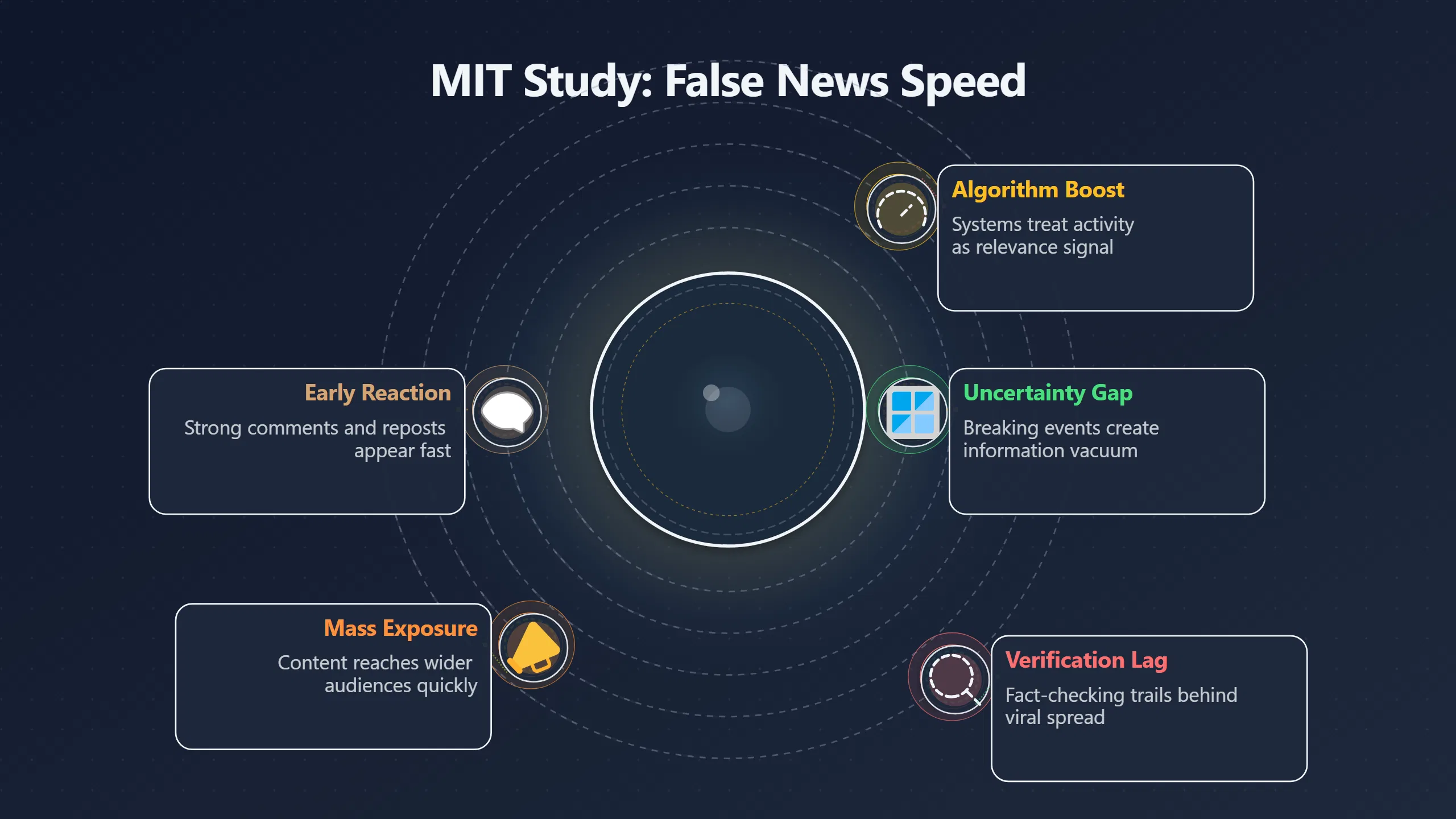
A rumour that performs well early can be pushed to wider audiences before verification has time to catch up.
On this page
- Early engagement and automated distribution
- Why speed matters during breaking events
- How near duplicates keep a narrative alive
Page outline Jump by section
Introduction
A rumour does not become a mass myth simply because many people believe it. On modern social platforms, a crucial step is automated recommendation. When a claim receives an early burst of attention, recommendation systems may treat that attention as a signal of relevance and begin showing the content to wider audiences. The resulting cycle can turn an unverified assertion into something that feels familiar, widely discussed and therefore credible. By the time verification arrives, the rumour may already have travelled far beyond its original audience. Research on online misinformation consistently shows that false information can spread faster and more broadly than accurate information, creating ideal conditions for recommendation-driven amplification.[MIT News]news.mit.edustudy twitter false news travels faster true stories 0308MIT NewsStudy: On Twitter, false news travels faster than true stories8 Mar 2018 A new study by three MIT scholars has found that false…
 This mechanism helps explain why some myths appear to emerge suddenly. In reality, they often begin as small rumours that enter a feedback loop involving engagement signals, recommendation engines, resharing behaviour and repeated exposure.
Early Engagement and Automated Distribution
Recommendation systems are designed to predict what users are likely to engage with. They do not usually begin by determining whether a claim is true. Instead, they analyse signals such as clicks, comments, shares, watch time and reactions.
A typical rumour loop works like this:
- An unverified claim appears during a moment of uncertainty.
- Early viewers react strongly through comments, reposts or debate.
- The platform interprets this activity as evidence that the content is interesting or relevant.
- Recommendation systems expose it to larger groups.
- New viewers generate more engagement, which justifies further distribution.
This process creates a self-reinforcing cycle. The rumour gains visibility because it attracts attention, and it attracts more attention because it gains visibility.
Researchers studying recommender systems have found that algorithmic design choices can influence how misinformation spreads through networks. While recommendation systems are not the sole cause of false beliefs, they can increase the exposure of misleading content once engagement signals begin accumulating.[Open University]oro.open.ac.ukOpen UniversityAnalysing the Effect of Recommendation Algorithms on the…March 11, 2024 by M Fernandez 2024 Cited by 35 the Eff…
The key point is that recommendation systems often reward performance before verification. A rumour that captures curiosity in its first minutes or hours may receive large-scale distribution before anyone has established whether it is accurate.
Why Speed Matters During Breaking Events
Rumours are especially powerful during breaking news because reliable information is often incomplete. In the early stages of a crisis, disaster, crime or political event, uncertainty creates a vacuum that speculation can fill.
Social media rumour researchers have long noted that newly emerging rumours thrive in fast-moving situations where information arrives in fragments and verification lags behind public discussion.[arXiv]arxiv.orgSource details in endnotes.
Recommendation loops magnify this problem because algorithms operate far faster than fact-checking processes. A dramatic claim can gain thousands or millions of views while journalists, authorities or eyewitnesses are still trying to establish basic facts.
This creates an asymmetry:
- The rumour is immediate.
- Verification takes time.
- Recommendation systems reward immediate engagement.
The result is that visibility often peaks before certainty exists.
Studies of false news diffusion have found that false stories travel farther, faster and more broadly than true ones. The MIT research that analysed millions of Twitter posts found that falsehoods were significantly more likely to be reshared and reached large audiences much more quickly than accurate information. Researchers suggested that novelty and surprise contribute to this advantage. MIT News[science]science.orgThe spread of true and false news onlineby S Vosoughi 2018 Cited by 13885 This suggests that false news spreads farther, faster, de… When recommendation systems are optimised for engagement, novel and emotionally charged rumours can therefore receive an additional distribution advantage at exactly the moment when verification is weakest.

How Near-Duplicates Keep a Narrative Alive
A common misconception is that a rumour disappears once the original post is removed or corrected. In practice, recommendation loops often operate across many versions of the same claim.
Users may:
- Rephrase the rumour.
- Upload screenshots of the original.
- Create reaction videos discussing it.
- Share clips, memes or summaries.
- Repeat key allegations without linking to the source.
These near-duplicates allow a narrative to survive even when individual posts are challenged.
From the perspective of recommendation systems, each version can generate fresh engagement signals. A user may encounter essentially the same claim multiple times through different creators, formats or communities. Repetition then produces an important psychological effect: familiarity.
People often interpret repeated exposure as evidence that a claim is widely accepted or supported. The rumour begins to feel less like a disputed statement and more like a commonly known fact. The myth gains strength not because every exposure provides new evidence, but because the narrative repeatedly re-enters attention through slightly different forms.
This helps explain why corrections frequently struggle to catch up. Corrective information must compete against many interconnected copies of the original story rather than a single viral post.
When Debate Fuels Distribution
Another feature of recommendation loops is that disagreement can increase visibility.
A rumour does not need universal support to spread. Outrage, criticism and attempts to debunk a claim can all generate comments, shares and discussion. To a recommendation system focused on engagement metrics, intense disagreement may resemble strong audience interest.
As a result, a false claim can receive additional exposure precisely because people are arguing about it. The platform may interpret the growing volume of interaction as evidence that more users should see the content.
This dynamic helps explain why some rumours remain prominent long after they have been challenged. Public controversy can sustain recommendation signals even when much of the attention is negative.
From Rumour to Myth
The transition from rumour to myth occurs when repeated exposure changes public perception. A rumour begins as an unverified claim. A myth emerges when large numbers of people come to treat that claim as established reality, regardless of the underlying evidence.
Recommendation loops contribute to this transition in three ways:
- Scale: Automated distribution expands the audience far beyond the original network.
- Speed: Exposure grows faster than verification can spread.
- Persistence: Near-duplicates, reactions and ongoing discussion keep the narrative circulating.
Importantly, recommendation systems do not need to invent misinformation to amplify it. Their influence lies in selecting what receives attention and repeatedly placing successful content before new audiences. Research on misinformation diffusion and recommendation algorithms suggests that these feedback mechanisms can significantly shape which rumours remain obscure and which evolve into widely believed myths.[Open University]oro.open.ac.ukOpen UniversityAnalysing the Effect of Recommendation Algorithms on the…March 11, 2024 by M Fernandez 2024 Cited by 35 the Eff… 2arXiv
The most consequential myths of the social media era are therefore often not the rumours that begin with the largest audiences. They are the rumours that perform well enough in their first moments to enter a recommendation loop before verification has a chance to catch up.[publications.parliament.uk]publications.parliament.ukSocial media, misinformation and harmful algorithmsCalls to violence were posted across major platforms, in some cases seemingly amplifie…[2sinanaral.medium.com]sinanaral.medium.comNews about our Fake News Study Spread Faster than its…But in social media, that's just not how misinformation works. Falsity spreads f…
eBay marketplace picks
Marketplace Samples
Example marketplace items related to this page. Use the search link to explore similar finds on eBay.




Endnotes
1.
Source: news.mit.edu
Title: study twitter false news travels faster true stories 0308
Link:https://news.mit.edu/2018/study-twitter-false-news-travels-faster-true-stories-0308
Source snippet
MIT NewsStudy: On Twitter, false news travels faster than true stories8 Mar 2018 A new study by three MIT scholars has found that false...
2.
Source: arxiv.org
Link:https://arxiv.org/abs/2103.14748
3.
Source: arxiv.org
Title: arXiv Detection and Resolution of Rumours in Social Media: A Survey
Link:https://arxiv.org/abs/1704.00656
Source snippet
Detection and Resolution of Rumours in Social Media: A SurveyApril 3, 2017...
Published: April 3, 2017
4.
Source: arxiv.org
Title: arXiv Using Gaussian Processes for Rumour Stance Classification in Social Media
Link:https://arxiv.org/abs/1609.01962
5.
Source: publications.parliament.uk
Link:https://publications.parliament.uk/pa/cm5901/cmselect/cmsctech/441/report.html
Source snippet
Social media, misinformation and harmful algorithmsCalls to violence were posted across major platforms, in some cases seemingly amplifie...
6.
Source: sinanaral.medium.com
Link:https://sinanaral.medium.com/fake-news-about-our-fake-news-study-spread-faster-than-its-truth-just-as-we-predicted-77db6d9ca8c8
Source snippet
News about our [Fake News]({{ 'fake-news/' | relative_url }}) Study Spread Faster than its...But in social media, that's just not how misinformation works. Falsity spreads f...
7.
Source: arxiv.org
Link:https://arxiv.org/pdf/2103.14748
Source snippet
fake news or other dubious pieces of information are spread... Adal, Nela-gt-2018: A large multi-labelled news dataset for the study of...
8.
Source: arxiv.org
Link:https://arxiv.org/html/2507.21724v1
Source snippet
Agent-Based Exploration of Recommendation Systems in...29 Jul 2025 This study uses agent-based modeling to examine the impact of vario...
9.
Source: mitsloan.mit.edu
Title: study false news spreads faster truth
Link:https://mitsloan.mit.edu/ideas-made-to-matter/study-false-news-spreads-faster-truth
Source snippet
mit.eduStudy: False news spreads faster than the truth8 Mar 2018 Falsehoods are 70 percent more likely to be retweeted on Twitter than...
10.
Source: mitsloan.mit.edu
Link:https://mitsloan.mit.edu/ideas-made-to-matter/mit-sloan-research-about-social-media-misinformation-and-elections
Source snippet
Sloan research about social media, misinformation...05-Oct-2020 They found falsehoods are 70% more likely to be retweeted on Twitter...
11.
Source: science.org
Link:https://www.science.org/doi/10.1126/science.aap9559
Source snippet
The spread of true and false news onlineby S Vosoughi 2018 Cited by 13885 This suggests that false news spreads farther, faster, de...
12.
Source: oro.open.ac.uk
Link:https://oro.open.ac.uk/96966/1/websci24-12.pdf
Source snippet
Open UniversityAnalysing the Effect of Recommendation Algorithms on the...March 11, 2024 by M Fernandez 2024 Cited by 35 the Eff...
Published: March 11, 2024
13.
Source: science.org
Title: fake news spreads faster true news twitter thanks people not bots
Link:https://www.science.org/content/article/fake-news-spreads-faster-true-news-twitter-thanks-people-not-bots
Source snippet
Fake news spreads faster than true news on Twitter...Tweets containing falsehoods reach 1500 people on Twitter six times faster than tru...
14.
Source: sciencedirect.com
Link:https://www.sciencedirect.com/science/article/abs/pii/S157401372200065X
Source snippet
study how fake news is crafted and what is the environment they spread in. While the problem of disinformation has been framed either as...
Additional References
15.
Source: tesi.luiss.it
Link:https://tesi.luiss.it/39196/1/755221_AMADORI_MARCO.pdf
Source snippet
news spread and detection: a network and machine...The study of fake news and identifying it in digital landscapes exposes a challenge t...
16.
Source: techcrunch.com
Title: false news spreads faster than truth online thanks to human nature
Link:https://techcrunch.com/2018/03/08/false-news-spreads-faster-than-truth-online-thanks-to-human-nature/
Source snippet
False news spreads faster than truth online thanks to...Mar 8, 2018 A comprehensive new study from MIT looks at a decade of tweets, an...
17.
Source: pbs.org
Title: false news travels 6 times faster on twitter than truthful news
Link:https://www.pbs.org/newshour/science/false-news-travels-6-times-faster-on-twitter-than-truthful-news
Source snippet
9 Mar 2018 False information spreads much faster and farther than the truth on Twitter-and although it is tempting to blame automated ...
18.
Source: facebook.com
Link:https://www.facebook.com/ipb1910/posts/-stop-the-spread-recognize-fake-news%EF%B8%8F-according-to-a-study-by-mit-false-news-spr/1065561165599377/
Source snippet
Recognize Fake News According to a study by MIT...27 Jan 2025 Specifically, false news is 70% more likely to be retweeted compared...
19.
Source: reddit.com
Link:https://www.reddit.com/r/skeptic/comments/ha0brt/huge_mit_study_of_fake_news_travels_6_times_more/
Source snippet
istribution of the average propagation rate of stories. With...Read more...
20.
Source: theguardian.com
Title: fake news social media twitter mit journalism
Link:https://www.theguardian.com/commentisfree/2018/mar/19/fake-news-social-media-twitter-mit-journalism
Source snippet
Why fake news on social media travels faster than the truth19 Mar 2018 The study found that falsehood diffused significantly farther...
21.
Source: dl.acm.org
Link:https://dl.acm.org/doi/10.1145/3616088
Source snippet
the Contribution of Recommendation...GossipCop focuses on gossip, which is related to a different form of misinformation...
22.
Source: facebook.com
Link:https://www.facebook.com/CITEZW/posts/misinformation-spreads-faster-than-the-truth-and-leaves-real-damage-behind-broke/1278544307640744/
Source snippet
cording to a study by MIT Media Lab by Dr. Deb Roy, Dr. Soroush...
23.
Source: pirg.org
Title: misinformation on social media
Link:https://pirg.org/edfund/articles/misinformation-on-social-media/
Source snippet
How misinformation on social media has changed news30 Jul 2025 Researchers at MIT have found that fake news can spread up to 10 times f...
24.
Source: tandfonline.com
Link:https://www.tandfonline.com/doi/full/10.1080/24751839.2020.1847379
Source snippet
Trends in combating fake news on social media a surveyby B Collins 2021 Cited by 230 This study explores the various methods of c...
Topic Tree