Within Mythcraft
Why Political Myths Resist Correction
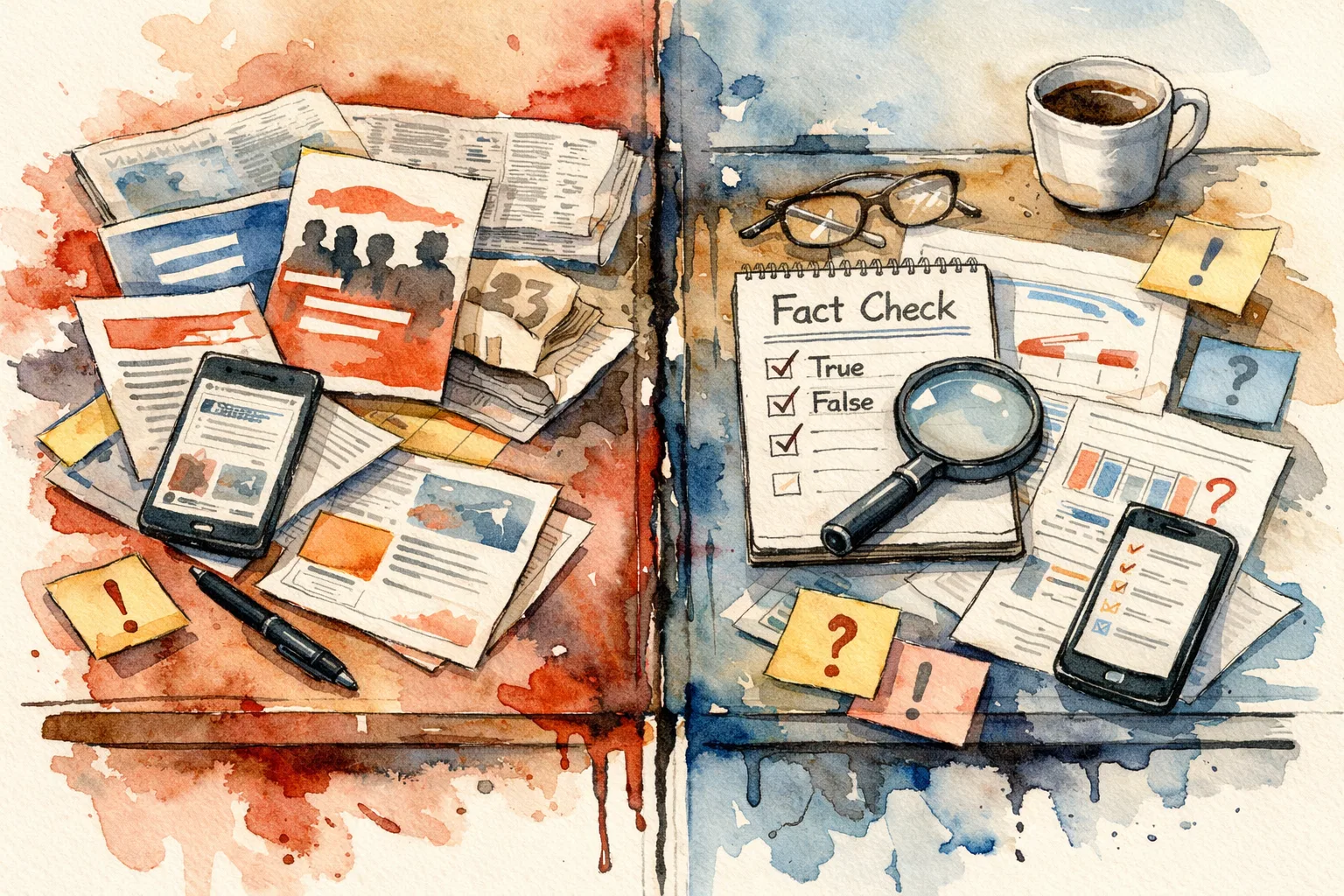
Political myths are hard to correct when accepting the correction feels like rejecting a group or worldview.
On this page
- Identity protective reasoning
- Trusted messengers and group cues
- Lower conflict correction strategies
Page outline Jump by section
Introduction
Political myths are often difficult to correct because they are rarely experienced as simple factual claims. They can become tied to identity, loyalty and belonging. Accepting a correction may feel less like updating information and more like distancing oneself from a political community, social network or moral worldview. Research on political misinformation repeatedly finds that people do not evaluate evidence in a vacuum. They interpret claims through group affiliations, trusted messengers and perceived social risks.[ndg.asc.upenn.edu]ndg.asc.upenn.eduIdeology motivated reasoningIdeology, motivated reasoning, and cognitive reflectionby DM Kahan · 2013 · Cited by 2084 — When in- dividuals display identity-protectiv…
This does not mean people are incapable of changing their minds. Evidence suggests that factual corrections usually help more than they harm, and dramatic “backfire effects” appear to be less common than once feared. The challenge is that political myths often survive because they serve social as well as informational functions. Correcting them therefore requires understanding identity-protective reasoning, trust networks and the conditions under which people can reconsider a belief without feeling that they are betraying their group.[PNAS]pnas.orgbackfire effect · misinformation · fake news · fact checking. Acknowledgments. I…Read more…[PMC]pmc.ncbi.nlm.nih.govPMCUsing narratives to correct politically charged healthby HM Lillie · 2024 · Cited by 10 — This study investigated the efficacy of a narrative corrective with a relief ending for correcting…
Why political myths become identity markers
Political arguments are often framed as disagreements about facts, but many are also struggles over status, values and collective identity. A claim about election integrity, immigration, climate policy or public health can become a signal of group membership. Once that happens, rejecting the claim may carry social costs.
Researchers associated with the cultural cognition framework describe this process as “identity-protective cognition”. People tend to evaluate information in ways that protect their standing within groups they value. Information that threatens group norms or shared narratives can feel personally threatening even when it concerns an empirical question.[ndg.asc.upenn.edu]ndg.asc.upenn.eduIdeology motivated reasoningIdeology, motivated reasoning, and cognitive reflectionby DM Kahan · 2013 · Cited by 2084 — When in- dividuals display identity-protectiv…[SSRN]papers.ssrn.comMisconceptions, Misinformation, and the Logic of Identity-…by DM Kahan · 2017 · Cited by 565 — Identity protective cognition refer…
This helps explain a common puzzle: why highly educated people can still hold demonstrably false political beliefs. More knowledge does not automatically eliminate motivated reasoning. In some situations, people with stronger reasoning skills become better at defending conclusions that align with their political identities.[ndg.asc.upenn.edu]ndg.asc.upenn.eduIdeology motivated reasoningIdeology, motivated reasoning, and cognitive reflectionby DM Kahan · 2013 · Cited by 2084 — When in- dividuals display identity-protectiv…
The result is not usually conscious dishonesty. Instead, people may:
- Pay greater attention to evidence that supports their side.
- Judge supportive sources as more credible.
- Apply stricter scrutiny to opposing evidence.
- Remember information that reinforces group narratives more easily than information that challenges them.
These tendencies are not limited to one ideology or political camp. Studies of motivated reasoning have found versions of the pattern across a range of political identities and policy disputes.[The Cultural Cognition Project]culturalcognition.netThe Cultural Cognition Project Motivated reasoning & its cognatesThe Cultural Cognition ProjectMotivated reasoning & its cognates - Cultural Cognition of…15 May 2013 — Identity-protective cognition…
Identity-protective reasoning is about belonging, not just belief
One reason political myths resist correction is that people often belong to communities built around shared interpretations of events.
In strongly polarised environments, political identity can function like a social identity. Friends, family members, media habits and cultural preferences may cluster around the same political affiliation. A factual correction can therefore carry implications beyond the claim itself. The person receiving the correction may wonder whether accepting it means questioning trusted allies or admitting that political opponents were right.[SSRN]papers.ssrn.comTaking Fact-checks Literally But Not Seriously?The Effects…by B Nyhan · 2019 · Cited by 576 — Keywords: Fact checking, corrections, misperceptions, backfire effect, debunking, motiv…
This dynamic helps explain why misinformation can persist even after repeated debunking. The myth may continue to provide social benefits. It can reinforce solidarity, identify enemies, express moral commitments or signal loyalty to a movement.
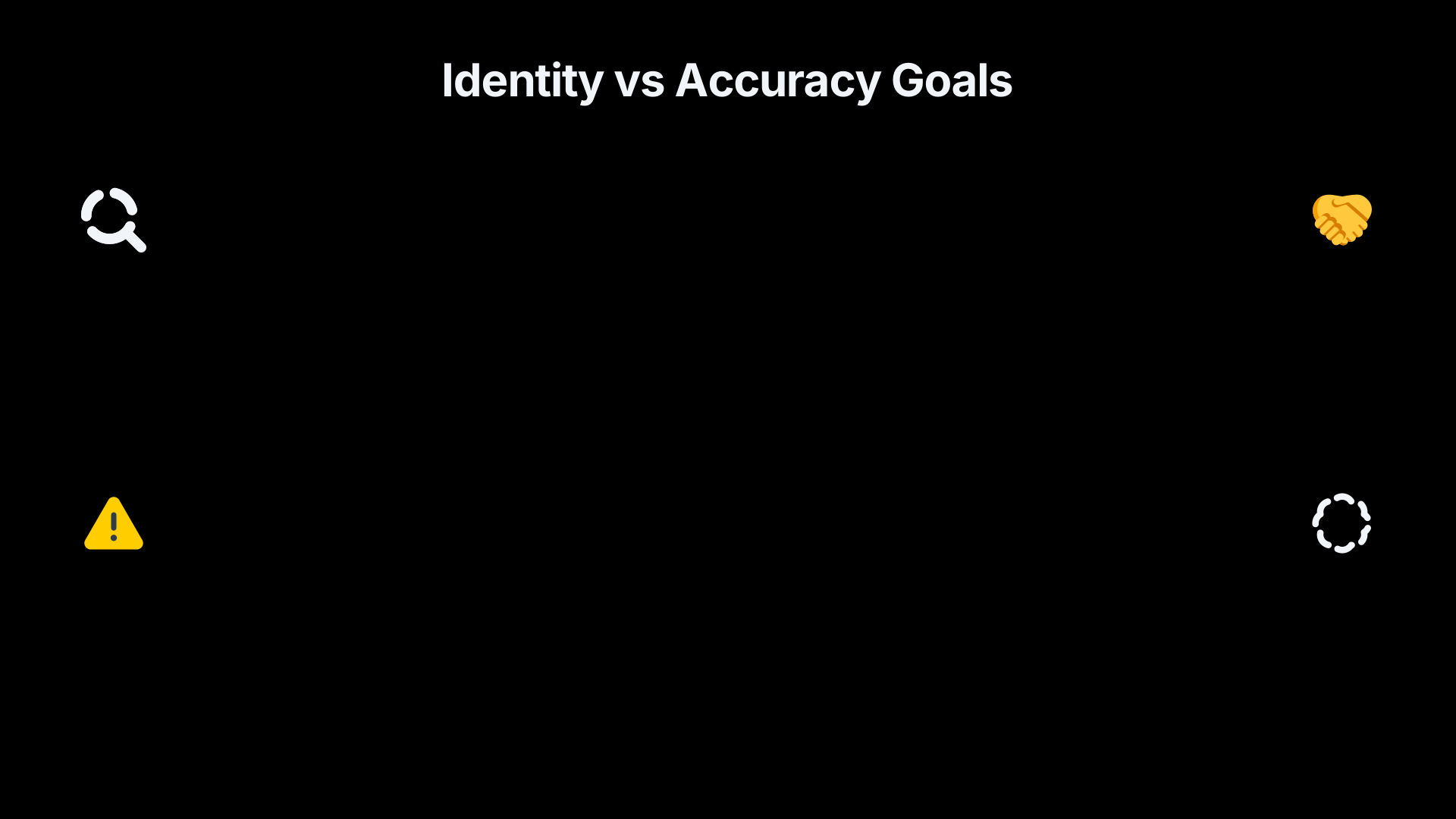
Research on identity-protective cognition argues that people often face two competing pressures:
- Accuracy goals, which encourage them to understand reality correctly.
- Identity goals, which encourage them to remain aligned with valued groups.
When these pressures conflict, identity concerns can become unusually powerful.[ndg.asc.upenn.edu]ndg.asc.upenn.eduIdeology motivated reasoningIdeology, motivated reasoning, and cognitive reflectionby DM Kahan · 2013 · Cited by 2084 — When in- dividuals display identity-protectiv…
This does not mean facts cease to matter. Rather, facts are filtered through concerns about trust, reputation and group membership.
Why simple fact-checking sometimes has limited impact
Fact-checking remains valuable. Studies generally find that corrections improve factual accuracy more often than they worsen it. Yet factual corrections do not always translate into major attitude change.[PNAS]pnas.orgbackfire effect · misinformation · fake news · fact checking. Acknowledgments. I…Read more…[PMC]pmc.ncbi.nlm.nih.govPMCUsing narratives to correct politically charged healthby HM Lillie · 2024 · Cited by 10 — This study investigated the efficacy of a narrative corrective with a relief ending for correcting…
Part of the reason is that political beliefs are often connected to broader narratives. Correcting one false claim may leave the underlying worldview untouched.
For example, a correction might successfully reduce belief in a specific rumour while leaving broader distrust of institutions unchanged. The individual updates one fact but retains the framework that made the rumour seem plausible in the first place.
Research by Brendan Nyhan and others has helped shift understanding of this issue. Early discussions of the “backfire effect” suggested that corrections could frequently strengthen false beliefs. Later reviews and replication efforts found that strong backfire effects appear relatively rare. Most people move at least somewhat toward the evidence when presented with clear corrections. ScienceDirect[3calgara.github.io]calgara.github.ioWhen Corrections Fail: The Persistence of Political…by B Nyhan · 2010 · Cited by 4606 — our findings and test the generality of the ba…[PNAS]pnas.orgbackfire effect · misinformation · fake news · fact checking. Acknowledgments. I…Read more…
However, the movement is often modest. Political identities, emotional investments and social incentives can still limit how far a correction changes broader attitudes.
Trusted messengers matter as much as the message
People rarely evaluate political information purely on content. They also evaluate who is delivering it.
Research consistently shows that trust functions as a shortcut for judging credibility. When a correction comes from someone perceived as hostile, biased or outside the group, resistance is more likely. When similar information comes from a trusted insider, it often receives a fairer hearing.[Research Square]researchsquare.comThe rise of election-related misinformation has been linked to a decline… ResearchGate This is why political corrections sometimes succeed when delivered by:[researchgate.net]researchgate.netRecent research suggests that psychological…Read more…
- Members of the same political party.
- Respected community figures.
- Religious leaders trusted by the audience.
- Local representatives rather than distant institutions.
- Influential voices already accepted within the group.
The importance of messenger credibility has been observed across election misinformation, public health communication and other politically charged issues.[Research Square]researchsquare.comThe rise of election-related misinformation has been linked to a decline…
Interestingly, some newer research suggests that even fact-checkers perceived as politically aligned with a target audience can reduce misinformation beliefs without producing widespread backlash. The effectiveness appears to depend partly on whether recipients view the messenger as understanding their values and concerns.

Group cues can outweigh raw evidence
Political myths often spread through social environments rather than isolated encounters with information.
People observe how peers react to stories, which claims receive approval and which views carry social penalties. A belief can become attractive because it signals loyalty rather than because it offers the strongest explanation of events.
This process is visible in online political communities. Research examining misinformation and political polarisation has found that disputes over what counts as “fake news” can themselves become politically polarised. Competing groups may label information as misinformation partly because it conflicts with their existing worldview.
In practice, this means that evidence competes with social signals. Individuals may ask:
- What do people like me believe?
- What will happen if I publicly disagree?
- Which sources does my group trust?
- Does accepting this correction place me closer to an opposing camp?
These questions are often implicit rather than deliberate. Yet they can strongly influence how political myths survive.
Lower-conflict correction strategies
Because political myths are often tied to identity, aggressive confrontation can become counterproductive even when the factual correction is accurate.
Research and communication practice suggest several approaches that reduce unnecessary defensiveness.
Separate identity from the claim
People are generally more receptive when corrections avoid suggesting that holding a false belief makes them foolish, immoral or disloyal.
A correction that focuses on evidence while respecting the person’s underlying concerns creates less pressure to defend identity. Instead of attacking motives, it addresses the claim itself.
For example, someone concerned about election integrity, public safety or government accountability can have those concerns acknowledged before discussing whether a particular allegation is supported by evidence.

Offer a replacement explanation
Political myths often persist because they provide a satisfying story.
Simply removing the false claim can leave a gap. More effective corrections explain what actually happened and why the misleading claim gained traction. This reduces the tendency for people to return to the original narrative.[SSRN]papers.ssrn.comssrn.comIdeology, Motivated Reasoning, and Cognitive Reflectionby DM Kahan · 2012 · Cited by 2090 — This paper describes a study of three…
Use trusted in-group voices
Corrections are often easier to accept when they come from figures who share the audience’s broader values.
This does not guarantee success, but it can reduce the perception that the correction is an attack from an opposing tribe.[Research Square]researchsquare.comThe rise of election-related misinformation has been linked to a decline…
Reduce status threats
People are more willing to update beliefs when doing so does not require public humiliation or social isolation.
Private reflection, respectful dialogue and opportunities to revise views gradually can be more effective than public shaming. Evidence from misinformation research increasingly points toward lowering social threat rather than intensifying confrontation.[PMC]pmc.ncbi.nlm.nih.govPMCUsing narratives to correct politically charged healthby HM Lillie · 2024 · Cited by 10 — This study investigated the efficacy of a narrative corrective with a relief ending for correcting…
Why political myths persist even after being disproved
A political myth can survive long after the factual basis collapses because the myth is serving functions beyond information.
It may:
- Reinforce a shared identity.
- Express distrust of institutions.
- Provide a simple explanation for complex events.
- Mark loyalty to a movement or leader.
- Offer emotional certainty during periods of social change.
When these functions remain intact, disproving a specific claim may not eliminate the conditions that sustain it.
This is one reason misinformation researchers increasingly focus on social environments rather than treating false beliefs as isolated cognitive errors. Information ecosystems, community norms and political incentives all influence whether a correction takes hold.[Carnegie Endowment]carnegieendowment.orgcountering disinformation effectively an evidence based policy guideCarnegie EndowmentCountering Disinformation Effectively: An Evidence-Based…31 Jan 2024 — A high-level, evidence-informed guide to some…[ScienceDirect]sciencedirect.comSearching for the Backfire Effect: Measurement and Design…by B Swire-Thompson · 2020 · Cited by 418 — A backfire effect is when people…
The central challenge: correcting myths without demanding social exile
Political myth resistance is often misunderstood as a refusal to care about facts. In many cases, the deeper issue is that facts become entangled with identity.
People may perceive a correction as carrying hidden social meaning: not merely “this claim is wrong”, but “your group is wrong”, “your community is naïve” or “your loyalties are misplaced”. When corrections trigger those interpretations, resistance becomes more likely.
The most successful approaches therefore do more than provide evidence. They reduce the perceived conflict between accuracy and belonging. They make it easier for people to revise a claim without feeling that they must abandon their community, values or sense of self. Research on political misinformation increasingly suggests that this balance—protecting dignity while challenging falsehoods—is one of the most important conditions for reducing durable political myths. SSRN[2ndg.asc.upenn.edu]ndg.asc.upenn.eduIdeology motivated reasoningIdeology, motivated reasoning, and cognitive reflectionby DM Kahan · 2013 · Cited by 2084 — When in- dividuals display identity-protectiv…
Amazon book picks
Further Reading
Books and field guides related to Why Political Myths Resist Correction. Use these as the next step if you want deeper reading beyond the article.
Mistakes Were Made (but Not by Me) Third Edition
Explains self-justification and resistance to correcting beliefs.
The Constitution of Knowledge
Examines how societies distinguish reliable knowledge from misinformation.

The Righteous Mind
First published 2012. Subjects: Political psychology, Social psychology, Ethics, Religious Psychology, nyt:combined-print-and-e-book-nonf...
eBay marketplace picks
Marketplace Samples
Example marketplace items related to this page. Use the search link to explore similar finds on eBay.




Endnotes
1.
Source: ndg.asc.upenn.edu
Title: Ideology motivated reasoning
Link:https://ndg.asc.upenn.edu/wp-content/uploads/2017/08/Ideology-motivated-reasoning.pdf
Source snippet
Ideology, motivated reasoning, and cognitive reflectionby DM Kahan · 2013 · Cited by 2084 — When in- dividuals display identity-protectiv...
2.
Source: papers.ssrn.com
Link:https://papers.ssrn.com/sol3/papers.cfm?abstract_id=2973067
Source snippet
Misconceptions, Misinformation, and the Logic of Identity-...by DM Kahan · 2017 · Cited by 565 — Identity protective cognition refer...
3.
Source: pnas.org
Link:https://www.pnas.org/doi/10.1073/pnas.1912440117
Source snippet
backfire effect · misinformation · fake news · fact checking. Acknowledgments. I...Read more...
4.
Source: pmc.ncbi.nlm.nih.gov
Link:https://pmc.ncbi.nlm.nih.gov/articles/PMC9283209/
Source snippet
Furthermore, we aimed to examine whether...Read more...
5.
Source: papers.ssrn.com
Title: Taking Fact-checks Literally But Not Seriously?
Link:https://papers.ssrn.com/sol3/papers.cfm?abstract_id=2995128
Source snippet
The Effects...by B Nyhan · 2019 · Cited by 576 — Keywords: Fact checking, corrections, misperceptions, backfire effect, debunking, motiv...
6.
Source: calgara.github.io
Link:https://calgara.github.io/Pol157_Spring2019/Nyhan%20%26%20Reifler%202010.pdf
Source snippet
When Corrections Fail: The Persistence of Political...by B Nyhan · 2010 · Cited by 4606 — our findings and test the generality of the ba...
7.
Source: sciencedirect.com
Link:https://www.sciencedirect.com/science/article/pii/S2211368120300516
Source snippet
Searching for the Backfire Effect: Measurement and Design...by B Swire-Thompson · 2020 · Cited by 418 — A backfire effect is when people...
8.
Source: researchgate.net
Link:https://www.researchgate.net/publication/400679083_Who_are_Effective_and_Trustworthy_Messengers_for_Election-Related_Communications_How_Local_Messengers_Impact_Effectiveness_of_Psychological_Inoculation
Source snippet
Recent research suggests that psychological...Read more...
9.
Source: pmc.ncbi.nlm.nih.gov
Title: PMCUsing narratives to correct politically charged health
Link:https://pmc.ncbi.nlm.nih.gov/articles/PMC11358629/
Source snippet
by HM Lillie · 2024 · Cited by 10 — This study investigated the efficacy of a narrative corrective with a relief ending for correcting...
10.
Source: sciencedirect.com
Link:https://www.sciencedirect.com/science/article/pii/S0277953625006033
Source snippet
Misinformation, trust, and health: The case for information...by A Palmer · 2025 · Cited by 24 — We present empirical evidence demonstra...
11.
Source: sciencedirect.com
Link:https://www.sciencedirect.com/science/article/pii/S0010027725003142
Source snippet
On political topics specifically, we find that a...
12.
Source: papers.ssrn.com
Link:https://papers.ssrn.com/sol3/papers.cfm?abstract_id=2182588
Source snippet
ssrn.comIdeology, Motivated Reasoning, and Cognitive Reflectionby DM Kahan · 2012 · Cited by 2090 — This paper describes a study of three...
13.
Source: informalscience.org
Link:https://informalscience.org/identity/dan-kahan/
Source snippet
Identity | Dan KahanDan Kahan's identity-related work has focused on “identity protective cognition”, which refers to the tendency of ind...
14.
Source: culturalcognition.net
Title: The Cultural Cognition Project Motivated reasoning & its cognates
Link:https://www.culturalcognition.net/blog/2013/5/15/motivated-reasoning-its-cognates.html
Source snippet
The Cultural Cognition ProjectMotivated reasoning & its cognates - Cultural Cognition of...15 May 2013 — Identity-protective cognition...
Published: May 2013
15.
Source: researchsquare.com
Link:https://www.researchsquare.com/article/rs-8663461/latest
Source snippet
The rise of election-related misinformation has been linked to a decline...
16.
Source: carnegieendowment.org
Title: countering disinformation effectively an evidence based policy guide
Link:https://carnegieendowment.org/research/2024/01/countering-disinformation-effectively-an-evidence-based-policy-guide
Source snippet
Carnegie EndowmentCountering Disinformation Effectively: An Evidence-Based...31 Jan 2024 — A high-level, evidence-informed guide to some...
17.
Source: cssh.northeastern.edu
Title: backfire effects
Link:https://cssh.northeastern.edu/nulab/backfire-effects/
Source snippet
In other words, instead of belief...Read more...
Additional References
18.
Source: fondationdescartes.org
Link:https://www.fondationdescartes.org/en/2020/06/les-idees-fausses-les-fausses-informations-et-la-logique-du-raisonnement-pour-proteger-son-identite/
Source snippet
False ideas, fake information, and the logic of identity-...This 2017 article is a preparatory work proposed by social scientist Dan Kah...
19.
Source: misinforeview.hks.harvard.edu
Link:https://misinforeview.hks.harvard.edu/article/the-small-effects-of-short-user-corrections-on-misinformation-in-brazil-india-and-the-united-kingdom/
Source snippet
small effects of short user corrections on...by S Altay · 2025 · Cited by 1 — We found that in India and Brazil, short user corrections...
20.
Source: cambridge.org
Title: identityprotective reasoning an epistemic and political defense
Link:https://www.cambridge.org/core/services/aop-cambridge-core/content/view/5C62B4A3FC3F564ADE86BA5B7C5EF2BE/S1742360025000176a.pdf/identityprotective_reasoning_an_epistemic_and_political_defense.pdf
Source snippet
Kahan 2017, he claims that individuals are motivated to defend beliefs that are standard in their group, and in Kahan 2015 the motivation is...
21.
Source: ore.exeter.ac.uk
Title: exeter.ac.uk Taking Fact-checks Literally But Not Seriously?
Link:https://ore.exeter.ac.uk/articles/journal_contribution/Taking_Fact-Checks_Literally_But_Not_Seriously_The_Effects_of_Journalistic_Fact-Checking_on_Factual_Beliefs_and_Candidate_Favorability/29753936/1/files/56778089.pdf
Source snippet
The Effects...by B Nyhan · 2019 · Cited by 576 — “Emotions, partisanship, and misperceptions: How anger and anx- iety moderate the effec...
22.
Source: misinforeview.hks.harvard.edu
Title: who knowingly shares false political information online
Link:https://misinforeview.hks.harvard.edu/article/who-knowingly-shares-false-political-information-online/
Source snippet
Misinformation ReviewWho knowingly shares false political information online?by S Littrell · 2023 · Cited by 28 — We found that 14 percen...
23.
Source: scispace.com
Link:https://scispace.com/pdf/misconceptions-misinformation-and-the-logic-of-identity-mpc3ka7t6o.pdf
Source snippet
individuals to selectively credit and dismiss evi- dence in patterns that reflect the...
24.
Source: srbluemle.wordpress.com
Title: motivated reasoning and identity protective cognition
Link:https://srbluemle.wordpress.com/2020/10/05/motivated-reasoning-and-identity-protective-cognition/
Source snippet
reasoning and identity protective cognitionOct 5, 2020 — Kahan, by contrast, emphasizes that identity protective cognition is, when pract...
25.
Source: merriam-webster.com
Title: POLITICA L Definition & Meaning4 days ago — 1
Link:https://www.merriam-webster.com/dictionary/political
Source snippet
a: of or relating to government, a government, or the conduct of government b: of, relating to, or concerned with the making as disting...
26.
Source: cidob.org
Link:https://www.cidob.org/sites/default/files/2025-10/REGROUP%20focus%20paper%20no.%208.pdf
Source snippet
3. Avoid overreliance on “Western epistemic authority...Read more...
27.
Source: mattnurse.com
Title: The winding story of the backfire effect
Link:https://mattnurse.com/2019/06/29/the-story-of-the-backfire-effect/
Source snippet
Matthew S Nurse29 Jun 2019 — Misinformation is now able to spread rapidly across social media networks (Vosoughi, Roy, & Aral, 2018) and...
Topic Tree