Within Slogans
Why emotional myths travel faster
Claims that trigger surprise, anger, pride, or belonging can travel farther because they give people a reason to share.
On this page
- Novelty and emotion in online sharing
- Moral language and social identity
- How accurate messages can use emotion ethically
Page outline Jump by section
Introduction
Emotional slogans spread faster online because they do more than communicate an idea: they give people a feeling to share. In discussions about myths and misconceptions, this matters because a misleading claim often arrives packaged with surprise, anger, pride, fear, or a sense of belonging. An accurate explanation may be more informative, but it usually demands more attention and offers less immediate emotional reward.
 Research across social media platforms suggests that content triggering strong emotions is more likely to be noticed, remembered, and passed on. The advantage is not simply that emotional messages are louder. They provide social signals—about who we are, what we value, and which groups we belong to—that encourage sharing. When a myth combines a simple explanation with a strong emotional reaction, it gains a powerful transmission advantage over a careful but less emotionally engaging correction. PNAS[PubMed]pubmed.ncbi.nlm.nih.govshapes the diffusion of moralized content in social…by WJ Brady · 2017 · Cited by 1902 — We show that the expression of moral emotion…
Novelty and emotion in online sharing
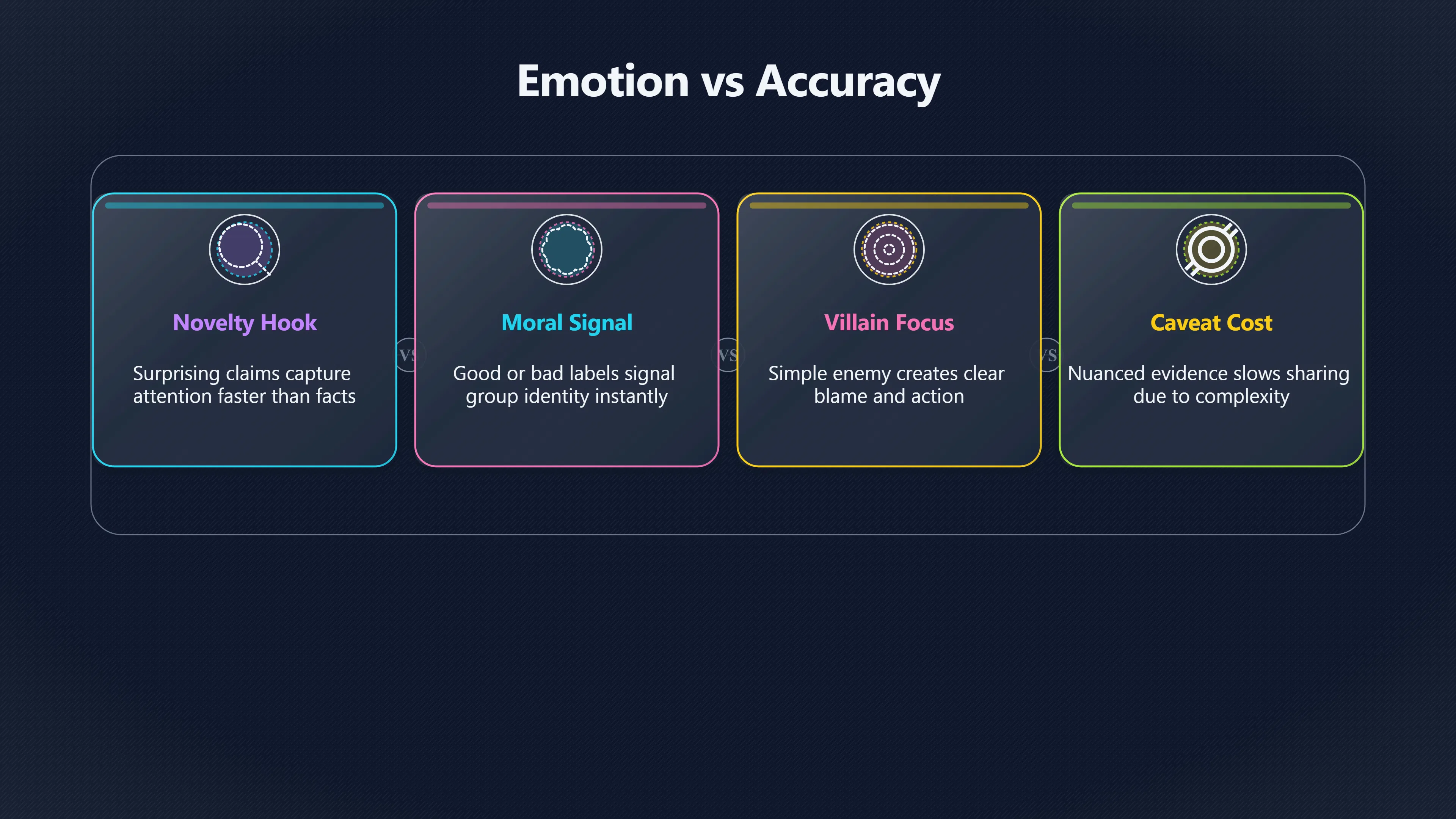
One reason emotional slogans travel quickly is that they often feel novel. People are naturally drawn to information that seems surprising, alarming, or unexpected. Online platforms amplify this tendency because users constantly compete for attention in crowded feeds.
A large study of Twitter information cascades found that false news spread farther, faster, deeper, and more broadly than true news. The researchers concluded that novelty was a key factor: false stories often appeared more surprising than accurate ones, making them more likely to be shared.[PubMed]pubmed.ncbi.nlm.nih.govshapes the diffusion of moralized content in social…by WJ Brady · 2017 · Cited by 1902 — We show that the expression of moral emotion…[MIT News]news.mit.edustudy twitter false news travels faster true stories 0308MIT NewsStudy: On Twitter, false news travels faster than true storiesMar 8, 2018 — Researchers from the Media Lab and Sloan found that h…
Emotion and novelty frequently work together:
- Surprise makes people feel they have discovered something worth passing on.
- Anger creates a desire to warn others or condemn perceived wrongdoing.
- Fear encourages rapid sharing as a protective response.
- Pride and hope allow people to signal optimism or group loyalty.
A slogan such as “They’ve been hiding this from you” combines novelty with emotion. It promises a secret, identifies a potential villain, and gives the reader a reason to share immediately. An accurate explanation often has to discuss evidence, uncertainty, and competing interpretations, which makes it harder to process and repeat.
Studies of online content diffusion have also found that specific emotional expressions can influence how widely information spreads. Research on millions of users showed that some negative emotions, particularly anxiety, can increase the size and depth of sharing cascades.[arXiv]arxiv.orgarXiv Emotions in Online Content DiffusionEmotions in Online Content DiffusionNovember 17, 2020…
Moral language and social identity
Many successful online myths do not merely claim that something is true or false. They imply that someone is good or bad, responsible or irresponsible, loyal or disloyal. This moral framing gives people a social reason to share.
Research published in the Proceedings of the National Academy of Sciences found that messages containing moral-emotional language spread more widely through social networks. In analyses of hundreds of thousands of posts about contentious public issues, each additional moral-emotional word was associated with increased diffusion. PNAS[2csmapnyu.org]csmapnyu.orgemotion shapes the diffusion of moralized content in social networksEmotion Shapes the Diffusion of Moralized Content in…Jul 11, 2017 — We show that the expression of moral emotion is key for the spread…
This mechanism is especially important for myths because moral language turns information into identity:
- Sharing becomes a signal of values rather than a simple exchange of facts.
- Agreement strengthens bonds within a group.
- Disagreement can mark outsiders or opponents.
- Repetition becomes a way of expressing loyalty.
For example, a slogan that portrays an issue as a battle between virtuous ordinary people and corrupt elites can spread even when evidence is weak. The slogan allows users to communicate group membership with a single click.
Research on social media engagement has found that hostility towards perceived out-groups generates particularly strong engagement. Posts focused on opponents or rival groups tend to receive more sharing and reactions than comparable content without that element.[PNAS]pnas.orgEmotion shapes the diffusion of moralized content in social…by WJ Brady · 2017 · Cited by 1902 — JM Salerno, LC Peter-Hagene, The…
This helps explain why myths framed around blame, betrayal, or moral outrage often outperform nuanced explanations. The myth offers both an interpretation of events and a social identity statement.

Why feelings often beat corrections
Accurate explanations face a structural disadvantage online. They frequently require qualifications such as “it depends”, “the evidence is mixed”, or “the effect is small”. Those caveats improve accuracy but reduce emotional intensity.
Meanwhile, a myth can offer:
- A clear villain.
- A simple cause.
- A strong emotional reaction.
- An easy action, such as sharing or endorsing.
Because emotional content is easier to remember and discuss, people may recall the feeling long after they forget the evidence supporting or contradicting a claim. In fast-moving social environments, emotional usefulness can matter more for sharing than factual accuracy.
This does not mean people deliberately prefer falsehoods. Rather, online environments often reward content that provokes immediate reactions. Researchers studying false news diffusion found that human behaviour—not merely automated accounts—was central to the faster spread of false stories.[PubMed]pubmed.ncbi.nlm.nih.govshapes the diffusion of moralized content in social…by WJ Brady · 2017 · Cited by 1902 — We show that the expression of moral emotion…[MIT News]news.mit.edustudy twitter false news travels faster true stories 0308MIT NewsStudy: On Twitter, false news travels faster than true storiesMar 8, 2018 — Researchers from the Media Lab and Sloan found that h…
How accurate messages can use emotion ethically
The lesson is not that truthful communication should become manipulative. Instead, evidence suggests that accurate information benefits when it acknowledges the emotional realities of communication.
Effective factual messages often combine evidence with legitimate emotional elements:
- Curiosity instead of sensational surprise.
- Concern instead of panic.
- Shared responsibility instead of scapegoating.
- Hope and efficacy instead of helplessness.
For example, a correction that merely states “this claim is false” may struggle to compete with an emotionally charged myth. A stronger response explains what is actually happening, why it matters, and what people can do about it. The goal is to provide both understanding and motivation without distorting the evidence.
There is also an ethical distinction between emotion and manipulation. Emotion becomes problematic when it substitutes for evidence. It can support accurate communication when it helps people understand why facts matter in human terms.
Why emotional myths travel faster
The central mechanism is straightforward: emotional slogans give people a reason to share. They capture attention through novelty, strengthen social identity through moral language, and provide an immediate psychological reward for passing the message along. Accurate explanations often contain more truth, but they must compete in an environment where attention is scarce and sharing decisions are made in seconds.
As a result, myths that evoke anger, pride, fear, outrage, or belonging can spread rapidly even when their factual foundations are weak. Understanding that emotional advantage is essential for explaining why misconceptions flourish online—and why effective corrections need to be not only accurate, but also memorable and emotionally meaningful. nature.com 3PNAS[3csmapnyu.org]csmapnyu.orgemotion shapes the diffusion of moralized content in social networksEmotion Shapes the Diffusion of Moralized Content in…Jul 11, 2017 — We show that the expression of moral emotion is key for the spread…
Amazon book picks
Further Reading
Books and field guides related to Why emotional myths travel faster. Use these as the next step if you want deeper reading beyond the article.
Thinking, Fast and Slow
Provides foundational insight into intuitive versus reflective thinking.

The Righteous Mind
First published 2012. Subjects: Political psychology, Social psychology, Ethics, Religious Psychology, nyt:combined-print-and-e-book-nonf...

eBay marketplace picks
Marketplace Samples
Example marketplace items related to this page. Use the search link to explore similar finds on eBay.



Endnotes
1.
Source: pnas.org
Link:https://www.pnas.org/doi/10.1073/pnas.1618923114
Source snippet
Emotion shapes the diffusion of moralized content in social...by WJ Brady · 2017 · Cited by 1902 — JM Salerno, LC Peter-Hagene, The...
2.
Source: news.mit.edu
Title: study twitter false news travels faster true stories 0308
Link:https://news.mit.edu/2018/study-twitter-false-news-travels-faster-true-stories-0308
Source snippet
MIT NewsStudy: On Twitter, false news travels faster than true storiesMar 8, 2018 — Researchers from the Media Lab and Sloan found that h...
3.
Source: mitsloan.mit.edu
Title: study false news spreads faster truth
Link:https://mitsloan.mit.edu/ideas-made-to-matter/study-false-news-spreads-faster-truth
Source snippet
MIT SloanStudy: False news spreads faster than the truthMar 8, 2018 — It uses the term “false news” instead of “[fake news]({{ 'fake-news/' | relative_url }})” because the la...
4.
Source: arxiv.org
Title: arXiv Emotions in Online Content Diffusion
Link:https://arxiv.org/abs/2011.09003
Source snippet
Emotions in Online Content DiffusionNovember 17, 2020...
Published: November 17, 2020
5.
Source: csmapnyu.org
Title: emotion shapes the diffusion of moralized content in social networks
Link:https://csmapnyu.org/research/academic-research/emotion-shapes-the-diffusion-of-moralized-content-in-social-networks
Source snippet
Emotion Shapes the Diffusion of Moralized Content in...Jul 11, 2017 — We show that the expression of moral emotion is key for the spread...
6.
Source: pnas.org
Link:https://www.pnas.org/doi/10.1073/pnas.2024292118
Source snippet
Out-group animosity drives engagement on social mediaby S Rathje · 2021 · Cited by 873 — This research is consistent with prior resea...
7.
Source: nature.com
Link:https://www.nature.com/nature-index/topics/l4/moral-outrage-dynamics-in-social-media
Source snippet
Moral Outrage Dynamics in Social MediaMoral outrage on social media arises when users perceive violations of ethical norms and respond wi...
8.
Source: pnas.org
Link:https://www.pnas.org/doi/abs/10.1073/pnas.1618923114?utm=
Source snippet
Emotion shapes the diffusion of moralized content in social...by WJ Brady · 2017 · Cited by 1779 — JM Salerno, LC Peter-Hagene, The inte...
9.
Source: nature.com
Link:https://www.nature.com/articles/d41586-018-02934-x
Source snippet
'News' spreads faster and more widely when it's falseMar 8, 2018 — A study of information sharing on Twitter shows people more... How Fa...
10.
Source: pubmed.ncbi.nlm.nih.gov
Link:https://pubmed.ncbi.nlm.nih.gov/28652356/
Source snippet
shapes the diffusion of moralized content in social...by WJ Brady · 2017 · Cited by 1902 — We show that the expression of moral emotion...
11.
Source: pubmed.ncbi.nlm.nih.gov
Link:https://pubmed.ncbi.nlm.nih.gov/29590045/
Source snippet
The spread of true and false news onlineby S Vosoughi · 2018 · Cited by 13949 — Falsehood diffused significantly farther, faster, d...
12.
Source: merriam-webster.com
Link:https://www.merriam-webster.com/dictionary/why
Source snippet
Definition & Meaning4 Apr 2026 — 1. The cause, reason, or purpose for which know why you did it that is why you did it 2. For which: on...
13.
Source: dictionary.cambridge.org
Link:https://dictionary.cambridge.org/dictionary/english/false
Source snippet
English meaning - Cambridge DictionaryFALSE definition: 1. not real, but made to look or seem real: 2. not true, but made to seem true...
14.
Source: dictionary.cambridge.org
Link:https://dictionary.cambridge.org/us/dictionary/english/moral
Source snippet
definition in the Cambridge English Dictionaryrelating to the standards of good or bad behavior, fairness, honesty, etc. that each pers...
15.
Source: dictionary.cambridge.org
Link:https://dictionary.cambridge.org/dictionary/english/why
Source snippet
English meaning - Cambridge DictionaryWHY definition: 1. for what reason: 2. used to express surprise or anger: 3. the reasons for some...
16.
Source: Wikipedia
Link:https://en.wikipedia.org/wiki/Why
Source snippet
Why - WikipediaWhy may refer to: Causality, a consequential relationship between two or more events; Reason (argument), a premise in s...
17.
Source: vocabulary.com
Link:https://www.vocabulary.com/dictionary/why
Source snippet
Definition, Meaning & Synonymsnoun the cause or intention underlying an action or situation, especially in the phrase `the whys and where...
Additional References
18.
Source: wired.com
Link:https://www.wired.com/story/twitter-false-news-elections-scientific-study
Source snippet
The research, conducted by Sinan Aral and his colleagues at MIT, found that false news spreads more rapidly, broadly, and extensively tha...
19.
Source: merriam-webster.com
Link:https://www.merriam-webster.com/dictionary/moral
Source snippet
MORAL Definition & Meaningmoral, ethical, virtuous, righteous, noble mean conforming to a standard of what is right and good. moral impli...
20.
Source: reddit.com
Link:https://www.reddit.com/r/AcademicPsychology/comments/o9zkq2/outgroup_animosity_drives_engagement_on_social/
Source snippet
Out-group animosity drives engagement on social mediaLanguage about the out-group was a very strong predictor of “angry” reactions (the m...
21.
Source: collinsdictionary.com
Link:https://www.collinsdictionary.com/dictionary/english/why
Source snippet
WHY definition and meaning | Collins English Dictionary4 meanings: 1. a. for what reason, purpose, or cause? b. (used in indirect questio...
22.
Source: linkedin.com
Link:https://www.linkedin.com/posts/jon-roozenbeek-33a5365a_new-paper-now-out-in-pnas-we-know-that-activity-7366921841866612736-Mvf9
23.
Source: cottonwoodpsychology.com
Link:https://cottonwoodpsychology.com/news/why-outrage-about-political-opponents-spreads-so-fast-on-social-media-according-to-a-pnas-study/
Source snippet
Posts that trigger anger or moral judgment can pull us in. When someone feels a rush of outrage, a share can feel like...Read more...
24.
Source: retractionwatch.com
Link:https://retractionwatch.com/2014/07/03/rapid-mood-swing-pnas-issues-expression-of-concern-for-controversial-facebook-study/
Source snippet
outrage, in the context of free market profit, is much higher than the threshold for outrage in the context of improving society. And may...
25.
Source: pmc.ncbi.nlm.nih.gov
Title: PMCOut-group animosity drives engagement on social media
Link:https://pmc.ncbi.nlm.nih.gov/articles/PMC8256037/
Source snippet
nih.govOut-group animosity drives engagement on social media - PMCby S Rathje · 2021 · Cited by 909 — We report evidence that posts about...
26.
Source: collaborate.princeton.edu
Title: emotion shapes the diffusion of moralized content in social netwo
Link:https://collaborate.princeton.edu/en/publications/emotion-shapes-the-diffusion-of-moralized-content-in-social-netwo/
Source snippet
shapes the diffusion of moralized content in social...by WJ Brady · 2017 · Cited by 2043 — Furthermore, we found that moral contagion wa...
27.
Source: pbs.org
Title: false news travels 6 times faster on twitter than truthful news
Link:https://www.pbs.org/newshour/science/false-news-travels-6-times-faster-on-twitter-than-truthful-news
Source snippet
Mar 9, 2018 — False news -- inaccurate information presented as truth or opinion presented as fact -- is 70 percent more likely to be ret...
Topic Tree