Within Politics
Why Changing Your Mind Can Feel Like Betrayal
Accepting a correction can threaten friendships, family ties, status, and belonging when a myth has become a group signal.
On this page
- How factual claims become loyalty tests
- The hidden costs of public disagreement
- Ways private doubt can become safer to express
Page outline Jump by section
Introduction
Political myths often survive not because people never encounter corrections, but because accepting a correction can carry social consequences. In highly polarised environments, a factual claim may double as a signal of loyalty, identity or belonging. Admitting that a political belief was wrong can feel less like updating information and more like risking conflict with friends, family members, colleagues or online communities.
 Research on misinformation, social identity and political psychology suggests that many people experience political disagreements through a social lens. A correction may threaten relationships, status within a group or a sense of moral consistency. As a result, the obstacle is often not a lack of information. The obstacle is the fear that changing one’s mind will be interpreted as changing sides.[ScienceDirect]sciencedirect.comUpdating the identity-based model of belief: From false…by JJ Van Bavel · 2024 · Cited by 92 — The spread of misinformati…[Semantic]semanticscholar.orgSemantic ScholarMisinformation and Identity-Protective Cognition2 Oct 2017 — This paper synthesizes existing work on misinformation relat…
Why Changing Your Mind Can Feel Like Betrayal
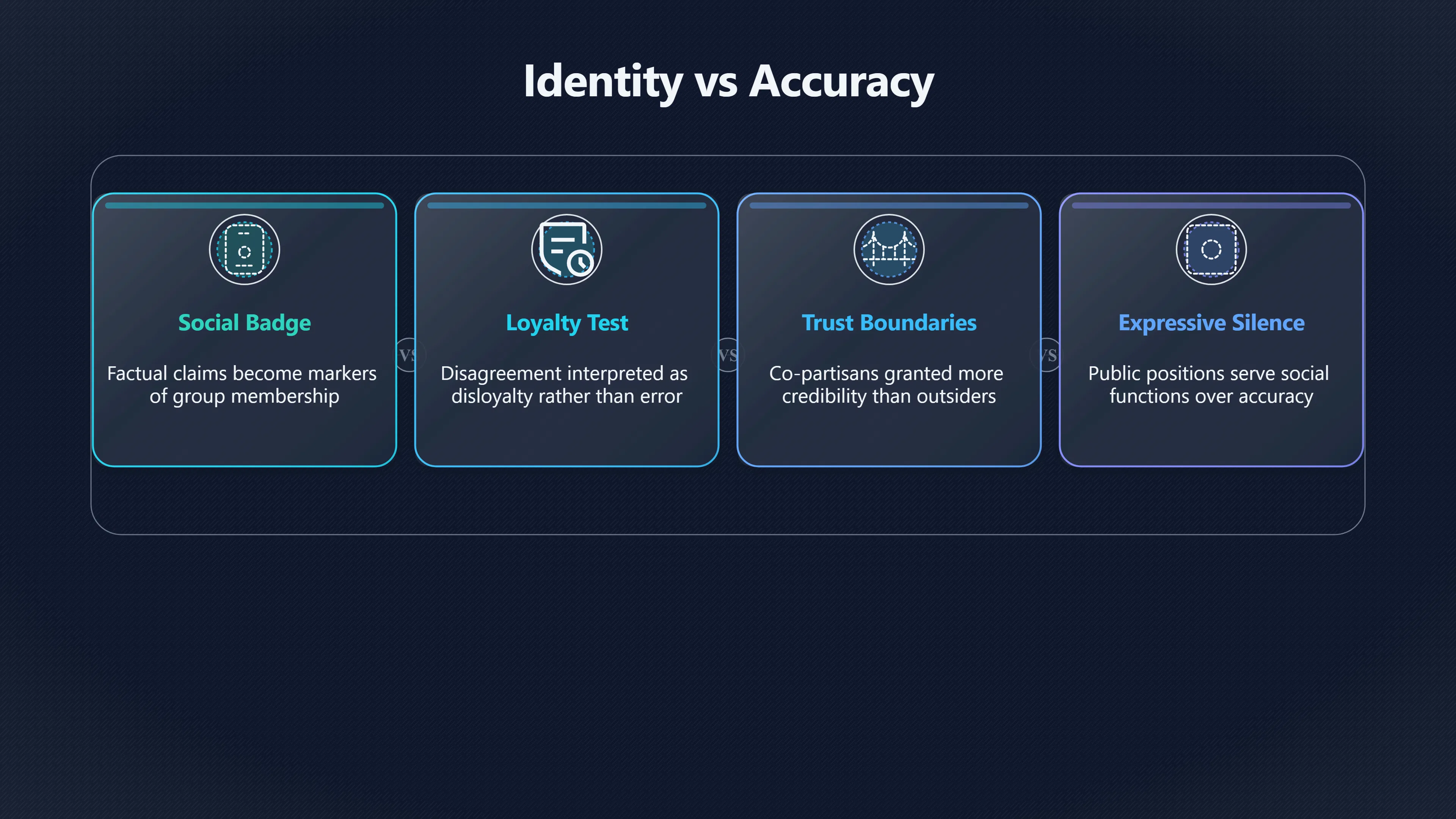
Political beliefs are frequently embedded in social networks rather than held in isolation. People tend to consume news from trusted sources, share information with like-minded contacts and participate in communities that reward certain interpretations of events. Over time, some factual claims become markers of group membership.
When this happens, accepting a correction can create a conflict between two goals:
- Being accurate.
- Remaining aligned with a valued group.
Researchers studying identity-protective cognition argue that people often process information in ways that protect their standing within important social groups. The pressure is not necessarily conscious. Instead, information that threatens a group’s shared narrative can feel personally unsettling because it risks social separation or loss of status. Semantic Scholar[2informalscience.org]informalscience.orgIdentity | Dan KahanDan Kahan's identity-related work has focused on “identity protective cognition”, which refers to the tendency of ind…
This helps explain why political corrections can feel unusually charged. A person may not only be evaluating whether a claim is true. They may also be evaluating what accepting the correction would communicate about who they are.
How Factual Claims Become Loyalty Tests
When a belief becomes part of group identity
Political communities often develop shared stories about national events, institutions, leaders or opponents. These stories help create a sense of collective identity. Once a belief becomes tied to that identity, disagreement can be interpreted as disloyalty rather than ordinary factual disagreement.
A claim that began as an empirical question may gradually become a symbolic marker. Members signal commitment by repeating it, defending it or treating scepticism as suspicious. Under these conditions, changing one’s position may be interpreted by others as evidence of weakened commitment to the group itself. ScienceDirect[2hybridcoe.fi]hybridcoe.fiIdentity as a tool for disinformation: Exploiting social…8 Nov 2023 — Identities can therefore be manipulated and attacked through the…
This dynamic appears across ideological and national contexts. The specific beliefs differ, but the underlying mechanism is similar: factual positions become social badges.
Trust follows social boundaries
People often judge information partly through the perceived trustworthiness of its source. In political settings, co-partisans and in-group figures are frequently granted more credibility than outsiders.
This means that a correction delivered by an opposing political group may encounter resistance even if the evidence is strong. Accepting the correction may feel like granting legitimacy to people viewed as rivals. Conversely, the same information may be easier to accept when it comes from a trusted member of one’s own community.[people.jacobs.cornell.edu]people.jacobs.cornell.eduThe Role of Source and Expressive Responding in PoliticalStudies have observed that readers are more likely to trust news sources that align with their own political leanings…[APSA Preprints]preprints.apsanet.orgpartisan political beliefs and social learningAPSA PreprintsPartisan Political Beliefs and Social Learningby P Matthews · 2022 — We find that participants are responsive to the cues o…
The result is that debates over facts often become debates over who deserves trust.
Public agreement and private doubt
Studies of “expressive responding” suggest that some people report more partisan positions in public than they privately hold. Research has found that partisan gaps on factual questions sometimes shrink when respondents receive incentives for accuracy, indicating that social or expressive pressures can shape what people say.[johnbullock.org]johnbullock.orgPartisan Bias in Factual Beliefs about PoliticsOctober 24, 2020 — by JG Bullock · 2015 · Cited by 800 — The model shows that incentives can reduce partisan divergence when expressive r…[Cambridge University Press & Assessment]cambridge.orgCambridge University Press & AssessmentExpressive Survey Responding: A Closer Look at the…by A Malka · 2023 · Cited by 60 — Concerns a…
This does not mean people are secretly free of political bias. It does suggest that public expressions of belief may sometimes serve social functions. In certain environments, stating the group’s preferred position can communicate loyalty even when personal certainty is weaker than it appears.
The Hidden Costs of Public Disagreement
Risking relationships
For many people, politics is intertwined with family, friendship and community ties. Admitting error may trigger uncomfortable questions:
- Will friends see me differently?
- Will relatives think I have abandoned shared values?
- Will I be excluded from discussions or social circles?
- Will I be accused of helping the opposing side?
These concerns can make silence feel safer than open revision. A person may privately reconsider a belief while avoiding public acknowledgment of the change.
The stronger the social connection between political identity and everyday relationships, the higher these perceived costs become. ScienceDirect[PMC]pmc.ncbi.nlm.nih.govPMCExplaining Lifelong Loyalty: The Role of Identity Fusionby M Newson · 2016 · Cited by 176 — In Van Vugt and Hart's study [17], positive group perception explained group loyalty better than '…
Losing status inside a community
Political groups often reward consistency and commitment. Members who strongly defend group narratives may gain influence, recognition or credibility. Publicly reversing a position can therefore carry status costs.
In online spaces, these pressures can be amplified. Social media platforms make political expressions visible, searchable and easy to judge. A correction is no longer merely a private update. It can become a public performance witnessed by allies, critics and strangers alike.
Research on misinformation challenges online has found that social concerns are among the most common barriers preventing people from correcting false claims or confronting misleading content. Many users anticipate conflict, backlash or damaged relationships if they speak up.[ScienceDirect]sciencedirect.comUpdating the identity-based model of belief: From false…by JJ Van Bavel · 2024 · Cited by 92 — The spread of misinformati…
The fear of helping the opposition
Another social risk comes from zero-sum political thinking. In highly polarised environments, admitting a mistake can feel like providing ammunition to political opponents.
People may worry that acknowledging one false claim will be interpreted as conceding a broader political battle. As a result, the factual correction becomes linked to concerns about collective success or failure rather than accuracy alone.
This helps explain why some myths persist even after substantial evidence accumulates against them. The social meaning attached to the belief may become more important than the factual claim itself.[ScienceDirect]sciencedirect.comUpdating the identity-based model of belief: From false…by JJ Van Bavel · 2024 · Cited by 92 — The spread of misinformati…[ResearchGate]researchgate.net401514533 Partisan Expressive Responding Lessons from Two Decades of ResearchPDF) Partisan Expressive Responding: Lessons from Two…19 May 2026 — Research on partisan expressive responding suggests that the beli…
Why Corrections Sometimes Fail Even When Evidence Is Strong
A common assumption is that people reject corrections because they have not seen enough evidence. Sometimes that is true. But in politically charged contexts, evidence can collide with social incentives.
Researchers increasingly describe misinformation as part of a broader social system involving identity, belonging and group cohesion. Groups may collectively resist uncomfortable information because accepting it threatens shared narratives that help maintain solidarity and status.[ScienceDirect]sciencedirect.comUpdating the identity-based model of belief: From false…by JJ Van Bavel · 2024 · Cited by 92 — The spread of misinformati…
This means that factual accuracy and social safety do not always point in the same direction. A correction can be intellectually persuasive while remaining socially costly.
The distinction matters because it changes how myth persistence is understood. The problem is not always that people cannot recognise evidence. Sometimes they are navigating competing pressures between accuracy and belonging.
Ways Private Doubt Can Become Safer to Express
Corrections from trusted insiders
Evidence from political communication research suggests that corrections can be more effective when delivered by people perceived as members of the same community. Shared identity reduces the fear that accepting new information requires joining an opposing camp.[APSA Preprints]preprints.apsanet.orgpartisan political beliefs and social learningAPSA PreprintsPartisan Political Beliefs and Social Learningby P Matthews · 2022 — We find that participants are responsive to the cues o…
When a correction is framed as protecting the group’s values rather than attacking them, people may find it easier to reconsider a claim without feeling disloyal.

Creating room for uncertainty
Political cultures often reward certainty. Yet many factual disputes are complex, and people frequently hold mixed or evolving views.
Environments that allow uncertainty can reduce the social cost of changing one’s mind. Statements such as “I’m not sure anymore” or “I need to look into that” create space between total commitment and public reversal. This makes belief revision feel less like surrender and more like normal learning.
Separating identity from specific claims
One of the most important shifts occurs when people stop treating every factual disagreement as a test of allegiance.
A person can remain committed to a political movement, value system or community while acknowledging that a particular claim was inaccurate. The more a group allows that distinction, the easier it becomes for members to update beliefs without fearing exclusion.
Where that distinction collapses, myths become unusually resistant. Rejecting a false claim starts to resemble rejecting the group itself.
Social Risk Helps Explain Why Myths Persist
Political myths are often sustained by more than confusion or lack of information. They can persist because beliefs become woven into relationships, identities and social expectations. In those circumstances, accepting a correction may carry emotional and social costs that extend far beyond the disputed fact.
Understanding this mechanism helps explain why misinformation can survive repeated debunking. People are not only deciding what is true. They are also navigating questions of trust, loyalty, status and belonging. When changing one’s mind feels socially dangerous, even strong evidence may struggle to compete with the desire to remain connected to a valued group.[ScienceDirect]sciencedirect.comUpdating the identity-based model of belief: From false…by JJ Van Bavel · 2024 · Cited by 92 — The spread of misinformati…[Semantic]semanticscholar.orgSemantic ScholarMisinformation and Identity-Protective Cognition2 Oct 2017 — This paper synthesizes existing work on misinformation relat…
Amazon book picks
Further Reading
Books and field guides related to Why Changing Your Mind Can Feel Like Betrayal. Use these as the next step if you want deeper reading beyond the article.
Mistakes Were Made (but Not by Me) Third Edition
Explains the emotional costs of admitting error.

Mistakes Were Made (But Not by Me)
First published 2007. Subjects: Fouten, Vergissingen, Cognitive dissonance, Self-deception, Rechtvaardiging.

The Righteous Mind
First published 2012. Subjects: Political psychology, Social psychology, Ethics, Religious Psychology, nyt:combined-print-and-e-book-nonf...
eBay marketplace picks
Marketplace Samples
Example marketplace items related to this page. Use the search link to explore similar finds on eBay.



Endnotes
1.
Source: sciencedirect.com
Link:https://www.sciencedirect.com/science/article/abs/pii/S2352250X23002324
Source snippet
Updating the identity-based model of belief: From false...by JJ Van Bavel · 2024 · Cited by 92 — The spread of misinformati...
2.
Source: informalscience.org
Link:https://informalscience.org/identity/dan-kahan/
Source snippet
Identity | Dan KahanDan Kahan's identity-related work has focused on “identity protective cognition”, which refers to the tendency of ind...
3.
Source: hybridcoe.fi
Link:https://www.hybridcoe.fi/wp-content/uploads/2023/11/20231108-Hybrid-CoE-SA-34-Identity-as-a-tool-for-disinformation-WEB.pdf
Source snippet
Identity as a tool for disinformation: Exploiting social...8 Nov 2023 — Identities can therefore be manipulated and attacked through the...
4.
Source: people.jacobs.cornell.edu
Title: The Role of Source and Expressive Responding in Political
Link:https://people.jacobs.cornell.edu/mor/publications/thegoods/jakesch_cplusj19__trustnews.pdf
Source snippet
Studies have observed that readers are more likely to trust news sources that align with their own political leanings...
5.
Source: johnbullock.org
Title: Partisan Bias in Factual Beliefs about Politics
Link:https://johnbullock.org/papers/partisanBiasInFactualBeliefs.pdf
Source snippet
October 24, 2020 — by JG Bullock · 2015 · Cited by 800 — The model shows that incentives can reduce partisan divergence when expressive r...
Published: October 24, 2020
6.
Source: cambridge.org
Link:https://www.cambridge.org/core/journals/perspectives-on-politics/article/expressive-survey-responding-a-closer-look-at-the-evidence-and-its-implications-for-american-democracy/6A103C2A09C4F37C5AEA5F95A7E869DD
Source snippet
Cambridge University Press & AssessmentExpressive Survey Responding: A Closer Look at the...by A Malka · 2023 · Cited by 60 — Concerns a...
7.
Source: researchgate.net
Title: 401514533 Partisan Expressive Responding Lessons from Two Decades of Research
Link:https://www.researchgate.net/publication/401514533_Partisan_Expressive_Responding_Lessons_from_Two_Decades_of_Research
Source snippet
(PDF) Partisan Expressive Responding: Lessons from Two...19 May 2026 — Research on partisan expressive responding suggests that the beli...
Published: May 2026
8.
Source: pmc.ncbi.nlm.nih.gov
Title: PMCExplaining Lifelong Loyalty: The Role of Identity Fusion
Link:https://pmc.ncbi.nlm.nih.gov/articles/PMC4980014/
Source snippet
by M Newson · 2016 · Cited by 176 — In Van Vugt and Hart's study [17], positive group perception explained [group loyalty]({{ 'group-loyalty/' | relative_url }}) better than '...
9.
Source: sciencedirect.com
Title: ScienceDirect Why do we not stand up to misinformation?
Link:https://www.sciencedirect.com/science/article/pii/S0160791X2300249X
Source snippet
S Gurgun · 2024 · Cited by 59 —... identity threats and political self-censorship on social media'. Int. J... correcting...
10.
Source: researchgate.net
Link:https://www.researchgate.net/publication/317999685_Misconceptions_Misinformation_and_the_Logic_of_Identity-Protective_Cognition
Source snippet
Misconceptions, Misinformation, and the Logic of Identity-...This tendency is compounded by identity-protective cognition, in which indi...
11.
Source: pmc.ncbi.nlm.nih.gov
Title: studies and evolving threats.Read more
Link:https://pmc.ncbi.nlm.nih.gov/articles/PMC11724212/
Source snippet
Understanding and Combating Misinformation - PMC - NIHby NL Bragazzi · 2024 · Cited by 21 — As previously said, misinformation can pla...
12.
Source: sciencedirect.com
Link:https://www.sciencedirect.com/science/article/pii/S2352250X25002064
Source snippet
A social-psychological model of the self-reinforcing cycle...by T Gkinopoulos · 2025 · Cited by 3 — While prior research ha...
13.
Source: cambridge.org
Link:https://www.cambridge.org/core/journals/episteme/article/identityprotective-reasoning-an-epistemic-and-political-defense/5C62B4A3FC3F564ADE86BA5B7C5EF2BE
Source snippet
Identity-protective reasoning: an epistemic and political...by C Flores · 2025 · Cited by 5 — Identity-protective reasoning – motivated...
14.
Source: researchgate.net
Title: To correct or not to correct?
Link:https://www.researchgate.net/publication/347314690_To_correct_or_not_to_correct_Social_identity_threats_increase_willingness_to_denounce_fake_news_through_presumed_media_influence_and_hostile_media_perceptions
Source snippet
Social identity threats increase...2 Dec 2020 —... political misinformation spreading on social media, user correction... [fake news]({{ 'fake-news/' | relative_url }}) as...
15.
Source: semanticscholar.org
Link:https://www.semanticscholar.org/paper/Misinformation-and-Identity-Protective-Cognition-Kahan/06c54da8033d3449a283722d367b0856de4b10dc
Source snippet
Semantic ScholarMisinformation and Identity-Protective Cognition2 Oct 2017 — This paper synthesizes existing work on misinformation relat...
16.
Source: preprints.apsanet.org
Title: partisan political beliefs and social learning
Link:https://preprints.apsanet.org/engage/api-gateway/apsa/assets/orp/resource/item/6312bf995351a3f5e0ed3b89/original/partisan-political-beliefs-and-social-learning.pdf
Source snippet
APSA PreprintsPartisan Political Beliefs and Social Learningby P Matthews · 2022 — We find that participants are responsive to the cues o...
17.
Source: semanticscholar.org
Link:https://www.semanticscholar.org/paper/The-roles-of-information-deficits-and-identity-in-Nyhan-Reifler/65eb15ca42184864c8d46e4f4672bcff047648da
Source snippet
The psychological drivers of misinformation belief and its resistance to correction.Read more...
Additional References
18.
Source: resdal.org
Link:https://www.resdal.org/Archivo/vconflict-identity.htm
Source snippet
Social Identity, Group Loyalty, and Intergroup ConflictThis study was designed to test and get some empirical verification of whether the...
19.
Source: europarl.europa.eu
Link:https://www.europarl.europa.eu/RegData/etudes/STUD/2021/653635/EXPO_STU%282021%29653635_EN.pdf
Source snippet
Under this definition, the risk of harm includes threats to...Read more...
20.
Source: pen.org
Link:https://pen.org/the-psychology-of-belief-and-how-perceived-threats-to-identity-are-linked-to-misinformation/
Source snippet
The psychology of belief, and how perceived threats to...28 Oct 2024 — The psychology of belief, and how perceived threats to identity a...
21.
Source: youtube.com
Title: Are Smart People Ruining Democracy? | Dan Kahan | TEDx Vienna
Link:http://www.youtube.com/watch?v=1KFtQV7SiII
Source snippet
Why is it hard to change political opinions social risk Dealing with Hostile Conversations (5 Steps) Vinh Giang...
22.
Source: tandfonline.com
Link:https://www.tandfonline.com/doi/full/10.1080/02691728.2024.2362680
Source snippet
Taylor & Francis OnlineFull article: How Partisanship Can Moderate the Influence...by M van Doorn · 2025 · Cited by 2 — Partisan epistem...
23.
Source: youtube.com
Link:http://www.youtube.com/watch?v=QBUcOb_hnjU
Source snippet
Cognitive Dissonance: Your Response to Conflicting Beliefs...
24.
Source: pmc.ncbi.nlm.nih.gov
Link:https://pmc.ncbi.nlm.nih.gov/articles/PMC11574615/
Source snippet
belief in new misinformation is resistant to accuracy...by J Stein · 2024 · Cited by 5 — We study how experimental participants rate the...
25.
Source: youtube.com
Title: How to Deal with Difficult People | Jay Johnson | TEDx Livonia CCLibrary
Link:http://www.youtube.com/watch?v=kARkOdRHaj8
Source snippet
Are Smart People Ruining Democracy? | Dan Kahan | TEDxVienna...
26.
Source: pmc.ncbi.nlm.nih.gov
Link:https://pmc.ncbi.nlm.nih.gov/articles/PMC8643655/
Source snippet
There is much concern today about the spread of fake news and the misinformation it can produce among the public.Read more...
27.
Source: pcl.sites.stanford.edu
Title: peterson ajps partisan gaps
Link:https://pcl.sites.stanford.edu/sites/g/files/sbiybj22066/files/media/file/peterson-ajps-partisan-gaps.pdf
Source snippet
In one, partisan divides reflect genuine differences in factual beliefs...
Topic Tree