Within Sciencey Words
When 'Clinically Proven' Does Not Prove Much
A label can say 'clinically proven' while hiding whether the tested outcome, comparison group and study quality support the promise.
On this page
- What the phrase makes readers assume
- Questions that reveal the evidence gap
- Why weak substantiation matters in health claims
Page outline Jump by section
Introduction
“Clinically proven” is one of the most powerful phrases in health and wellness marketing. To many readers, it suggests that a product has been rigorously tested, compared against meaningful alternatives, and shown to deliver the advertised benefit. In practice, the phrase often carries far less information than consumers assume. A claim can be based on a small study, a weak outcome measure, a short follow-up period, or research that does not directly support the promise being made. The gap between what the phrase implies and what the evidence actually shows is a recurring source of misunderstanding in health advertising. Regulators in the UK and elsewhere do not treat “clinically proven” as a magic label; they expect objective health claims to be supported by robust evidence that matches the claim being made.[ASA]asa.org.ukhealthcare medicinal claimsHealthcare: Medicinal claims7 Aug 2024 — This CAP Guidance explains the types and levels of evidence the ASA would expect to see for s…[ASA]asa.org.uksubstantiation for health beauty and slimming claimsSubstantiation for health, beauty and slimming claims23 Jun 2025 — The Advertising Guidance identifies three types of health, beauty and…
 Within the broader problem of science-sounding language, “clinically proven” is a particularly effective credibility signal because it sounds precise while often leaving crucial questions unanswered.
What the Phrase Makes Readers Assume
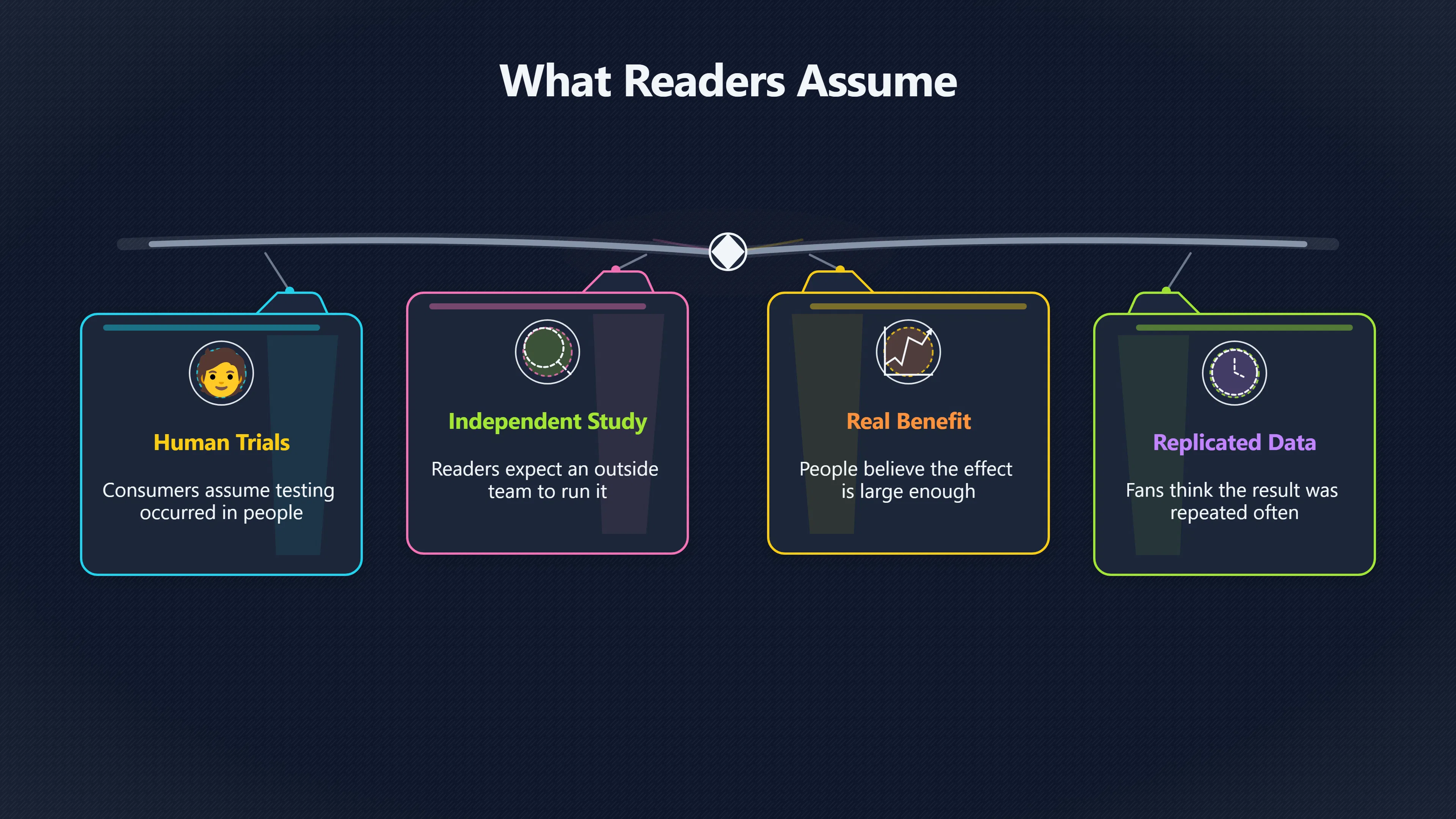
When people encounter “clinically proven”, they commonly infer several things at once:
- The product was tested in humans rather than only in a laboratory.
- The study was well designed and independently conducted.
- The claimed benefit was large enough to matter in real life.
- The results have been replicated.
- The evidence supports the specific marketing promise being made.
Yet the phrase itself guarantees none of these points. There is no universal legal definition that automatically requires a particular study design, sample size, duration, or level of replication whenever marketers use the words “clinically proven”. What matters is whether the advertiser can substantiate the specific claim with evidence appropriate to that claim. Regulators focus on the quality and relevance of the supporting evidence, not on the presence of the phrase itself.[Federal Trade Commission]ftc.govhealth products compliance guidanceFederal Trade CommissionHealth Products Compliance Guidance20 Dec 2022 — This document provides guidance from FTC staff on how to ensure…[Covington]cov.comingtonFTC Issues New Guidance on Health-Related Claims to…5 Jan 2023 — FTC reiterates that health benefit claims must be substantia…
This distinction is important because a product may have been involved in some form of clinical testing while still lacking strong evidence for the advertised outcome. The existence of a study is not the same as proof of effectiveness.
Why Human Testing Is Not Automatically Strong Evidence
A common misconception is that any human study settles the question. In reality, clinical research varies enormously in quality.
A trial involving a few dozen participants, no meaningful comparison group, and a short follow-up period may provide preliminary information but cannot support broad claims with the same confidence as a large, well-controlled randomised trial. Regulators assessing health claims typically look beyond whether a study exists and ask whether experts would regard the evidence as reliable and appropriate for the claim. Nutraceuticals World[Federal Trade Commission]ftc.govhealth products compliance guidanceFederal Trade CommissionHealth Products Compliance Guidance20 Dec 2022 — This document provides guidance from FTC staff on how to ensure…[Covington]cov.comingtonFTC Issues New Guidance on Health-Related Claims to…5 Jan 2023 — FTC reiterates that health benefit claims must be substantia…
The phrase therefore compresses a wide range of evidence quality into two reassuring words.
Questions That Reveal the Evidence Gap
The fastest way to evaluate a “clinically proven” statement is to ask what is missing from the advertisement.
Proven To Do What, Exactly?
The tested outcome may differ from the advertised promise.
A skin product might be “clinically proven” to improve the appearance of skin hydration under study conditions, while advertising language encourages consumers to believe it will reverse visible ageing. A supplement may be tested against a laboratory marker rather than a meaningful health outcome experienced by patients. The evidence can technically support one claim while consumers interpret a much broader one. Regulators frequently examine whether advertisers are implying benefits beyond what their evidence demonstrates.[ASA]asa.org.ukbeauty and cosmetics generalBeauty and Cosmetics: General02 Feb 2026 — Marketers of beauty and cosmetics must hold clinical evidence of any efficacy claims, and s…[ASA]asa.org.ukhealth therapies generalHealth: Therapies (General)2 Mar 2022 — Rule 12.1 indicates that objective claims for health products (including therapies) must be suppo…
Compared With What?
A result can sound impressive without a meaningful comparison.
Questions worth asking include:
- Was the product compared with a placebo?
- Was it compared with an established treatment?
- Was it compared only with users’ starting condition?
- Would similar improvement have occurred without the product?
A claim that participants improved over time does not necessarily show that the product caused the improvement. Controlled comparisons are often essential for separating genuine effects from expectation, natural variation, or regression towards the mean.[Federal Trade Commission]ftc.govhealth products compliance guidanceFederal Trade CommissionHealth Products Compliance Guidance20 Dec 2022 — This document provides guidance from FTC staff on how to ensure…[NYC Debt Defense Attorney]thelangelfirm.comNYC Debt Defense AttorneySubstantiating Health Claims: Examples of Proof (and Lack…26 May 2023 — In Proving Health-Advertising Claims…
How Big Was the Effect?
Statistical significance and practical significance are not the same thing.
A study may find a measurable difference while the real-world effect remains small. Marketing often highlights that an effect exists while paying less attention to its size. Consumers, however, are usually interested in whether the improvement is noticeable and worthwhile, not merely whether it reached a statistical threshold.
Who Was Studied?
Evidence may come from a narrowly selected group.
If participants were unusually healthy, unusually young, or chosen according to strict criteria, the findings may not apply broadly. Claims directed at the general public can therefore overstate what the evidence actually supports.
Has Anyone Reproduced the Finding?
Single studies can be wrong.
Chance findings, methodological flaws, selective reporting, and publication bias all contribute to scientific error. Replication by independent researchers generally increases confidence that a result is genuine. Regulatory and scientific guidance repeatedly emphasises that evidence becomes more persuasive when findings are reproduced rather than relying on one favourable study.[cooley.com]cooley.com2023 03 02 ftc revises health products compliance guidanceFTC Revises Health Products Compliance Guidance2 Mar 2023 — Only then can advertisers confidently say that their health claim is supporte…
Why Weak Substantiation Matters in Health Claims
The evidence gap is not merely a technical problem. It changes how consumers make decisions about health.
Health-related purchases often involve uncertainty, fear, hope, or chronic conditions. When an advertisement uses “clinically proven” to imply a stronger evidential foundation than actually exists, consumers may spend money on products that are less effective than they believe, delay seeking established treatments, or develop unrealistic expectations.
Because of these risks, regulators place special emphasis on substantiation for health claims. The UK advertising framework requires objective health-related claims to be supported by evidence, while health and medicinal claims face additional scrutiny depending on the type of product involved.[ASA]asa.org.ukfood health claimsFood: Health claims2 Aug 2022 — Advertisers seeking to make authorised health claims must hold documentary evidence showing the product m…[ASA]asa.org.ukCAPThe Advertising Standards Authority (ASA) is the UK's independent regulator of advertising across all media…[ASA]asa.org.ukBeauty products, grooming and hygieneA poster ad for Eucerin Skincare misleadingly claimed that a serum was clinically proven to make you…
The underlying principle is straightforward: the stronger the claim, the stronger the evidence should be.
The Regulatory View: Claims Must Match the Evidence
Advertising regulators do not generally ask whether a marketer believes a product works. They ask whether the evidence supports the specific message consumers are likely to take away.
Recent UK rulings concerning skincare advertising illustrate this point. Claims framed as “clinically proven” have been challenged where regulators concluded that the available evidence did not adequately support the advertised effect or the way the claim would be understood by consumers.[ASA]asa.org.ukHealth therapies and evidenceWhy do you allow consumer-based claims for some products and not for health therapies such as mine? The type…[CTPA]ctpa.org.ukasa ruling on misleading clinically proven claim 8986ASA Ruling on Misleading Clinically Proven Claim22 Apr 2026 — On 22 April 2026, the Advertising Standards Authority (ASA) upheld a ruling…
Similarly, US Federal Trade Commission guidance stresses that health claims should be supported by “competent and reliable scientific evidence”, with the required level of substantiation depending on the nature and consequences of the claim.[Federal Trade Commission]ftc.govhealth products compliance guidanceFederal Trade CommissionHealth Products Compliance Guidance20 Dec 2022 — This document provides guidance from FTC staff on how to ensure…[Covington]cov.comingtonFTC Issues New Guidance on Health-Related Claims to…5 Jan 2023 — FTC reiterates that health benefit claims must be substantia…

A Practical Rule for Readers
When encountering a “clinically proven” claim, it is often more useful to ignore the phrase itself and ask for the evidence behind it.
The key questions are not whether testing occurred, but:
- What outcome was tested?
- How was it measured?
- Compared with what?
- In whom?
- For how long?
- How large was the effect?
- Has the finding been independently replicated?
If an advertisement does not help answer those questions, the phrase “clinically proven” may be functioning more as a credibility signal than as a meaningful summary of strong evidence. That is the central misconception behind many science-sounding health claims: the appearance of scientific certainty can exceed what the underlying research actually demonstrates.
Amazon book picks
Further Reading
Books and field guides related to When 'Clinically Proven' Does Not Prove Much. Use these as the next step if you want deeper reading beyond the article.
The Skeptics' Guide to the Universe
Teaches evaluation of scientific-sounding claims and evidence quality.
eBay marketplace picks
Marketplace Samples
Example marketplace items related to this page. Use the search link to explore similar finds on eBay.

Endnotes
1.
Source: asa.org.uk
Title: healthcare medicinal claims
Link:https://www.asa.org.uk/advice-online/healthcare-medicinal-claims.html
Source snippet
Healthcare: Medicinal claims7 Aug 2024 — This CAP Guidance explains the types and levels of evidence the ASA would expect to see for s...
2.
Source: asa.org.uk
Title: substantiation for health beauty and slimming claims
Link:https://www.asa.org.uk/advice-online/substantiation-for-health-beauty-and-slimming-claims.html
Source snippet
Substantiation for health, beauty and slimming claims23 Jun 2025 — The Advertising Guidance identifies three types of health, beauty and...
3.
Source: cooley.com
Title: 2023 03 02 ftc revises health products compliance guidance
Link:https://www.cooley.com/news/insight/2023/2023-03-02-ftc-revises-health-products-compliance-guidance
Source snippet
FTC Revises Health Products Compliance Guidance2 Mar 2023 — Only then can advertisers confidently say that their health claim is supporte...
4.
Source: asa.org.uk
Title: beauty and cosmetics general
Link:https://www.asa.org.uk/advice-online/beauty-and-cosmetics-general.html
Source snippet
Beauty and Cosmetics: General02 Feb 2026 — Marketers of beauty and cosmetics must hold clinical evidence of any efficacy claims, and s...
5.
Source: asa.org.uk
Title: health therapies general
Link:https://www.asa.org.uk/advice-online/health-therapies-general.html
Source snippet
Health: Therapies (General)2 Mar 2022 — Rule 12.1 indicates that objective claims for health products (including therapies) must be suppo...
6.
Source: asa.org.uk
Title: food health claims
Link:https://www.asa.org.uk/advice-online/food-health-claims.html
Source snippet
Food: Health claims2 Aug 2022 — Advertisers seeking to make authorised health claims must hold documentary evidence showing the product m...
7.
Source: ftc.gov
Title: health products compliance guidance
Link:https://www.ftc.gov/business-guidance/resources/health-products-compliance-guidance
Source snippet
Federal Trade CommissionHealth Products Compliance Guidance20 Dec 2022 — This document provides guidance from FTC staff on how to ensure...
8.
Source: cov.com
Link:https://www.cov.com/en/news-and-insights/insights/2023/01/ftc-issues-new-guidance-on-health-related-claims-to-replace-the-dietary-supplements-advertising-guide
Source snippet
ingtonFTC Issues New Guidance on Health-Related Claims to...5 Jan 2023 — FTC reiterates that health benefit claims must be substantia...
9.
Source: ftc.gov
Link:https://www.ftc.gov/sites/default/files/attachments/training-materials/substantiation.pdf
Source snippet
Federal Trade CommissionAdvertising Substantiation PrinciplesBefore disseminating an advertisement, the advertiser must substantiate all...
10.
Source: thelangelfirm.com
Link:https://www.thelangelfirm.com/debt-collection-defense-blog/2023/may/substantiating-health-claims-examples-of-proof-a/
Source snippet
NYC Debt Defense AttorneySubstantiating Health Claims: Examples of Proof (and Lack...26 May 2023 — In Proving Health-Advertising Claims...
Published: May 2023
11.
Source: asa.org.uk
Link:https://www.asa.org.uk/
Source snippet
CAPThe Advertising Standards Authority (ASA) is the UK's independent regulator of advertising across all media...
Additional References
12.
Source: asa.org.uk
Link:https://www.asa.org.uk/topic/Beauty_products_grooming_and_hygiene.html
Source snippet
Beauty products, grooming and hygieneA poster ad for Eucerin Skincare misleadingly claimed that a serum was clinically proven to make you...
13.
Source: linkedin.com
Link:https://www.linkedin.com/posts/coslaw-eu_can-your-cosmetic-claims-stand-up-to-regulatory-activity-7459541835959623680-uFlW
Source snippet
COSlaw.eu's PostCan your cosmetic claims stand up to regulatory scrutiny? A recent UK ASA ruling on the claims “look up to 5 years younge...
14.
Source: jonesday.com
Link:https://www.jonesday.com/en/insights/2023/05/ftc-signals-[intent
Source snippet
FTC Targets Deceptive Health Claims AdvertisingFTC warns companies advertising health- and wellness-related products against making unsub...
15.
Source: intertek.com
Link:https://www.intertek.com/assuris/food/regulatory/health-claims/
Source snippet
Health Claim Substantiation and SubmissionsIntertek provides scientific and regulatory support for substantiation of health claims for fo...
16.
Source: asa.org.uk
Link:https://www.asa.org.uk/static/uploaded/f6d9a0c6-3e9b-475b-aa831a597de615ff.pdf
Source snippet
Health therapies and evidenceWhy do you allow consumer-based claims for some products and not for health therapies such as mine? The type...
17.
Source: asa.org.uk
Link:https://www.asa.org.uk/topic/Medical_procedures_and_services.html
Source snippet
Medical procedures and servicesProven procedures being advertised is fine as long as the procedures are carried out under suitably qualif...
18.
Source: intertek.com
Link:https://www.intertek.com/form/webinars-the-new-ftc-health-products-compliance-guide-emea/
Source snippet
The New FTC Health Products Compliance GuideAlso new is the very clear guidance on the “competent and reliable scientific evidence” subst...
19.
Source: citruslabs.com
Link:https://www.citruslabs.com/post/enhancing-your-brand-the-impact-of-clinically-validated-vs-clinically-tested-claims-on-supplement
Source snippet
Clinically Validated vs. Tested Claims17 May 2024 — In the competitive supplement industry, the credibility and appeal of your products h...
Published: May 2024
20.
Source: nutraceuticalsworld.com
Link:https://www.nutraceuticalsworld.com/reviewing-claims-substantiation-for-supplements-and-the-roles-of-federal-and-state-regulatory-bodies/
Source snippet
Reviewing Claims Substantiation for Supplements and the...10 Jan 2024 — The FTC requires advertisers to have a “reasonable basis” for th...
21.
Source: asa.org.uk
Link:https://www.asa.org.uk/topic_category/health_and_beauty.html
Topic Tree