Within Mythcraft
When Authority Shortcuts Spread Myths
People often use a familiar person's confidence as a shortcut for credibility, especially online.
On this page
- Confidence as a signal
- Expertise versus popularity
- How audiences can check claims
Page outline Jump by section
Introduction
Influencers can spread myths quickly because audiences often use social signals as shortcuts for credibility. A confident voice, a familiar face, a large following or a verified-looking profile can make a claim feel trustworthy before the audience has checked whether the person is qualified to make it. This is not simply a problem of gullible users or dishonest celebrities. It is a normal human response to information overload: when there is too much to evaluate, people lean on cues such as authority, popularity, confidence and personal connection.
That shortcut becomes risky when popularity is mistaken for expertise. A myth repeated by a favourite creator, celebrity, wellness personality, political figure or community leader may travel faster than a careful correction from an unfamiliar expert. Research on online credibility shows that authority cues can strongly shape perceived source credibility, while studies of influencer misinformation suggest that virality itself can reduce perceived deception and increase willingness to share.[ScienceDirect]sciencedirect.comSocial media and credibility indicators: The effect of influence cues - ScienceDirect…
Why confidence feels like credibility
A confident person is easier to follow than a cautious one. Myths often benefit from that imbalance. The false claim is usually simple, vivid and emotionally satisfying; the correction is often conditional, technical or less dramatic. An influencer who says “this is what they are not telling you” may therefore sound more compelling than an expert who says “the evidence is mixed, and here are the limits”.
Online platforms intensify this effect because they strip claims from many of the cues people would use offline. A short video or post may show confidence, polish and emotional certainty, but not the speaker’s training, conflicts of interest, evidence base or error history. In one study of Twitter credibility cues, authority, identity and bandwagon signals all affected perceived credibility, with authority cues having the strongest effect. The study’s important lesson is not that authority is useless, but that people may treat the appearance of authority as a substitute for checking the claim itself.[ScienceDirect]sciencedirect.comSocial media and credibility indicators: The effect of influence cues - ScienceDirect…
Influencer culture adds a further layer: familiarity. Followers may see the same creator every day, hear personal stories, watch behind-the-scenes content and feel that they “know” the person. This one-sided bond is often called a parasocial relationship: a felt relationship with a media figure who does not personally know the audience member. When a creator has become part of someone’s routine, their claims can arrive with the warmth of a recommendation from a friend, even when the topic is science, medicine, law or history.
That is why confident myth-spreading often works even without formal credentials. The source does not need to be a doctor to sound doctor-like, a historian to sound historically authoritative, or a statistician to sound data-driven. The shortcut is emotional and social before it is evidential.
Expertise versus popularity
The central confusion is simple: popularity proves reach, not accuracy. A large audience can mean that someone is entertaining, relatable, early to a trend, good at platform formats, skilled at self-branding or trusted within a community. None of those qualities automatically means the person is competent on the claim being made.
This distinction matters most when a claim crosses domains. A fitness influencer may be knowledgeable about their own training routine but unreliable on hormones, vaccines or eating disorders. A celebrity may have lived experience of illness without being qualified to interpret clinical trials. A political commentator may be persuasive about values while misreading a chart. The myth spreads when the audience transfers trust from one area to another: “I trust this person” becomes “this person must be right about this”.
Health misinformation shows the mechanism clearly because the stakes are visible. A scoping review on social media influencers and adolescent health found that influencers had become an important source of health information for adolescents, but that lack of expertise and commercial interests created risks. The review identified problems including unrealistic body images, unhealthy diets, substance-use promotion and inaccurate diagnosis or treatment advice, while also noting that influencers can build unusually trustworthy relationships with followers.[ScienceDirect]sciencedirect.comSocial media and credibility indicators: The effect of influence cues - ScienceDirect…
The same authority shortcut can work in the opposite direction when credible people learn to communicate well. Health workers, scientists, librarians and community leaders can use the same platforms to answer questions, correct myths and build trust. The difference is that responsible authority does not rely only on status. It makes evidence visible, explains uncertainty and shows when a claim falls outside the speaker’s competence.
How virality becomes a false signal
A myth can look more credible simply because many people have already reacted to it. Likes, shares, comments, reposts and stitched videos are not just measurements of attention; they are social proof. They tell the next viewer that the claim is worth noticing. In fast-moving feeds, that can become a credibility cue before the content is understood.
Research on false news diffusion helps explain why this matters. A major MIT study of Twitter data found that false news travelled farther, faster, deeper and more broadly than true news, and that the difference persisted even when bots were removed from the dataset. The researchers’ finding is especially relevant to myth spread because it points to human sharing behaviour, not just automated manipulation, as a driver of falsehood’s reach.[MIT News]news.mit.eduMIT NewsStudy: On Twitter, false news travels faster than true stories | MIT News | Massachusetts Institute of Technology…
Influencer-specific research adds another piece. A 2025 study on TikTok and Instagram influencer misinformation found that higher virality reduced perceived deception, strengthened parasocial connection and increased sharing intentions. In other words, people were not merely seeing a viral post; they were reading its popularity as a sign that it might be acceptable, normal or trustworthy. Critical comments, however, could increase perceptions of deception in highly viral posts, suggesting that visible challenge can interrupt the shortcut.[Sage Journals]journals.sagepub.comSage Journals Going Viral: Sharing of Misinformation by Social Media InfluencersSage JournalsGoing Viral: Sharing of Misinformation by Social Media Influencers - Rory Mulcahy, Renee Barnes, Retha de Villiers Scheepers…
This is why corrections from experts can struggle. A careful correction may be accurate but socially quiet. The myth may already have the crowd, the joke format, the celebrity name, the emotional story and the appearance of consensus. By the time the correction arrives, the audience may have seen the myth several times from people they recognise.
The influencer problem is also a training problem
Many creators are not deliberately trying to deceive their audiences. They may be repeating something that sounded plausible, summarising a half-read article, sharing an anecdote, reacting to a trend or trusting another creator. That does not remove the harm, but it changes the solution: some myth spread comes from incentives and missing verification habits rather than only from bad faith.
UNESCO’s 2024 survey of digital content creators is useful here. It found that 62% did not carry out rigorous and systematic fact-checking before sharing information, while 73% said they wanted training. UNESCO framed creators as an important part of the information ecosystem because they now engage large audiences with cultural, social and political news, often without the editorial routines used in journalism.[UNESCO]unesco.org2/3 of digital content creators do not check their facts before2/3 of digital content creators do not check their facts before…
This creates a mismatch. Platforms reward speed, confidence, novelty and engagement. Verification rewards slowness, doubt, context and sometimes silence. A creator who pauses to check a claim may miss the trend window; a creator who posts immediately may gain reach even if the claim is wrong. The authority shortcut then compounds the error: followers assume the creator has checked because the creator sounds certain and has a large audience.
Commercial incentives can make the problem sharper. Sponsored posts, affiliate links, product launches and personal brands can blur the line between advice and advertising. A creator may sincerely believe a claim, but still benefit when followers accept it. In health, beauty, finance and lifestyle content, the audience may not always see where personal experience ends and commercial persuasion begins.
Corrections need more than an unfamiliar expert
A common response to influencer-driven myths is to say: “Listen to experts instead.” That is true but incomplete. The audience may not know who counts as an expert, may distrust institutions, or may feel that official explanations do not speak to their everyday concerns. In some communities, a local pastor, youth worker, parent creator or niche educator may be more influential than a national authority.
Public health organisations increasingly recognise this. The US Surgeon General’s health misinformation resources include guidance not only for health care providers but also for educators, librarians, faith leaders and trusted community members. The emphasis is practical: misinformation often spreads through communities, so responses need trusted people inside those communities, not only distant institutions.[HHS.gov]hhs.govHealth Misinformation | HHS.govHealth Misinformation | HHS.gov
The World Health Organization has also produced social media guidance for health-care practitioners, aimed at helping them share authentic and reliable information online, create posts, reshare trusted sources and communicate vaccine-confidence messages. This approach treats credibility as something that must be carried into the spaces where myths are spreading, rather than waiting for audiences to leave those spaces and search official websites.[World Health Organization]who.intA Social Media Toolkit for Healthcare Practitioners - mobile…
The best corrective messenger is therefore not always the most senior expert. It may be the person who combines relevant expertise, audience trust, clarity and humility. A local clinician who answers common questions in plain language may outperform a formal statement. A creator who admits a previous mistake and shows how they checked it may teach better habits than a scolding correction.
How audiences can check claims without becoming full-time fact-checkers
The aim is not to treat every influencer as suspicious or every expert as right. The useful habit is to separate the source cue from the claim. A familiar person can be sincere and wrong. An unfamiliar expert can be accurate and poor at communication. A viral post can be popular because it is funny, frightening or identity-affirming, not because it is true.
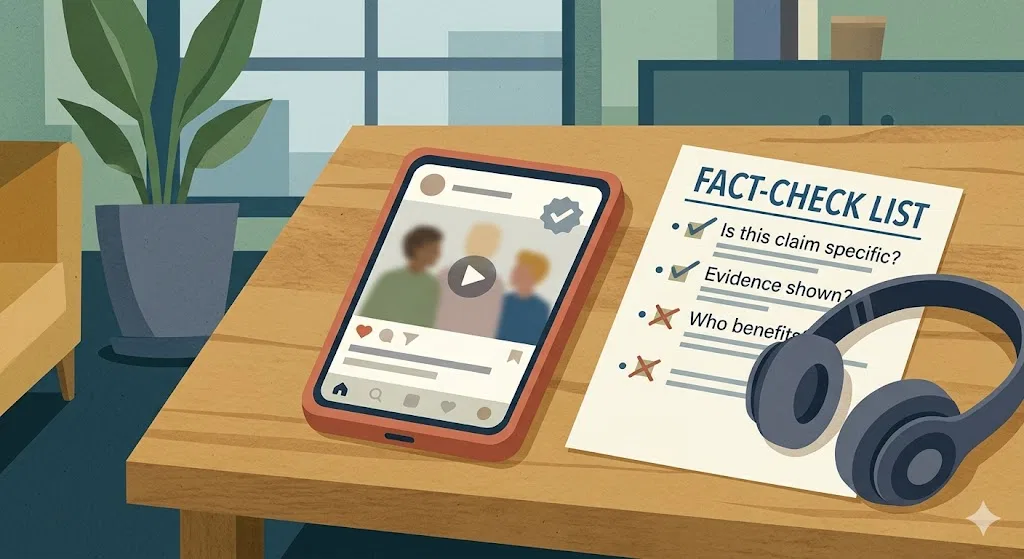
A practical check starts with three questions:
Is this person qualified on this specific claim?
Do not ask only whether the person is famous, successful or intelligent. Ask whether they have relevant expertise for the exact topic. A personal trainer, actor, entrepreneur or commentator may be worth hearing on some subjects and unreliable on others.
What evidence is being shown?
Anecdotes can raise questions, but they cannot settle broad claims. Stronger signals include links to primary sources, named institutions, transparent data, clear dates and acknowledgement of uncertainty. Weak signals include “do your own research”, screenshots without context, unnamed insiders, miracle claims and claims that all critics are corrupt.
Who benefits if I believe or share this?
Myths often travel with incentives: attention, sales, political loyalty, group identity or personal branding. A claim is not automatically false because someone benefits from it, but hidden incentives should lower the audience’s willingness to accept it quickly.
Social cues deserve special caution. A post with millions of views may still be wrong. A confident speaker may still be guessing. A creator who has been right before may still be outside their depth this time. The more consequential the decision — health, money, safety, voting, legal rights, reputational harm — the more the audience should slow down and look beyond the person delivering the claim.
What responsible influencers do differently
Influencers are not only a risk in myth spread; they can also be part of the solution. The difference lies in practice. Responsible creators make it harder for followers to confuse confidence with proof.
They usually do four things well. First, they label uncertainty instead of turning every claim into a certainty. Second, they distinguish personal experience from general evidence. Third, they cite sources that followers can inspect, preferably from institutions, peer-reviewed research or subject-matter experts with relevant qualifications. Fourth, they correct visible mistakes without burying the update.
They also avoid borrowing authority they have not earned. A creator can say, “This worked for me,” without implying, “This will work for you.” They can interview an expert without pretending to become one. They can discuss a study while making clear what it does and does not show.
The healthiest information environment is not one where audiences ignore influencers. It is one where audiences understand what influencer credibility can and cannot prove. Familiarity may tell you why a person is persuasive. It does not tell you whether the claim is true.
Amazon book picks
Further Reading
Books and field guides related to When Authority Shortcuts Spread Myths. Use these as the next step if you want deeper reading beyond the article.
How to Talk to a Science Denier
Explores trust and credibility in contested information.

The death of expertise
First published 2017. Subjects: Higher Education, Sociology of Knowledge, Theory of Knowledge, Internet, Expertise.
eBay marketplace picks
Marketplace Samples
Example marketplace items related to this page. Use the search link to explore similar finds on eBay.


Endnotes
1.
Source: sciencedirect.com
Link:https://www.sciencedirect.com/science/article/abs/pii/S074756321630320X
Source snippet
Social media and credibility indicators: The effect of influence cues - ScienceDirect...
2.
Source: sciencedirect.com
Link:https://www.sciencedirect.com/science/article/pii/S027795362300744X
Source snippet
Social media influencers and adolescents’ health: A scoping review of the research field - ScienceDirect...
3.
Source: news.mit.edu
Link:https://news.mit.edu/2018/study-twitter-false-news-travels-faster-true-stories-0308
Source snippet
MIT NewsStudy: On Twitter, false news travels faster than true stories | MIT News | Massachusetts Institute of Technology...
4.
Source: unesco.org
Title: 2/3 of digital content creators do not check their facts before
Link:https://www.unesco.org/en/articles/2/3-digital-content-creators-do-not-check-their-facts-sharing-want-learn-how-do-so-unesco-survey
Source snippet
2/3 of digital content creators do not check their facts before...
5.
Source: hhs.gov
Title: Health Misinformation | HHS.gov
Link:https://www.hhs.gov/surgeongeneral/reports-and-publications/health-misinformation/index.html
6.
Source: who.int
Title: World Health Organization
Link:https://www.who.int/publications/m/item/a-social-media-toolkit-for-healthcare-practitioners-desktop
Source snippet
A Social Media Toolkit for Healthcare Practitioners - mobile...
7.
Source: sciencedirect.com
Link:https://www.sciencedirect.com/science/article/pii/S004727272500043X
8.
Source: sciencedirect.com
Link:https://www.sciencedirect.com/science/article/abs/pii/S0040162523006583
9.
Source: unesco.org
Link:https://www.unesco.org/en/digital-content-creators
10.
Source: unesco.org
Link:https://www.unesco.org/en/articles/unesco-trains-digital-content-creators-become-trusted-voices-online
11.
Source: who.int
Link:https://www.who.int/europe/news/item/01-09-2022-infodemics-and-misinformation-negatively-affect-people-s-health-behaviours–new-who-review-finds
12.
Source: ouci.dntb.gov.ua
Link:https://ouci.dntb.gov.ua/en/works/7WdBwwz4/
13.
Source: instagram.com
Link:https://www.instagram.com/p/DC4eXFXPqY0/
14.
Source: journals.sagepub.com
Title: Sage Journals Going Viral: Sharing of Misinformation by Social Media Influencers
Link:https://journals.sagepub.com/doi/10.1177/14413582241273987
Source snippet
Sage JournalsGoing Viral: Sharing of Misinformation by Social Media Influencers - Rory Mulcahy, Renee Barnes, Retha de Villiers Scheepers...
15.
Source: science.org
Link:https://www.science.org/content/article/fake-news-spreads-faster-true-news-twitter-thanks-people-not-bots
16.
Source: science.org
Link:https://www.science.org/doi/10.1126/science.aap9559
17.
Source: ebm.bmj.com
Link:https://ebm.bmj.com/content/30/6/420
18.
Source: europeanjournalists.org
Link:https://europeanjournalists.org/blog/2024/12/06/unesco-report-highlights-urgent-need-for-media-literacy-training-for-digital-content-creators-who-report-the-news/
19.
Source: business-humanrights.org
Title: unesco warns that online influencers urgently need fact checking training
Link:https://www.business-humanrights.org/zh-hant/%E6%9C%80%E6%96%B0%E6%B6%88%E6%81%AF/unesco-warns-that-online-influencers-urgently-need-fact-checking-training/
Additional References
20.
Source: bridgeportct.gov
Title: social media influencers and health misinformation why we must be cautious
Link:https://www.bridgeportct.gov/news/social-media-influencers-and-health-misinformation-why-we-must-be-cautious
21.
Source: facebook.com
Link:https://www.facebook.com/unesco/videos/behind-the-screens-study-reveals-a-critical-landscape-for-online-content-creatio/1327322601611148/
22.
Source: spokanetribe.com
Link:https://spokanetribe.com/wp-content/uploads/2021/11/HealthMisinformationToolkitNon508.pdf
23.
Source: thedecisionlab.com
Link:https://thedecisionlab.com/biases/authority-bias
24.
Source: researchgate.net
Link:https://www.researchgate.net/publication/353556729_Fake_news_on_Facebook_examining_the_impact_of_heuristic_cues_on_perceived_credibility_and_sharing_intention
25.
Source: facebook.com
Link:https://www.facebook.com/WBTVNews3/posts/researchers-found-that-fake-news-sped-through-twitter-farther-faster-deeper-and-/10155105921436455/
26.
Source: researchgate.net
Link:https://www.researchgate.net/publication/395328308_Exploring_the_Impact_of_Social_Media_Influencers_on_Adults%27_Health_Behaviour_The_Role_of_Credibility_Trust_and_Emotional_Resonance
27.
Source: researchgate.net
Link:https://www.researchgate.net/publication/323649207_The_spread_of_true_and_false_news_online
28.
Source: misinforeview.hks.harvard.edu
Link:https://misinforeview.hks.harvard.edu/article/a-survey-of-expert-views-on-misinformation-definitions-determinants-solutions-and-future-of-the-field/
29.
Source: researchportal.port.ac.uk
Link:https://researchportal.port.ac.uk/files/63065979/Thesis.pdf
Topic Tree