Within Common Sense
What would we see if it were true?
A claim becomes stronger when it says what should happen, what should not happen, and what evidence would count against it.
On this page
- Define the claim before judging it
- Turn common sense into observable predictions
- Look for comparisons that anecdotes leave out
Page outline Jump by section
Introduction
A plausible claim becomes stronger when it stops being merely a satisfying story and starts making risky predictions. The key question is not whether an idea sounds reasonable, but what we would expect to observe if it were true — and what evidence would count against it. That shift matters because many myths survive on flexibility. They can explain almost any outcome after the fact, which makes them feel convincing while protecting them from serious testing.
 In debates about misconceptions, the strongest claims are usually the ones that take the biggest risk. They specify what should happen, what should not happen, and what result would force supporters to reconsider. A claim that cannot be challenged by evidence may remain attractive, but it cannot be meaningfully tested. Philosophers of science such as Karl Popper argued that useful theories expose themselves to possible failure by making predictions that could be contradicted by observation.[Simply Psychology]simplypsychology.orgkarl popperSimply PsychologyKarl Popper: Falsification Theory31 Jul 2023 — Karl Popper's theory of falsification contends that scientific inquiry sh…[Encyclopedia Britannica]britannica.comcriterion of falsifiabilityEncyclopedia BritannicaCriterion of falsifiability | Falsificationism, Popper, Hypotheses19 Mar 2026 — Scientific theories are instead in…
Define the claim before judging it
Many myths survive because the original claim remains vague. Before asking whether a belief is true, it helps to state exactly what is being asserted.
Consider the common learning-styles idea. People often begin with a broad statement such as “everyone learns differently”. That observation is largely uncontroversial. People do have different experiences, interests and study preferences. The problem is that this statement is too broad to test.[Evidence Based Education]evidencebased.educationthe lingering learning styles mythThe truth with this myth is that individuals will have different study techniques…Read more…
To make the claim testable, it must become more specific:
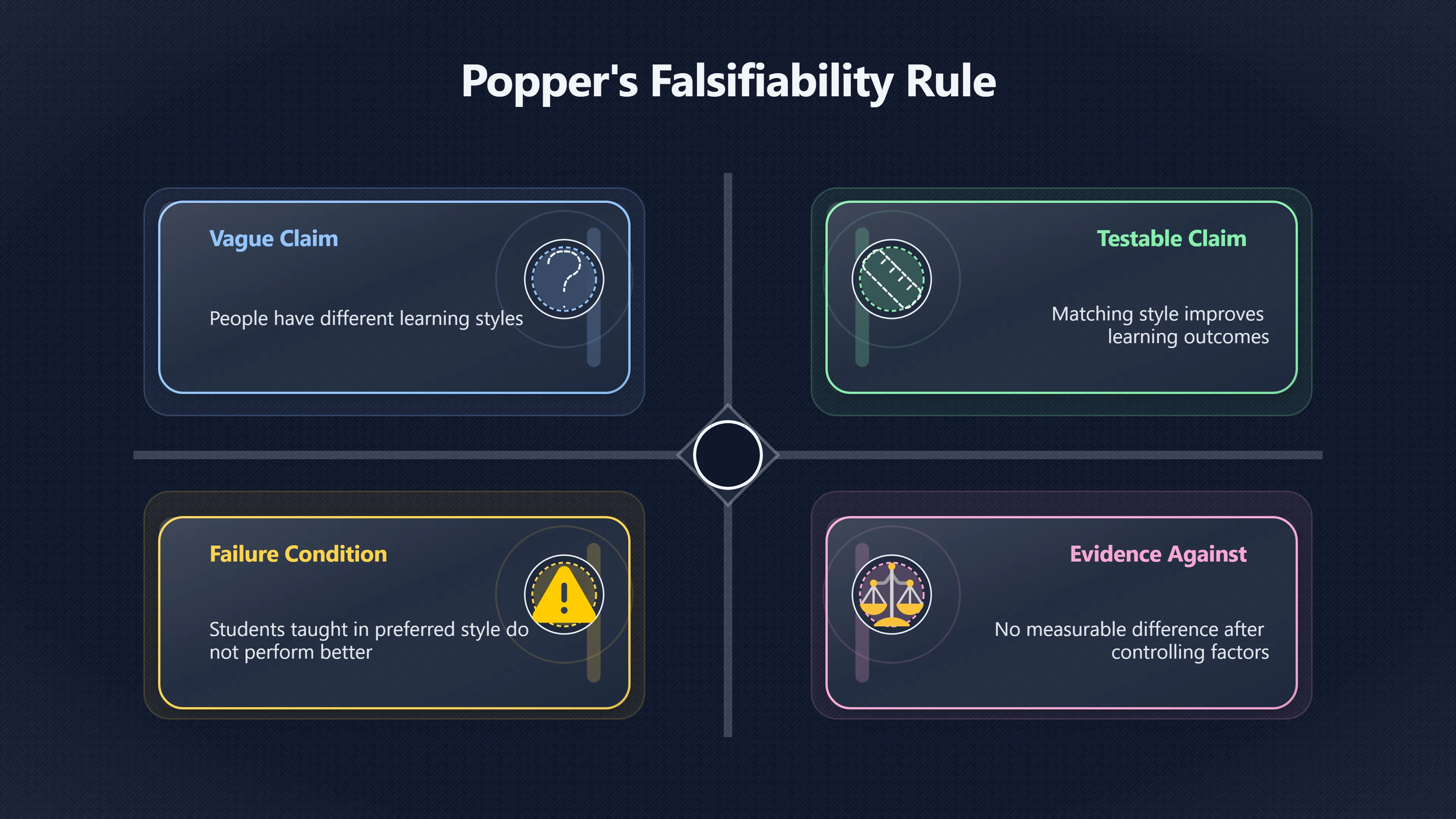
- Vague claim: “People have different learning styles.”[evidencebased.education]evidencebased.educationthe lingering learning styles mythThe truth with this myth is that individuals will have different study techniques…Read more…
- Testable claim: “Students learn more effectively when teaching methods are matched to their preferred learning style.”
- Possible disconfirming result: Students taught in their preferred style do not perform better than comparable students taught in other ways.
Notice what changed. The second version creates observable consequences. It predicts a measurable difference in outcomes. Researchers can compare groups, collect results and see whether the expected pattern appears. Reviews of learning-styles research have repeatedly found little support for the prediction that matching instruction to a preferred style improves learning outcomes.[The Learning Dispatch]carlhendrick.substack.comThe Learning Dispatch Why The Learning Styles Myth Persists And How It DamagesThe Learning DispatchWhy The Learning Styles Myth Persists And How It Damages…April 4, 2025 — The central myth of learning styles is s…[PMC]pmc.ncbi.nlm.nih.govPMCThe Learning Styles Myth is Thriving in Higher EducationLearning Styles Myth is Thriving in Higher Education - PMCby PM Newton · 2015 · Cited by 476 — The existence of 'Learning Styles' is a co…
A useful rule is that a claim should be precise enough that two people could disagree about the evidence without first arguing over what the claim means.
Turn common sense into observable predictions
A common-sense explanation often sounds persuasive because it points to a plausible cause. Testing begins when that cause is translated into expected observations.
The process can be surprisingly simple:
- State the proposed cause.
- Ask what pattern should appear if that cause is real.
- Ask what pattern should not appear.
- Identify evidence that could prove the prediction wrong.
For example:
Common-sense claimPrediction if trueEvidence against itFull moons increase unusual behaviourRelevant incidents should rise consistently during full moonsNo reliable increase compared with other lunar phasesA supplement boosts concentrationUsers should outperform comparable non-users on concentration measuresNo measurable difference after controlling for other factorsA teaching method improves learningStudents using it should learn more than similar students using alternativesComparable or worse outcomes
The important step is the move from explanation to expectation. A story explains what already happened. A prediction specifies what should happen next.
Popper’s falsification principle emphasised this distinction. A claim becomes more informative when it rules out possibilities. If a theory can accommodate every possible outcome, it predicts nothing. If it forbids certain outcomes and those outcomes occur anyway, the theory faces a genuine challenge.[Simply Psychology]simplypsychology.orgkarl popperSimply PsychologyKarl Popper: Falsification Theory31 Jul 2023 — Karl Popper's theory of falsification contends that scientific inquiry sh…[Wikipedia]WikipediaFalsifiabilityFalsifiability is a standard of evaluation of scientific statements, including theories and hypotheses. A statement is f…
What would count as failure?
Many misconceptions become difficult to test because supporters never define what would change their minds.
Imagine someone claims that a hidden force causes people to make poor decisions during specific periods. If every outcome can be reinterpreted as support, the claim becomes effectively immune to evidence. Success confirms it. Failure confirms it. Mixed results confirm it. At that point, testing has largely disappeared.
A stronger approach is to specify failure conditions in advance.
Before looking at evidence, ask:
- What result would surprise me if the claim were true?
- What observation would make the claim less likely?
- What outcome would force revision rather than explanation?
This is one reason scientific testing often requires pre-specified hypotheses. Researchers try to define predictions before examining results. Otherwise it becomes easy to invent explanations after the outcome is already known.
The more clearly a claim defines its own failure conditions, the easier it becomes to distinguish evidence from rationalisation.[Simply Psychology]simplypsychology.orgkarl popperSimply PsychologyKarl Popper: Falsification Theory31 Jul 2023 — Karl Popper's theory of falsification contends that scientific inquiry sh…
Look for comparisons that anecdotes leave out
Anecdotes often make myths seem stronger because they highlight events that fit the story while hiding the comparison that would reveal whether the pattern is unusual.
Suppose someone says, “Every time I use this method, it works.” That statement sounds persuasive until a comparison appears.
Questions that improve testability include:
- Compared with what?
- How often does the outcome occur without the supposed cause?
- What happens in similar cases where the cause is absent?
- Are we noticing only the successes?
A hospital worker may remember unusual events during a full moon because those nights are memorable. The test is not whether unusual events happened. The test is whether they happened more often than on comparable nights. The comparison, not the anecdote, carries most of the evidential weight.
This is why controlled studies often produce results that feel counterintuitive. They include the background rate that personal experience tends to overlook.
Why confirmation feels easier than testing
People naturally search for examples that fit their expectations. Psychologists refer to this tendency as confirmation bias: the habit of noticing, remembering and favouring information that supports existing beliefs.[UC San Diego Pages]pages.ucsd.eduUC San Diego Pages Confirmation Bias: A Ubiquitous Phenomenon in ManyUC San Diego PagesConfirmation Bias: A Ubiquitous Phenomenon in Many…October 6, 2004 — by RS Nickerson · 1998 · Cited by 12332 — Confi…[Encyclopedia Britannica]britannica.comcriterion of falsifiabilityEncyclopedia BritannicaCriterion of falsifiability | Falsificationism, Popper, Hypotheses19 Mar 2026 — Scientific theories are instead in…
That tendency creates a trap when evaluating plausible claims. If someone believes a myth, examples supporting it become easy to find.
For example:
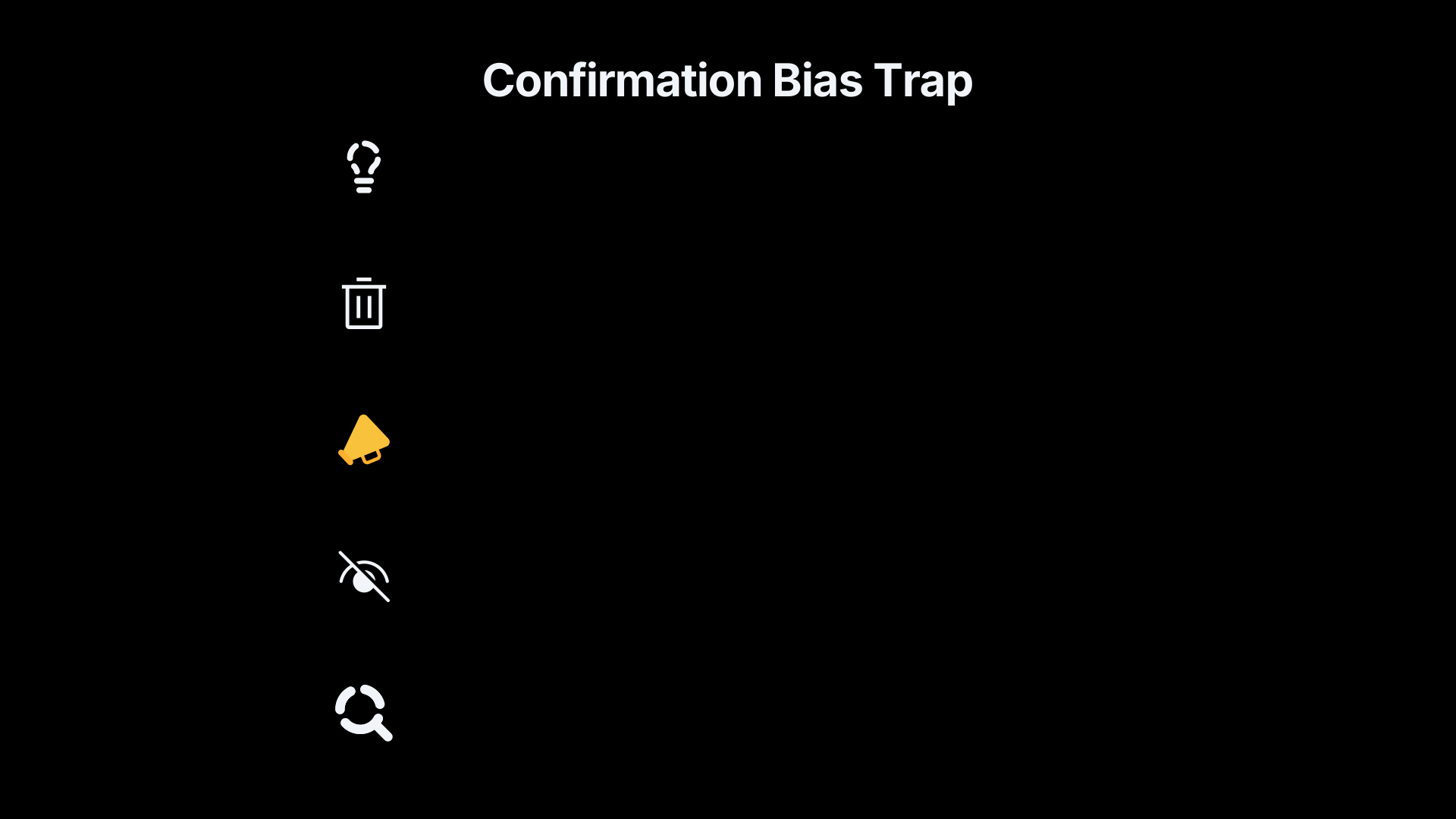
- A prediction comes true and is remembered.
- A prediction fails and is forgotten.
- Supporting anecdotes are shared.
- Contradictory cases seem like exceptions.
Turning a claim into a testable prediction helps counter this bias because it forces attention toward outcomes that would challenge the belief, not just outcomes that support it.
Instead of asking, “Can I find evidence for this?”, the better question becomes, “What evidence should appear if this is true, and does it appear more often than the alternatives predict?”
The difference between a story and a prediction
Many misconceptions begin as stories that organise experience. Stories are useful because they compress complexity into something memorable. The problem comes when a story is mistaken for evidence.
A story says:
This outcome happened because of this cause.
A prediction says:
If this cause is real, we should observe these specific outcomes and not these others.
That second form is harder to create, but it is also more informative. It creates a path by which evidence can strengthen, weaken or overturn the claim.
Testing myths therefore begins with a simple transformation. Instead of asking whether an explanation sounds sensible, ask what the world should look like if the explanation is true. Once a claim commits itself to observable consequences, it stops being merely plausible and becomes something evidence can genuinely challenge.
eBay marketplace picks
Marketplace Samples
Example marketplace items related to this page. Use the search link to explore similar finds on eBay.


Endnotes
1.
Source: britannica.com
Title: criterion of falsifiability
Link:https://www.britannica.com/topic/criterion-of-falsifiability
Source snippet
Encyclopedia BritannicaCriterion of falsifiability | Falsificationism, Popper, Hypotheses19 Mar 2026 — Scientific theories are instead in...
2.
Source: Wikipedia
Link:https://en.wikipedia.org/wiki/Falsifiability
Source snippet
FalsifiabilityFalsifiability is a standard of evaluation of scientific statements, including theories and hypotheses. A statement is f...
3.
Source: pmc.ncbi.nlm.nih.gov
Title: PMCThe Learning Styles Myth is Thriving in Higher Education
Link:https://pmc.ncbi.nlm.nih.gov/articles/PMC4678182/
Source snippet
Learning Styles Myth is Thriving in Higher Education - PMCby PM Newton · 2015 · Cited by 476 — The existence of 'Learning Styles' is a co...
4.
Source: britannica.com
Link:https://www.britannica.com/science/confirmation-bias
Source snippet
Encyclopedia BritannicaConfirmation bias | Definition, Examples, Psychology, & FactsConfirmation bias is a person's tendency to process i...
5.
Source: Wikipedia
Title: Confirmation bias
Link:https://en.wikipedia.org/wiki/Confirmation_bias
Source snippet
Confirmation biasConfirmation bias is the tendency to search for, interpret, favor and recall information in a way that confirms or su...
6.
Source: simplypsychology.org
Title: karl popper
Link:https://www.simplypsychology.org/karl-popper.html
Source snippet
Simply PsychologyKarl Popper: Falsification Theory31 Jul 2023 — Karl Popper's theory of falsification contends that scientific inquiry sh...
7.
Source: evidencebased.education
Title: the lingering learning styles myth
Link:https://evidencebased.education/resource/the-lingering-learning-styles-myth/
Source snippet
The truth with this myth is that individuals will have different study techniques...Read more...
8.
Source: carlhendrick.substack.com
Title: The Learning Dispatch Why The Learning Styles Myth Persists And How It Damages
Link:https://carlhendrick.substack.com/p/the-learning-styles-illusion-[debunking
Source snippet
The Learning DispatchWhy The Learning Styles Myth Persists And How It Damages...April 4, 2025 — The central myth of learning styles is s...
Published: April 4, 2025
9.
Source: pages.ucsd.edu
Title: UC San Diego Pages Confirmation Bias: A Ubiquitous Phenomenon in Many
Link:https://pages.ucsd.edu/~mckenzie/nickersonConfirmationBias.pdf
Source snippet
UC San Diego PagesConfirmation Bias: A Ubiquitous Phenomenon in Many...October 6, 2004 — by RS Nickerson · 1998 · Cited by 12332 — Confi...
Published: October 6, 2004
10.
Source: apa.org
Title: learning styles myth
Link:https://www.apa.org/news/press/releases/2019/05/learning-styles-myth
Source snippet
Belief in learning styles myth may be detrimental30 May 2019 — Many people, including educators, believe learning styles are set at birth...
Published: May 2019
11.
Source: plato.stanford.edu
Link:https://plato.stanford.edu/entries/popper/
Source snippet
Stanford Encyclopedia of Philosophyby S Thornton · 1997 · Cited by 444 — In later years Popper came under philosophical criticism for his...
Additional References
12.
Source: researchgate.net
Link:https://www.researchgate.net/publication/316486755_Cognitive_Biases_and_Their_Influence_on_Critical_Thinking_and_Scientific_Reasoning_A_Practical_Guide_for_Students_and_Teachers
Source snippet
Cognitive Biases and Their Influence on Critical Thinking...21 Jul 2023 — Researchers have discovered 200 cognitive biases that result i...
13.
Source: ebsco.com
Link:https://www.ebsco.com/research-starters/religion-and-philosophy/falsifiability-rule
Source snippet
Falsifiability rule | Religion and PhilosophyAustrian-born British philosopher Karl Popper proposed that ideas could be regarded as legit...
14.
Source: thedecisionlab.com
Link:https://thedecisionlab.com/biases/confirmation-bias
Source snippet
Confirmation BiasConfirmation bias describes our underlying tendency to notice, focus on, and provide greater credence to evidence that f...
15.
Source: fs.blog
Link:https://fs.blog/the-uses-of-being-wrong/
Source snippet
The Uses Of Being WrongPopper's falsifiability criterion ignores the tenacity of scientific theories, even in the face of disconfirming e...
16.
Source: gc-bs.org
Link:https://gc-bs.org/articles/from-styles-to-science-debunking-the-learning-styles-myth-and-embracing-an-evidence-based-framework-for-learning/
Source snippet
Debunking the Learning Styles Myth and Embracing...12 Jan 2026 — At the heart of nearly all learning style theories lies a single, core...
17.
Source: my.chartered.college
Link:https://my.chartered.college/research-hub/why-is-the-myth-of-learning-styles-so-hard-to-slay/
Source snippet
is the myth of 'learning styles' so hard to slay?One reason is likely that it feels a very compelling and convincing idea – that we have...
18.
Source: youtube.com
Link:https://www.youtube.com/watch?v=rhgwIhB58PA
19.
Source: pmc.ncbi.nlm.nih.gov
Title: Clinicians might apply the same notion to understand
Link:https://pmc.ncbi.nlm.nih.gov/articles/PMC8140582/
Source snippet
in medicine: what clinicians can learn from Karl...by S Taran · 2021 · Cited by 18 — Popper applied the notion of falsifiability to dist...
20.
Source: whyevolutionistrue.com
Title: is falsifiability a good criterion for a scientific theory
Link:https://whyevolutionistrue.com/2012/04/29/is-falsifiability-a-good-criterion-for-a-scientific-theory/
Source snippet
?29 Apr 2012 — Testability is falsifiability; but there are degrees of testability: some theories are more testable, more exposed to refu...
21.
Source: hamzatzortzis.com
Title: What is Karl Popper’s View of the Scientific Method?
Link:https://www.hamzatzortzis.com/what-is-karl-poppers-view-of-the-scientific-method-is-that-view-satisfactory/
Source snippet
Is That...12 May 2020 — Popper's view was that a scientific claim was only valid if it can be falsified; he maintains that “the possibil...
Published: May 2020
Topic Tree