Within Backfire
How Much Should a Debunk Repeat the Myth?
Good debunking names the false claim clearly enough to correct it but keeps the true claim as the message people remember.
On this page
- Why evasive corrections can confuse readers
- How headlines and repetition amplify false claims
- Better ways to lead with the truth
Page outline Jump by section
Introduction
A good debunk has a naming problem. It must identify the false claim clearly enough that readers know what is being corrected, but it must avoid turning the myth itself into the most memorable part of the message.
 This tension sits at the centre of modern misinformation research. Studies on the illusory truth effect show that repetition can make information feel more familiar and therefore more believable. At the same time, research on corrections consistently finds that clear debunking usually improves accuracy rather than causing widespread “backfire” effects. The practical challenge is not whether to mention the myth at all. It is how to mention it without giving it centre stage. ScienceDirect PubMed The most effective corrections tend to keep the true claim as the headline[ksjhandbook.org]ksjhandbook.orgKSJ HandbookStructuring Your ArgumentThe “fact-myth-fallacy” structure when debunking a claim. This involves presenting the correct infor…, the takeaway and the final message readers remember. The myth is named because readers need context, but it is treated as the object of correction rather than the main story.[KSJ Handbook]ksjhandbook.orgKSJ HandbookStructuring Your ArgumentThe “fact-myth-fallacy” structure when debunking a claim. This involves presenting the correct infor…
Why evasive corrections can confuse readers
One temptation is to avoid naming the myth altogether. Communicators sometimes worry that even mentioning a false claim risks spreading it, so they produce vague corrections such as “there is misinformation about vaccines” or “some people have made inaccurate claims”.
The problem is that readers often cannot tell what is being corrected. A correction works partly because it updates an existing mental model. If the audience already encountered a specific false claim, they need enough information to connect the correction to that claim. Otherwise the correction floats free of the misconception it is meant to replace. Research on misinformation retraction and the continued influence effect has repeatedly found that corrections are more effective when they directly engage with the mistaken claim rather than merely gesturing toward it.[ResearchGate]researchgate.netResearch Gate Reminders and Repetition of Misinformation: Helping orReminders and Repetition of Misinformation: Helping or…April 1, 2017 — Retractions that explicitly repeated the misinforma…
This is one reason many researchers no longer support a blanket rule of “never repeat the myth”. The evidence suggests that naming the false claim can help readers identify what is wrong, especially when the correction is explicit and unambiguous. What matters is the balance between identification and amplification.[PMC]pmc.ncbi.nlm.nih.govPMCCorrection format has a limited role when debunkingby B Swire-Thompson · 2021 · Cited by 79 — The current paper investigated how altering the format of corrections influences people's s…[Springer Link]link.springer.comHowever, Ecker et al.Read more…
A correction that says:[link.springer.com]link.springer.comHowever, Ecker et al.Read more…
Vaccines do not alter human DNA. Claims that mRNA vaccines rewrite DNA misunderstand how the vaccines work.
gives readers both the myth and the replacement explanation.
A correction that says only:[link.springer.com]link.springer.comHowever, Ecker et al.Read more…
Some online claims about vaccine technology are misleading.
avoids repetition but may leave readers unsure about what has actually been corrected.
How headlines and repetition amplify false claims
The biggest naming risk often appears before readers reach the body of an article.
Many fact-checks historically used the myth itself as the headline:
- “No, wind turbines do not cause cancer”
- “False: election machines changed votes”
- “Claim that climate change is a hoax is wrong”
Such headlines are understandable because they target search queries and identify the claim immediately. Yet they also repeat the false statement in the most prominent position on the page.
Researchers studying familiarity effects have long found that repeated exposure increases perceived truthfulness, even when people are warned about the risk. Familiarity creates a sense of processing fluency: statements feel easier to understand because they have been encountered before. That ease can later be misread as evidence that the statement is true.[PMC]pmc.ncbi.nlm.nih.govPMCCorrection format has a limited role when debunkingby B Swire-Thompson · 2021 · Cited by 79 — The current paper investigated how altering the format of corrections influences people's s…[Wikipedia]WikipediaIllusory truth effectIllusory truth effect ScienceDirect This does not mean every myth headline automatically spreads misinformation. Correction studies generally find that the corrective informatio[sciencedirect.com]sciencedirect.comThe illusory truth effect: A review of how repetition…by J Udry · 2024 · Cited by 116 — Repetition increases belief in in… n outweighs the familiarity boost produced by repetition. However, communicators still have reasons to avoid making the myth the most visible element.[Center for Climate Change Communication]climatechangecommunication.orgCenter for Climate Change CommunicationDebunking HandbookThus, while repeating misinformation generally increases familiarity and truth r…[PMC]pmc.ncbi.nlm.nih.govPMCCorrection format has a limited role when debunkingby B Swire-Thompson · 2021 · Cited by 79 — The current paper investigated how altering the format of corrections influences people's s…
A reader may:
- See only the headline in a social feed.
- Remember the claim but forget the correction.
- Encounter the myth repeatedly across multiple debunks.
- Share the claim while discussing the correction.
In those situations, prominence matters. The issue is less about catastrophic backfire and more about cumulative exposure. Repetition can make false claims feel culturally familiar even when people cannot remember where they heard them. ScienceDirect[First Draft]firstdraftnews.orgFirst DraftThe psychology of misinformation: Why it's so hard to correct14 Jul 2020 — The illusory truth effect occurs when familiarity m…
Climate communication research has highlighted this concern. Studies examining repeated exposure to climate-related claims found that repetition increased perceived truthfulness for both accurate and inaccurate statements. The implication is not that myths should never be corrected, but that communicators should ensure truthful information receives at least as much repetition and visibility as the misinformation it answers.[The Guardian]theguardian.comThe research, published in Plos One, was led by Mary Jiang from the Australian National University and highlighted the "illusory truth…
Better ways to lead with the truth
The most influential debunking guides now recommend structures that keep accurate information in the foreground.
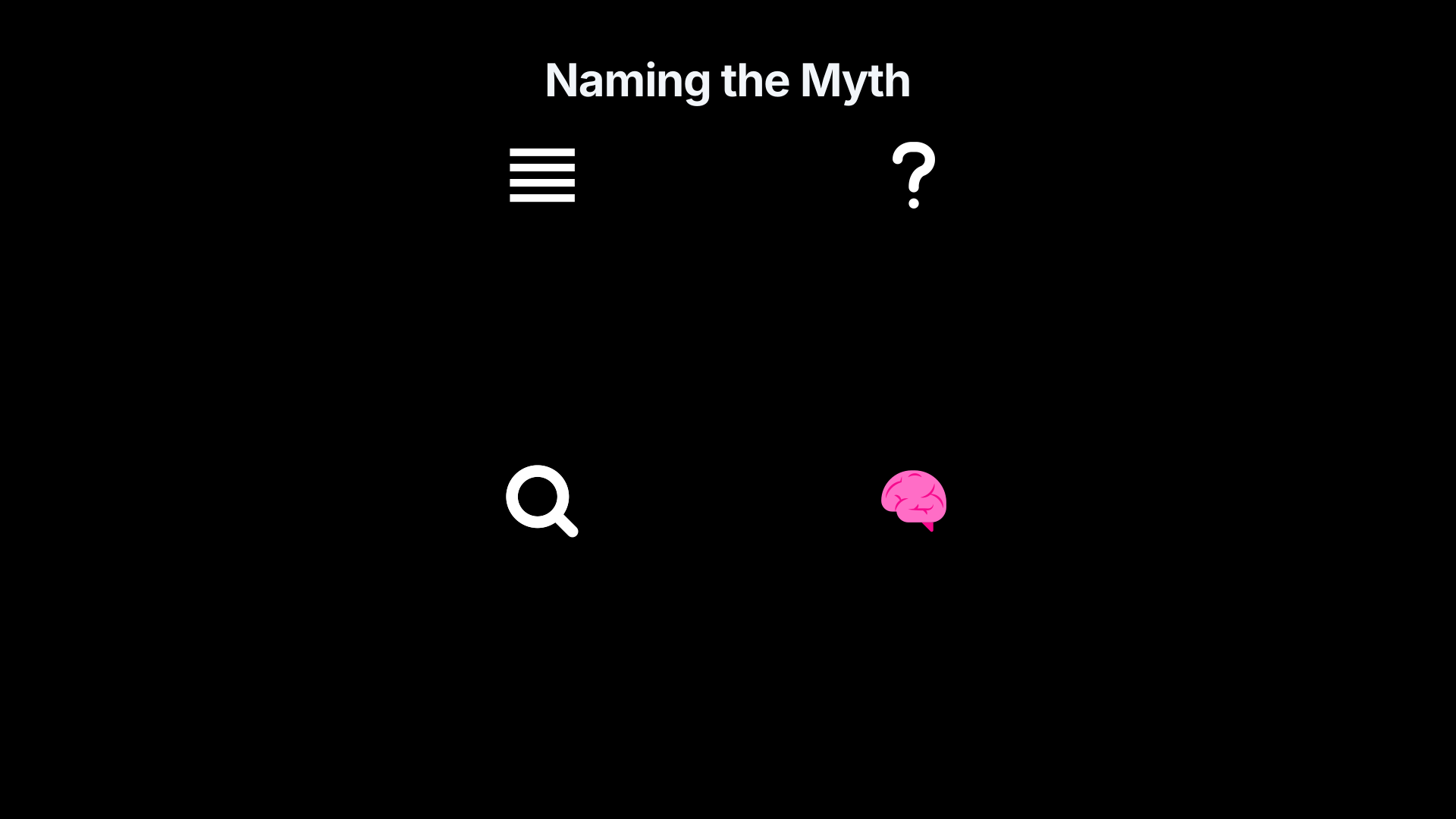
One common approach is the “fact–myth–fallacy” or “truth sandwich” model:
- State the accurate information first.
- Identify the myth.
- Explain why the myth is wrong.
- Reinforce the accurate information again.
The purpose is not to hide the myth. It is to make the truth the first and last thing readers encounter. Communication researchers and debunking practitioners have promoted this structure because it reduces the chance that the myth becomes the dominant memory trace.[KSJ Handbook]ksjhandbook.orgKSJ HandbookStructuring Your ArgumentThe “fact-myth-fallacy” structure when debunking a claim. This involves presenting the correct infor…[Center for Climate Change Communication]climatechangecommunication.orgCenter for Climate Change CommunicationDebunking HandbookThus, while repeating misinformation generally increases familiarity and truth r…
For example:
Truth-led version
Human activity is warming the climate. Some commentators claim current warming is entirely natural, but measurements show greenhouse gas emissions are driving the long-term trend. Human activity remains the primary cause of recent warming.
Compared with:
Myth-led version
Climate change is natural. This claim is false because greenhouse gas emissions are driving warming.
Both contain the correction. The difference is which idea occupies the most prominent positions.
Recent experiments suggest that the precise ordering of myth and fact may matter less than once believed, provided the correction clearly contains the necessary elements. Yet even when correction formats produce similar belief outcomes, truth-led framing still helps communicators emphasise what they want audiences to remember.[PMC]pmc.ncbi.nlm.nih.govPMCCorrection format has a limited role when debunkingby B Swire-Thompson · 2021 · Cited by 79 — The current paper investigated how altering the format of corrections influences people's s…
Naming the myth without branding it
A useful rule is that myths should be identifiable but not marketable.
Some misinformation gains power because it is short, vivid and easy to repeat. Communicators can accidentally strengthen that advantage by turning the false claim into a memorable slogan.
Consider the difference between these approaches:
- Myth-centred: “The great election theft theory”
- Truth-centred: “Election audits found no evidence of widespread vote manipulation”
The first phrase packages the myth into a memorable label. The second packages the correction.
Similarly, debunkers often face choices about whether to quote a misleading phrase verbatim. If a slogan is already widely known, naming it directly may be necessary. If it is obscure, introducing it to a new audience can be counterproductive. Researchers have noted that corrections can create familiarity problems when they expose people to misinformation they had never encountered before.[Springer Link]link.springer.comHowever, Ecker et al.Read more…
This creates a practical distinction:
- Correct myths that audiences are already likely to know.
- Be cautious about publicising fringe claims solely for the purpose of debunking them.
The goal is not silence. It is proportionality.
What readers are most likely to remember
Memory research helps explain why naming decisions matter.
People do not always retain the full structure of a correction. Over time they may forget where information came from, who said it or whether it appeared in a debunk. What often remains is a simplified memory of the claim itself. This is one reason familiarity effects are so persistent.[Wikipedia]WikipediaIllusory truth effectIllusory truth effect[Journal of Cognition]journalofcognition.orgAll explanations of the illusory truth effect, including…Read more…
Because of this, effective debunking asks a simple question:
If readers remember only one sentence a week later, which sentence should it be?
That question changes how corrections are written.
Instead of leading with:
False claim: renewable energy causes blackouts.
A communicator might lead with:
Power-grid failures have many causes, and renewable energy is not the primary driver of major outages.
The correction still addresses the myth. But the remembered message is more likely to be the accurate explanation.
This approach also aligns with a broader lesson from misinformation research. The strongest defence against falsehoods is often not endless repetition of the myth followed by correction. It is repeated exposure to accurate, clear and memorable information. Familiarity works for truth as well as falsehood.[Center for Climate Change Communication]climatechangecommunication.orgCenter for Climate Change CommunicationDebunking HandbookThus, while repeating misinformation generally increases familiarity and truth r…[The Guardian]theguardian.comThe research, published in Plos One, was led by Mary Jiang from the Australian National University and highlighted the "illusory truth…
A practical naming checklist
For journalists, educators, fact-checkers and public agencies, a few implementation rules emerge from the evidence:
- Lead with the fact. Make the truthful claim the headline, opening sentence and concluding takeaway.
- Name the myth clearly when needed. Readers must know what is being corrected.
- Avoid sloganising the falsehood. Do not give misleading claims a catchy new label.
- Explain the error. Corrections work better when they show why a claim is wrong rather than merely declaring it false.
- Repeat the truth more than the myth. Familiarity can strengthen accurate information too.
- Be careful with obscure claims. Debunking should not become a publicity campaign for misinformation that few people had previously encountered.
- Design for memory. Assume readers may forget details and remember only the central message.
The evidence on backfire effects has made communicators less fearful of naming myths directly. The remaining challenge is not whether to mention false claims, but how to ensure that the correction—not the myth—becomes the lasting memory. Springer Link[PMC]pmc.ncbi.nlm.nih.govPMCCorrection format has a limited role when debunkingby B Swire-Thompson · 2021 · Cited by 79 — The current paper investigated how altering the format of corrections influences people's s…[PMC]pmc.ncbi.nlm.nih.govPMCCorrection format has a limited role when debunkingby B Swire-Thompson · 2021 · Cited by 79 — The current paper investigated how altering the format of corrections influences people's s…
Amazon book picks
Further Reading
Books and field guides related to How Much Should a Debunk Repeat the Myth?. Use these as the next step if you want deeper reading beyond the article.
Thinking, Fast and Slow
Provides cognitive foundations for familiarity, repetition, and belief formation.

eBay marketplace picks
Marketplace Samples
Example marketplace items related to this page. Use the search link to explore similar finds on eBay.




Endnotes
1.
Source: sciencedirect.com
Link:https://www.sciencedirect.com/science/article/abs/pii/S2352250X23001811
Source snippet
The illusory truth effect: A review of how repetition...by J Udry · 2024 · Cited by 116 — Repetition increases belief in in...
2.
Source: pmc.ncbi.nlm.nih.gov
Link:https://pmc.ncbi.nlm.nih.gov/articles/PMC9283209/
Source snippet
The backfire effect after correcting misinformation is strongly...by B Swire-Thompson · 2022 · Cited by 111 — The backfire effect is...
3.
Source: researchgate.net
Title: Research Gate Reminders and Repetition of Misinformation: Helping or
Link:https://www.researchgate.net/publication/313796069_Reminders_and_Repetition_of_Misinformation_Helping_or_Hindering_Its_Retraction
Source snippet
Reminders and Repetition of Misinformation: Helping or...April 1, 2017 — Retractions that explicitly repeated the misinforma...
Published: April 1, 2017
4.
Source: link.springer.com
Link:https://link.springer.com/article/10.1186/s41235-020-00241-6
Source snippet
However, Ecker et al.Read more...
5.
Source: pmc.ncbi.nlm.nih.gov
Title: PMCCorrection format has a limited role when debunking
Link:https://pmc.ncbi.nlm.nih.gov/articles/PMC8715407/
Source snippet
by B Swire-Thompson · 2021 · Cited by 79 — The current paper investigated how altering the format of corrections influences people's s...
6.
Source: Wikipedia
Title: Illusory truth effect
Link:https://en.wikipedia.org/wiki/Illusory_truth_effect
7.
Source: pmc.ncbi.nlm.nih.gov
Link:https://pmc.ncbi.nlm.nih.gov/articles/PMC11750381/
Source snippet
implications: incidental exposure to ideas can induce...by J Mikell · 2025 · Cited by 1 — Under many accounts of the illusory truth effe...
8.
Source: sciencedirect.com
Title: ScienceDirect Familiarity backfire effects?
Link:https://www.sciencedirect.com/science/article/pii/S0167811626000261
Source snippet
Disentangling the competing...by IN Nibat · 2026 — Repetition reliably increases belief in misinformation (illusory truth effect), while...
9.
Source: sciencedirect.com
Link:https://www.sciencedirect.com/science/article/pii/S0010027723000550
Source snippet
The illusory truth effect leads to the spread of misinformationby V Vellani · 2023 · Cited by 118 — Importantly, the relatio...
10.
Source: pmc.ncbi.nlm.nih.gov
Link:https://pmc.ncbi.nlm.nih.gov/articles/PMC12377696/
Source snippet
The truth sandwich format does not enhance the correction of...by B Swire-Thompson · 2025 · Cited by 2 — This study examined whether...
11.
Source: sciencedirect.com
Link:https://www.sciencedirect.com/science/article/pii/S0010027724000775
Source snippet
This truth effect has been widely researched and is relevant for topics...R...
12.
Source: link.springer.com
Link:https://link.springer.com/article/10.1186/s41235-021-00301-5
Source snippet
This finding is known as the illusory truth effect, and it is...
13.
Source: ksjhandbook.org
Link:https://ksjhandbook.org/misinformation/structuring-your-argument/
Source snippet
KSJ HandbookStructuring Your ArgumentThe “fact-myth-fallacy” structure when debunking a claim. This involves presenting the correct infor...
14.
Source: climatechangecommunication.org
Link:https://www.climatechangecommunication.org/wp-content/uploads/2023/09/DebunkingHandbook2020.pdf
Source snippet
Center for Climate Change CommunicationDebunking HandbookThus, while repeating misinformation generally increases familiarity and truth r...
15.
Source: journalofcognition.org
Link:https://journalofcognition.org/articles/10.5334/joc.161
Source snippet
All explanations of the illusory truth effect, including...Read more...
16.
Source: firstdraftnews.org
Link:https://firstdraftnews.org/articles/the-psychology-of-misinformation-why-its-so-hard-to-correct/
Source snippet
First DraftThe psychology of misinformation: Why it's so hard to correct14 Jul 2020 — The illusory truth effect occurs when familiarity m...
17.
Source: theguardian.com
Link:https://www.theguardian.com/australia-news/article/2024/aug/08/repeating-climate-denial-claims-makes-them-seem-more-credible-australian-led-study-finds
Source snippet
The research, published in *Plos One*, was led by Mary Jiang from the Australian National University and highlighted the "illusory truth...
18.
Source: thedecisionlab.com
Title: The Decision Lab Illusory truth effect
Link:https://thedecisionlab.com/biases/illusory-truth-effect
Source snippet
Illusory truth effect - The Decision...Illusory Truth Effect is the positive feeling when we hear information that we believe to be true...
19.
Source: ebsco.com
Link:https://www.ebsco.com/research-starters/psychology/illusory-truth-effect
Source snippet
Illusory truth effect | Psychology | Research StartersThe illusory truth effect is a cognitive phenomenon where repeated exposure to fals...
Additional References
20.
Source: psychologytoday.com
Link:https://www.psychologytoday.com/gb/basics/illusory-truth-effect
Source snippet
Illusory Truth EffectThe illusory truth effect is the tendency for any statement that is repeated frequently—whether it is factually true...
21.
Source: fs.blog
Link:https://fs.blog/illusory-truth-effect/
Source snippet
The Illusory Truth EffectThe effect is so powerful that repetition can persuade us to believe information we know is false in the first p...
22.
Source: arno.uvt.nl
Link:https://arno.uvt.nl/show.cgi?fid=161900
Source snippet
Is The Effect of the Illusory Truth Effect on Conspiracy...However, results indicated that the truth judgment of conspiracy theories was...
23.
Source: facebook.com
Link:https://www.facebook.com/AmericanPsychologicalAssociation/posts/you-keep-seeing-the-same-claim-made-over-and-over-onlineso-it-must-be-true-right/1290086699819665/
24.
Source: aclanthology.org
Link:https://aclanthology.org/anthology-files/anthology-files/pdf/climatenlp/2024.climatenlp-1.4.pdf
Source snippet
e mis- information once, as one repetition of the myth is beneficial to belief updating (Ecker et...Read mor...
25.
Source: commonslibrary.org
Title: from elephants to sandwiches countering false information
Link:https://commonslibrary.org/from-elephants-to-sandwiches-countering-false-information/
Source snippet
From Elephants to Sandwiches: Countering False InformationDec 11, 2024 — Learn about countering false information with tips to help you a...
26.
Source: westerntc.libguides.com
Link:https://westerntc.libguides.com/c.php?g=1009191&p=10388001
Source snippet
a Truth Sandwich - [Fake News]({{ 'fake-news/' | relative_url }}) and Fake FactsApr 13, 2026 — A truth sandwich ensures the facts are the first thing people read or hear...
27.
Source: pubmed.ncbi.nlm.nih.gov
Link:https://pubmed.ncbi.nlm.nih.gov/38113667/
Source snippet
The illusory truth effect: A review of how repetition...by J Udry · 2024 · Cited by 131 — Repetition even increases belief in clai...
28.
Source: ltrr.arizona.edu
Link:https://www.ltrr.arizona.edu/~katie/kt/natsgc/Debunking_Handbook.pdf
Source snippet
Debunking Handbookby S Lewandowsky — To debunk a myth, you often have to mention it - otherwise, how will people know what you're talking...
29.
Source: arxiv.org
Link:https://arxiv.org/html/2407.05599v1
Source snippet
Generative Debunking of Climate MisinformationJul 8, 2024 — Psychological research recommends that debunkings should adopt the fact-myth...
Topic Tree