Within Rumour Gaps
The Fire Rumour That Still Explains Too Much
The warehouse fire scenario shows how people can remember a correction but still rely on a disproved cause when explaining events.
On this page
- Why the fire example became useful
- What people remember after correction
- What the scenario reveals about replacement explanations
Page outline Jump by section
Introduction
One of the most influential demonstrations in misinformation research involves a fictional warehouse fire. The scenario became famous not because of the fire itself, but because it revealed a surprising pattern: people could remember that a rumour had been corrected and still continue to use that rumour when explaining what happened. The experiment provided some of the clearest evidence for the “continued influence effect”—the tendency for discredited information to keep shaping reasoning after retraction.[ScienceDirect]sciencedirect.comA replication study of Johnson and Seifert's (1994)…by V Laurent · 2023 · Cited by 5 — The term “Continued Influence Effe…
 The warehouse-fire studies are especially important within research on myths and misconceptions because they show that corrections do not fail simply because people forget them. In many cases, participants accurately recalled the correction. The problem was that the original rumour had supplied a causal story, and removing that story left an explanatory gap.[ltrr.arizona.edu]ltrr.arizona.eduThe Debunking HandbookNovember 25, 2011 — by S Lewandowsky — In the warehouse fire experiment, when an alternative explanation involving lighter fluid and acce…
Why the fire example became useful
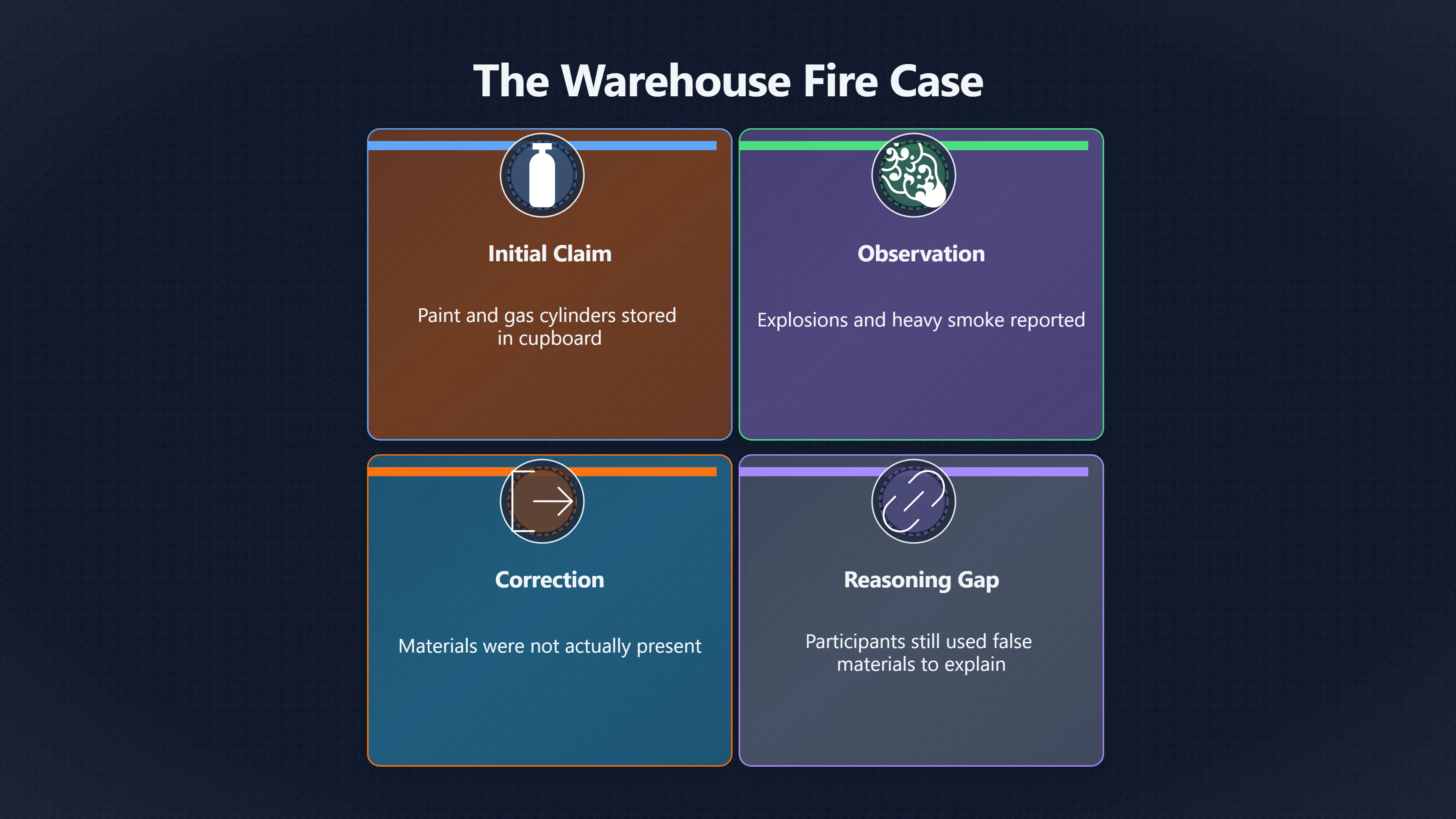
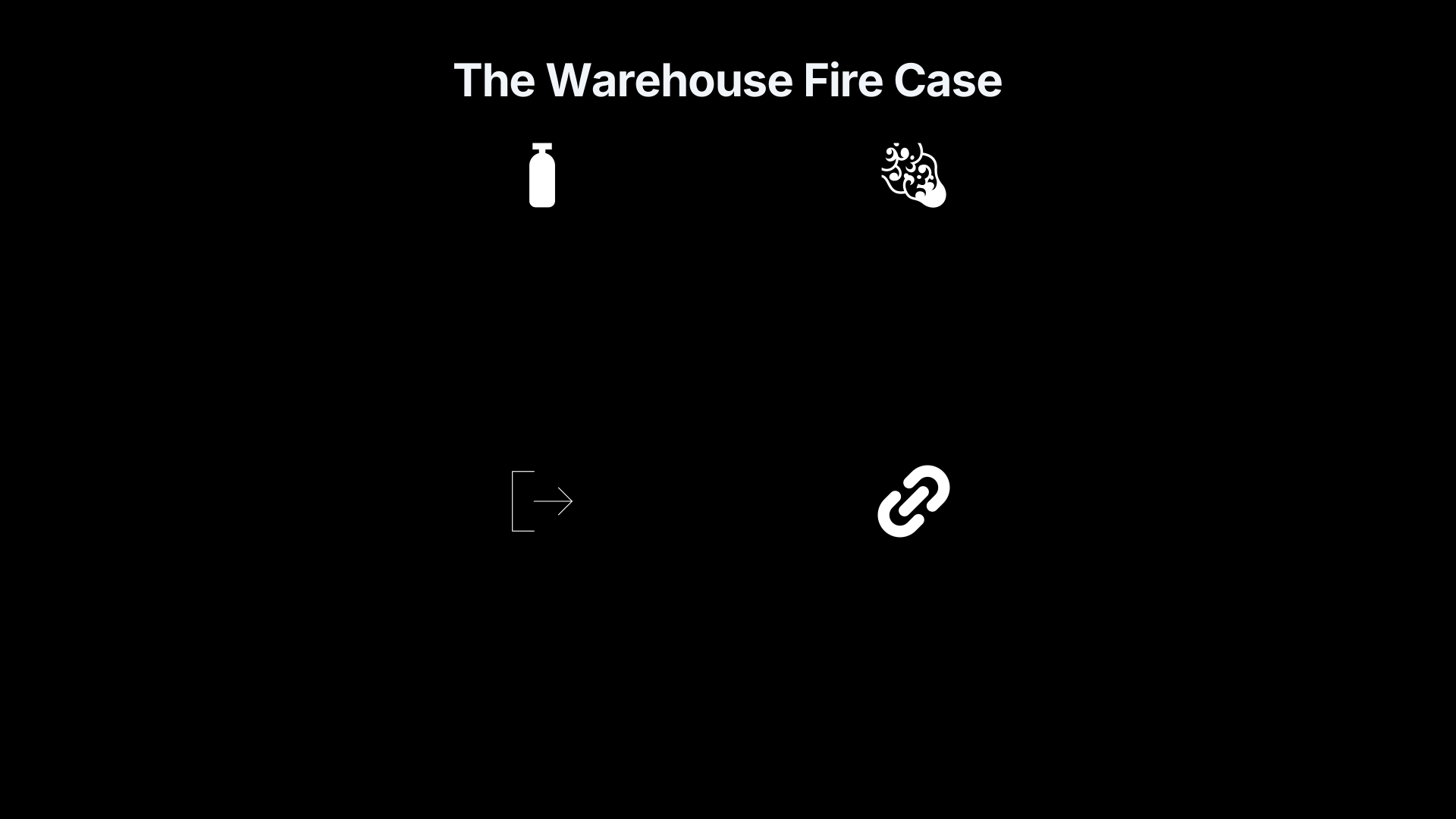
The classic scenario, developed by researchers Hollyn Johnson and Colleen Seifert in the 1990s, presented participants with a sequence of news-style updates about a warehouse fire. Early reports suggested that oil paint and gas cylinders had been stored in a cupboard near the fire. Given later reports of explosions and heavy smoke, these materials appeared to provide a plausible cause. Participants naturally incorporated that information into their understanding of the event. ScienceDirect[2ltrr.arizona.edu]ltrr.arizona.eduThe Debunking HandbookNovember 25, 2011 — by S Lewandowsky — In the warehouse fire experiment, when an alternative explanation involving lighter fluid and acce…
Later in the story, however, participants were told that the earlier information was wrong: the cupboard had not contained paint or gas cylinders after all. The critical question came afterwards. When asked to explain features of the fire—such as the explosions or thick smoke—many participants continued to refer to the supposedly retracted materials.[ltrr.arizona.edu]ltrr.arizona.eduThe Debunking HandbookNovember 25, 2011 — by S Lewandowsky — In the warehouse fire experiment, when an alternative explanation involving lighter fluid and acce…[Ecker Memory & Cognition Lab]emc-lab.orgEcker Memory & Cognition LabMisinformation and its Correctionby B Swire · Cited by 139 — For example, if people are told that it was not…
Researchers valued the scenario because it isolated a common real-world problem. The misinformation was not emotionally charged, politically divisive or personally important. Yet it still persisted. That made the warehouse fire an unusually clean test of how corrections interact with human reasoning.[ScienceDirect]sciencedirect.comA replication study of Johnson and Seifert's (1994)…by V Laurent · 2023 · Cited by 5 — The term “Continued Influence Effe…
A 2023 replication study again found support for the original finding, showing that participants exposed to corrected false information continued to draw misinformation-related inferences more often than control participants who had never encountered the false information in the first place.[ScienceDirect]sciencedirect.comA replication study of Johnson and Seifert's (1994)…by V Laurent · 2023 · Cited by 5 — The term “Continued Influence Effe…
What people remember after correction
A common misconception is that people rely on rumours because they forget the correction. The warehouse-fire research challenged that assumption.
Participants often demonstrated that they remembered the correction perfectly well. They could state that the paint and gas cylinders were not present and could acknowledge that the original report had been withdrawn. Nevertheless, when asked to reason about the fire, they still used the withdrawn information as part of their explanations.[Ecker Memory & Cognition Lab]emc-lab.orgEcker Memory & Cognition LabMisinformation and its Correctionby B Swire · Cited by 139 — For example, if people are told that it was not…[2ltrr.arizona.edu]ltrr.arizona.eduThe Debunking HandbookNovember 25, 2011 — by S Lewandowsky — In the warehouse fire experiment, when an alternative explanation involving lighter fluid and acce…
This distinction matters. The experiments suggest that misinformation can survive in reasoning even when it does not survive as an accepted fact. People may simultaneously hold two pieces of information:
- The original claim was false.
- The original claim still helps explain the event.
When the mind lacks a replacement explanation, the disproved rumour remains available as a causal link in the story. Researchers describe this as continued reliance on misinformation rather than simple memory failure.[PMC]pmc.ncbi.nlm.nih.govPMCThe role of discomfort in the continued influence effectby MW Susmann · 2021 · Cited by 90 — Research examining the continued influence effect (CIE) of misinformation has reliably found that…
Subsequent studies have repeatedly found similar patterns. Even explicit warnings that information may be misleading reduce reliance on misinformation only partially. People can recognise a correction and still draw inferences based on the earlier claim.[Ecker Memory & Cognition Lab]emc-lab.orgEcker Memory & Cognition LabMisinformation and its Correctionby B Swire · Cited by 139 — For example, if people are told that it was not…
Why a bare retraction struggles
The warehouse-fire case became a textbook example because the correction removed an explanation without replacing it.
The initial report linked several observations together:
- Paint and gas cylinders were allegedly present.
- Explosions occurred.
- Large amounts of smoke were reported.
Once the materials were removed from the story, the observations still needed explaining. The correction answered the question “What was not there?” but did not answer “What caused the fire?” or “Why was there so much smoke?”[ltrr.arizona.edu]ltrr.arizona.eduThe Debunking HandbookNovember 25, 2011 — by S Lewandowsky — In the warehouse fire experiment, when an alternative explanation involving lighter fluid and acce…
Research on mental models argues that people prefer a coherent account of events, even an imperfect one, over a fragmented account with missing causal links. The warehouse-fire rumour provided coherence, which helps explain its persistence.[PMC]pmc.ncbi.nlm.nih.govPMCExploring factors that mitigate the continued influenceby IP Kan · 2021 · Cited by 27 — For example, Johnson and Seifert (1994) reported that individuals who received both a correction stat…
What the scenario reveals about replacement explanations
The most important finding from later versions of the warehouse-fire experiments was that corrections become more effective when they provide an alternative explanation.
Instead of merely stating that paint and gas cylinders were absent, some versions supplied another cause, such as evidence pointing towards arson or the presence of another accelerant. Under those conditions, participants were much less likely to rely on the original misinformation when answering questions about the fire. PMC[Skeptical Science]skepticalscience.comSkeptical ScienceThe Debunking Handbook Part 5: Filling the gap with an…25 Nov 2011 — In the warehouse fire experiment, when an altern…[3ltrr.arizona.edu]ltrr.arizona.eduThe Debunking HandbookNovember 25, 2011 — by S Lewandowsky — In the warehouse fire experiment, when an alternative explanation involving lighter fluid and acce…
The result supports a central idea in misinformation research: successful correction often requires replacing a story, not just deleting a fact. An alternative explanation gives people a new way to connect the evidence and rebuild their mental model of events. PMC[Ecker Memory & Cognition Lab]emc-lab.orgEcker Memory & Cognition LabMisinformation and its Correctionby B Swire · Cited by 139 — For example, if people are told that it was not…
Later work explored whether explaining where misinformation came from might help even further. Researchers tested corrections that attributed the false warehouse-fire reports to mistakes or deliberate deception. The results were mixed. Explaining the origin of the misinformation did not consistently outperform a straightforward correction, suggesting that what matters most is often not why the rumour appeared but whether people receive a convincing replacement explanation for the event itself.[City Research Online]openaccess.city.ac.ukCity Research OnlineDoes explaining the origins of misinformation improve the…September 14, 2022 — by S Connor Desai · 2023 · Cited by…
Why the fire scenario still matters
The warehouse-fire story remains one of the most cited demonstrations of how myths and misconceptions endure. Its lasting value lies in showing that correction is not merely a memory problem. People can know a rumour is false and still use it as part of their reasoning because it continues to supply an explanation. ScienceDirect[Ecker Memory & Cognition Lab]emc-lab.orgEcker Memory & Cognition LabMisinformation and its Correctionby B Swire · Cited by 139 — For example, if people are told that it was not…
For researchers, the fire scenario provides a controlled way to study how misinformation survives. For communicators, journalists and fact-checkers, it highlights a practical lesson: when a correction removes a false cause, it is often more effective to offer a plausible replacement than to stop at a denial. The warehouse-fire experiments demonstrated that the battle against misconceptions is frequently a battle between competing explanations rather than a simple contest between truth and falsehood.[ltrr.arizona.edu]ltrr.arizona.eduThe Debunking HandbookNovember 25, 2011 — by S Lewandowsky — In the warehouse fire experiment, when an alternative explanation involving lighter fluid and acce…[Ecker Memory & Cognition Lab]emc-lab.orgEcker Memory & Cognition LabMisinformation and its Correctionby B Swire · Cited by 139 — For example, if people are told that it was not…
Amazon book picks
Further Reading
Books and field guides related to The Fire Rumour That Still Explains Too Much. Use these as the next step if you want deeper reading beyond the article.
Thinking, Fast and Slow
Provides cognitive foundations for understanding persistent misconceptions.
The Invisible Gorilla
Illustrates how human reasoning and attention can produce lasting errors.
Mistakes Were Made (but Not by Me) Third Edition
Explains why people continue defending beliefs after contradictory evidence appears.

eBay marketplace picks
Marketplace Samples
Example marketplace items related to this page. Use the search link to explore similar finds on eBay.

Endnotes
1.
Source: sciencedirect.com
Link:https://www.sciencedirect.com/science/article/pii/S0001691823002706
Source snippet
A replication study of Johnson and Seifert's (1994)...by V Laurent · 2023 · Cited by 5 — The term “Continued Influence Effe...
2.
Source: ltrr.arizona.edu
Title: The [Debunking]({{ ‘debunking/’ | relative_url }}) Handbook
Link:https://www.ltrr.arizona.edu/~katie/kt/natsgc/Debunking_Handbook.pdf
Source snippet
November 25, 2011 — by S Lewandowsky — In the warehouse fire experiment, when an alternative explanation involving lighter fluid and acce...
Published: November 25, 2011
3.
Source: pmc.ncbi.nlm.nih.gov
Title: PMCThe role of discomfort in the continued influence effect
Link:https://pmc.ncbi.nlm.nih.gov/articles/PMC8447889/
Source snippet
by MW Susmann · 2021 · Cited by 90 — Research examining the continued influence effect (CIE) of misinformation has reliably found that...
4.
Source: sciencedirect.com
Link:https://www.sciencedirect.com/science/article/abs/pii/S0010027720302729
Source snippet
The rational continued influence of misinformationby SAC Desai · 2020 · Cited by 71 — Studies on the 'Continued Influence Effect' (CIE) s...
5.
Source: pmc.ncbi.nlm.nih.gov
Title: PMCExploring factors that mitigate the continued influence
Link:https://pmc.ncbi.nlm.nih.gov/articles/PMC8627545/
Source snippet
by IP Kan · 2021 · Cited by 27 — For example, Johnson and Seifert (1994) reported that individuals who received both a correction stat...
6.
Source: pmc.ncbi.nlm.nih.gov
Title: PMCDoes explaining the origins of misinformation improve
Link:https://pmc.ncbi.nlm.nih.gov/articles/PMC9487849/
Source snippet
by SC Desai · 2022 · Cited by 25 — Experiment 2 explored the effectiveness of corrections that explain the origins of the misinformati...
7.
Source: research-information.bris.ac.uk
Link:https://research-information.bris.ac.uk/files/298647515/NRPSYCHOL_21046_Ecker_figure_proof_v3_correction_UE_1.pdf
Source snippet
bris.ac.ukEcker, UKH, Lewandowsky, S., Cook, J., Schmid, P., Fazio...by UKH Ecker · 2022 · Cited by 1911 — Investigators have inspected...
8.
Source: emc-lab.org
Link:https://www.emc-lab.org/uploads/1/1/3/6/113627673/chapter_swireecker_revised.pdf
9.
Source: emc-lab.org
Title: This occurs
Link:https://www.emc-lab.org/uploads/1/1/3/6/113627673/ecker.2010.mc.pdf
Source snippet
Ecker Memory & Cognition LabExplicit warnings reduce but do not eliminate the continued...August 27, 2017 — by UKH ECKER · 2010 · Cited...
Published: August 27, 2017
10.
Source: skepticalscience.com
Link:https://skepticalscience.com/print.php?n=1139
Source snippet
Skeptical ScienceThe Debunking Handbook Part 5: Filling the gap with an...25 Nov 2011 — In the warehouse fire experiment, when an altern...
11.
Source: openaccess.city.ac.uk
Link:https://openaccess.city.ac.uk/id/eprint/28822/1/ConnorDesai%26Reimers2022.pdf
Source snippet
City Research OnlineDoes explaining the origins of misinformation improve the...September 14, 2022 — by S Connor Desai · 2023 · Cited by...
Published: September 14, 2022
Additional References
12.
Source: researchgate.net
Link:https://www.researchgate.net/publication/375867267_I_know_It%27s_false_but_I_keep_thinking_as_if_it_were_true_A_replication_study_of_Johnson_and_Seifert%27s_1994_continued_influence_effect
Source snippet
A replication study of Johnson and Seifert's (1994)...26 Nov 2023 — Researchers Johnson and Seifert (1994, Experiment 1A) penned a semin...
13.
Source: researchgate.net
Link:https://www.researchgate.net/profile/Saoirse-Connor-Desai/publication/325106381_Some_misinformation_is_more_easily_countered_An_experiment_on_the_continued_influence_effect/links/5af70b254585157136ce117d/Some-misinformation-is-more-easily-countered-An-experiment-on-the-continued-influence-effect.pdf
Source snippet
An experiment on the continued influence effectConversely, in the warehouse fire narrative implied misinformation was more resistant to c...
14.
Source: everydayconcepts.io
Link:https://everydayconcepts.io/continued-influence-effect
Source snippet
Continued Influence EffectAmerican psychologists Hollyn Johnson and Colleen Seifert at the University of Michigan named and formalized th...
15.
Source: climatechangecommunication.org
Link:https://www.climatechangecommunication.org/wp-content/uploads/2023/09/DebunkingHandbook2020.pdf
Source snippet
Debunking HandbookBackfire Effect: A [backfire]({{ 'backfire/' | relative_url }}) effect is where a correction inadvertently increases belief in, or reliance on, misinformat...
16.
Source: scispace.com
Link:https://scispace.com/pdf/the-continued-influence-of-misinformation-in-memory-what-4tijzg1jh2.pdf
Source snippet
The continued influence of misinformation in memoryYet despite these factors, the misinformation continues to influence later judgments a...
17.
Source: escholarship.org
Title: An experiment on the continued influence effect
Link:https://escholarship.org/content/qt8sb9k1kb/qt8sb9k1kb_noSplash_086317268511e6a8f7bc117f0c34ba68.pdf?t=ssy869
Source snippet
Abstract. Information initially presented as a likely cause of an event but turns out to be incorrect can affect people's reasoning...
18.
Source: escholarship.org
Title: But where’s the evidence?
Link:https://escholarship.org/content/qt90q1k1r7/qt90q1k1r7_noSplash_89e39d5052c4fb3421a8456938be2e80.pdf?t=sgijj7
Source snippet
The effect of explanatory...In the warehouse fire example, an individual might infer that a fire started by an electrical short circuit...
19.
Source: classes.cs.uchicago.edu
Link:https://www.classes.cs.uchicago.edu/archive/2020/spring/33231-1/readings/Ecker2010_Article_ExplicitWarningsReduceButDoNot.pdf
Source snippet
Explicit warnings reduce but do not eliminate the continued...by UKH ECKER · 2010 · Cited by 741 — Misinformation continues to affect be...
20.
Source: link.springer.com
Link:https://link.springer.com/article/10.1186/s41235-021-00335-9
Source snippet
factors that mitigate the continued influence of...by IP Kan · 2021 · Cited by 27 — The term “continued influence effect” (CIE) refers t...
21.
Source: scholarworks.boisestate.edu
Link:https://scholarworks.boisestate.edu/cgi/viewcontent.cgi?article=1058&context=marketing_facpubs
Source snippet
How Stories in Memory Perpetuate the Continued Influence of...by A Hamby · 2020 · Cited by 65 — In Johnson and Seifert's (1994) work, pa...
Topic Tree