Within Debunking
Why a better story beats a bare denial
People are more likely to drop a misconception when the correction gives them a clearer story to remember instead.
On this page
- Why false claims survive as explanations
- What a replacement explanation must answer
- Examples that swap a myth for a clearer cause
Page outline Jump by section
Introduction
People often imagine that correcting misinformation is mainly about proving a claim false. Research on misinformation suggests something more complicated: many false beliefs survive because they do explanatory work. They provide a story about why an event happened, who caused a problem, what risk exists, or whom to blame. When a correction removes that story without replacing it, people can be left with a gap in their understanding. A simple denial may change what they say they believe while leaving the original explanation available when they later try to make sense of events. This is one reason misinformation can continue to influence reasoning even after it has been corrected.[PubMed]pubmed.ncbi.nlm.nih.govAuthors. Stephan Lewandowsky, Ullrich K H Ecker, Colleen M SeifertMisinformation and Its Correction: Continued Influence and…by S Lewandowsky · 2012 · Cited by 4636 — Misinformation and Its Corr…
 The fact-warning-explanation approach is built around this problem. Instead of stopping at “that is false”, it gives readers a replacement explanation that answers the same question the myth appeared to answer. The goal is not merely to remove misinformation from memory. It is to leave behind a better, more coherent account that people can recall later. Researchers studying the continued influence effect repeatedly find that corrections become more effective when they supply an alternative explanation rather than a bare retraction.[Laboratory of Tree-Ring Research]ltrr.arizona.eduLaboratory of Tree-Ring ResearchThe Debunking HandbookNovember 25, 2011 — by S Lewandowsky — The most effective way to reduce the effect…[Association for Psychological Science]psychologicalscience.orgAssociation for Psychological ScienceMisinformation and Its Correction: Continued Influence and…Sep 18, 2012 — The authors suggest rep…
Why false claims survive as explanations
One of the most important findings in misinformation research is that people can remember a correction and still rely on the false information. Psychologists call this the continued influence effect. In experiments, participants are often told that an earlier claim was mistaken or withdrawn, yet they continue to use it when answering questions or drawing conclusions.[PubMed]pubmed.ncbi.nlm.nih.govAuthors. Stephan Lewandowsky, Ullrich K H Ecker, Colleen M SeifertMisinformation and Its Correction: Continued Influence and…by S Lewandowsky · 2012 · Cited by 4636 — Misinformation and Its Corr…[ScienceDirect]sciencedirect.comIn a dynamic world, information in memory is frequently outdated, corrected, or replaced.Read more…
A classic example involves reports about a warehouse fire. Early information suggests that flammable materials such as paint and gas cylinders caused the blaze. Later, participants are told that this information was incorrect. Even after seeing the correction, many people continue referring to the supposedly retracted materials when explaining how the fire spread. The original claim persists because it supplied a causal explanation for the event. Once that explanation is removed, people still need an answer to the question, “What caused the fire?”[Laboratory of Tree-Ring Research]ltrr.arizona.eduLaboratory of Tree-Ring ResearchThe Debunking HandbookNovember 25, 2011 — by S Lewandowsky — The most effective way to reduce the effect…[ScienceDirect]sciencedirect.comA replication study of Johnson and Seifert's (1994)…by V Laurent · 2023 · Cited by 5 — The term “Continued Influence Effe…
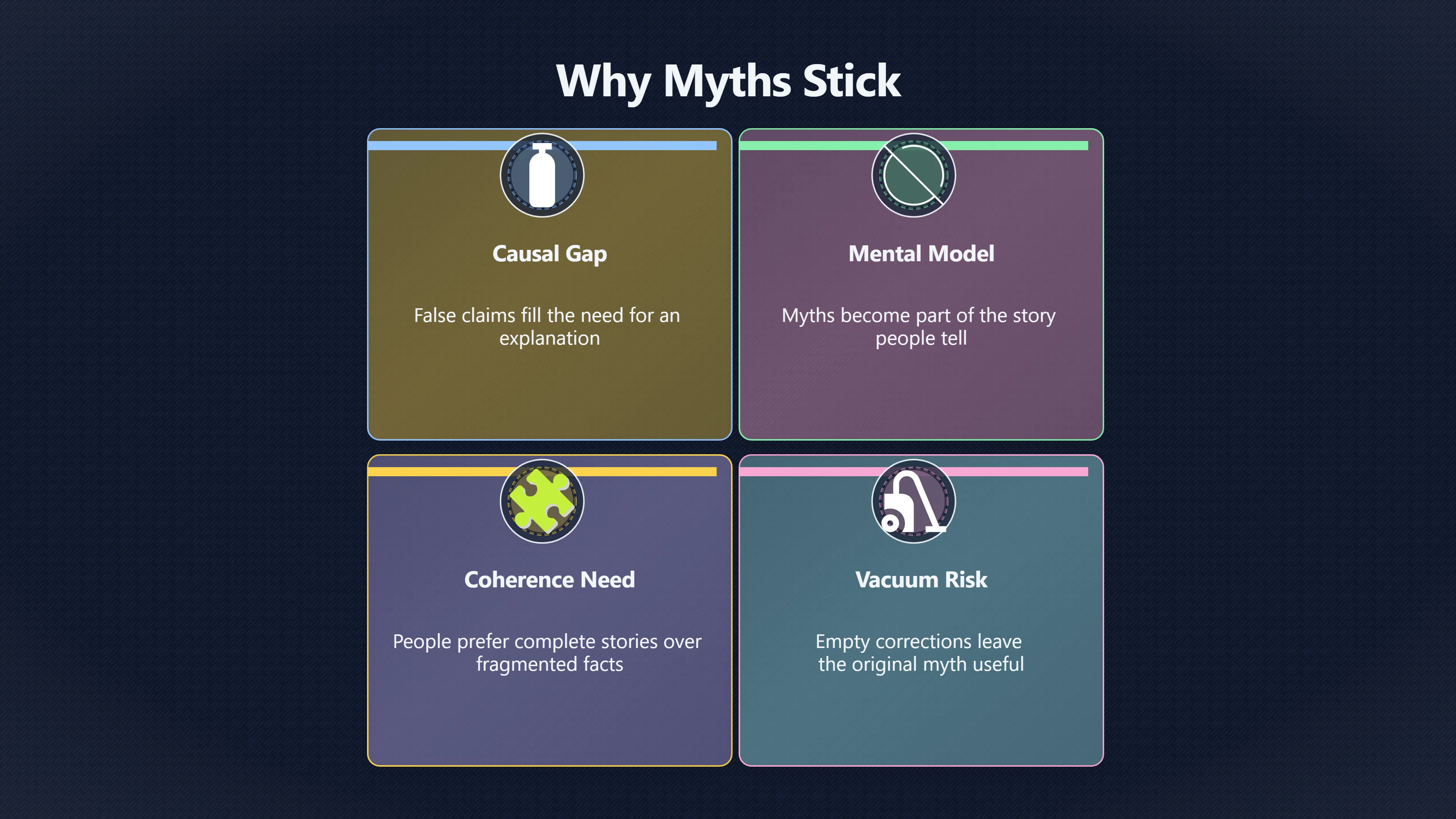
This helps explain why myths can be surprisingly resilient. They are not stored only as isolated facts. They become part of a mental model. A rumour about election fraud explains an unexpected result. A health myth explains a frightening symptom. A conspiracy theory explains uncertainty by assigning hidden motives and actors. If a correction simply says “that did not happen”, the underlying question remains unresolved.
Researchers have argued that people prefer coherent explanations over fragmented information. A correction that destroys coherence can therefore struggle against a false story that still feels complete. Alternative explanations help because they restore coherence rather than merely removing it.[Brown Climate Social Science Network]cssn.orgDB2020paper 1Corrections are more effective if in addition to providing a simple retraction (“not true”), they propose a causal alternative, and gener…
What a replacement explanation must answer
Not every alternative explanation works. Replacing a myth requires more than attaching a true fact to the end of a correction.
The replacement has to answer the same basic question that made the myth attractive in the first place. If the false claim appears to explain a cause, the correction should explain the real cause. If the myth offers a motive, the correction should provide a more accurate account of events. If the myth explains a visible outcome, the correction should explain that outcome in a different way.
Research reviewed in the Debunking Handbook argues that corrections are more effective when they provide a causal alternative and establish a coherent narrative. In other words, the correction should help readers understand not only that the myth is wrong but also what happened instead.[Brown Climate Social Science Network]cssn.orgDB2020paper 1Corrections are more effective if in addition to providing a simple retraction (“not true”), they propose a causal alternative, and gener…
A useful replacement explanation usually does three things:
- It fills the causal gap. It explains why an event occurred without relying on the false claim.
- It preserves relevance. It addresses the same issue that made the misinformation memorable.
- It is simple enough to retrieve later. An explanation that is technically correct but impossible to remember may lose out to a vivid myth.[Association for Psychological Science]psychologicalscience.orgAssociation for Psychological ScienceMisinformation and Its Correction: Continued Influence and…Sep 18, 2012 — The authors suggest rep…[Laboratory of Tree-Ring Research]ltrr.arizona.eduLaboratory of Tree-Ring ResearchThe Debunking HandbookNovember 25, 2011 — by S Lewandowsky — The most effective way to reduce the effect…
This is why effective corrections often feel like short stories rather than verdicts. They connect facts into a structure that can compete with the original narrative.
Why a better story is easier to remember
Memory is not a perfect archive. People frequently reconstruct events from fragments, using whatever information seems to fit together. When misinformation provides a ready-made explanation, it can become part of that reconstruction process. Later, even if people vaguely recall that a correction existed, they may still fall back on the original story because it remains the most available explanation.[ScienceDirect]sciencedirect.comIn a dynamic world, information in memory is frequently outdated, corrected, or replaced.Read more…[Ecker Memory & Cognition Lab]emc-lab.orgEcker Memory & Cognition LabManipulating the strength of misinformation encoding and its…by UKH Ecker · 2011 · Cited by 527 — The pers…
Replacement explanations reduce this problem by giving memory another route to follow.
Imagine hearing a false claim that a public figure appeared intoxicated during a speech. A bare correction says the claim is untrue. A stronger correction explains that the video was edited, slowed down, and circulated with a misleading caption. The second version does more cognitive work. It supplies a mechanism. When people later try to remember what happened, they can retrieve the editing explanation instead of returning to the original accusation.
Researchers have repeatedly found that alternative explanations can reduce reliance on misinformation because they replace rather than merely negate the earlier account. The correction becomes easier to integrate into a coherent mental model of events.[Laboratory of Tree-Ring Research]ltrr.arizona.eduLaboratory of Tree-Ring ResearchThe Debunking HandbookNovember 25, 2011 — by S Lewandowsky — The most effective way to reduce the effect…[Association for Psychological Science]psychologicalscience.orgAssociation for Psychological ScienceMisinformation and Its Correction: Continued Influence and…Sep 18, 2012 — The authors suggest rep…
Importantly, the replacement does not have to be elaborate. In many cases, a brief but plausible explanation is enough. What matters is that readers are not left with a vacuum.
Examples that swap a myth for a clearer cause
The difference between denial and replacement becomes clearer when comparing how corrections are framed.
Health rumours
A weak correction might say:
The claim is false.
A stronger correction says:
The symptom increase was linked to seasonal infection rates and reporting changes, not to the vaccine being discussed.
The second version gives readers an alternative cause. It answers the question that the myth appeared to answer.
Misleading photographs
A weak correction:
This image is not from yesterday’s protest.
A stronger correction:
The image was taken during a demonstration several years earlier and was reposted with a misleading date.
Again, the correction explains why the misleading image exists rather than merely denying the claim attached to it.

Climate misinformation
A weak correction:
Scientists are wrong to say recent warming stopped.
A stronger correction:
Short-term temperature fluctuations caused by ocean cycles can temporarily slow surface warming trends, even while long-term greenhouse-gas-driven warming continues.
The replacement explanation supplies a mechanism that helps readers understand the observation that originally made the myth seem plausible.
In each case, the correction succeeds not because it argues more aggressively but because it leaves the reader with a usable account of events.
The risk of leaving the gap empty
One reason replacement explanations matter is that people dislike unresolved uncertainty. If a correction removes an explanation without offering another, readers may continue searching for answers. In that situation, the original misinformation can remain surprisingly useful because it still provides structure and meaning.
Research on misinformation correction consistently finds that retractions alone are often less effective than corrections that include explanatory detail. The goal is not to overwhelm readers with evidence. It is to prevent the myth from remaining the only complete story available in memory. Brown Climate Social Science Network[PMC]pmc.ncbi.nlm.nih.govPMCExploring factors that mitigate the continued influenceby IP Kan · 2021 · Cited by 27 — The term “continued influence effect” (CIE) refers to the phenomenon that discredited and obsolete in…
This principle also helps explain why some myths return after apparently being debunked. The correction may have succeeded at the moment of reading but failed to provide a memorable alternative. When people later reconstruct the event from memory, the original explanation can re-emerge because it remains more coherent than the correction.
The most durable debunks therefore do more than identify an error. They replace one explanation with another. They give readers a fact to remember, a reason to understand, and a story that remains intact after the myth is gone.[Association for Psychological Science]psychologicalscience.orgAssociation for Psychological ScienceMisinformation and Its Correction: Continued Influence and…Sep 18, 2012 — The authors suggest rep…[Laboratory of Tree-Ring Research]ltrr.arizona.eduLaboratory of Tree-Ring ResearchThe Debunking HandbookNovember 25, 2011 — by S Lewandowsky — The most effective way to reduce the effect…
Amazon book picks
Further Reading
Books and field guides related to Why a better story beats a bare denial. Use these as the next step if you want deeper reading beyond the article.
Foolproof: Why We Fall for Misinformation and How to Build Im...
Directly explains why corrections work better when they replace misleading narratives.
Calling Bullshit
Shows how to replace misleading claims with evidence-based reasoning.
Thinking, Fast and Slow
Explains cognitive processes that make myths and explanations persuasive.
Mistakes Were Made (but Not by Me) Third Edition
Explores why people resist corrections and cling to explanations.
eBay marketplace picks
Marketplace Samples
Example marketplace items related to this page. Use the search link to explore similar finds on eBay.
Endnotes
1.
Source: pmc.ncbi.nlm.nih.gov
Title: PMCExploring factors that mitigate the continued influence
Link:https://pmc.ncbi.nlm.nih.gov/articles/PMC8627545/
Source snippet
by IP Kan · 2021 · Cited by 27 — The term “continued influence effect” (CIE) refers to the phenomenon that discredited and obsolete in...
2.
Source: sciencedirect.com
Link:https://www.sciencedirect.com/science/chapter/bookseries/pii/S0079742102800093
Source snippet
In a dynamic world, information in memory is frequently outdated, corrected, or replaced.Read more...
3.
Source: sciencedirect.com
Link:https://www.sciencedirect.com/science/article/pii/S0001691823002706
Source snippet
A replication study of Johnson and Seifert's (1994)...by V Laurent · 2023 · Cited by 5 — The term “Continued Influence Effe...
4.
Source: sciencedirect.com
Link:https://www.sciencedirect.com/science/article/abs/pii/S0010027720302729
Source snippet
The rational continued influence of misinformationby SAC Desai · 2020 · Cited by 70 — Studies on the 'Continued Influence Effect' (CIE) s...
5.
Source: sciencedirect.com
Link:https://www.sciencedirect.com/science/article/abs/pii/S0749596X15001035
Source snippet
He did it! She did it! No, she did not! Multiple causal...by UKH Ecker · 2015 · Cited by 162 — Countering Misinformation and [Fake News]({{ 'fake-news/' | relative_url }}) T...
6.
Source: sciencedirect.com
Link:https://www.sciencedirect.com/science/article/pii/S004727272500043X
Source snippet
Debunking “fake news” on social media: Immediate and...by LM Berger · 2025 · Cited by 21 — We conduct a randomized survey experiment to...
7.
Source: pubmed.ncbi.nlm.nih.gov
Title: Authors. Stephan Lewandowsky, Ullrich K H Ecker, Colleen M Seifert
Link:https://pubmed.ncbi.nlm.nih.gov/26173286/
Source snippet
Misinformation and Its Correction: Continued Influence and...by S Lewandowsky · 2012 · Cited by 4636 — Misinformation and Its Corr...
8.
Source: ltrr.arizona.edu
Link:https://www.ltrr.arizona.edu/~katie/kt/natsgc/Debunking_Handbook.pdf
Source snippet
Laboratory of Tree-Ring ResearchThe Debunking HandbookNovember 25, 2011 — by S Lewandowsky — The most effective way to reduce the effect...
Published: November 25, 2011
9.
Source: psychologicalscience.org
Link:https://www.psychologicalscience.org/publications/journals/pspi/misinformation1.html
Source snippet
Association for Psychological ScienceMisinformation and Its Correction: Continued Influence and...Sep 18, 2012 — The authors suggest rep...
10.
Source: cssn.org
Title: DB2020paper 1
Link:https://cssn.org/wp-content/uploads/2020/10/DB2020paper-1.pdf
Source snippet
Corrections are more effective if in addition to providing a simple retraction (“not true”), they propose a causal alternative, and gener...
11.
Source: emc-lab.org
Link:https://www.emc-lab.org/uploads/1/1/3/6/113627673/ecker.2011.pbr.pdf
Source snippet
Ecker Memory & Cognition LabManipulating the strength of misinformation encoding and its...by UKH Ecker · 2011 · Cited by 527 — The pers...
12.
Source: pubmed.ncbi.nlm.nih.gov
Link:https://pubmed.ncbi.nlm.nih.gov/36988856/
Source snippet
impact of misinformation corrections on source...by V Westbrook · 2023 · Cited by 26 — Research on the continued influence effect (CIE)...
13.
Source: bristol.ac.uk
Title: debunking handbook
Link:https://www.bristol.ac.uk/news/2020/october/debunking-handbook-.html
Source snippet
October: Debunking Handbook | News and features14 Oct 2020 — "This handbook helps explain how best to combat misinformation, namely throu...
Additional References
14.
Source: climatechangecommunication.org
Link:https://www.climatechangecommunication.org/wp-content/uploads/2023/09/DebunkingHandbook2020.pdf
Source snippet
Debunking HandbookCorrections are most successful if people are suspicious, or made to be suspicious, of the source or [intent]({{ 'intent/' | relative_url }}) of the misi...
15.
Source: communityengagementhub.org
Link:https://communityengagementhub.org/resource/the-debunking-handbook/
Source snippet
The debunking handbookA handbook on how to prevent and debunk misinformation. Available in multiple languages. Related Resources. Managin...
16.
Source: scispace.com
Link:https://scispace.com/pdf/the-continued-influence-of-misinformation-in-memory-what-4tijzg1jh2.pdf
17.
Source: skepticalscience.com
Title: Debunking Handbook Part 5 Filling gap with alternative explanation
Link:https://skepticalscience.com/Debunking-Handbook-Part-5-Filling-gap-with-alternative-explanation.html
Source snippet
The Debunking Handbook Part 5: Filling the gap with an...25 Nov 2011 — The most effective way to reduce the effect of misinformation is...
18.
Source: shapingtomorrowsworld.org
Link:https://www.shapingtomorrowsworld.org/debunking-handbook-part-1-first-myth-about-debunking.html
Source snippet
ive explanation that accounts for important qualities in the original misinformation.Read more...
19.
Source: education.umd.edu
Title: 10 14 20 debunking handbook 2020 countering misinformation
Link:https://education.umd.edu/news/10-14-20-debunking-handbook-2020-countering-misinformation
Source snippet
Handbook 2020: Countering Misinformation14 Oct 2020 — The Debunking Handbook 2020 aims to do just that by summarizing the current state o...
20.
Source: pmc.ncbi.nlm.nih.gov
Title: Theoretical accounts of the CIE
Link:https://pmc.ncbi.nlm.nih.gov/articles/PMC10075451/
Source snippet
function and the continued influence of misinformationby P McIlhiney · 2023 · Cited by 13 — Misinformation can continue to influence reas...
21.
Source: mpls.ox.ac.uk
Title: ox.ac.uk Read: Misinformation and Its Correction
Link:https://www.mpls.ox.ac.uk/public-engagement/latest/read-misinformation-and-its-correction
Source snippet
ox.ac.ukRead: Misinformation and Its Correction - MPLS Division4 Jun 2020 — The article is a literature review of various studies from ps...
22.
Source: researchgate.net
Link:https://www.researchgate.net/publication/391015007To_be_continued_misinformation%27s_bizarre_adventure_beyond_memory_failures-_exploring_non-memory-based_mechanisms_driving_the_continued_influence_effect_CIE
Source snippet
(PDF) To be continued: misinformation's bizarre adventure...18 Nov 2025 — The psychology of fake news: Accepting, sharing, and correctin...
23.
Source: research-repository.uwa.edu.au
Title: Seifert ·, N. Schwarz ·, J. Coo
Link:https://research-repository.uwa.edu.au/en/publications/misinformation-and-its-correction-continued-influence-and-success/
Source snippet
and Its Correction: Continued Influence and...by S Lewandowsky · 2012 · Cited by 4668 — Misinformation and Its Correction: Continued Inf...
Topic Tree