Within Health Claims
When Cancer Cure Stories Leave Out Treatment
Personal cancer recovery stories can offer hope while hiding treatment details that make a cure claim unsafe.
On this page
- Why survivor stories feel more convincing than statistics
- What cure claims often omit about diagnosis and treatment
- How to respect hope while checking evidence
Page outline Jump by section
Introduction
Cancer recovery stories can be powerful. They offer hope during frightening diagnoses, make complex medical experiences feel personal, and often spread faster than scientific explanations. The problem is not that survivor stories exist. Many are genuine and meaningful. The problem is that a story about someone who improved after cancer treatment can easily become a story about what supposedly cured them, even when crucial details are missing.
 In cancer misinformation, personal testimony often carries more emotional weight than evidence. A social media post may credit a special diet, supplement, detox, prayer practice or alternative therapy for a recovery while barely mentioning surgery, chemotherapy, radiotherapy, immunotherapy or years of medical monitoring. Readers may come away believing that the alternative approach caused the recovery. For some patients, that misunderstanding can encourage delays in proven treatment or create false expectations about what is realistically known to work. Cancer organisations and researchers have repeatedly warned that misinformation about cancer treatments can influence decisions in ways that worsen outcomes.[Cancer.gov]cancer.govThe Challenges of Cancer Misinformation on Social MediaSep 9, 2021 — Misinformation about cancer is pervasive on the Internet and social…[PMC]pmc.ncbi.nlm.nih.govCancer Misinformation and Harmful Information on Facebook…by SB Johnson · 2021 · Cited by 240 — Health misinformation threatens pub…
Why Survivor Stories Feel More Convincing Than Statistics
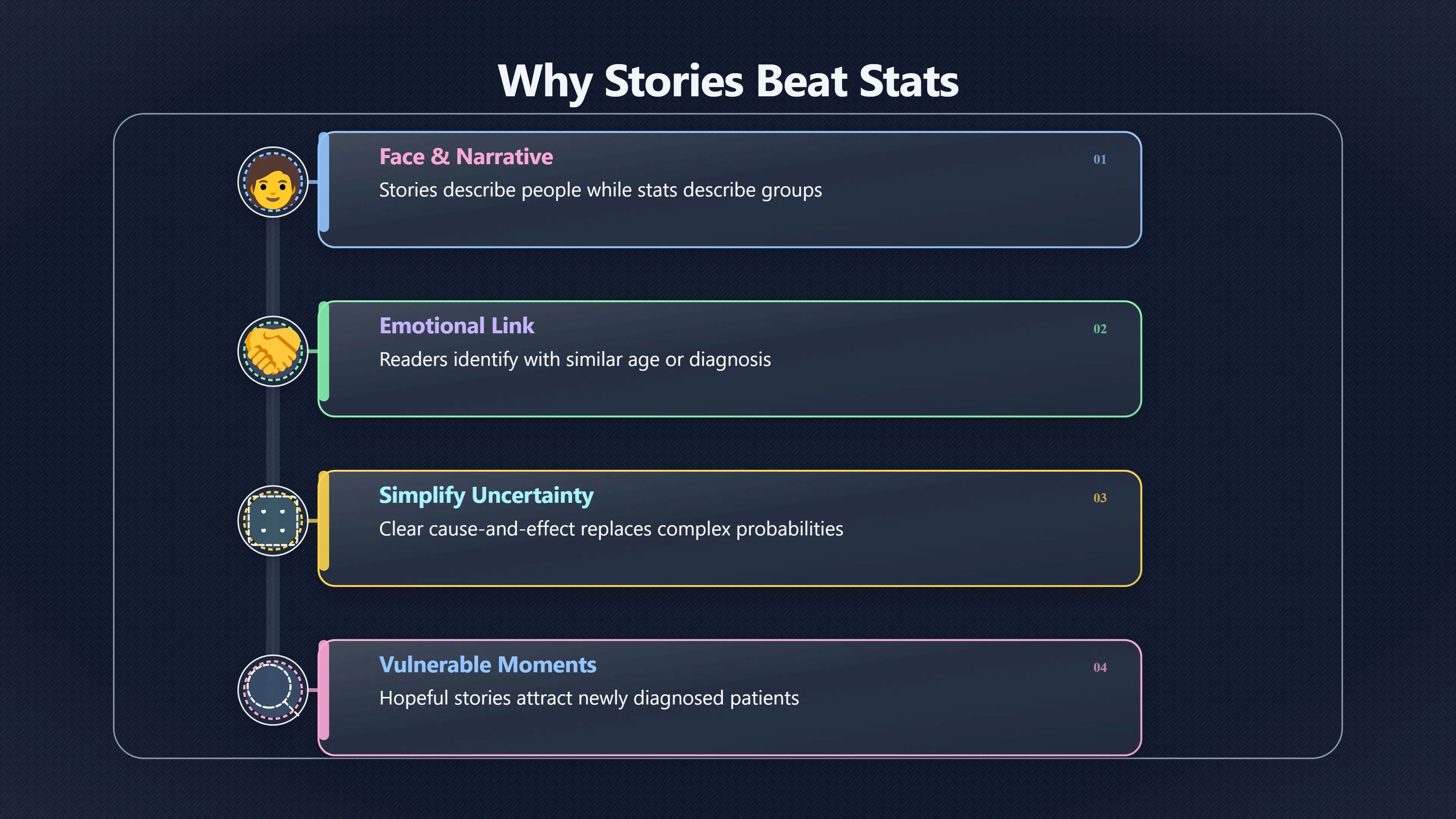
Human beings naturally learn through stories. A single detailed account of a person who says, “I had cancer and this cured me,” often feels more persuasive than population-level evidence showing treatment outcomes across thousands of patients.
Several psychological factors make these stories especially influential:
- They provide a face and a narrative. Statistics describe groups; stories describe people.
- They create emotional identification. Patients may see someone of a similar age, diagnosis or background and imagine the same outcome for themselves.
- They simplify uncertainty. Cancer treatment involves probabilities, risks and incomplete guarantees. A recovery story appears to offer a clear cause-and-effect explanation.
- They arrive at vulnerable moments. Newly diagnosed patients often search urgently for reassurance, making hopeful stories especially attractive.
Researchers studying cancer misinformation have found that false claims about alternative cures spread widely online and are often amplified through emotionally engaging content rather than strong evidence.[PMC]pmc.ncbi.nlm.nih.govCancer misinformation on social media - PMC - NIHby S Loeb · 2024 · Cited by 58 — This should be distinguished from disinformation, wh…[PMC]pmc.ncbi.nlm.nih.govExposure and Reactions to Cancer Treatment Misinformation…by AJ Lazard · 2023 · Cited by 30 — Cancer treatment misinformation, or f…
The persuasive power of testimony does not mean the testimony is false. A person may honestly believe a particular diet, supplement or wellness practice saved their life. The difficulty is that personal experience alone cannot reliably show which part of a treatment journey caused the outcome.
What Cure Claims Often Leave Out
Many misleading cancer recovery stories do not depend on outright fabrication. Instead, they leave out information that changes how the story should be interpreted.
Conventional Treatment in the Background
One of the most common omissions is established medical treatment. A person may publicly credit a natural therapy while having also undergone surgery, chemotherapy, radiation or another evidence-based intervention.
A widely discussed example involved model Elle Macpherson’s account of recovering from breast cancer. Media coverage often highlighted alternative approaches she adopted, but medical experts noted that she had also undergone a lumpectomy, a standard cancer treatment that may have played a central role in removing the cancer. Critics argued that framing the story primarily around alternative therapies risked creating a misleading impression about what caused the successful outcome.[Business Insider]businessinsider.comDoctors say that's misleading and potentially dangerous.September 4, 2024 — Elle Macpherson, an Australian supermodel, revealed she was d…
This pattern appears frequently in online testimonials. The visible story centres on the unusual intervention, while the routine medical treatment receives little attention because it is less novel and less likely to attract clicks.
Differences in Diagnosis and Stage
Cancer is not a single disease. Even cancers with the same name can behave very differently.
A story about someone surviving a slow-growing cancer may be interpreted by readers as evidence that a particular remedy works for aggressive disease. Yet the original diagnosis may involve different tumour biology, a different stage, different genetic features or a different prognosis.
Without those details, readers cannot know whether the treatment being promoted had any meaningful effect. A patient with an early-stage cancer that was already highly treatable may mistakenly be presented as proof that an alternative intervention cures cancer generally.
Natural Disease Variation
Not every improvement in a patient’s condition happens because of a treatment being promoted.
Some cancers grow slowly. Symptoms may fluctuate. Imaging findings can change over time. Patients may experience periods of stability that become incorrectly attributed to a supplement, restrictive diet or alternative therapy started around the same time.
Memorial Sloan Kettering Cancer Center has warned that people promoting natural cancer cures often mistake correlation for causation, assuming that because an improvement followed a treatment, the treatment caused it.[Memorial Sloan Kettering]mskcc.orgMemorial Sloan KetteringThe Truth Behind Four Natural Cancer “Cures”Jun 25, 2024 — “Natural” cancer therapies should be regarded with gre…
Survivorship Bias
Cancer cure stories are heavily shaped by who remains visible.
People who believe an alternative treatment helped them are more likely to share their experiences publicly. Patients who tried the same approach and deteriorated may never create a viral post, write a book or become a wellness influencer.
As a result, audiences see a filtered sample. They encounter the apparent successes while remaining largely unaware of unsuccessful cases.
This is one reason why medicine relies on controlled studies rather than individual testimonials. Clinical research attempts to count both positive and negative outcomes rather than only the stories that attract attention.
When Hope Becomes a Reason to Delay Treatment
The most serious risk arises when hopeful stories encourage patients to postpone, refuse or replace evidence-based care.
Researchers have repeatedly found links between reliance on alternative cancer treatments and worse outcomes when those treatments are used instead of conventional care. One widely cited study found that cancer patients who chose alternative medicine as their initial treatment experienced substantially poorer survival than comparable patients who received standard treatment. For some cancer types, mortality risks were dramatically higher.[Cancer.gov]cancer.govalternative medicine cancer survivalAlternative Medicine for Cancer Treatment Raises Mortality…Sep 12, 2017 — Choosing alternative medicine as an initial cancer treatment…
Another study found that patients using complementary medicine were more likely to refuse conventional treatment, a decision associated with higher mortality. Researchers suggested that the survival difference was strongly connected to whether patients completed recommended medical therapies.[PMC]pmc.ncbi.nlm.nih.govComplementary Medicine, Refusal of Conventional Cancer…by SB Johnson · 2018 · Cited by 432 — Patients who received complementary me…
This distinction matters. Complementary approaches such as mindfulness, exercise programmes, counselling, massage, acupuncture for symptom management or nutritional support may sometimes help patients cope with treatment side effects and improve quality of life. The danger arises when alternative approaches are presented as replacements for treatment rather than additions to supportive care.[NCCIH]nccih.nih.govem inappropriately can be harmful. For your safety:.Read more…
How Social Media Changes the Meaning of a Story
A cancer survivor speaking to friends and family is not the same thing as a cancer story circulating to millions of people online.
On social media, recovery stories often undergo a process of simplification:
- A patient shares a complex personal experience.
- Followers focus on the most unusual element.
- Reposts remove medical context.
- Headlines emphasise the surprising intervention.
- Audiences receive a simplified message: “This cured cancer.”
Researchers and cancer organisations have warned that social platforms can accelerate the spread of cancer misinformation because emotionally engaging claims often attract more attention than careful scientific explanations.[PMC]pmc.ncbi.nlm.nih.govCancer Misinformation and Harmful Information on Facebook…by SB Johnson · 2021 · Cited by 240 — Health misinformation threatens pub…[Cancer.gov]cancer.orghow to interpret news about new cancer treatmentsAmerican Cancer SocietyUnderstanding Information About New Cancer TreatmentsAug 8, 2025 — Before a new medicine or device can be marketed…
The result is a distorted information environment in which dramatic anecdotes compete directly with evidence gathered from thousands of patients.
The Wellness Influencer Problem
Some of the most influential cancer cure narratives emerge from wellness culture.
The Australian influencer Belle Gibson became one of the most notorious examples after building a large following around claims that she had cured terminal brain cancer through diet and alternative health practices. Investigations later found that she never had the cancer she claimed to have survived. Her story demonstrated how difficult it can be for audiences to distinguish between genuine patient experiences and commercially useful narratives.[People.com]people.comDid Belle Gibson Actually Have Cancer?Inside the "Apple Cider Vinegar" True Story and the Influencer's Real-Life Disease-Curing ScamFebruary 6, 2025 — Belle Gibson, a former A…
Most misleading stories are not deliberate frauds on that scale. Nevertheless, the case showed how emotionally compelling recovery claims can spread long before their factual basis is examined.
Why Good Intentions Do Not Make a Story Reliable
Many people sharing cancer recovery stories genuinely want to help.
Family members share articles because they are frightened. Survivors describe what felt meaningful during treatment. Friends pass along stories because they want to offer hope. The emotional motivation is often sincere.
The problem is that sincerity does not create evidence.
A patient may honestly believe a particular supplement cured their cancer. Another may sincerely credit a strict diet. A third may feel certain that positive thinking changed the course of their illness. Yet personal conviction cannot separate what caused a recovery from what merely accompanied it.
Cancer organisations consistently caution against treating individual testimonials as proof of effectiveness. Unproven therapies may sound persuasive because they are attached to real people, but personal experiences cannot substitute for clinical evidence showing that a treatment works consistently and safely across many patients.[Memorial Sloan Kettering]mskcc.orgMemorial Sloan KetteringThe Truth Behind Four Natural Cancer “Cures”Jun 25, 2024 — “Natural” cancer therapies should be regarded with gre…[NCCIH]nccih.nih.govem inappropriately can be harmful. For your safety:.Read more…
How to Respect Hope While Checking the Evidence
Patients do not need to reject hopeful stories altogether. Survivor experiences can provide comfort, practical advice and emotional support. The challenge is learning how to separate inspiration from evidence.
Useful questions include:
- What medical treatment did the person also receive?
- What type and stage of cancer did they have?
- Is the claimed cure supported by clinical trials?
- Are cancer organisations or oncology specialists recommending it?
- Is the story based on one person’s experience or on systematic evidence?
- Are there documented cases where the same approach failed?
Reliable cancer organisations stress that promising treatments should be evaluated through research, regulatory review and clinical trials rather than anecdotal success stories alone.[American Cancer Society]cancer.orghow to interpret news about new cancer treatmentsAmerican Cancer SocietyUnderstanding Information About New Cancer TreatmentsAug 8, 2025 — Before a new medicine or device can be marketed…
Hope and evidence are not opposites. Patients often need both. Survivor stories can remind people that treatment is worth enduring and that life after cancer is possible. Problems arise when stories stop being sources of encouragement and start being treated as proof that an unverified cure works. In those moments, a reassuring narrative can become a form of misinformation, even when everyone involved believes they are helping.
Amazon book picks
Further Reading
Books and field guides related to When Cancer Cure Stories Leave Out Treatment. Use these as the next step if you want deeper reading beyond the article.
The Emperor of All Maladies
Provides evidence-based understanding of cancer and treatment.
Foolproof: Why We Fall for Misinformation and How to Build Im...
Helps explain why cancer cure stories can be so persuasive.
eBay marketplace picks
Marketplace Samples
Example marketplace items related to this page. Use the search link to explore similar finds on eBay.


Endnotes
1.
Source: cancer.gov
Link:https://www.cancer.gov/news-events/cancer-currents-blog/2021/cancer-misinformation-social-media
Source snippet
The Challenges of Cancer Misinformation on Social MediaSep 9, 2021 — Misinformation about cancer is pervasive on the Internet and social...
2.
Source: pmc.ncbi.nlm.nih.gov
Link:https://pmc.ncbi.nlm.nih.gov/articles/PMC9275772/
Source snippet
Cancer Misinformation and Harmful Information on Facebook...by SB Johnson · 2021 · Cited by 240 — Health misinformation threatens pub...
3.
Source: pmc.ncbi.nlm.nih.gov
Link:https://pmc.ncbi.nlm.nih.gov/articles/PMC11648589/
Source snippet
Cancer misinformation on social media - PMC - NIHby S Loeb · 2024 · Cited by 58 — This should be distinguished from disinformation, wh...
4.
Source: pmc.ncbi.nlm.nih.gov
Link:https://pmc.ncbi.nlm.nih.gov/articles/PMC10422174/
Source snippet
Exposure and Reactions to Cancer Treatment Misinformation...by AJ Lazard · 2023 · Cited by 30 — Cancer treatment misinformation, or f...
5.
Source: cancer.gov
Title: alternative medicine cancer survival
Link:https://www.cancer.gov/news-events/cancer-currents-blog/2017/alternative-medicine-cancer-survival
Source snippet
Alternative Medicine for Cancer Treatment Raises Mortality...Sep 12, 2017 — Choosing alternative medicine as an initial cancer treatment...
6.
Source: pmc.ncbi.nlm.nih.gov
Link:https://pmc.ncbi.nlm.nih.gov/articles/PMC6233773/
Source snippet
Complementary Medicine, Refusal of Conventional Cancer...by SB Johnson · 2018 · Cited by 432 — Patients who received complementary me...
7.
Source: nccih.nih.gov
Link:https://www.nccih.nih.gov/health/cancer-and-complementary-health-approaches-what-you-need-to-know
Source snippet
em inappropriately can be harmful. For your safety:.Read more...
8.
Source: time.com
Title: Can Complementary Therapies Ease Cancer Treatment Symptoms?
Link:https://time.com/6171230/complementary-integrative-therapies-cancer/
Source snippet
What the Science SaysComplementary therapies can ease the side effects of cancer treatment, such as anxiety, depression, and pain, althou...
9.
Source: people.com
Title: Did Belle Gibson Actually Have Cancer?
Link:https://people.com/apple-cider-vinegar-true-story-8786382
Source snippet
Inside the "Apple Cider Vinegar" True Story and the Influencer's Real-Life Disease-Curing ScamFebruary 6, 2025 — Belle Gibson, a former A...
Published: February 6, 2025
10.
Source: cancer.org
Title: how to interpret news about new cancer treatments
Link:https://www.cancer.org/cancer/managing-cancer/how-to-interpret-news-about-new-cancer-treatments.html
Source snippet
American Cancer SocietyUnderstanding Information About New Cancer TreatmentsAug 8, 2025 — Before a new medicine or device can be marketed...
11.
Source: cancer.org
Title: how to use safely
Link:https://www.cancer.org/cancer/supportive-care/integrative-medicine/how-to-use-safely.html
Source snippet
How to Use Integrative (Holistic) Therapies SafelyJul 11, 2025 — Like any treatment, certain integrative (holistic) therapies may pose ri...
12.
Source: cancer.org
Link:https://www.cancer.org/about-us/what-we-do/cancer-stories.html
Source snippet
Cancer StoriesRead stories of real people who have survived cancer – and the positive impact the American Cancer Society had on their can...
13.
Source: cancer.ca
Link:https://cancer.ca/en/about-us/stories
Source snippet
Our storiesDiscover stories about the impact of cancer on the lives of Canadians. Learn more about cancer research, support programs, hea...
14.
Source: businessinsider.com
Link:https://www.businessinsider.com/elle-macpherson-breast-cancer-treatment-lumpectomy-misleading
Source snippet
Doctors say that's misleading and potentially dangerous.September 4, 2024 — Elle Macpherson, an Australian supermodel, revealed she was d...
Published: September 4, 2024
15.
Source: mskcc.org
Link:https://www.mskcc.org/news/truth-behind-three-natural-cures
Source snippet
Memorial Sloan KetteringThe Truth Behind Four Natural Cancer “Cures”Jun 25, 2024 — “Natural” cancer therapies should be regarded with gre...
16.
Source: mskcc.org
Title: Memorial Sloan Kettering Alternative Cancer Treatments: The Science vs
Link:https://www.mskcc.org/podcasts/cancer-straight-talk/alternative-cancer-treatments-science-vs-hype
Source snippet
The HypeFeb 19, 2025 — Many widely discussed alternative treatments lack scientific evidence for treating cancer. For example, Ivermectin...
17.
Source: macmillan.org.uk
Link:https://www.macmillan.org.uk/cancer-information-and-support/worried-about-cancer/cancer-myths-and-misinformation
Source snippet
Wrong information can increase worry and delay people seeing their doctor or...Read more...
Additional References
18.
Source: ecancer.org
Link:https://ecancer.org/en/news/27083-study-finds-most-cancer-patients-exposed-to-misinformation-researchers-pilot-information-prescription
Source snippet
Study finds most cancer patients exposed to misinformation...25 Sept 2025 — Ninety-three percent of patients with a new cancer diagnosis...
19.
Source: ecancer.org
Link:https://ecancer.org/en/news/15035-surprising-number-of-americans-believe-alternative-therapies-can-cure-cancer
Source snippet
Surprising number of Americans believe alternative...1 Nov 2018 — Nearly four in 10 Americans (39%) believe cancer can be cured solely t...
20.
Source: fda.gov
Link:https://www.fda.gov/about-fda/conversations-cancer/conversations-cancer-cancer-misinformation-truth-or-consequences
Source snippet
Conversations on Cancer: Cancer Misinformation: Truth or...Nov 6, 2024 — Rapid evolution of social media platforms on the internet has f...
21.
Source: oncologynewscentral.com
Title: interest in ivermectin for cancer has spread like wildfire oncologists say
Link:https://www.oncologynewscentral.com/oncology/interest-in-ivermectin-for-cancer-has-spread-like-wildfire-oncologists-say
Source snippet
Interest in Ivermectin for Cancer “Has Spread Like Wildfire,”...Jun 13, 2025 — “There is currently no evidence in humans, or in patients...
22.
Source: ilcn.org
Link:https://www.ilcn.org/cancer-misinformation-its-impact-on-patients-and-mitigation-strategies/
Source snippet
ing the delivery of evidence-based therapies, but it threatens public health by eroding trust.Read more...
23.
Source: hhs.gov
Title: surgeon general misinformation advisory
Link:https://www.hhs.gov/sites/default/files/surgeon-general-misinformation-advisory.pdf
Source snippet
Confronting Health MisinformationJul 14, 2021 — Social media, political polarization and political disinformation: A review of the scient...
24.
Source: Wikipedia
Title: List of unproven and disproven cancer treatments
Link:https://en.wikipedia.org/wiki/List_of_unproven_and_disproven_cancer_treatments
Source snippet
List of unproven and disproven cancer treatmentsMany alternative cancer treatments are considered disproven because they have been inv...
25.
Source: facebook.com
Link:https://www.facebook.com/cancerresearchuk/posts/anyone-can-give-you-cancer-advice-online-but-the-consequences-could-be-seriousin/1438189448342826/
Source snippet
what's not, and why it matters. We're joined by breast...Read more...
26.
Source: cancerresearchuk.org
Link:https://www.cancerresearchuk.org/about-cancer/treatment/complementary-alternative-therapies/individual-therapies/essiac
Source snippet
s use as a treatment for cancer. Essiac can have side effects...
27.
Source: youtube.com
Title: Understanding the Science Behind Cancer Treatment
Link:https://www.youtube.com/watch?v=Xh0YyQW1VqQ
Source snippet
These videos are relevant because they explore how emotional testimonials and unverified claims about "miracle cures" can distract from e...
Topic Tree