Within Identity
Why family health myths feel so convincing
Health myths can feel safest when they come from parents or relatives who shaped a person's earliest ideas about care and risk.
On this page
- How affection becomes credibility
- When family experience outranks outside evidence
- How to correct without insulting the relationship
Page outline Jump by section
Introduction
Health myths often survive not because the information is strong, but because the relationship behind it is strong. Advice from parents, grandparents, siblings and other relatives is usually learned early, repeated often and delivered by people who are closely associated with safety, care and survival. When a family member says that a cold must be “sweated out”, that a particular food cures illness, or that a vaccine is risky, the claim can feel different from the same statement coming from a stranger.
 This helps explain why some health misconceptions remain surprisingly resistant to correction. The issue is not simply a lack of scientific evidence. Family advice often carries emotional authority, personal history and a sense of loyalty. Rejecting the advice can feel like questioning the judgement of people who provided comfort, protection and practical help throughout life. Research on health misinformation consistently finds that trust, familiarity and social relationships influence which health claims people accept and how willing they are to revise them.[NAM]nam.eduIdentifying Credible Sources of Health Information in Social…by RS Kington · Cited by 278 — People seek, share, and receive health…[NCBI]ncbi.nlm.nih.govNCBIWE CAN TAKE ACTIONConfronting Health MisinformationBecause it pollutes our information environment, misinformation is harmful to individual and public heal…
How affection becomes credibility
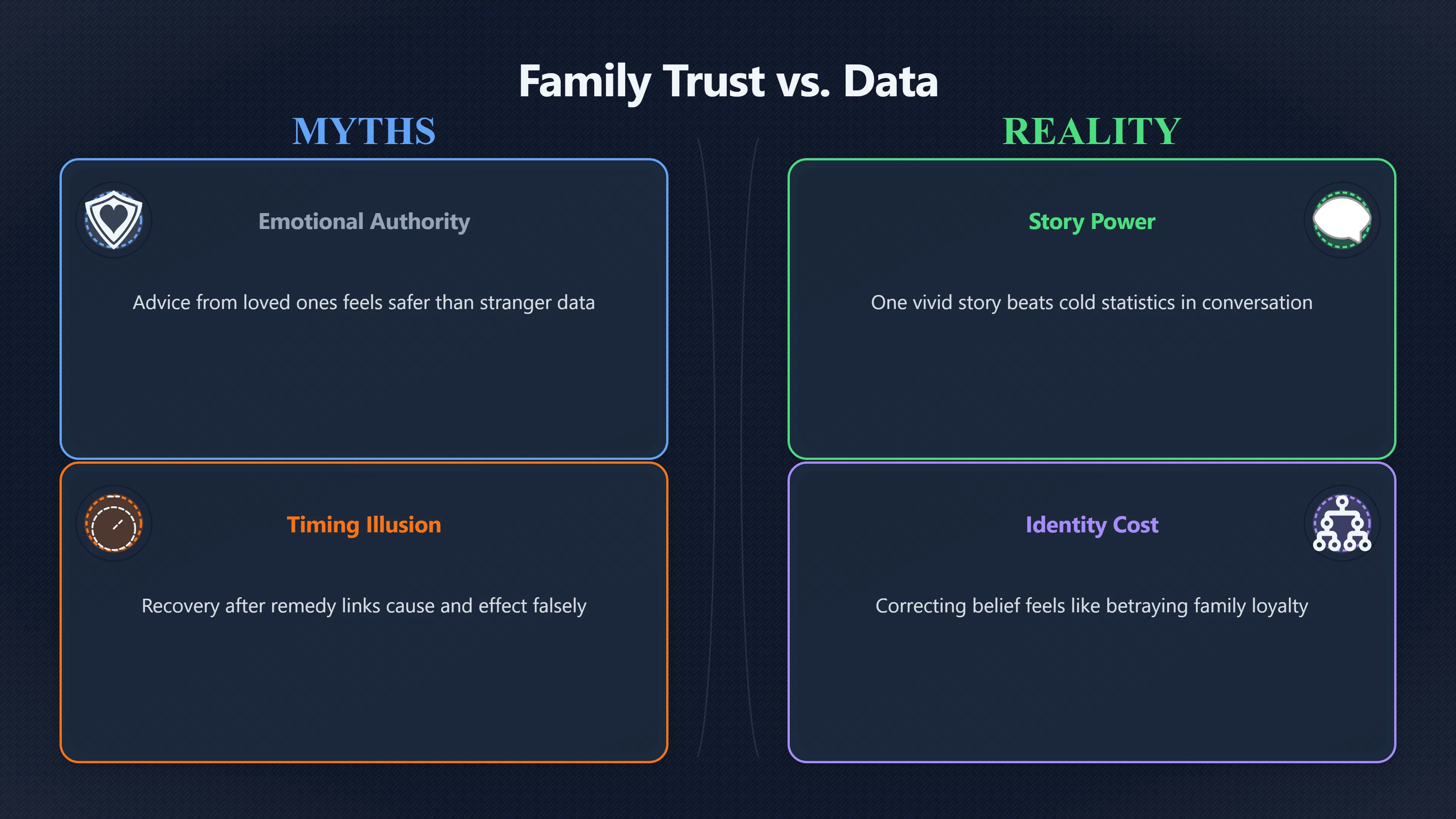
People learn their earliest health habits from family long before they learn how to evaluate evidence. Parents decide when children see a doctor, what remedies are used at home, how illness is interpreted and which risks deserve attention. These experiences create mental shortcuts that often continue into adulthood.
A child who repeatedly hears that antibiotics are needed for every cold, that “natural” remedies are always safer than medicine, or that certain foods prevent disease may not store these ideas as isolated facts. Instead, the ideas become woven into memories of care and protection. The advice is associated with someone who was trusted during vulnerable moments.
Psychologists sometimes describe this as source-based credibility. People do not assess every claim independently. They rely on cues about who is speaking and whether that person has been dependable in the past. Family members score highly on perceived trustworthiness even when they have no special expertise in medicine. Research from the US National Academy of Medicine notes that people regularly obtain health information from family and friends alongside professional and institutional sources.[NAM]nam.eduIdentifying Credible Sources of Health Information in Social…by RS Kington · Cited by 278 — People seek, share, and receive health…
This is one reason myths can feel emotionally true even after they have been factually challenged. The correction competes not only with the claim itself but also with years of accumulated trust.
Why personal stories often beat statistics
Family health advice is usually delivered through stories rather than data.
A grandmother might say she never took a certain vaccine and remained healthy. A parent may insist that a particular herbal treatment worked for them decades ago. An uncle may describe a frightening side effect that followed a medical procedure. These stories are vivid, memorable and tied to a real person the listener knows.
Scientific evidence works differently. It relies on large groups, probabilities and averages. That makes it more reliable for understanding health outcomes, but often less emotionally compelling in everyday conversation.
This mismatch helps myths survive. A family story feels concrete. A clinical study feels distant. When the two conflict, many people instinctively give more weight to the experience of someone they know personally.
Health misinformation researchers have repeatedly found that anecdotal evidence and personal testimony can increase the perceived credibility of unsupported claims. Emotional narratives are easier to remember and share than nuanced explanations that include uncertainty or statistical reasoning.[ASM.org]asm.orgThis article offers tips for how to recognize and combat misinformation,How to Spot and Combat Health MisinformationSeptember 9, 2022 — 9 Sept 2022 — The spread of health misinformation has dangerous consequences…[The Health Policy Partnership]healthpolicypartnership.comrebuilding trust in public health the battle against misinformationThe Health Policy PartnershipRebuilding trust in public health: the battle against…27 Feb 2025 — Health misinformation is often develo…
The result is that a single family experience can sometimes outweigh decades of accumulated medical evidence in a person’s mind.
When family experience outranks outside evidence
Family advice becomes especially persuasive when it appears to confirm direct observation.
Imagine a child recovers from a cold after being given a traditional home remedy. The recovery was likely going to happen anyway, but the timing creates a powerful impression. The remedy becomes associated with improvement.
Over time, families build collections of these experiences:
- A relative felt better after using a supplement.
- Someone experienced side effects after a medication.
- A grandparent lived to old age despite ignoring a medical recommendation.
- A neighbour’s child became ill after a vaccination and the two events became linked in family memory.
These experiences are often genuine. The problem is that individual experiences cannot easily reveal cause and effect. People rarely see all the cases where the remedy did not work, the disease would have improved naturally, or the feared outcome never occurred.
Yet family knowledge often gains authority precisely because it appears to come from lived experience rather than institutions. Studies examining responses to health misinformation have found that cultural beliefs, trust in traditional treatments and social influences can shape how people judge competing health claims.[infodemiology.jmir.org]infodemiology.jmir.orgHow the General Public Navigates Health Misinformation on…by S Sathianathan · 2025 · Cited by 13 — This study aims to explore the appr…
In everyday life, “I’ve seen it myself” can feel more convincing than “research shows otherwise”.
Why correcting a myth can feel like betraying someone
One overlooked reason family health myths persist is that changing a belief can carry social costs.
If a daughter concludes that a long-held family remedy does not actually work, she may worry that saying so will sound dismissive or ungrateful. If a son decides a relative’s vaccine fears are unfounded, he may feel he is challenging the judgement of someone he loves.
The disagreement becomes about more than health information. It touches identity, respect and family hierarchy.
This is particularly visible when health practices are linked to family traditions. Some remedies are remembered as symbols of care from older generations. Questioning the remedy can accidentally sound like questioning the people who passed it down.
Research on misinformation correction suggests that people can resist updates when new information appears to threaten trusted relationships or social belonging. Corrections are often less successful when they are experienced as attacks rather than invitations to reconsider evidence. NCBI[ASM.org]asm.orgThis article offers tips for how to recognize and combat misinformation,How to Spot and Combat Health MisinformationSeptember 9, 2022 — 9 Sept 2022 — The spread of health misinformation has dangerous consequences…
In families, this dynamic is amplified because the relationship usually matters more than winning an argument.
The role of repetition inside families
A myth heard once may be forgotten. A myth heard hundreds of times over many years can start to feel self-evident.
Family environments provide repeated exposure. The same claims may appear during meals, illnesses, holidays and conversations with multiple relatives. Even when no one is intentionally spreading misinformation, repetition increases familiarity.
Psychological research has long shown that familiar statements tend to feel more believable than unfamiliar ones. Repetition creates a sense of fluency: the claim becomes easier to process and therefore seems more likely to be true.
Health misinformation researchers describe a similar process online, where repeated exposure strengthens belief. The same mechanism can operate within families, except that the repetition comes from trusted people rather than algorithms.[ASM.org]asm.orgThis article offers tips for how to recognize and combat misinformation,How to Spot and Combat Health MisinformationSeptember 9, 2022 — 9 Sept 2022 — The spread of health misinformation has dangerous consequences…[APA]apa.orgending health misinformationHow to reverse the alarming trend of health misinformation1 Jul 2024 — Experts are studying how false information spreads, who is most vu…
A misconception repeated by several relatives can start to feel like common knowledge rather than a claim that needs verification.
Why some myths survive even after people learn the facts
People often assume that once someone encounters accurate information, the myth should disappear. In practice, belief change is usually gradual.
A person may intellectually accept that a family health belief is unsupported while still feeling emotionally attached to it. They may continue following parts of the advice “just in case”. Others may compartmentalise, trusting medical professionals for major decisions while preserving family remedies for minor illnesses.
This helps explain why misinformation can remain influential even after correction. Researchers studying misinformation describe a “continued influence” effect, where previously learned claims continue shaping judgement after being disproved.[ASM.org]asm.orgThis article offers tips for how to recognize and combat misinformation,How to Spot and Combat Health MisinformationSeptember 9, 2022 — 9 Sept 2022 — The spread of health misinformation has dangerous consequences…
Family myths are especially vulnerable to this effect because they are embedded in routines, memories and relationships. The factual correction may succeed, but the emotional residue remains.
How to correct without insulting the relationship
Because family health myths are relationship-based, purely factual corrections are often insufficient.
People tend to respond better when the conversation protects dignity and shared values. Public embarrassment, ridicule and aggressive fact-checking can trigger defensiveness, especially when older relatives feel their experience is being dismissed.
Health communication experts commonly recommend approaches built around empathy and collaboration rather than confrontation.[ASM.org]asm.orgThis article offers tips for how to recognize and combat misinformation,How to Spot and Combat Health MisinformationSeptember 9, 2022 — 9 Sept 2022 — The spread of health misinformation has dangerous consequences…
Several strategies are often more effective:
Acknowledge the intention behind the advice.
Many family myths originate from genuine concern. Recognising that concern helps separate the person from the inaccurate claim.
Ask where the belief came from.
Tracing the history of a family health belief often reveals that nobody knows its original source. This can create space for discussion without direct confrontation.
Compare sources rather than people.
Instead of arguing that a relative is wrong, focus on how doctors, researchers or public health organisations evaluate evidence.
Use shared goals.
Conversations become less threatening when framed around protecting health rather than proving someone mistaken.
Allow gradual change.
Deeply rooted beliefs rarely disappear after a single discussion. Small shifts in confidence may be more realistic than immediate conversion.
The goal is not merely to replace false information with correct information. It is to do so without damaging the trust that makes family relationships valuable in the first place.

Why family myths remain one of the hardest forms of misinformation
Many health myths survive because they are carried by the people who first taught individuals how to navigate illness, safety and risk. Family advice arrives wrapped in affection, familiarity and personal history. It is reinforced by stories, repetition and loyalty, then protected by the desire to maintain important relationships.
That combination makes family-based misconceptions unusually durable. The myth is rarely standing alone. It is supported by memories of care, a trusted source and a sense of belonging. Understanding that emotional structure helps explain why correcting health misinformation is often as much a social challenge as an informational one. The strongest corrections do not merely present better evidence; they find ways to preserve trust while making room for new understanding.[NAM]nam.eduIdentifying Credible Sources of Health Information in Social…by RS Kington · Cited by 278 — People seek, share, and receive health…[NCBI]ncbi.nlm.nih.govNCBIWE CAN TAKE ACTIONConfronting Health MisinformationBecause it pollutes our information environment, misinformation is harmful to individual and public heal…
eBay marketplace picks
Marketplace Samples
Example marketplace items related to this page. Use the search link to explore similar finds on eBay.
Endnotes
1.
Source: nam.edu
Link:https://nam.edu/perspectives/identifying-credible-sources-of-health-information-in-social-media-principles-and-attributes/
Source snippet
Identifying Credible Sources of Health Information in Social...by RS Kington · Cited by 278 — People seek, share, and receive health...
2.
Source: asm.org
Title: This article offers tips for how to recognize and combat misinformation,
Link:https://asm.org/articles/2022/september/how-to-spot-and-combat-health-misinformation
Source snippet
How to Spot and Combat Health MisinformationSeptember 9, 2022 — 9 Sept 2022 — The spread of health misinformation has dangerous consequences...
Published: September 9, 2022
3.
Source: infodemiology.jmir.org
Link:https://infodemiology.jmir.org/2025/1/e67464
Source snippet
How the General Public Navigates Health Misinformation on...by S Sathianathan · 2025 · Cited by 13 — This study aims to explore the appr...
4.
Source: apa.org
Title: ending health misinformation
Link:https://www.apa.org/monitor/2024/07/ending-health-misinformation
Source snippet
How to reverse the alarming trend of health misinformation1 Jul 2024 — Experts are studying how false information spreads, who is most vu...
5.
Source: apa.org
Title: hea hea0000978
Link:https://www.apa.org/pubs/journals/releases/hea-hea0000978.pdf
Source snippet
Who Is Susceptible to Online Health Misinformation?by LD Scherer · 2021 · Cited by 227 — Misinformation susceptibility across all three t...
6.
Source: who.int
Link:https://www.who.int/europe/news/item/01-09-2022-infodemics-and-misinformation-negatively-affect-people-s-health-behaviours–new-who-review-finds
Source snippet
Infodemics and misinformation negatively affect people's...1 Sept 2022 — The systematic review found that people feel mental, social, po...
7.
Source: healthpolicypartnership.com
Title: rebuilding trust in public health the battle against misinformation
Link:https://www.healthpolicypartnership.com/rebuilding-trust-in-public-health-the-battle-against-misinformation/
Source snippet
The Health Policy PartnershipRebuilding trust in public health: the battle against...27 Feb 2025 — Health misinformation is often develo...
8.
Source: guides.library.ubc.ca
Link:https://guides.library.ubc.ca/healthmisinformation/communication
Source snippet
UBC Library GuidesEvaluating Health Misinformation7 Mar 2025 — Below are some guidelines for the “Do's” and “Don'ts” for addressing misin...
Additional References
9.
Source: rch.org.au
Link:https://www.rch.org.au/kidsinfo/fact_sheets/How_to_find_health_information_you_can_trust/
Source snippet
Disinformation is false information spread on purpose to harm or trick others. Mis and disinformation can stop you from...Read more...
10.
Source: youtube.com
Link:https://www.youtube.com/watch?v=KdXaUsNvntY
11.
Source: europarl.europa.eu
Title: eu How to reduce the impact of disinformation on Europeans’ health
Link:https://www.europarl.europa.eu/RegData/etudes/STUD/2024/754205/IPOL_STU%282024%29754205_EN.pdf
Source snippet
This paper provides a broad overview of the emerging challenges connected with disinformation in the area of health, how it spreads and t...
12.
Source: ballardbrief.byu.edu
Title: the effects of medical misinformation on the american public
Link:https://ballardbrief.byu.edu/issue-briefs/the-effects-of-medical-misinformation-on-the-american-public
Source snippet
Ballard BriefThe Effects of Medical Misinformation on the American Public15 Mar 2024 — Medical misinformation causes higher rates of deat...
13.
Source: premierscience.com
Link:https://premierscience.com/pjph-24-353/
Source snippet
al health risks, especially in networks where peers have a lot of power.Read more...
14.
Source: ncbi.nlm.nih.gov
Title: NCBIWE CAN TAKE ACTION
Link:https://www.ncbi.nlm.nih.gov/books/NBK572168/
Source snippet
Confronting Health MisinformationBecause it pollutes our information environment, misinformation is harmful to individual and public heal...
15.
Source: rch.org.au
Link:https://www.rch.org.au/kidsinfo/healthinfo/
Source snippet
Kids Health Info: How to find health information you can trustMis and disinformation can stop you from making safe decisions about your...
16.
Source: gov.scot
Title: www.gov.scot Footnotes
Link:https://www.gov.scot/publications/scottish-health-information-integrity-strategy/pages/19/
Source snippet
Scottish Health Information Integrity Strategy31 Oct 2025 — Sets out the framework for safe, coherent, evidence-based and ethical approac...
17.
Source: pmc.ncbi.nlm.nih.gov
Link:https://pmc.ncbi.nlm.nih.gov/articles/PMC11369541/
Source snippet
by D Kbaier · 2024 · Cited by 105 — This scoping review underscores the significance of addressing online health misinformation, parti...
18.
Source: pmc.ncbi.nlm.nih.gov
Link:https://pmc.ncbi.nlm.nih.gov/articles/PMC12412888/
Source snippet
Health Misinformation on Social Media and Public...by JP Stimpson · 2025 · Cited by 13 — This study examines the role of healthcare visi...
Topic Tree