Within Debunking
Why corrections should lead with the fact
A correction headline works best when it gives the true answer before briefly naming the false claim it replaces.
On this page
- What a fact first opening gives the reader
- How myth led headlines can backfire
- Before and after examples of stronger correction leads
Page outline Jump by section
Introduction
A correction headline has one job before anything else: stop the false claim from becoming the reader’s mental starting point. That is why many misinformation researchers and fact-checking guides recommend leading with the fact, then naming the myth only as much as necessary. A fact-first headline gives readers the correct frame before the false one takes hold. Instead of “No, vaccines do not contain tracking chips”, a fact-first version begins with the reality: “Vaccines do not contain tracking chips”. The difference may look cosmetic, but it changes what readers encounter first, remember first, and often repeat later.[KSJ Handbook]ksjhandbook.orgKSJ Handbook Structuring Your ArgumentKSJ HandbookStructuring Your Argument - MisinformationThe “fact-myth-fallacy” structure when debunking a claim. This involves presenting…
 This approach sits at the centre of the broader fact-warning-explanation correction structure. Corrections compete against simple, memorable stories, and the opening line often determines which story becomes the reference point. Research on misinformation persistence shows that false information can continue to influence reasoning even after correction, making the initial frame unusually important.[Nature]nature.comIn the typical CIE laboratory paradigm, participants are presented with a…Read more…[Sage Journals]journals.sagepub.comSage JournalsA Meta-Analytic Examination of the Continued Influence…22 Jun 2019 — A negative r indicates stronger continued influence…
What a fact-first opening gives the reader
A fact-first headline does more than avoid repeating a myth. It provides an immediate answer to the question a reader is trying to resolve: what is true?
When readers encounter a correction, they are often deciding between two competing explanations. A headline that starts with the verified information reduces ambiguity and gives the audience a stable reference point before introducing the disputed claim. The Debunking Handbook explicitly recommends stating the truth first because doing so allows communicators to frame the message around their own evidence rather than around someone else’s misinformation.[Skeptical Science]skepticalscience.comIf it's easy to do in a few clear words… MYTH: Point to misinformation. Repeat the misinformation, only…
This matters because misinformation is not usually remembered as a detached sentence. It is often stored as part of a larger story about why something happened. The continued influence effect describes the tendency for misinformation to keep shaping judgements even after it has been corrected. Researchers have repeatedly found that outdated information is not simply erased from memory when a correction appears.[Nature]nature.comIn the typical CIE laboratory paradigm, participants are presented with a…Read more…[Sage Journals]journals.sagepub.comSage JournalsA Meta-Analytic Examination of the Continued Influence…22 Jun 2019 — A negative r indicates stronger continued influence…
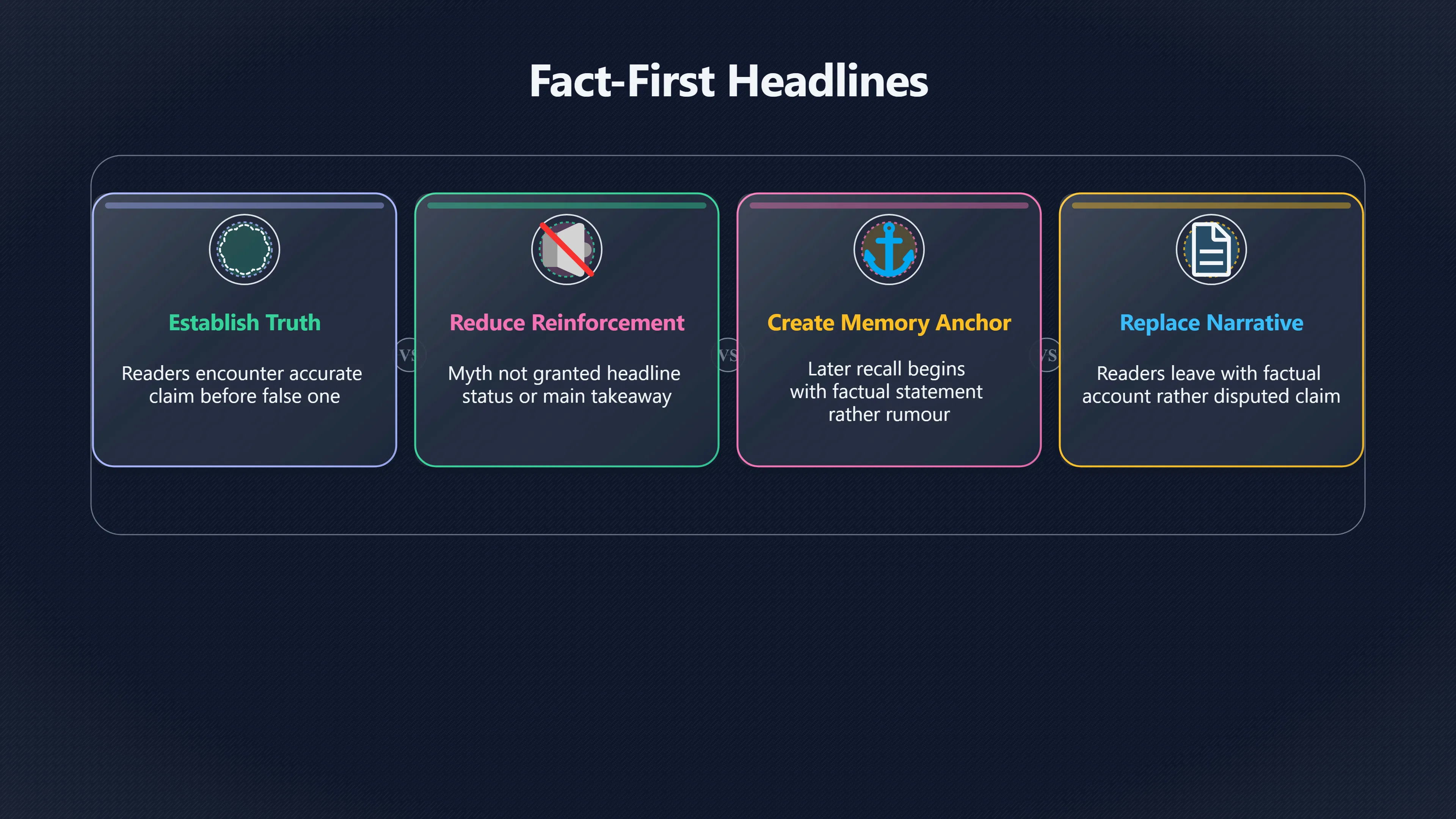
A fact-first opening helps counter that problem in three ways:
- It establishes the correct interpretation immediately. Readers encounter the accurate claim before seeing the false one.
- It reduces accidental reinforcement. The myth is not granted headline status or treated as the main takeaway.
- It creates a memory anchor. Later recall is more likely to begin with the factual statement rather than with the rumour being corrected.[KSJ Handbook]ksjhandbook.orgKSJ Handbook Structuring Your ArgumentKSJ HandbookStructuring Your Argument - MisinformationThe “fact-myth-fallacy” structure when debunking a claim. This involves presenting…[Skeptical Science]skepticalscience.comIf it's easy to do in a few clear words… MYTH: Point to misinformation. Repeat the misinformation, only…
In practical terms, a headline such as “Human emissions are driving current global warming” gives readers a complete factual proposition. A headline such as “The claim that humans are not causing warming is false” still centres the myth. Both communicate a correction, but only one makes the fact the organising idea.
Why the first frame often wins
Headlines matter because many people only skim them. Others remember them more clearly than the body of an article. Researchers studying misinformation and memory have shown that early information can continue influencing judgement even when later corrections are available.[Nature]nature.comIn the typical CIE laboratory paradigm, participants are presented with a…Read more…[Sage Journals]journals.sagepub.comSage JournalsA Meta-Analytic Examination of the Continued Influence…22 Jun 2019 — A negative r indicates stronger continued influence…
This creates a practical problem for fact-checkers and journalists. If the myth appears in the headline, the correction may unintentionally help spread the false claim’s wording, imagery or assumptions. Readers may later remember the topic but forget whether the statement was presented as true or false.
Communication guidance built around the fact-myth-fallacy structure warns against making the myth the headline for exactly this reason. The recommendation is not to conceal the false claim. Instead, it is to ensure that the correction’s most visible element is the verified information.[KSJ Handbook]ksjhandbook.orgKSJ Handbook Structuring Your ArgumentKSJ HandbookStructuring Your Argument - MisinformationThe “fact-myth-fallacy” structure when debunking a claim. This involves presenting…[Skeptical Science]skepticalscience.comSkeptical ScienceThe Debunking Handbook Part 1: The first myth about…16 Nov 2011 — First, the refutation must focus on core facts rath…
The underlying psychology overlaps with what researchers call the illusory truth effect: repeated statements often feel more believable simply because they become more familiar. Modern misinformation research has complicated some early fears about dramatic “backfire effects”, and repeating a myth once within a clear correction can be useful. However, familiarity still matters. Repetition should serve the correction rather than become the correction’s dominant feature.[Center for Climate Change Communication]climatechangecommunication.orgCenter for Climate Change CommunicationDebunking HandbookThus, while repeating misinformation generally increases familiarity and truth r…[Digital Commons]digitalcommons.unl.eduDigital CommonsThe Debunking Handbook 2020 - DigitalCommons@UNLby S Lewandowsky · Cited by 502 — Thus, while repeating misinformation gen…
A fact-first headline therefore acts as a framing intervention. It increases the visibility and familiarity of the accurate claim while limiting the false claim’s opportunity to define the discussion.
How myth-led headlines can backfire
The most common correction mistake is not necessarily getting the facts wrong. It is allowing the myth to occupy the strongest position in the message.
Consider a headline structure such as:
“No, wind turbines do not cause cancer.”
Although technically accurate, the headline still introduces the false association first. A reader scanning quickly may encode “wind turbines” and “cause cancer” together before processing the negation.
Research on headline effects suggests that headlines can shape interpretation even when article text later qualifies or contradicts them. Because readers often process headlines rapidly and incompletely, the initial framing can leave a lasting impression.[Sherwin Arnott]sherwinarnott.orgSherwin ArnottHeadlines, cognitive processing, and problematic information15 Oct 2019 — Even when an article contradicts the headline, re…
Myth-led headlines can create several problems:
- They amplify the false claim’s language. The rumour receives prime placement.
- They encourage selective memory. People may later remember the claim but not the correction.
- They make the correction reactive. The myth appears to set the agenda while the fact-check merely responds.
- They weaken the replacement narrative. Readers hear what is wrong before learning what is true.[KSJ Handbook]ksjhandbook.orgKSJ Handbook Structuring Your ArgumentKSJ HandbookStructuring Your Argument - MisinformationThe “fact-myth-fallacy” structure when debunking a claim. This involves presenting…[Skeptical Science]skepticalscience.comIf it's easy to do in a few clear words… MYTH: Point to misinformation. Repeat the misinformation, only…
This does not mean every myth reference should be removed. Readers need enough specificity to recognise what is being corrected. The key distinction is between acknowledging a myth and letting it define the frame.
Before-and-after examples of stronger correction leads
The shift from myth-first to fact-first is often small in wording but large in effect.
Public health
Myth-led
“False claim says measles vaccines cause autism”
Fact-first
“Measles vaccines do not cause autism, despite a persistent false claim”
The second version delivers the answer before introducing the misinformation.
Climate misinformation
Myth-led
“No, recent warming is not caused by natural cycles”
Fact-first
“Human greenhouse gas emissions are driving recent warming, not natural cycles”
The fact-first version provides a complete explanation rather than only rejecting one.
Election misinformation
Myth-led
“Viral post wrongly claims voting machines deleted ballots”
Fact-first
“Election audits found no evidence that voting machines deleted ballots”
The correction begins with the verified finding instead of the allegation.

Mislabelled images and videos
Myth-led
“Photo is not from today’s protest”
Fact-first
“Photo was taken in 2018, not at today’s protest”
The factual version supplies a replacement explanation, making it easier to remember later.
Across these examples, the strongest correction leads do not merely negate. They replace. Readers leave with a factual account rather than with a disputed claim and a denial.
Fact-first does not mean fact-only
A common misunderstanding is that communicators should never mention the myth. Most misinformation researchers do not recommend that. People often need to know exactly which rumour is being addressed, especially when the claim is already circulating widely.[PMC]pmc.ncbi.nlm.nih.govPMCCorrection format has a limited role when debunkingby B Swire-Thompson · 2021 · Cited by 79 — Traditionally, most fact-checking has used a myth-first format to disseminate corrective in…[Skeptical Science]skepticalscience.comSkeptical ScienceThe Debunking Handbook Part 1: The first myth about…16 Nov 2011 — First, the refutation must focus on core facts rath…
The distinction is one of sequence and emphasis.
A typical fact-first structure looks like this:[ksjhandbook.org]ksjhandbook.orgKSJ Handbook Structuring Your ArgumentKSJ HandbookStructuring Your Argument - MisinformationThe “fact-myth-fallacy” structure when debunking a claim. This involves presenting…
- State the fact clearly.
- Briefly identify the false claim.
- Explain why the claim is wrong or misleading.
- Return to the factual conclusion.
This arrangement ensures that the myth appears inside a correction rather than functioning as the correction’s headline. The audience receives a replacement frame before encountering the misinformation.[KSJ Handbook]ksjhandbook.orgKSJ Handbook Structuring Your ArgumentKSJ HandbookStructuring Your Argument - MisinformationThe “fact-myth-fallacy” structure when debunking a claim. This involves presenting…[Skeptical Science]skepticalscience.comSkeptical ScienceThe Debunking Handbook Part 1: The first myth about…16 Nov 2011 — First, the refutation must focus on core facts rath…
When misinformation has already become familiar, the goal is not to pretend it does not exist. The goal is to stop it from becoming the organising idea around which the entire correction is built.
Why fact-first headlines fit the wider correction structure
The fact-warning-explanation model depends on the idea that people need a better story, not merely a rejection of the old one. Fact-first headlines are the entry point to that process.
They establish what is true before readers encounter the false claim. They reduce the chance that the myth becomes the most memorable part of the correction. They give later explanations somewhere to attach. And they help ensure that, when readers remember only a fragment of the article, the fragment is more likely to be the fact than the rumour. Sage Journals[KSJ Handbook]ksjhandbook.orgKSJ Handbook Structuring Your ArgumentKSJ HandbookStructuring Your Argument - MisinformationThe “fact-myth-fallacy” structure when debunking a claim. This involves presenting…[Skeptical Science]skepticalscience.comSkeptical ScienceThe Debunking Handbook Part 1: The first myth about…16 Nov 2011 — First, the refutation must focus on core facts rath…
In misinformation correction, framing is not a cosmetic choice. The opening sentence often determines whether the correction reinforces the truth or accidentally helps the myth stay at the centre of attention.
Amazon book picks
Further Reading
Books and field guides related to Why corrections should lead with the fact. Use these as the next step if you want deeper reading beyond the article.
Calling Bullshit
Bullshit isn’t what it used to be. Now, two science professors give us the tools to dismantle misinformation and think clearly in a world...
The Elements of Journalism
Ten years ago, the Committee of Concerned Journalists gathered some of America's most influential newspeople to ask the question, "What i...
Made to Stick
Beschrijving van een benadering om ideeën, commercieel of anderszins, te laten aanslaan bij een groot publiek.

Don't Think of an Elephant!
First published 2004. Subjects: Politics and government, Communication in politics, Progressivism (United States politics), Politische Ko...
eBay marketplace picks
Marketplace Samples
Example marketplace items related to this page. Use the search link to explore similar finds on eBay.

![Listing image for NCT 127 [FACT CHECK] 5th Album CHANDELIER Ver/CD+Photo Book+Photo Card+Poster](https://i.ebayimg.com/images/g/SSwAAOSw37BlETvP/s-l225.jpg)
Endnotes
1.
Source: nature.com
Link:https://www.nature.com/articles/s44159-021-00006-y
Source snippet
In the typical CIE laboratory paradigm, participants are presented with a...Read more...
2.
Source: pmc.ncbi.nlm.nih.gov
Link:https://pmc.ncbi.nlm.nih.gov/articles/PMC10075451/
Source snippet
Misinformation can continue to influence reasoning after correction; this is known as the continued influence effect (CIE).Read more...
3.
Source: pmc.ncbi.nlm.nih.gov
Title: PMCCorrection format has a limited role when debunking
Link:https://pmc.ncbi.nlm.nih.gov/articles/PMC8715407/
Source snippet
by B Swire-Thompson · 2021 · Cited by 79 — Traditionally, most fact-checking has used a myth-first format to disseminate corrective in...
4.
Source: ksjhandbook.org
Title: KSJ Handbook Structuring Your Argument
Link:https://ksjhandbook.org/misinformation/structuring-your-argument/
Source snippet
KSJ HandbookStructuring Your Argument - MisinformationThe “fact-myth-fallacy” structure when debunking a claim. This involves presenting...
5.
Source: skepticalscience.com
Link:https://skepticalscience.com/print.php?n=4891
Source snippet
If it's easy to do in a few clear words... MYTH: Point to misinformation. Repeat the misinformation, only...
6.
Source: journals.sagepub.com
Link:https://journals.sagepub.com/doi/10.1177/0093650219854600
Source snippet
Sage JournalsA Meta-Analytic Examination of the Continued Influence...22 Jun 2019 — A negative r indicates stronger continued influence...
7.
Source: climatechangecommunication.org
Link:https://www.climatechangecommunication.org/wp-content/uploads/2023/09/DebunkingHandbook2020.pdf
Source snippet
Center for Climate Change CommunicationDebunking HandbookThus, while repeating misinformation generally increases familiarity and truth r...
8.
Source: skepticalscience.com
Link:https://skepticalscience.com/print.php?n=1105
Source snippet
Skeptical ScienceThe Debunking Handbook Part 1: The first myth about...16 Nov 2011 — First, the refutation must focus on core facts rath...
9.
Source: digitalcommons.unl.edu
Link:https://digitalcommons.unl.edu/context/scholcom/article/1247/viewcontent/DebunkingHandbook2020.pdf
Source snippet
Digital CommonsThe Debunking Handbook 2020 - DigitalCommons@UNLby S Lewandowsky · Cited by 502 — Thus, while repeating misinformation gen...
10.
Source: journals.sagepub.com
Link:https://journals.sagepub.com/doi/10.1177/0956797620952797
Source snippet
A challenge in using corrections effectively is that repeating misinformation can have negative consequences.Read more...
11.
Source: sherwinarnott.org
Link:https://www.sherwinarnott.org/2019/10/headlines-cognitive-processing-and-problematic-information/
Source snippet
Sherwin ArnottHeadlines, cognitive processing, and problematic information15 Oct 2019 — Even when an article contradicts the headline, re...
Additional References
12.
Source: escholarship.org
Link:https://escholarship.org/content/qt8sb9k1kb/qt8sb9k1kb_noSplash_086317268511e6a8f7bc117f0c34ba68.pdf?t=ssy869
Source snippet
An experiment on the continued influence effectFigure 1 Schematic diagram of the version of continued influence effect task used in the p...
13.
Source: caad.info
Link:https://caad.info/wp-content/uploads/2022/10/Journalist-Field-Guide-3pager.pdf
Source snippet
NaviGatiNG Climate misiNFormatioNLead with the facts, but only if it's clear and sticky. Debunk often and properly. Framing is fixed. Myt...
14.
Source: ltrr.arizona.edu
Link:https://www.ltrr.arizona.edu/~katie/kt/natsgc/Debunking_Handbook.pdf
Source snippet
Debunking Handbookby S Lewandowsky — When you debunk a myth, you create a gap in the person's mind. To be effective, your debunking must...
15.
Source: research-portal.uea.ac.uk
Title: keeping track of alternative facts the neural correlates of proce
Link:https://research-portal.uea.ac.uk/en/publications/keeping-track-of-alternative-facts-the-neural-correlates-of-proce/
Source snippet
University of East AngliaKeeping track of 'alternative facts': The neural correlates...by A Gordon · 2019 · Cited by 77 — Whereas some r...
16.
Source: charitytoday.co.uk
Title: how misinformation can impact all of us
Link:https://www.charitytoday.co.uk/how-misinformation-can-impact-all-of-us/
Source snippet
Fact, Myth, Fallacy: Unraveling Misinformation in Climate...16 Oct 2023 — The 'Fact, Myth, Fallacy' model was developed by academic John...
17.
Source: shapingtomorrowsworld.org
Title: debunking handbook part 2 familiarity backfire effect
Link:https://www.shapingtomorrowsworld.org/debunking-handbook-part-2-familiarity-backfire-effect.html
Source snippet
The driving force is the fact that familiarity increases the chances of accepting information as true.Read more...
18.
Source: cambridge.org
Link:https://www.cambridge.org/core/books/social-media-and-democracy/misinformation-and-its-correction/61FA7FD743784A723BA234533012E810
Source snippet
Misinformation and Its Correction (Chapter 8)24 Aug 2020 — There are two pathways through which misinformation might continue to shape at...
19.
Source: sciencedirect.com
Title: Familiarity backfire effects?
Link:https://www.sciencedirect.com/science/article/pii/S0167811626000261
Source snippet
Disentangling the competing...by IN Nibat · 2026 — Familiarity backfire effects? Disentangling the competing effects of repetition and f...
20.
Source: papers.ssrn.com
Title: SSRN ID3742120 code1680361
Link:https://papers.ssrn.com/sol3/Delivery.cfm/SSRN_ID3742120_code1680361.pdf?abstractid=3742120
Source snippet
Labeling ProjectContinued Influence. The continued influence effect is where, despite corrections, original misperceptions still influenc...
21.
Source: pmc.ncbi.nlm.nih.gov
Link:https://pmc.ncbi.nlm.nih.gov/articles/PMC11345346/
Source snippet
[fake news headlines]({{ 'headlines/' | relative_url }}) after repeated exposure - PMCby PL Kemp · 2024 · Cited by 5 — The available literature suggests that more exposure to...
Topic Tree