Within Mythcraft
Why Sciencey Language Makes Myths Persuasive
Technical words can give myths a false aura of authority when readers cannot easily judge the underlying evidence.
On this page
- Borrowed authority
- Jargon without evidence
- Questions that reveal weak claims
Page outline Jump by section
Introduction
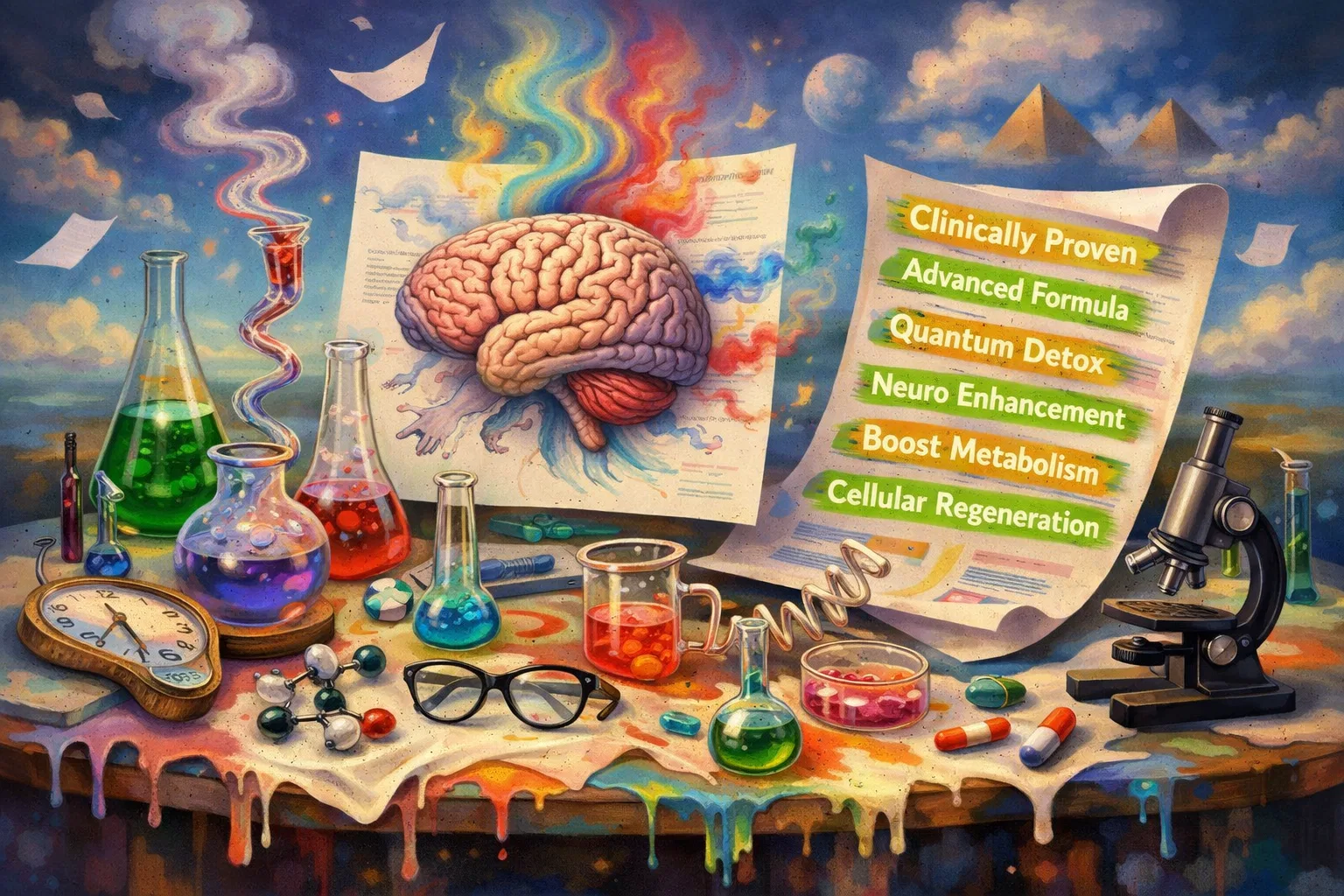
Science-sounding language can make a weak claim feel stronger than it is. A myth gains borrowed authority when it uses technical words, named mechanisms, laboratory imagery, references to “studies”, or phrases such as “clinically proven” without showing the quality of the evidence behind them. The danger is not jargon itself: specialists need precise terms. The problem is jargon used as a costume, where impressive wording substitutes for testable claims, clear methods, measured outcomes and fair comparison with better evidence.
This matters because many myths and misconceptions do not announce themselves as anti-science. They often imitate science. A wellness advert may mention “cellular detoxification”, a productivity guru may cite “dopamine pathways”, or a conspiracy claim may attach a scientific reference that does not support the conclusion. Research on misinformation suggests that these cues can exploit people’s respect for science unless readers pause to ask what evidence is actually being offered. In experiments, false claims with scientific references were more believable and shareable among people who trusted science, while reminders to critically evaluate the evidence reduced belief in those claims.[ScienceDirect]sciencedirect.comSource details in endnotes.
Borrowed authority
Science has earned public authority because its stronger claims are expected to be testable, revisable and exposed to criticism. Science-sounding myths borrow that authority while avoiding the discipline that gives it value. They may use technical language, graphs, lab coats, complex acronyms or impressive institutional references, but the core claim remains weak: vague, overextended, cherry-picked, untested or unsupported by the cited source.
A useful phrase for this pattern is “borrowed authority”. The claim does not stand on the strength of its own evidence; it leans on the prestige of science as a social signal. That is why the presence of a citation is not enough. A reference can be irrelevant, low-quality, preliminary, misquoted or about a different question. The O’Brien, Palmer and Albarracín experiments are especially relevant here because they did not simply show that people trust science. They showed a more specific risk: scientific references can make false claims look credible, and critical evaluation performs better than a generic “trust science” cue.[Annenberg]asc.upenn.edumisplaced trust when trust science fosters pseudosciencemisplaced trust when trust science fosters pseudoscience
This is not an argument against trusting scientific institutions, peer review or expertise. It is an argument against treating the surface features of science as if they were the same as evidence. Real scientific authority is earned through methods: well-designed studies, transparent data, plausible mechanisms, appropriate statistics, expert scrutiny, replication and limits on what the findings can support. Weak claims often display the symbols of this process while skipping the process itself.
One reason this works is that scientific topics often place readers in an unequal knowledge position. Most people cannot instantly judge whether a phrase such as “quantum bio-resonance”, “neuro-linguistic recalibration” or “epigenetic optimisation” is meaningful in the context where it appears. When a claim is hard to inspect, readers may use fluency shortcuts: Does it sound expert? Does it include a technical mechanism? Does it resemble language I have seen in credible sources? Those shortcuts are not foolish; they are normal. But they are exploitable.
Jargon without evidence
Jargon becomes suspicious when it makes a claim less clear while making it feel more authoritative. In legitimate science, technical terms compress precise shared meanings. In weak claims, technical terms often do the opposite: they blur the claim, hide missing evidence, or create an impression that a simple question has already been answered.
Studies of science communication show that jargon can obstruct understanding. In an experiment with 650 participants, exposure to jargon in information about emerging technologies impaired people’s ability to process the information; that difficulty was linked to greater resistance to persuasion, higher risk perceptions and lower support for technology adoption.[PubMed]pubmed.ncbi.nlm.nih.govSource details in endnotes. That finding cuts two ways. Jargon can alienate readers from good science, but it can also create a fog in which weak science-sounding claims become harder to interrogate.
A related body of work shows how irrelevant technical detail can make an explanation feel more satisfying. The well-known “seductive allure of neuroscience” research found that non-expert groups judged explanations as more satisfying when they included logically irrelevant neuroscience information. Later work described this as an effect where extra scientific detail can act as a marker of explanation quality even when it does not actually improve the reasoning.[PMC]pmc.ncbi.nlm.nih.govPMCThe Seductive Allure of Neuroscience ExplanationsPMCThe Seductive Allure of Neuroscience Explanations
The same mechanism appears in everyday myths. A claim that “stress is bad for health” is broad but plausible. A claim that a bracelet “restores cellular frequency through quantum resonance to neutralise stress pathways” sounds more sophisticated, but the extra words have not provided a testable effect, a measured outcome, a comparison group or a reason to believe the bracelet works. The language has moved from explanation to decoration.
Three features are especially common:
A named mechanism with no measurement. The claim identifies a biological, neurological or physical mechanism but never shows that the mechanism was measured in the people, product or situation being discussed.
A real term used outside its proper range. Words such as “quantum”, “epigenetic”, “inflammation”, “detox”, “microbiome”, “frequency” and “neuroplasticity” have legitimate meanings. Weak claims stretch them into vague promises.
A precise-sounding phrase attached to a vague outcome. “Supports cellular health”, “balances hormones”, “optimises brain chemistry” and “boosts immunity” may sound technical, but they are often too broad to evaluate unless the speaker defines the outcome and evidence standard.
When the claim looks testable but is not
Weak science-sounding claims often protect themselves from failure. They may say the product works only if the user is “ready”, that negative findings prove the method is too advanced for conventional testing, or that critics lack the right framework to understand it. This matters because testability is not a decorative feature of science; it is central to whether a claim can be checked.
A tutorial on science and pseudoscience in communication disorders describes pseudoscience as claims that appear to be based on the scientific method but are not, and lists untestability as a key warning sign: if no direct observation could test or disprove the claimed benefit, credibility rests on the developer’s assertions rather than on scientific acceptance.[Speech Language Therapy]speech-language-therapy.comSpeech Language Therapy
This is where many myths become resilient. A weak claim may be phrased in a way that has no clear failure condition. For example, “this method helps your body remember its natural healing intelligence” can absorb almost any outcome. If the person improves, the method gets credit. If the person does not improve, the explanation can shift to dosage, mindset, hidden toxins, emotional blockage or individual variation. The claim keeps moving just beyond the reach of evidence.
Real scientific claims also have uncertainty, exceptions and boundary conditions. The difference is that good evidence narrows the claim rather than expanding it without limit. It asks: for whom, compared with what, measured how, over what period, and with what harms or trade-offs? Pseudoscientific language often removes those boundaries. McGill University’s Office for Science and Society describes this as a hallmark of pseudoscience: where real science sees complexity and uncertainty, pseudoscience often offers unnatural simplicity and overconfident certainty.[McGill University]mcgill.caSource details in endnotes.
The advert test: what evidence would have to exist?
Health and wellness claims provide a clear example because they often use scientific language in commercial settings. Regulators do not treat impressive wording as proof. The US Federal Trade Commission’s health-products guidance says advertising must be truthful, not misleading, and adequately substantiated before it is disseminated; for health benefits and safety claims, that usually means “competent and reliable scientific evidence”, often including randomised controlled human clinical testing depending on the claim.[Federal Trade Commission]ftc.govSource details in endnotes.
This standard exposes the gap between science-sounding language and evidence. A supplement advert might say an ingredient “activates mitochondrial pathways associated with vitality”. Even if that phrase refers to a real biological pathway, it does not establish that taking the product improves fatigue, mood, lifespan, disease risk or any other meaningful outcome in humans. The relevant question is not “Can the seller name a mechanism?” but “Has the claimed outcome been tested well enough to support what consumers are likely to believe?”
The FDA’s consumer warnings about fraudulent products make the same point from the safety side. It warns against products marketed as alternatives to approved drugs or claiming drug-like effects, and flags unproven claims sold through dubious channels, rapid-effect promises and products that may pose serious health risks.[U.S. Food and Drug Administration]fda.govU.S. Food and Drug Administration Fraudulent Products | FDAU.S. Food and Drug Administration Fraudulent Products | FDA Science-sounding language can therefore cause two kinds of harm: it can waste money, and it can steer people towards unsafe or ineffective choices.
For a reader, the practical advert test is simple: translate the claim into a plain sentence. “Clinically formulated to support immune resilience” becomes “This product reduces my chance of getting ill, or reduces severity or duration when I do.” Once translated, the evidence burden becomes clearer. If the seller cannot define the outcome, identify the study population, show relevant human evidence and explain the size of the effect, the scientific language has done more persuasive work than evidential work.
Questions that reveal weak claims
The most useful response to science-sounding language is not cynicism. It is controlled curiosity. The goal is to slow down the jump from “this sounds scientific” to “this is scientifically supported”.
Ask these questions before accepting the claim:
- What is the exact claim in plain English? If the speaker cannot translate the technical wording into a clear, testable sentence, the wording may be doing camouflage work.
- What outcome was measured? “Improves cellular health” is not enough. Look for specific outcomes: symptom scores, disease incidence, recovery time, blood markers, performance measures, adverse events or other defined endpoints.
- Was the evidence about humans, animals, cells or theory? Lab and animal studies can be useful early evidence, but they do not automatically justify claims about real-world benefits in people.
- Does the citation support the advertised conclusion? A paper can be real and still irrelevant. Check whether it studied the same product, dose, population, comparison and outcome.
- What would count against the claim? If every possible result can be explained away, the claim is not behaving like a scientific claim.
- Are uncertainty and limits stated? Strong evidence usually comes with boundaries. Overconfident promises, universal cures and “one cause of everything” explanations are warning signs.
- Who benefits if I believe this? Commercial interest does not automatically make a claim false, but it raises the importance of independent evidence.
These questions work because they shift attention from the style of the claim to the structure of the evidence. They do not require the reader to be a specialist in every field. They require the claimant to make the claim inspectable.

Why “sciencey words” are persuasive
Science-sounding language is persuasive because it offers a shortcut through uncertainty. It tells the reader: this has already been worked out by people who know more than you do. That shortcut is sometimes appropriate. Modern life depends on deferring to expertise. But weak claims exploit the same habit by presenting the appearance of expertise without the constraints of expertise.
The strongest defence is not to reject technical language outright. Some accurate explanations really are technical, and oversimplifying them can create new misconceptions. The better rule is to treat technical language as an invitation to inspect, not a reason to stop inspecting. Good science can survive translation into plain claims and clear evidence. Weak claims often cannot.
The clearest warning sign is a mismatch between verbal sophistication and evidential thinness. When a claim sounds complex but rests on anecdotes, testimonials, undefined mechanisms, irrelevant citations or impossible-to-falsify promises, the reader is not being offered stronger science. They are being offered a myth wearing a lab coat.
Amazon book picks
Further Reading
Books and field guides related to Why Sciencey Language Makes Myths Persuasive. Use these as the next step if you want deeper reading beyond the article.
The Skeptics' Guide to the Universe
Explains pseudoscience and misuse of scientific authority.
eBay marketplace picks
Marketplace Samples
Example marketplace items related to this page. Use the search link to explore similar finds on eBay.


Endnotes
1.
Source: sciencedirect.com
Link:https://www.sciencedirect.com/science/article/abs/pii/S0022103121000871
2.
Source: pmc.ncbi.nlm.nih.gov
Title: PMCThe Seductive Allure of Neuroscience Explanations
Link:https://pmc.ncbi.nlm.nih.gov/articles/PMC2778755/
3.
Source: speech-language-therapy.com
Title: Speech Language Therapy
Link:https://www.speech-language-therapy.com/pdf/finn-bothe-bramlett-2005.pdf
4.
Source: mcgill.ca
Link:https://www.mcgill.ca/oss/article/critical-thinking-pseudoscience/hallmarks-pseudoscience
5.
Source: fda.gov
Title: U.S. Food and Drug Administration Fraudulent Products | FDA
Link:https://www.fda.gov/drugs/medication-health-fraud/fraudulent-products
6.
Source: sciencedirect.com
Link:https://www.sciencedirect.com/science/article/pii/S2352550922000938
7.
Source: sciencedirect.com
Link:https://www.sciencedirect.com/science/article/abs/pii/S0010027716301585
8.
Source: sciencedirect.com
Link:https://www.sciencedirect.com/science/article/pii/S0277953619305465
9.
Source: fda.gov
Link:https://www.fda.gov/consumers/health-fraud-scams/health-fraud-product-database
10.
Source: fda.gov
Link:https://www.fda.gov/consumers/health-fraud-scams
11.
Source: who.int
Link:https://www.who.int/europe/news/item/01-09-2022-infodemics-and-misinformation-negatively-affect-people-s-health-behaviours–new-who-review-finds
12.
Source: asc.upenn.edu
Title: misplaced trust when trust science fosters pseudoscience
Link:https://www.asc.upenn.edu/news-events/news/misplaced-trust-when-trust-science-fosters-pseudoscience
13.
Source: pubmed.ncbi.nlm.nih.gov
Link:https://pubmed.ncbi.nlm.nih.gov/31354058/
14.
Source: ftc.gov
Link:https://www.ftc.gov/business-guidance/resources/health-products-compliance-guidance
15.
Source: pubmed.ncbi.nlm.nih.gov
Link:https://pubmed.ncbi.nlm.nih.gov/39260088/
16.
Source: pubmed.ncbi.nlm.nih.gov
Link:https://pubmed.ncbi.nlm.nih.gov/41867879/
17.
Source: Wikipedia
Link:https://en.wikipedia.org/wiki/Pseudoscience
Additional References
18.
Source: youtube.com
Title: Science vs Pseudoscience: Critical Thinking
Link:https://www.youtube.com/watch?v=Yp6S3Z453rA
Source snippet
These videos explain how jargon and scientific-sounding language are used to provide "borrowed authority" to weak or pseudoscientific claims...
19.
Source: reddit.com
Link:https://www.reddit.com/r/psychology/comments/os471a/misplaced_trust_when_trust_in_science_fosters/
20.
Source: researchgate.net
Link:https://www.researchgate.net/publication/283269131_Deconstructing_the_Seductive_Allure_of_Neuroscience_Explanations
21.
Source: researchgate.net
Link:https://www.researchgate.net/publication/24357198_Making_Sense_of_scientific_claims_in_advertising_A_study_of_scientifically_aware_consumers
22.
Source: researchgate.net
Link:https://www.researchgate.net/publication/393895923Scientific_jargon_can_be%27satisfying%27_-_but_misleading
23.
Source: researchgate.net
Link:https://www.researchgate.net/publication/397534513_The_Power_of_Technical_Language_Does_Jargon_Use_Influence_the_Credibility_of_Misinformation
24.
Source: cohenhealthcarelaw.com
Link:https://cohenhealthcarelaw.com/fda-ftc-law/advertising-and-marketing-claims/
25.
Source: trinomics.eu
Link:https://trinomics.eu/wp-content/uploads/2018/10/CHAFEA2018-Behavioural-study-on-consumer-engagement-in-the-circular-economy.pdf
26.
Source: nationalacademies.org
Link:https://www.nationalacademies.org/read/27894/chapter/8
27.
Source: facebook.com
Link:https://www.facebook.com/FDA/posts/dont-be-fooled-by-health-fraud-here-are-some-tell-tale-signs-that-a-product-clai/595233712633991/
Topic Tree