Within Media Literacy
When outrage should make you pause
Strong emotion is not proof of falsehood, but outrage, fear, and simple villains are signals to slow down before believing or sharing.
On this page
- How emotional content speeds up sharing
- Common manipulation patterns in dramatic claims
- Questions that separate evidence from reaction
Page outline Jump by section
Introduction
Emotional headlines are not reliable indicators of truth. A headline that makes people angry, frightened, shocked, or morally outraged can be completely accurate, partly misleading, or entirely false. The key media-literacy lesson is not that emotion means a claim is wrong, but that strong emotion is a signal to slow down before accepting or sharing it.
 This matters because many myths and misconceptions spread through emotional reactions rather than careful evaluation. Research consistently finds that emotionally charged misinformation attracts attention, encourages sharing, and can bypass the normal habits people use to check evidence. When a headline makes you feel something immediately, that feeling is often the moment when critical thinking is most needed.[Science]science.orgMisinformation exploits outrage to spread onlineby KL McLoughlin · 2024 · Cited by 106 — We tested a hypothesis that misinformatio…
When outrage should make you pause
The most successful misleading headlines often deliver an emotional reward before they deliver evidence. They provide a villain to blame, a threat to fear, or a reason to feel morally certain. That emotional impact can create momentum that carries a claim through social networks long before anyone investigates whether it is true.
Researchers studying misinformation have found that outrage plays a particularly important role. A 2024 study published in Science concluded that misinformation often exploits moral outrage and that outrage helps drive online sharing. The effect appeared across different platforms and datasets, suggesting that emotional activation is not a minor feature of misinformation but one of its most powerful distribution mechanisms.[Science]science.orgMisinformation exploits outrage to spread onlineby KL McLoughlin · 2024 · Cited by 106 — We tested a hypothesis that misinformatio…[Tech Policy Press]Tech Policy PressResearchers Consider the Relationship Between…Dec 4, 2024 — Interestingly, misinformation triggered anger more than any other emotion…
Importantly, this does not mean accurate reporting should never provoke strong feelings. Real scandals, disasters, crimes, and injustices are often upsetting. The warning sign is not the presence of emotion alone but the combination of intense emotion with weak evidence, simplistic explanations, or pressure to react immediately.
How emotional content speeds up sharing
Emotional headlines often spread faster because they encourage rapid responses rather than reflective evaluation.
Several psychological processes contribute to this effect:
- Attention capture: Humans naturally notice threats, conflict, and surprise more readily than routine information.
- Social signalling: Sharing emotional content can express identity, loyalty, outrage, or group membership.
- Reduced scrutiny: Strong emotional reactions can shift attention away from source quality and toward the feeling the content creates.
- Immediate action impulses: Anger and fear frequently encourage quick reactions, including reposting and commenting. American Psychological Association[springer]link.springer.comon emotion promotes belief in fake newsby C Martel · 2020 · Cited by 775 — Such findings suggest that relying on existing feelings may co… Research examining belief in false information has found that people who rely more heavily on emotional responses tend to be more susceptible to fake news. The effect is not simply a matter of intelligence or education; it relates to whether people evaluate claims through evidence or through how the claims make them feel.[PMC]pmc.ncbi.nlm.nih.govPMCReliance on emotion promotes belief in fake newsNIHby C Martel · 2020 · Cited by 760 — More specifically within the domain of political fake news, anger has been suggested to prom…
Studies of health misinformation have reached similar conclusions. Anger-based messaging can increase recall of misleading claims, making them more memorable and therefore more likely to influence later judgments.[Taylor & Francis Online]tandfonline.comTaylor & Francis OnlineHow Anger Appeals Facilitate Health Misinformation Recall…by J Lee · 2024 · Cited by 10 — The studies test mech…
Common manipulation patterns in dramatic claims
Emotionally manipulative headlines tend to reuse a relatively small set of patterns. Recognising them does not prove a claim is false, but it does indicate that extra verification is warranted.
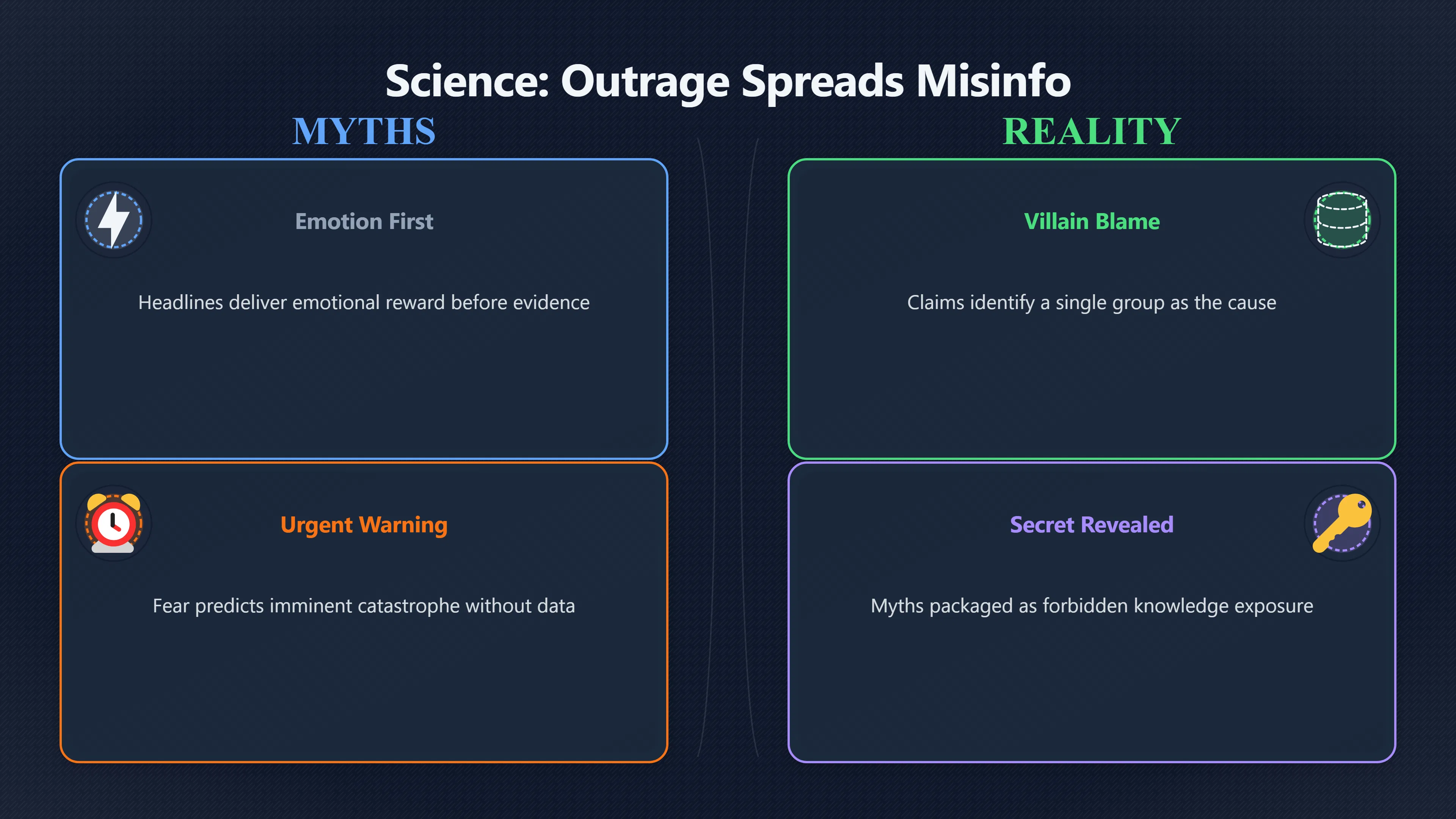
The instant villain
Some headlines identify a single person, group, or institution as the obvious cause of a complex problem. Reality is often more complicated than the emotional story being offered.
Examples include claims structured around:
- “They are hiding the truth.”
- “This group is responsible for everything.”
- “The media refuses to tell you this.”
Such framing encourages anger before evidence has been examined.
The emergency warning
Fear is one of the strongest motivators of attention and sharing. Headlines that predict imminent catastrophe can spread rapidly because people feel a responsibility to warn others.
Warning signs include:
- Claims of a hidden danger affecting everyone.
- Predictions of disaster without supporting data.
- Urgent instructions to share immediately.
The emotional urgency may be genuine, but urgency itself is not evidence.
The shocking secret
Many myths are packaged as revelations.
Phrases such as “what they don’t want you to know”, “the truth exposed”, or “finally revealed” encourage readers to feel they have gained access to forbidden knowledge. This can create a sense of excitement and certainty before verification occurs.
The outrage shortcut
Some headlines are designed primarily to provoke moral anger.
Research shows misinformation often generates stronger outrage responses than trustworthy information, and those responses can increase sharing even when accuracy is not the reason people are sharing the content.[Science]science.orgMisinformation exploits outrage to spread onlineby KL McLoughlin · 2024 · Cited by 106 — We tested a hypothesis that misinformatio…[Financial Times]ft.comWhile traditional citations reflect academic influence, altmetrics aim to capture external engagement, such as mentions on social media…

Questions that separate evidence from reaction
Media literacy works best when emotional reactions become cues for investigation rather than cues for sharing.
When a headline produces an immediate emotional response, useful questions include:
- What specific evidence is being presented?
Is there verifiable information, or only dramatic language?
- Who is making the claim?
Can the source be independently evaluated?
- Would this claim still seem convincing if the emotional wording were removed?
Rephrasing a headline in neutral language often reveals how much of its persuasive power comes from emotion rather than facts.
- Is there independent confirmation?
Major claims should appear in multiple reliable sources, not just one emotionally charged post.
- Am I reacting to the evidence or to the feeling?
This question is particularly useful when anger, fear, disgust, or excitement appear before understanding.
These habits align with media-literacy frameworks such as SIFT, whose first step is simply to stop before reacting. That pause creates space for verification before sharing.[guides.lib.uchicago.edu]guides.lib.uchicago.eduThe SIFT MethodEvaluating Resources and Misinformation30 Jun 2025 — Evaluating Resources and Misinformation · The SIFT Method · S - Stop · I - Investiga…
Why emotional awareness helps prevent myths
Media literacy is often described as a defence against misinformation because it helps people recognise manipulation techniques before they become persuaded by them. UNESCO identifies critical engagement with information as a core skill for navigating modern information environments and resisting disinformation.[UNESCO]unesco.orgMedia and Information LiteracyDiscover how UNESCO supports MIL for all to engage critically with information, navigate the digital…[UNESCO]unesco.orgOpen source on unesco.org.
Emotional awareness is one practical part of that defence. People do not need to suppress their reactions or become emotionally detached readers. Instead, they can treat strong emotional responses as prompts for closer inspection.
A useful rule is simple: the stronger the emotional pull of a headline, the more valuable a brief pause becomes. Outrage, fear, and shock are not proof that a claim is false. They are reminders that feelings arrive faster than verification—and that myths often rely on that difference. American Psychological Association[Science]science.orgMisinformation exploits outrage to spread onlineby KL McLoughlin · 2024 · Cited by 106 — We tested a hypothesis that misinformatio…
Amazon book picks
Further Reading
Books and field guides related to When outrage should make you pause. Use these as the next step if you want deeper reading beyond the article.
Thinking, Fast and Slow
Shows how emotional and intuitive thinking can distort evaluation of claims.

The Righteous Mind
First published 2012. Subjects: Political psychology, Social psychology, Ethics, Religious Psychology, nyt:combined-print-and-e-book-nonf...
eBay marketplace picks
Marketplace Samples
Example marketplace items related to this page. Use the search link to explore similar finds on eBay.


Endnotes
1.
Source: link.springer.com
Link:https://link.springer.com/article/10.1186/s41235-020-00252-3
Source snippet
on emotion promotes belief in fake newsby C Martel · 2020 · Cited by 775 — Such findings suggest that relying on existing feelings may co...
2.
Source: pmc.ncbi.nlm.nih.gov
Title: PMCReliance on emotion promotes belief in [fake news]({{ ‘fake-news/’ | relative_url }})
Link:https://pmc.ncbi.nlm.nih.gov/articles/PMC7539247/
Source snippet
NIHby C Martel · 2020 · Cited by 760 — More specifically within the domain of political fake news, anger has been suggested to prom...
3.
Source: guides.lib.uchicago.edu
Title: The SIFT Method
Link:https://guides.lib.uchicago.edu/c.php?g=1241077&p=9082322
Source snippet
Evaluating Resources and Misinformation30 Jun 2025 — Evaluating Resources and Misinformation · The SIFT Method · S - Stop · I - Investiga...
4.
Source: unesco.org
Link:https://www.unesco.org/en/media-information-literacy
Source snippet
Media and Information LiteracyDiscover how UNESCO supports MIL for all to engage critically with information, navigate the digital...
5.
Source: unesco.org
Link:https://www.unesco.org/en/articles/media-and-information-literacy-first-line-defence-against-disinformation
6.
Source: unesco.org
Title: media and information literacy and digital competencies
Link:https://www.unesco.org/en/articles/media-and-information-literacy-and-digital-competencies
Source snippet
Apr 12, 2025 — Media and Information Literacy (MIL) initiatives promote critical thinking and ethical AI use, combating misinformation an...
7.
Source: community.unesco.org
Link:https://community.unesco.org/milAlliance/s/feed/0D5Sm000010CYK0KAO
Source snippet
Detail24 Oct 2025 — UNESCO Global Media and Information Literacy... misinformation, analyze claims, and build their own automated fact-c...
8.
Source: unesco.org
Link:https://www.unesco.org/en/publication/action-plan-combatting-disinformation-and-misinformation-through-media-and-information-literacy-mil
Source snippet
ing misinformation by promoting information integrity.Read more...
9.
Source: unesco.org
Link:https://www.unesco.org/en/articles/new-unesco-issue-brief-reveals-global-gaps-media-and-information-literacy-policies-and-education
Source snippet
New UNESCO Issue Brief Reveals Global Gaps in Media...Oct 27, 2025 — This global analysis underscores a clear message: recognition of Me...
10.
Source: unesco.org
Title: media and information literacy critical thinking
Link:https://www.unesco.org/en/articles/media-and-information-literacy-critical-thinking
Source snippet
Media and Information Literacy for Critical ThinkingApr 20, 2023 — This has created a serious gap in critical thinking; webbed with the c...
11.
Source: unesco.org
Link:https://www.unesco.org/mil4teachers/en/module4
Source snippet
Module 4: Media and Information Literacy Competencies to...UNESCO discourages the term fake news, on the basis that if the content is fa...
12.
Source: unesco.org
Link:https://www.unesco.org/mil4teachers/en/module4/unit5
Source snippet
Unit 5: Media and Information Literacy and Misinformation11 Apr 2024 — After completing this unit, educators will be able to: Illustrate...
13.
Source: unesco.org
Link:https://www.unesco.org/en/articles/media-information-literacy-avenue-youth-combat-hate-speech-misinformation-disinformation
Source snippet
Media & Information Literacy: An Avenue for Youth to...29 Nov 2023 — UNESCO Dakar supported Gambia's National Youth Council's parallel s...
14.
Source: unesco.org
Link:https://www.unesco.org/mil4teachers/en/module4/unit3
Source snippet
Unit 3: Media and Misinformation11 Apr 2024 — Module 4: Media and Information Literacy Competencies to Tackle Misinformation, Disinformat...
15.
Source: unesco.at
Title: MIL Curriculum Modul 4
Link:https://www.unesco.at/fileadmin/user_upload/MIL_Curriculum_Modul_4.pdf
Source snippet
think CritiCaLLy, CLiCk WiseLy!8 Nov 2023 — (Second Edition of the UNESCO Model Media and Information Literacy Curriculum for... • Innov...
16.
Source: science.org
Link:https://www.science.org/doi/10.1126/science.adl2829
Source snippet
Misinformation exploits outrage to spread onlineby KL McLoughlin · 2024 · Cited by 106 — We tested a hypothesis that misinformatio...
17.
Source: Tech Policy Press
Link:https://techpolicy.press/researchers-consider-the-relationship-between-misinformation-outrage-and-the-sharing-of-content-on-social-media
Source snippet
Researchers Consider the Relationship Between...Dec 4, 2024 — Interestingly, misinformation triggered anger more than any other emotion...
18.
Source: ft.com
Link:https://www.ft.com/content/12aa378f-9c39-422b-802a-5b182c99a2bc
Source snippet
While traditional citations reflect academic influence, altmetrics aim to capture external engagement, such as mentions on social media...
19.
Source: tandfonline.com
Link:https://www.tandfonline.com/doi/abs/10.1080/15213269.2023.2269084
Source snippet
Taylor & Francis OnlineHow Anger Appeals Facilitate Health Misinformation Recall...by J Lee · 2024 · Cited by 10 — The studies test mech...
20.
Source: researchguides.austincc.edu
Title: The SIFT Method
Link:https://researchguides.austincc.edu/c.php?g=612891&p=9815507
Source snippet
SIFT Method - Fake News and Alternative Facts27 Mar 2026 — Online content is optimized with powerful algorithms and crowd-tested designs...
21.
Source: sciencedirect.com
Link:https://www.sciencedirect.com/science/article/pii/S1566253524000782
Source snippet
Emotion detection for misinformation: A reviewby Z Liu · 2024 · Cited by 104 — The specific query used was as follows: (emotion OR sentim...
22.
Source: sciencedirect.com
Link:https://www.sciencedirect.com/science/article/pii/S2405844024014117
Source snippet
Media and information literacy as a model of societal balanceby HMH Mansoor · 2024 · Cited by 16 — This study aimed to explore how to mit...
23.
Source: facebook.com
Link:https://www.facebook.com/unesco/posts/-stop-the-spread-of-disinformation-verify-the-information-before-you-share-toget/794851252690425/
Source snippet
unescoMisinformation, fake news, and misleading information can spread quickly on social media. It's always a good idea to verify informa...
24.
Source: guides.emich.edu
Link:https://guides.emich.edu/misinformation/evaluation
Source snippet
Methods - Misinformation, Disinformation, and BiasMisinformation, Disinformation, and Bias: Identifying misinformation, its various types...
25.
Source: unescoapceiu.org
Link:https://www.unescoapceiu.org/post/3228
Source snippet
EIU in the World10 Aug 2020 — Building resilience, openness and digital citizenship is part of what Media and Information Literacy (MIL)...
26.
Source: unesco.gov.ph
Link:https://www.unesco.gov.ph/wp-content/uploads/2020/03/UNESCO-Media-and-Information-Literacy-Framework-and-Recent-Initiatives.pdf
Source snippet
UNESCO's Media and Information Literacy Framework“Teaching media and information literacy to the youth in the face of post- truth: Testin...
27.
Source: sciencemediacentre.es
Title: outrage facilitates spread misinformation social networks
Link:https://sciencemediacentre.es/en/outrage-facilitates-spread-misinformation-social-networks
Source snippet
Outrage facilitates the spread of misinformation on social...28 Nov 2024 — According to a study, social media content containing misinfo...
Additional References
28.
Source: misinforeview.hks.harvard.edu
Link:https://misinforeview.hks.harvard.edu/article/happiness-and-surprise-are-associated-with-worse-truth-discernment-of-covid-19-headlines-among-social-media-users-in-nigeria/
Source snippet
misinformation is correctly identifying false headlines from true headlines.... Fake news grabs our attention, produces false memories a...
29.
Source: pledgeproject.eu
Link:https://www.pledgeproject.eu/fear-anger-and-uncertainty-when-disinformation-feeds-on-emotions-in-natural-disasters/
Source snippet
Fear, anger and uncertainty: when disinformation feeds on...Nov 6, 2025 — This heightened emotional state, often compounded by an initia...
30.
Source: pmc.ncbi.nlm.nih.gov
Link:https://pmc.ncbi.nlm.nih.gov/articles/PMC11656008/
Source snippet
in misinformation studies: distinguishing affective...by J Lühring · 2024 · Cited by 31 — Thus, both anger and anxiety can leave people...
31.
Source: ed.stanford.edu
Title: it doesn t take long learn how spot misinformation online stanford study finds
Link:https://ed.stanford.edu/news/it-doesn-t-take-long-learn-how-spot-misinformation-online-stanford-study-finds
Source snippet
doesn't take long to learn how to spot misinformation online...19 Apr 2022 — There may be new hope for helping young people – and anyone...
32.
Source: csh.ac.at
Link:https://csh.ac.at/news/do-emotions-make-us-more-susceptible-to-misinformation-not-per-se-according-to-a-new-study/
Source snippet
However... The paper “Emotions in misinformation studies: distinguishing affective state from emotional...Read more...
33.
Source: nature.com
Title: Why people share misinformation on social media?
Link:https://www.nature.com/articles/s41599-025-05511-6
Source snippet
M Wu · 2025 · Cited by 5 — Recent research on misinformation has also found that emotion plays a critical role in invoking misin...
34.
Source: libguides.ucmerced.edu
Title: The SIFT Method is complementary to [Lateral Reading]({{ ‘lateral-reading/’ | relative_url }}). Both
Link:https://libguides.ucmerced.edu/news/evaluation/sift-method
Source snippet
Evaluation & News Sources: The SIFT Method - LibGuides13 May 2026 — What to do about Fake News: Web Evaluation & News Sources: The SIFT...
Published: May 2026
35.
Source: hsph.harvard.edu
Title: lessons learned to fight misinformation focus on emotions
Link:https://hsph.harvard.edu/health-communication/news/lessons-learned-to-fight-misinformation-focus-on-emotions/
Source snippet
Harvard Chan School of Public HealthLessons learned: To fight misinformation, focus on emotions16 Jan 2025 — The experiments confirmed th...
36.
Source: facebook.com
Link:https://www.facebook.com/ScienceMagazine/posts/social-media-posts-containing-misinformation-evoke-more-moral-outrage-than-posts/957029976288972/
Source snippet
ts with trustworthy information, and that outrage facilitates the spread of...Read more...
37.
Source: committees.parliament.uk
Link:https://committees.parliament.uk/writtenevidence/141128/html/
Source snippet
content, critical thinking, and awareness of misinformation.... These include units on digital media messaging, source credibility, iden...
Topic Tree