Within Timing
Which myths need the fastest correction?
Health, safety, finance and voting rumours can require faster action because people may act before a full debunk is ready.
On this page
- The high harm and high spread decision matrix
- Why targeted correction may beat broad alerts
- Examples from health, disasters, finance and elections
Page outline Jump by section
Introduction
Not every false claim requires the same response speed. Some myths can be corrected over days or weeks with little practical consequence. Others can change behaviour within hours, causing people to avoid medical treatment, ignore safety instructions, withdraw money, distrust voting processes, or interfere with emergency responses. In these cases, waiting for a perfect debunk may allow the falsehood to do its damage first.
 The key question is not simply whether a claim is false, but whether it is likely to produce rapid real-world action before a fuller investigation is complete. Public health agencies, emergency communicators and election authorities increasingly treat certain rumours as high-priority threats because the cost of delay can be measured in illness, injuries, disrupted services, public disorder or lost trust. Effective correction in these situations is often targeted, rapid and action-focused rather than broad, comprehensive and slow.[World Health Organization]who.intdisinformation and public healthWorld Health OrganizationDisinformation and public health6 Feb 2024 — Both misinformation and disinformation may cause harm, which compri…[CDC]cdc.govCrisis & Emergency Risk Communication (CERC)Jul 28, 2025 — CDC's Crisis and Emergency Risk Communication (CERC) program provides training…
Which myths belong at the front of the queue?
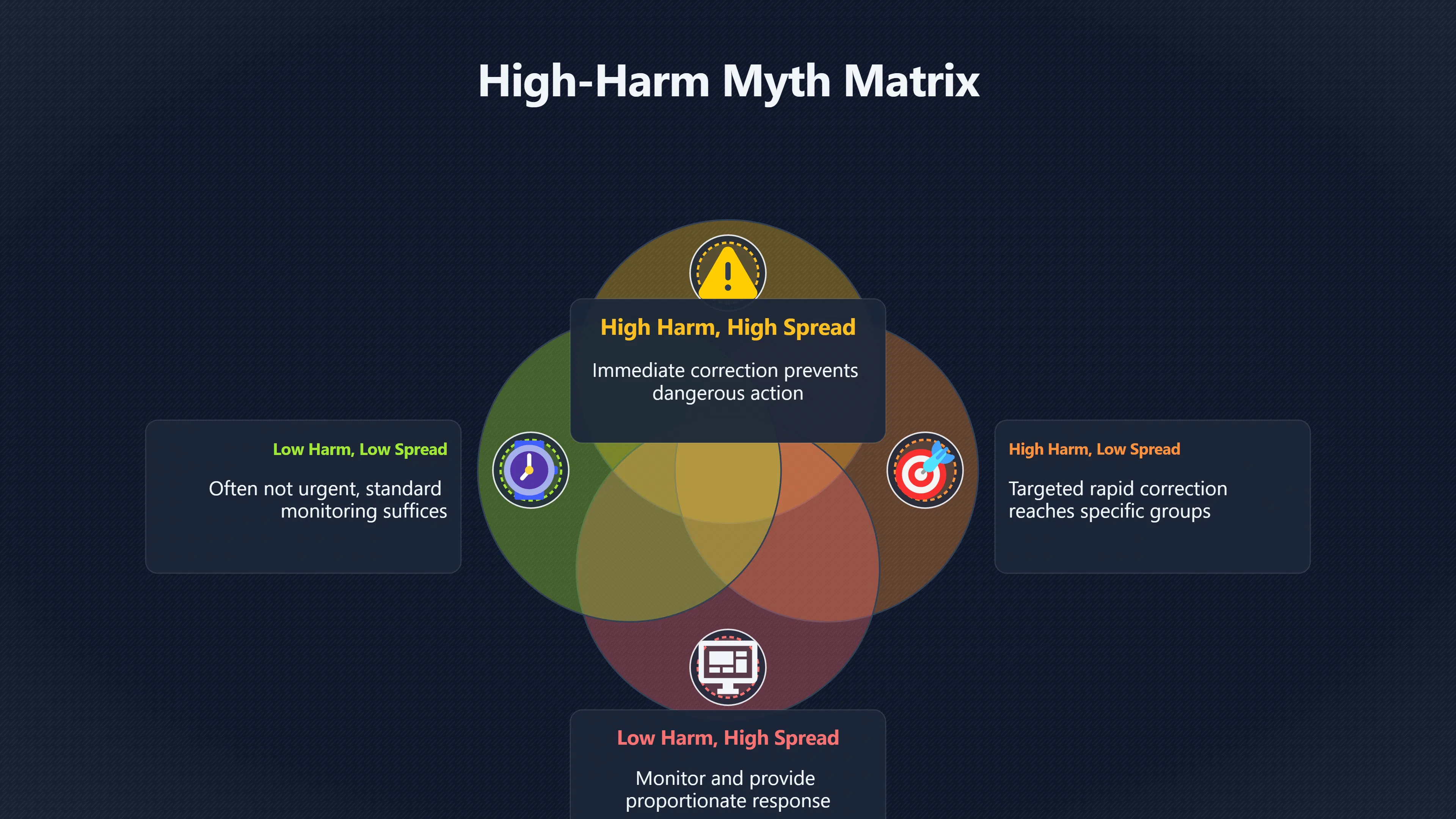
A useful way to prioritise misinformation is to consider two factors simultaneously:
Potential harmPotential spreadPriorityHigh harmHigh spreadImmediate correctionHigh harmLow spreadTargeted rapid correctionLow harmHigh spreadMonitor and proportionate responseLow harmLow spreadOften not urgent
The most dangerous category is the combination of high harm and high spread. A false claim that encourages people to reject emergency evacuation orders, avoid life-saving treatment, or distrust voting instructions can cause damage long before fact-checkers publish detailed analyses.
Risk communication frameworks used in public health and emergency management stress that communicators should be first, accurate and credible, while openly stating what is known and unknown. The goal is not merely to win an argument but to prevent harmful behaviour during periods of uncertainty. CDC[PMC]pmc.ncbi.nlm.nih.govPMCThe impact of misinformation on the COVID-19 pandemicby MMF Caceres · 2022 · Cited by 329 — Some examples include association of face masks and CO2 toxicity, conspiracy theories related t…
The high-harm and high-spread decision matrix
High-harm myths tend to share several characteristics.
They create an immediate behavioural instruction. The rumour effectively tells people to do something or stop doing something. Examples include avoiding vaccines, ignoring evacuation notices, withdrawing deposits from financial institutions, or using incorrect voting procedures.
They exploit uncertainty. These myths often emerge when reliable information is still developing. Natural disasters, disease outbreaks and election counts all create information gaps that rumours can fill.
They target trust. Many high-harm myths do not merely dispute a fact. They undermine confidence in institutions, experts or procedures that people rely upon during crises.[World Health Organization]who.intdisinformation and public healthWorld Health OrganizationDisinformation and public health6 Feb 2024 — Both misinformation and disinformation may cause harm, which compri…[Research Briefings]researchbriefings.files.parliament.ukPOST PN 0719parliament.ukDisinformation: sources, spread and impact25 Apr 2024 — Disinformation is the deliberate creation and spread of false and/or…
Because of these features, communicators frequently prioritise harm reduction over exhaustive explanation. A brief corrective message that prevents dangerous behaviour may be more valuable than a detailed report published too late.
Why targeted correction may beat broad alerts
A common mistake is assuming that the widest possible correction is always the best one. In high-harm situations, targeted communication can be more effective.
If a rumour is circulating primarily among a specific community, geographic area or online network, directly reaching that audience may prevent harm faster than issuing a general public statement. This approach also reduces the risk of amplifying a false claim to people who had never encountered it.
Targeted correction works best when it answers the practical question people face at that moment:
- What should I do right now?
- Which source should I trust?
- What action is safe while facts are still being verified?
- Where can I get updates?
Emergency communication research consistently emphasises promoting concrete protective actions alongside corrections. People under stress often need behavioural guidance more than lengthy factual rebuttals.[ASPR TRACIE]asprtracie.hhs.govd after an incident can help residents feel informed and empowered.Read more…[CDC]cdc.govCrisis & Emergency Risk Communication (CERC) Manual20 Nov 2024 — The CERC manual provides an evidence-based framework and recommended…
Health myths can cost lives before the evidence review is finished
Public health misinformation is one of the clearest examples of a category requiring rapid intervention.
During the COVID-19 pandemic, false claims about vaccines, treatments, masks and disease transmission influenced health behaviour around the world. Researchers documented how misinformation affected public understanding, treatment choices and vaccine acceptance. The World Health Organization described the situation as an accompanying “infodemic” in which misleading information spread alongside the disease itself.[PMC]pmc.ncbi.nlm.nih.govPMCThe impact of misinformation on the COVID-19 pandemicby MMF Caceres · 2022 · Cited by 329 — Some examples include association of face masks and CO2 toxicity, conspiracy theories related t…[2reutersinstitute.politics.ox.ac.uk]reutersinstitute.politics.ox.ac.uktypes sources and claims covid 19 misinformationTypes, sources, and claims of COVID-19 misinformation7 Apr 2020 — In mid-February, the World Health Organization announced that the new c…
The urgency arises because health decisions are often time-sensitive. A person persuaded that a vaccine is immediately dangerous, or that an unproven remedy is superior to medical treatment, may act before a full scientific rebuttal reaches them.
Recent events demonstrate that the danger is not merely theoretical. Reuters reported that false health rumours in the Democratic Republic of Congo contributed to panic, attacks on health workers and multiple deaths, illustrating how quickly misinformation can escalate from online claims into physical harm.[Reuters]reuters.comFake rumors, real killings: Inside Congo's deadly health misinformation crisisThe panic led to violence, including the killing of four health workers conducting vaccination surveys. The WHO and Africa Infodemic Resp…
In these circumstances, communicators often prioritise rapid messages such as:
- The claim is unverified.
- Current evidence does not support it.
- Continue following established medical guidance.
- Updates will be provided as more information becomes available.
Disaster rumours can interfere with emergency response
Natural disasters create ideal conditions for high-harm myths. Information changes rapidly, communication systems may be disrupted, and people urgently need guidance.
False claims about evacuation routes, shelter availability, contaminated water, weather manipulation or government response efforts can alter behaviour within hours. Rumours can discourage evacuation, overwhelm emergency services with unnecessary requests, or divert attention from genuine hazards.
After major disasters, emergency agencies increasingly maintain dedicated rumour-control pages because misinformation can directly interfere with relief operations. Reporting on misinformation following Hurricane Helene highlighted concerns that false claims were distracting from disaster response and creating confusion among affected communities.[The Guardian]theguardian.comTop Republicans, including Donald Trump, are accused of spreading falsehoods tying the disaster to immigration issues. Claims include gov…
For this reason, disaster communicators often favour short, repetitive corrections tied to specific actions:
- Which areas should evacuate.
- Which roads are open.
- Where official updates are available.
- Which claims are currently unsupported.
The practical instruction is often more important than winning a debate over the rumour’s origins.
Financial rumours can trigger self-fulfilling behaviour
Financial misinformation occupies a distinctive category because the belief itself can contribute to the outcome people fear.
A rumour suggesting that a bank, investment platform or payment system is about to fail may prompt customers to withdraw funds or change behaviour immediately. Even when the underlying claim is false, widespread reaction can create operational stress and market disruption.
This dynamic means that corrective communication often has a narrow time window. Delayed responses allow uncertainty to grow, while premature or poorly evidenced denials can damage credibility. Effective responses therefore focus on verifiable facts, operational status updates and clear explanations of what customers should do if they have concerns.
Because financial systems depend heavily on trust, rumours that undermine confidence often receive rapid attention even before every detail is known.
Election myths become more dangerous as deadlines approach
Election misinformation illustrates why timing matters as much as factual accuracy.
Many election-related rumours are not primarily designed to persuade voters of a policy position. Instead, they create confusion about procedures: where to vote, when to vote, whether ballots count, whether polling places are open, or whether results can be trusted.
These claims become increasingly harmful as election deadlines approach because there may be little opportunity for correction afterwards. False voting instructions can suppress participation even if a debunk appears later. Researchers, election officials and democracy organisations have repeatedly identified procedural voting misinformation as a particularly dangerous category.[Brennan Center for Justice]brennancenter.orgBrennan Center for JusticeElection MisinformationFalse claims have eroded trust in elections and provoked a wave of anti-voter laws. The…[Time]time.comvoting process is prevalent online. It is important to differentiate between misinformation, which is false information shared unknowingl…
Election security agencies have also warned that delays in vote counting or reporting can create opportunities for misleading narratives that exploit uncertainty and erode trust in outcomes.[Axios]axios.comThey cautioned that foreign actors are likely to exploit these delays to spread disinformation, potentially including false reports of vo…
As a result, election communication strategies often prioritise immediate correction of claims about:
- Voting dates and deadlines.
- Polling locations.
- Ballot submission methods.
- Vote-counting procedures.
- Election result reporting.
The objective is not simply factual accuracy but protecting citizens’ ability to participate based on reliable information.

The fastest correction is not always the longest correction
High-harm myths require a different communication strategy from ordinary online rumours. The most effective response is often a rapid, targeted intervention that prevents harmful action while a fuller investigation continues.
Health scares, disaster rumours, financial panic claims and election misinformation all share a common feature: people may act before a complete debunk is available. In these situations, communicators gain more by quickly establishing a trusted source, clarifying what is known, acknowledging uncertainty and providing a safe course of action than by waiting for a perfect rebuttal. The central challenge is not merely correcting a false belief but interrupting harmful behaviour before it spreads.[CDC]cdc.govCERC: IntroductionGood risk communication aims to keep outrage in proportion to hazard so people will have the appropriate level of co…[CDC]cdc.govCenters for Disease Control and PreventionCDC is the nation's leading science-based, data-driven, service organization that protects…
Amazon book picks
Further Reading
Books and field guides related to Which myths need the fastest correction?. Use these as the next step if you want deeper reading beyond the article.
The Psychology of Fake News
Provides evidence on belief formation, misinformation effects and correction.

eBay marketplace picks
Marketplace Samples
Example marketplace items related to this page. Use the search link to explore similar finds on eBay.



Endnotes
1.
Source: who.int
Title: disinformation and public health
Link:https://www.who.int/news-room/questions-and-answers/item/disinformation-and-public-health
Source snippet
World Health OrganizationDisinformation and public health6 Feb 2024 — Both misinformation and disinformation may cause harm, which compri...
2.
Source: cdc.gov
Link:https://www.cdc.gov/cerc/php/about/index.html
Source snippet
Crisis & Emergency Risk Communication (CERC)Jul 28, 2025 — CDC's Crisis and Emergency Risk Communication (CERC) program provides training...
3.
Source: cdc.gov
Link:https://www.cdc.gov/cerc/php/cerc-manual/index.html
Source snippet
Crisis & Emergency Risk Communication (CERC) Manual20 Nov 2024 — The CERC manual provides an evidence-based framework and recommended...
4.
Source: cdc.gov
Link:https://www.cdc.gov/cerc/media/pdfs/CERC_Introduction.pdf
Source snippet
CERC: IntroductionGood risk communication aims to keep outrage in proportion to hazard so people will have the appropriate level of co...
5.
Source: pmc.ncbi.nlm.nih.gov
Link:https://pmc.ncbi.nlm.nih.gov/articles/PMC7745758/
Source snippet
survey of crisis and emergency risk communication...by LMO Yong · 2020 · Cited by 49 — This integrated framework of risk and crisis comm...
6.
Source: asprtracie.hhs.gov
Link:https://asprtracie.hhs.gov/technical-resources/79/risk-communications-emncy-public-information-and-warning/77
Source snippet
d after an incident can help residents feel informed and empowered.Read more...
7.
Source: pmc.ncbi.nlm.nih.gov
Title: PMCThe impact of misinformation on the COVID-19 pandemic
Link:https://pmc.ncbi.nlm.nih.gov/articles/PMC9114791/
Source snippet
by MMF Caceres · 2022 · Cited by 329 — Some examples include association of face masks and CO2 toxicity, conspiracy theories related t...
8.
Source: reutersinstitute.[politics]({{ ‘politics/’ | relative_url }}). ox.ac.uk
Title: types sources and claims covid 19 misinformation
Link:https://reutersinstitute.politics.ox.ac.uk/types-sources-and-claims-covid-19-misinformation
Source snippet
Types, sources, and claims of COVID-19 misinformation7 Apr 2020 — In mid-February, the World Health Organization announced that the new c...
9.
Source: reuters.com
Title: Fake rumors, real killings: Inside Congo’s deadly health misinformation crisis
Link:https://www.reuters.com/business/media-telecom/fake-rumors-real-killings-inside-congos-deadly-health-misinformation-crisis-2026-05-07/
Source snippet
The panic led to violence, including the killing of four health workers conducting vaccination surveys. The WHO and Africa Infodemic Resp...
10.
Source: time.com
Link:https://time.com/5905903/election-misinformation/
Source snippet
voting process is prevalent online. It is important to differentiate between misinformation, which is false information shared unknowingl...
11.
Source: axios.com
Link:https://www.axios.com/2020/09/22/fbi-cisa-cyber-election-results-distrust
Source snippet
They cautioned that foreign actors are likely to exploit these delays to spread disinformation, potentially including false reports of vo...
12.
Source: cdc.gov
Link:https://www.cdc.gov/index.html
Source snippet
Centers for Disease Control and PreventionCDC is the nation's leading science-based, data-driven, service organization that protects...
13.
Source: cdc.gov
Title: cerc rad
Link:https://www.cdc.gov/radiation-emergencies/php/communication-resources/cerc-rad.html
Source snippet
Be credible. Protective actions will vary by location and time. People need to trust public health guidance and know they have a reliable...
14.
Source: researchbriefings.files.parliament.uk
Title: POST PN 0719
Link:https://researchbriefings.files.parliament.uk/documents/POST-PN-0719/POST-PN-0719.pdf
Source snippet
parliament.ukDisinformation: sources, spread and impact25 Apr 2024 — Disinformation is the deliberate creation and spread of false and/or...
15.
Source: theguardian.com
Link:https://www.theguardian.com/us-news/2024/oct/04/hurricane-helene-conspiracy-theories-election-misinformation
Source snippet
Top Republicans, including Donald Trump, are accused of spreading falsehoods tying the disaster to immigration issues. Claims include gov...
16.
Source: brennancenter.org
Link:https://www.brennancenter.org/election-misinformation
Source snippet
Brennan Center for JusticeElection MisinformationFalse claims have eroded trust in elections and provoked a wave of anti-voter laws. The...
Additional References
17.
Source: researchgate.net
Link:https://www.researchgate.net/publication/349791891_Being_First_Being_Right_and_Being_Credible_Since_2002_A_Systematic_Review_of_Crisis_and_Emergency_Risk_Communication_CERC_Research
Source snippet
A Systematic Review of Crisis and Emergency Risk...8 Jun 2021 — Being First, Being Right, and Being Credible Since 2002: A Systematic Re...
18.
Source: facebook.com
Link:https://www.facebook.com/BritishRedCross/posts/misinformation-is-false-or-inaccurate-information-thats-presented-as-news-andor-/1219608496864038/
19.
Source: europarl.europa.eu
Link:https://www.europarl.europa.eu/RegData/etudes/STUD/2021/653635/EXPO_STU%282021%29653635_EN.pdf
Source snippet
European ParliamentThe impact of disinformation on democratic processes and...by C COLOMINA · Cited by 196 — Around the world, disinform...
20.
Source: apa.org
Link:https://www.apa.org/topics/journalism-facts/misinformation-disinformation
Source snippet
Misinformation and disinformationThe spread of misinformation and disinformation has affected our ability to improve public health, addre...
21.
Source: debeaumont.org
Title: be first be right and be credible translating lessons from crisis communications
Link:https://debeaumont.org/news/2019/be-first-be-right-and-be-credible-translating-lessons-from-crisis-communications/
Source snippet
de Beaumont FoundationBe First, Be Right, and Be Credible: Translating Lessons...1 Feb 2019 — The Centers for Disease Control and Preven...
22.
Source: youtube.com
Link:https://www.youtube.com/watch?v=emPlFDVTOY4
Source snippet
An Oxford Conversation: The impact of [fake news]({{ 'fake-news/' | relative_url }}) on our livesAn Oxford Conversation: The impact of fake news on our lives. 275 views · 6 y...
23.
Source: youtube.com
Link:https://www.youtube.com/watch?v=yUlZlmePV_Y
Source snippet
CISA tackles election security threats amid misinformation surgeWith Election Day just a week away, ballot drop boxes are under attack, m...
24.
Source: carnegieendowment.org
Title: countering disinformation effectively an evidence based policy guide
Link:https://carnegieendowment.org/russia-eurasia/research/2024/01/countering-disinformation-effectively-an-evidence-based-policy-guide
Source snippet
Countering Disinformation Effectively: An Evidence-Based...31 Jan 2024 — A high-level, evidence-informed guide to some of the major prop...
25.
Source: mitsloan.mit.edu
Title: sloan research about social media misinformation and elections
Link:https://mitsloan.mit.edu/ideas-made-to-matter/mit-sloan-research-about-social-media-misinformation-and-elections
Source snippet
Sloan research about social media, misinformation...5 Oct 2020 — Fake news” and misinformation peak online during presidential election...
26.
Source: electoral-reform.org.uk
Title: how to tackle the infodemic of misinformation around coronavirus
Link:https://electoral-reform.org.uk/how-to-tackle-the-infodemic-of-misinformation-around-coronavirus/
Source snippet
How do we tackle the 'infodemic' of misinformation around...27 Apr 2020 — The proliferation of false, misleading and harmful information...
Topic Tree