Within Mythcraft
Why Helpful Health Advice Can Be Wrong
Health misinformation often spreads because people believe they are helping friends or family avoid harm.
On this page
- Good intent and bad evidence
- Risk, fear and urgency
- Gentle ways to correct
Page outline Jump by section
Introduction
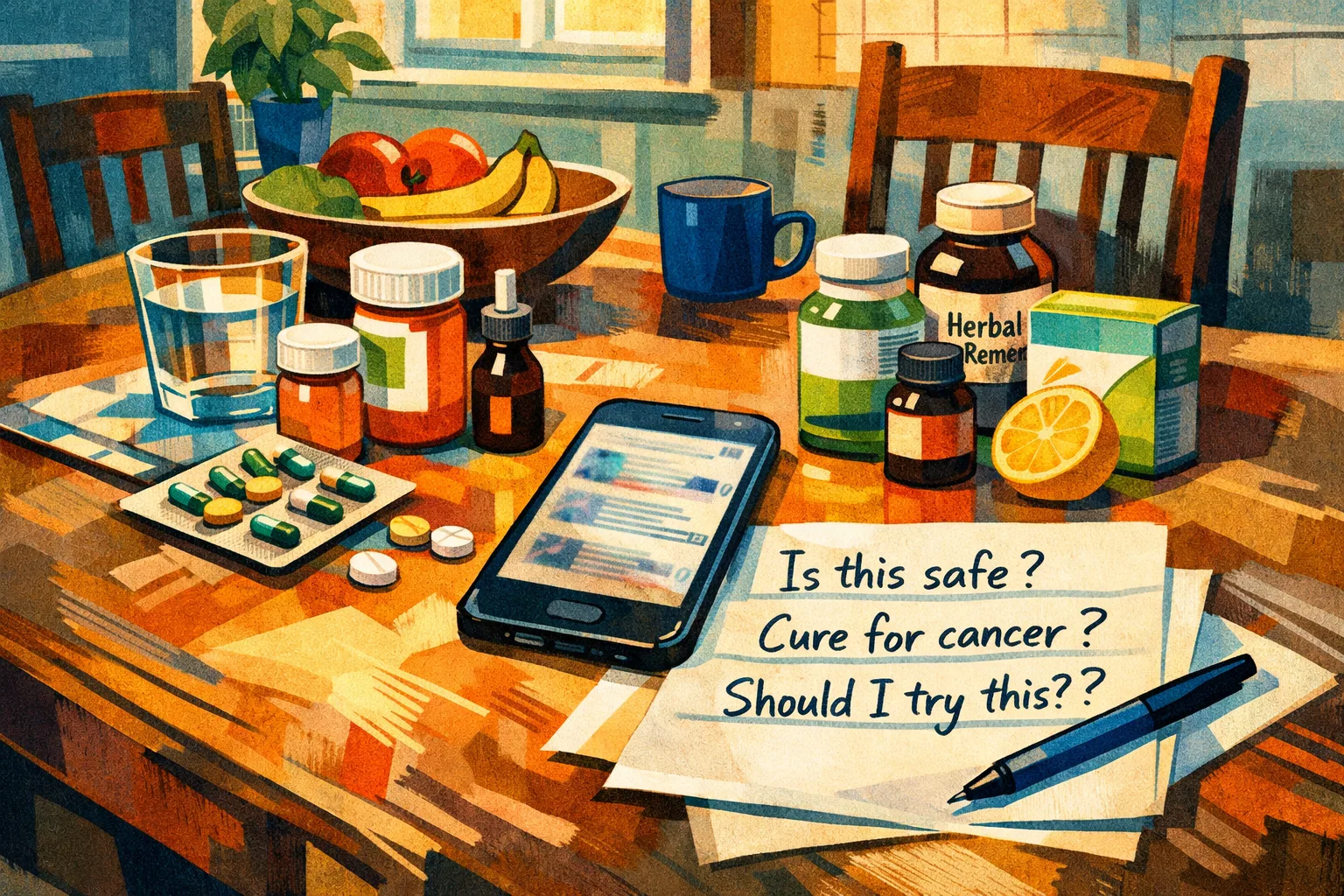
False health claims are often shared by people who are trying to help. A parent forwards a vaccine rumour because they want to protect a child; a friend sends a “natural cure” post because they are frightened for someone with cancer; a colleague shares an urgent warning because it feels safer to pass it on than to stay silent. That good intent matters, because it changes how the claim should be corrected. But it does not make the claim harmless.
Health myths are especially sticky because they combine fear, care, personal experience and urgency. They promise control at the exact moment when people feel vulnerable. During outbreaks, cancer diagnoses, fertility worries, mental health struggles or vaccine decisions, the wrong advice can delay treatment, increase anxiety, push people towards ineffective remedies or undermine trust in professionals. Health misinformation is therefore not just a problem of “bad information online”; it is also a social problem that travels through relationships people value. WHO describes an infodemic as too much information, including false or misleading information, in both digital and physical settings during disease outbreaks.[World Health Organization]who.intWorld Health OrganizationInfodemicAn infodemic is too much information including false or misleading information in digital and physical…
Good Intent and Bad Evidence
The most difficult false health claims are not always the most obviously malicious ones. Many arrive wrapped in care: “Just in case this helps”, “My cousin tried this”, “Doctors will not tell you this”, or “Please share before it is deleted”. The sender may not be trying to deceive anyone. They may be trying to reduce uncertainty, act quickly, show concern or offer hope.
This is why health misinformation differs from ordinary trivia myths. The stakes are bodily, emotional and immediate. A mistaken belief about a celebrity photo or a historical anecdote may waste attention; a mistaken claim about chemotherapy, vaccines, sepsis symptoms or medication interactions can change what someone does next. The U.S. Surgeon General’s advisory defines health misinformation as information that is false, inaccurate or misleading according to the best available evidence at the time, and frames it as a public health problem because it can affect individual choices and the wider information environment.[HHS.gov]hhs.govConfronting Health MisinformationJuly 2, 2021 — 14 Jul 2021 — A Surgeon General's Advisory is a public statement that calls the American people's attention to a public he…
Good intentions can also make false claims harder to challenge. Correcting a stranger’s post is one thing; correcting a worried aunt, parent, patient or friend is more delicate. The false claim may be tied to a relationship, a frightening experience or a memory of not being listened to by a health system. If the correction sounds like “you are foolish”, the person may defend the claim because they feel their care, judgement or identity is being attacked.
Research on misinformation sharing also shows that people do not always share falsehoods because they fully believe them. Some share because content is emotionally powerful, socially rewarded, novel or identity-confirming. The American Psychological Association notes that misinformation is more likely to be shared when it fits social norms or identity, feels new, or provokes strong emotion.[American Psychological Association]apa.orghow why misinformation spreadsAmerican Psychological AssociationHow and why does misinformation spread?29 Nov 2023 — People are more likely to share misinformation whe… Social media systems can amplify this by rewarding attention-grabbing posts, including inaccurate ones, with visibility, comments and social feedback.[Yale Insights]insights.som.yale.eduhow social media rewards misinformationYale InsightsHow Social Media Rewards Misinformation | Yale Insights31 Mar 2023 — Some scholars suggest that people share falsehoods out…
Why Health Myths Feel Like Protection
Many health myths work because they offer a simple protective action. “Take this supplement.” “Avoid this vaccine.” “Do not eat this food.” “Try this detox.” “Do not trust that test.” These instructions are appealing because they turn uncertainty into a clear task. The person sharing them may feel they are doing something useful rather than passively waiting.
That protective feeling can be strongest when the claim contains three ingredients:
- A frightening risk: cancer, infertility, infection, brain injury, sudden death or harm to children.
- A simple action: avoid, take, share, cleanse, boost, refuse, test or switch.[ncbi.nlm.nih.gov]ncbi.nlm.nih.govNCBIWE CAN TAKE ACTIONConfronting Health MisinformationBecause it pollutes our information environment, misinformation is harmful to individual and public heal…
- A moral pressure: “If you care, you will warn people.”
This is one reason vaccine myths spread so effectively among some parents. The decision is framed not as a population-level public health choice but as an immediate act of parental protection. Reviews of parental vaccine hesitancy repeatedly identify fear of adverse effects, distrust, misinformation and social context as major drivers; one qualitative systematic review of MMR vaccine hesitancy found fear of autism to be the most cited reason, despite the claim being scientifically discredited.[MDPI]mdpi.com2076 393X2076 393X
The same pattern appears in cancer misinformation. A loved one facing cancer may be overwhelmed by treatment side effects, medical uncertainty and fear of death. A post promising a natural cure can feel compassionate because it offers hope and agency. But cancer misinformation is especially dangerous when it encourages people to delay, refuse or replace evidence-based treatment. The U.S. National Cancer Institute has warned that promotion of unproven cancer treatments can be harmful, citing evidence that people who used alternative or complementary treatments instead of conventional cancer care had a higher risk of dying than those receiving conventional therapy.[Cancer.gov]cancer.govmisinformation social mediamisinformation social media

Risk, Fear and Urgency
False health claims often travel fastest when they feel urgent. A slow, cautious correction may struggle against a message that says “share this now”. Urgency reduces the time people spend checking whether a claim is current, properly sourced or relevant to their situation.
During COVID-19, this pattern was visible in everyday myths about prevention and treatment. Claims about garlic, vitamins, hot drinks and supplements often spread as low-cost, apparently harmless advice. WHO’s COVID-19 myth-busting guidance had to state clearly that vitamin and mineral supplements cannot cure COVID-19 and that there was no guidance supporting micronutrients as a treatment for the disease.[World Health Organization]who.intWorld Health OrganizationInfodemicAn infodemic is too much information including false or misleading information in digital and physical… The problem was not that every person who ate garlic or took vitamins was harmed directly. The risk was that folk remedies could be mistaken for protection, distract from effective measures, or create false confidence.
Health misinformation can also produce distress rather than comfort. WHO Europe’s review of infodemics and misinformation found that misleading health-related content on social media during pandemics, health emergencies and humanitarian crises was associated with mental, social, political and economic distress, and could affect health behaviours.[World Health Organization]who.intWorld Health OrganizationInfodemicAn infodemic is too much information including false or misleading information in digital and physical… This matters because fear-based sharing is often self-reinforcing: the more alarming the claim, the more morally necessary it can feel to forward it.
Fear is not always irrational. People may have real reasons to be cautious: previous medical harm, poor communication, unequal access to care, side effects that were dismissed, or changing public health advice during an evolving crisis. The mistake is not concern itself. The mistake is treating any alarming claim as useful simply because the subject is serious.
Personal Experience Is Powerful but Limited
A common form of well-meant health misinformation begins with a true personal experience: “This worked for me.” Personal stories are compelling because they are concrete, emotional and human. They can also identify real gaps in care. Patients often learn practical coping strategies from one another, and lived experience can help people feel less alone.
The trouble starts when a personal story becomes a general medical claim. Someone may feel better after a supplement, diet, prayer, detox, breathing exercise or alternative therapy for many reasons: natural recovery, placebo effects, reduced stress, simultaneous medical treatment, changed sleep, regression to the mean, or a condition that fluctuates over time. A sincere story can still lead to a false conclusion.
Cancer misinformation shows this clearly. A social media post may present a survivor’s diet or supplement routine as the reason for recovery while ignoring surgery, radiotherapy, chemotherapy, immunotherapy, early diagnosis or the type and stage of cancer. Research on cancer information shared on Facebook found that much cancer information was inconsistent with expert opinion, leaving patients in a confusing and uncomfortable position when deciding what to trust.[PMC]pmc.ncbi.nlm.nih.govSource details in endnotes.
This does not mean personal experience should be dismissed. It means it should be kept in its proper lane. “This helped me manage nausea” is different from “this cures cancer”. “This made me feel calmer” is different from “this treats depression”. “I had a side effect” is different from “nobody should take this medicine”. Good correction often depends on preserving the dignity of the story while challenging the unsupported leap.
When “Natural” Sounds Safer Than Evidence
Many false health claims gain trust by contrasting “natural” with “chemical”, “traditional” with “medical”, or “holistic” with “pharmaceutical”. These contrasts can be emotionally persuasive, but they are not reliable safety tests. Natural substances can be ineffective, contaminated, wrongly dosed or dangerous in combination with medicines. Evidence-based treatments can have risks while still offering proven benefits.
The word “natural” also helps false claims feel kind. Recommending a herbal remedy, juice cleanse or supplement may seem gentler than recommending a hospital appointment or a difficult treatment. But the gentler-sounding option can become harmful if it delays diagnosis, replaces treatment or creates shame when someone does not improve.
Macmillan Cancer Support warns that wrong cancer information can increase worry and delay people seeing their doctor or getting treatment, and notes that misleading claims spread quickly on social media.[Macmillan Cancer Support]macmillan.org.ukSource details in endnotes. More recent research on unproven cancer treatments has also highlighted that patients who believe misinformation may delay or reject evidence-based care and pursue unproven, sometimes toxic therapies.[JMIR Infodemiology]infodemiology.jmir.orgSource details in endnotes.
A useful rule is to separate comfort from cure. Some low-risk practices may help someone feel supported alongside proper care: a preferred meal, relaxation, gentle movement approved by a clinician, or social support. But claims about treating, preventing or curing disease need stronger evidence than sincerity, tradition or anecdote.
Why Corrections Can Feel Like Rejection
Correcting a false health claim can feel socially risky because the message is rarely just factual. It may carry an emotional subtext: “I love you”, “I am scared”, “I do not want this to happen to you”, “I found something the doctors missed”. A blunt correction can accidentally reject the care behind the message.
That does not mean corrections should be avoided. Evidence suggests clear corrections can work, especially when they provide a better explanation rather than merely repeating “false”. A CDC-linked study on COVID-19 misinformation found that corrective graphics on social media reduced misperceptions about the science of a false COVID-19 prevention strategy, with effects persisting more than a week later.[CDC]wwwnc.cdc.gov20 3139 article20 3139 article
The challenge is tone and timing. Public shaming may harden the social problem even when the factual correction is right. The American Society for Microbiology recommends empathy and inclusive language when talking with family and friends about misinformation, such as acknowledging that it can be hard to judge sources before sharing what you have learned.[ASM.org]asm.orgHow to Spot and Combat Health MisinformationHow to Spot and Combat Health Misinformation PEN America similarly advises recognising that friends and family who spread misinformation may believe it is true and may feel they are sharing something important.[PEN America]pen.orgSource details in endnotes.

Gentle Ways to Correct
The goal is not to win an argument; it is to reduce the chance that someone acts on bad health advice. A good correction protects the relationship without giving the false claim a free pass.
A practical approach is to respond in three moves:
- Acknowledge the intent. Start with the care behind the message: “I know you sent this because you are worried” or “I can see why that sounds alarming.”
- Name the evidence problem. Be specific: “This is based on a personal story, not a clinical trial”, “That claim has been checked by cancer specialists”, or “This advice is not recommended by WHO or the NHS.”
- Offer a safer next step. Replace the rumour with action: “Let’s check a reliable medical source”, “This is worth asking a pharmacist about”, or “Please do not stop prescribed treatment without speaking to your doctor.”
The replacement step matters because misinformation often fills a need. If someone is frightened, a bare correction leaves the fear behind. If someone is trying to help, a bare correction leaves them without a helpful action. Redirecting them towards checking medicine interactions, booking a GP appointment, reading a cancer charity page, or asking a qualified clinician gives the original care somewhere safer to go.
It is also worth matching the correction to the risk. A minor wellness exaggeration may need a light-touch response. A claim urging someone to stop medication, refuse urgent care, use a dangerous substance, avoid vaccination during an outbreak, or replace cancer treatment needs firmer intervention. Health misinformation is not equally dangerous in every case; the key question is what behaviour the claim might cause.
What to Check Before Sharing Health Advice
A well-meant health claim deserves a pause before it becomes someone else’s problem. The pause does not have to be complicated. It should ask whether the advice is specific, current, evidence-based and safe.
Before forwarding a health claim, check:
- Who is making the claim? A named qualified clinician, public health body or medical charity is different from an anonymous account, influencer or sales page.
- What is the evidence? Personal testimony is not the same as a clinical guideline, systematic review or regulated product information.
- Is anything being sold? Supplements, tests, courses and private clinics can create conflicts of interest.
- Does it tell people to avoid proven care? Claims that discourage vaccines, screening, prescribed medicine or emergency treatment deserve extra caution.
- Does it use urgency or secrecy? Phrases such as “they do not want you to know” and “share before it is removed” are warning signs, not proof.
- Could this advice harm a specific person? Pregnancy, children, older age, cancer treatment, immune suppression, long-term conditions and multiple medications can change the risk.
The U.S. Surgeon General’s public guidance encourages people to verify health information before sharing, check sources, avoid sharing if they are not sure, and talk to trusted health professionals when making health decisions.[HHS.gov]hhs.govOpen source on hhs.gov. That advice is simple, but it is not trivial. In health contexts, not sharing an uncertain claim can be an act of care.
The Better Version of Helping
The opposite of sharing false health advice is not indifference. It is better help. That may mean offering to sit with someone while they call a doctor, helping them find a reliable cancer charity page, asking what they need, checking whether a medicine question should go to a pharmacist, or saying, “I found this online, but I do not know if it is reliable, so let’s verify it first.”
This shift matters because it preserves the social energy that makes misinformation spread in the first place. People share health myths because they care, fear harm, want control or hope they have found something useful. The task is not to remove care from the conversation. It is to detach care from bad evidence.
False health claims shared with good intentions are dangerous precisely because they feel humane. They often look like protection, solidarity or hope. A healthy information culture needs all three, but it also needs humility: serious health decisions should not depend on viral urgency, personal anecdotes or claims that outrun the evidence. The most helpful health advice is not the advice that feels most reassuring in the moment; it is the advice least likely to mislead someone when the stakes are real.
Amazon book picks
Further Reading
Books and field guides related to Why Helpful Health Advice Can Be Wrong. Use these as the next step if you want deeper reading beyond the article.
Foolproof: Why We Fall for Misinformation and How to Build Im...
Explains why health misinformation spreads so effectively.
Trick or Treatment?
First published 2008. Subjects: Placebo Effect, Evidence-Based Medicine, Complementary Therapies, Alternative medicine, Quackery.
eBay marketplace picks
Marketplace Samples
Example marketplace items related to this page. Use the search link to explore similar finds on eBay.
Endnotes
1.
Source: who.int
Link:https://www.who.int/health-topics/infodemic
Source snippet
World Health OrganizationInfodemicAn infodemic is too much information including false or misleading information in digital and physical...
2.
Source: hhs.gov
Title: Confronting Health Misinformation
Link:https://www.hhs.gov/sites/default/files/surgeon-general-misinformation-advisory.pdf
Source snippet
July 2, 2021 — 14 Jul 2021 — A Surgeon General's Advisory is a public statement that calls the American people's attention to a public he...
Published: July 2, 2021
3.
Source: insights.som.yale.edu
Title: how social media rewards misinformation
Link:https://insights.som.yale.edu/insights/how-social-media-rewards-misinformation
Source snippet
Yale InsightsHow Social Media Rewards Misinformation | Yale Insights31 Mar 2023 — Some scholars suggest that people share falsehoods out...
4.
Source: mdpi.com
Title: 2076 393X
Link:https://www.mdpi.com/2076-393X/11/5/926
5.
Source: cancer.gov
Title: misinformation social media
Link:https://www.cancer.gov/news-events/cancer-currents-blog/2021/cancer-misinformation-social-media
6.
Source: who.int
Link:https://www.who.int/emergencies/diseases/novel-coronavirus-2019/advice-for-public/myth-busters
7.
Source: who.int
Link:https://www.who.int/europe/news/item/01-09-2022-infodemics-and-misinformation-negatively-affect-people-s-health-behaviours–new-who-review-finds
8.
Source: pmc.ncbi.nlm.nih.gov
Link:https://pmc.ncbi.nlm.nih.gov/articles/PMC9275772/
9.
Source: infodemiology.jmir.org
Link:https://infodemiology.jmir.org/2025/1/e62703
10.
Source: wwwnc.cdc.gov
Title: 20 3139 article
Link:https://wwwnc.cdc.gov/eid/article/27/2/20-3139_article
11.
Source: asm.org
Title: How to Spot and Combat Health Misinformation
Link:https://asm.org/articles/2022/september/how-to-spot-and-combat-health-misinformation
12.
Source: pen.org
Link:https://pen.org/disinformation/how-to-talk-to-friends-and-family-who-share-misinformation/
13.
Source: hhs.gov
Link:https://www.hhs.gov/surgeongeneral/reports-and-publications/health-misinformation/index.html
14.
Source: infodemiology.jmir.org
Link:https://infodemiology.jmir.org/2025/1/e67464
15.
Source: infodemiology.jmir.org
Link:https://infodemiology.jmir.org/2024/1/e51127
16.
Source: jmir.org
Link:https://www.jmir.org/2024/1/e38786/
17.
Source: facebook.com
Link:https://www.facebook.com/WHO/posts/not-all-information-you-find-on-social-media-is-true-some-use-it-to-spread-misle/1082224637270259/
18.
Source: facebook.com
Title: a new resource from the public health communication collaborative explains how t
Link:https://www.facebook.com/CDCFoundation/posts/a-new-resource-from-the-public-health-communication-collaborative-explains-how-t/10158370853193053/
19.
Source: facebook.com
Title: most of us have been in a situation where someone shares misinformation about he
Link:https://www.facebook.com/UtahDHHS/posts/most-of-us-have-been-in-a-situation-where-someone-shares-misinformation-about-he/520086100305123/
20.
Source: facebook.com
Link:https://www.facebook.com/USSurgeonGeneral/posts/today-i-issued-a-surgeon-generals-advisory-to-call-our-countrys-attention-to-hea/2138391522967968/
21.
Source: facebook.com
Title: why do people share health misinformation research shows its often out of genuin
Link:https://www.facebook.com/GAVI/posts/why-do-people-share-health-misinformation-research-shows-its-often-out-of-genuin/1058178486338495/
22.
Source: facebook.com
Link:https://www.facebook.com/deutschewellenews/posts/no-eating-garlic-and-drinking-warm-water-cannot-cure-the-coronavirus-but-how-do-/10157614715894440/
23.
Source: facebook.com
Link:https://www.facebook.com/WHOAFRO/posts/-garlic-does-not-prevent-covid19-keep-safe-by-staying-up-to-date-with-accurate-i/1417928378412074/
24.
Source: apa.org
Title: how why misinformation spreads
Link:https://www.apa.org/topics/journalism-facts/how-why-misinformation-spreads
Source snippet
American Psychological AssociationHow and why does misinformation spread?29 Nov 2023 — People are more likely to share misinformation whe...
25.
Source: macmillan.org.uk
Link:https://www.macmillan.org.uk/cancer-information-and-support/worried-about-cancer/cancer-myths-and-misinformation
Additional References
26.
Source: ncbi.nlm.nih.gov
Title: NCBIWE CAN TAKE ACTION
Link:https://www.ncbi.nlm.nih.gov/books/NBK572168/
Source snippet
Confronting Health MisinformationBecause it pollutes our information environment, misinformation is harmful to individual and public heal...
27.
Source: youtube.com
Title: Understanding the impact of health misinformation
Link:https://www.youtube.com/watch?v=84VbIqR2VqY
Source snippet
Strategies for talking to family about misinformation...
28.
Source: researchgate.net
Link:https://www.researchgate.net/publication/371745935_Health_misinformation_what_it_is_why_people_believe_it_how_to_counter_it
29.
Source: hbs.edu
Link:https://www.hbs.edu/ris/Publication%20Files/whr_prosociality_revision.final.1.15.2019%20%281%29_79b480d2-2ed6-4e42-b9e5-94905b2fed4c.pdf
30.
Source: ecancer.org
Link:https://ecancer.org/en/news/27083-study-finds-most-cancer-patients-exposed-to-misinformation-researchers-pilot-information-prescription
31.
Source: researchgate.net
Link:https://www.researchgate.net/publication/381922940_Motives_of_Sharing_Fake_News_and_Effects_on_Mental_Health_of_Social_Media_Users_A_Meta-analysis
32.
Source: spokanetribe.com
Link:https://spokanetribe.com/wp-content/uploads/2021/11/HealthMisinformationToolkitNon508.pdf
33.
Source: ilcn.org
Link:https://www.ilcn.org/cancer-misinformation-its-impact-on-patients-and-mitigation-strategies/
34.
Source: bmjgroup.com
Link:https://bmjgroup.com/combatting-misinformation-and-empowering-patient-decisions/
35.
Source: swgfl.org.uk
Link:https://swgfl.org.uk/topics/social-media/misinformation-on-social-media-guidance-impact-and-support/
Topic Tree