Within Old Stories
Why corrected causes still feel useful
A false cause can keep guiding people's explanations even after they remember that it was corrected.
On this page
- How false causes enter a mental model
- Why retractions leave explanatory gaps
- How later questions reactivate the old cause
Page outline Jump by section
Introduction
A corrected cause can continue shaping later explanations even when people know it was withdrawn. This happens because the original cause often became part of a working explanation rather than a standalone fact. Once people have used a claim to answer questions such as “Why did this happen?” or “Who was responsible?”, removing that claim leaves a hole in the story. The correction may be remembered, yet the old cause remains mentally useful because it still connects events together. Research on the continued influence effect repeatedly finds that people can recall a retraction and still rely on the retracted information when drawing inferences or explaining outcomes.[Sage Journals]journals.sagepub.comSage JournalsMisinformation and Its CorrectionAnother explanation for the continued influence of misinformation is the failure of control…
 The key issue is not simple forgetfulness. The false cause often survives because it performed explanatory work. It helped organise events into a coherent sequence, and later reasoning can reactivate that structure even after the claim has been labelled false. Understanding this mechanism helps explain why myths and misconceptions are difficult to fully remove once they have become part of a person’s understanding of an event.[PMC]pmc.ncbi.nlm.nih.govPMCThe role of discomfort in the continued influence effectby MW Susmann · 2021 · Cited by 88 — According to this account, people then reject correcting information and maintain belief in the m…
How false causes enter a mental model
People rarely store information as disconnected statements. As new information arrives, they build what psychologists call a mental model: a rough internal representation of what happened, what caused it, and how different events fit together. When a false cause appears early in a narrative, it can become one of the model’s organising pieces.[Sage Journals]journals.sagepub.comSage JournalsMisinformation and Its CorrectionAnother explanation for the continued influence of misinformation is the failure of control…
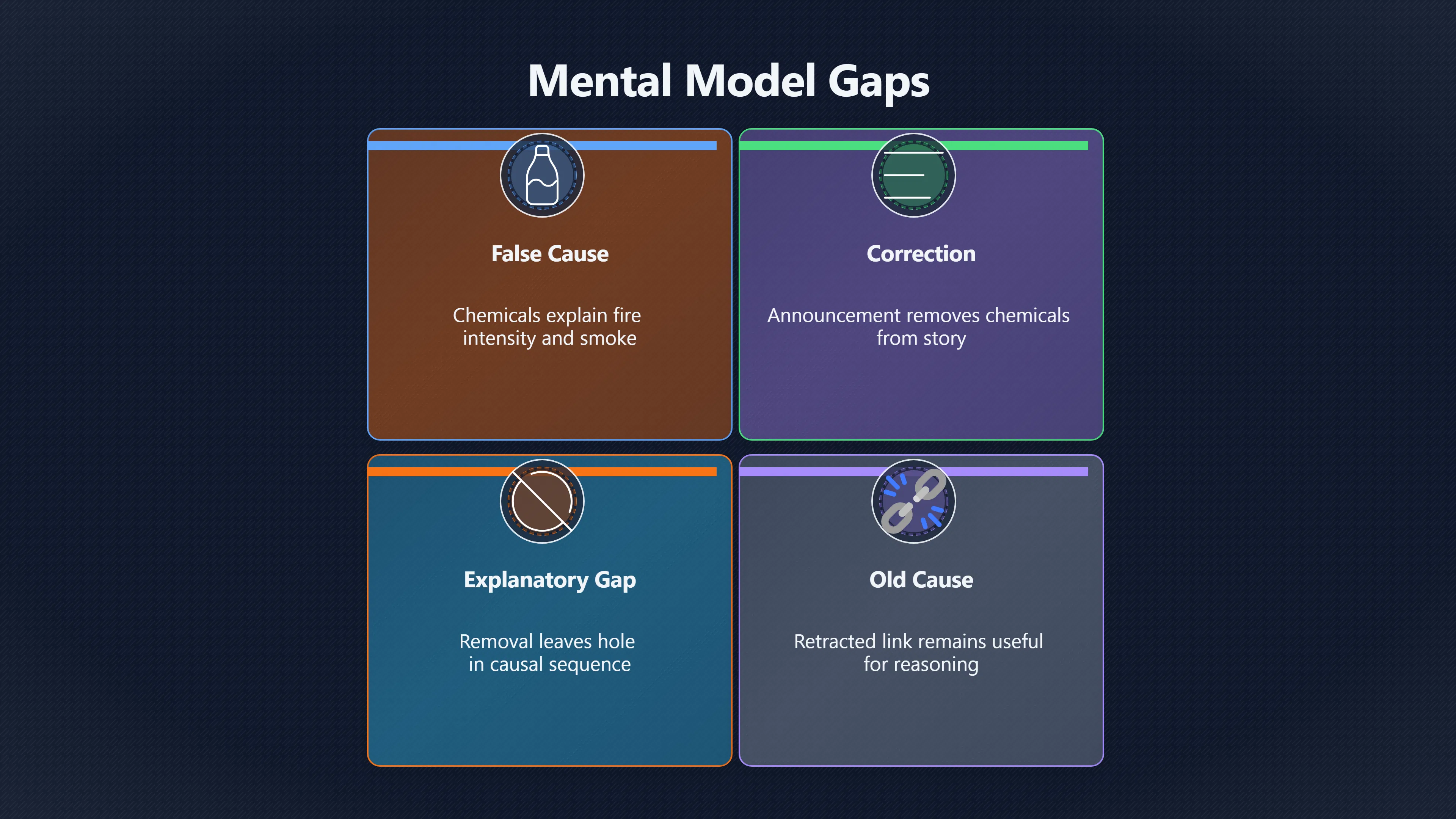
Consider a report about a major fire. If people hear that flammable chemicals were stored inside the building, that detail does more than add a fact. It explains the intensity of the fire, the smoke, the explosions and the emergency response. Multiple later details become linked to that single cause. When a correction later announces that the chemicals were never there, the correction removes the cause but does not automatically rebuild all the connections that depended on it.[Sage Journals]journals.sagepub.comSage JournalsMisinformation and Its CorrectionAnother explanation for the continued influence of misinformation is the failure of control…
This is why causal misinformation is especially persistent. A false claim about a date, a name or a minor detail may be easy to replace. A false claim that explains an outcome occupies a more central position in the mental model. Because it links many pieces of information together, it becomes easier to retrieve whenever the event is recalled.[PMC]pmc.ncbi.nlm.nih.govPMCThe role of discomfort in the continued influence effectby MW Susmann · 2021 · Cited by 88 — According to this account, people then reject correcting information and maintain belief in the m…
Researchers studying the continued influence effect have repeatedly found that misinformation embedded within a causal explanation remains influential even after correction. Participants often acknowledge that the information was retracted while still using it to answer questions about what happened and why.[classes.cs.uchicago.edu]classes.cs.uchicago.eduExplicit warnings reduce but do not eliminate the continued…by UKH ECKER · 2010 · Cited by 741 — correction, implying that the continu…
Why retractions leave explanatory gaps
The most influential account of this phenomenon focuses on explanatory gaps. A correction can successfully tell people that a cause was false while failing to answer the questions that the cause previously resolved.[PMC]pmc.ncbi.nlm.nih.govPMCThe role of discomfort in the continued influence effectby MW Susmann · 2021 · Cited by 88 — According to this account, people then reject correcting information and maintain belief in the m…
Imagine a story that initially attributes an economic problem to a particular policy failure. If that explanation is later withdrawn without a replacement, readers are left with an unresolved puzzle. The outcome still needs a cause. The original explanation may have been discredited, but it remains the most complete answer available. In later reasoning, people can drift back towards it because it continues to satisfy the need for causal coherence.[Sage Journals]journals.sagepub.comSage JournalsMisinformation and Its CorrectionAnother explanation for the continued influence of misinformation is the failure of control…
Research consistently shows that corrections work better when they provide an alternative explanation rather than a simple negation. A replacement cause gives people something new to insert into the mental model. Without that replacement, the retracted cause often remains the easiest way to make sense of the remaining information.[classes.cs.uchicago.edu]classes.cs.uchicago.eduExplicit warnings reduce but do not eliminate the continued…by UKH ECKER · 2010 · Cited by 741 — correction, implying that the continu…
This helps explain a common communication mistake. Many corrections focus exclusively on proving that a claim is false. From a factual perspective, that seems sufficient. From a cognitive perspective, it may not be. If the correction destroys a causal explanation without supplying another one, the audience still faces the original explanatory problem. The old cause can therefore continue influencing later judgements despite being officially rejected.[the UWA Profiles and Research Repository]research-repository.uwa.edu.auSeifert ·, N. Schwarz ·, J. Cook.Read morethe UWA Profiles and Research RepositoryMisinformation and Its Correction: Continued Influence and…by S Lewandowsky · 2012 · Cited by…
How later questions reactivate the old cause
A retracted cause often returns when people are asked to explain events rather than merely recall facts. Explanation tasks encourage retrieval of the broader mental model, including the relationships between events. During that retrieval process, the old causal link can become active again.[ScienceDirect]sciencedirect.comThe rational continued influence of misinformationby SAC Desai · 2020 · Cited by 70 — Studies on the 'Continued Influence Ef…
This creates a striking pattern in experiments. Participants may correctly answer a direct question such as “Was that information retracted?” yet still rely on the retracted information when asked why an event occurred. The correction exists in memory, but it competes with a previously established explanatory structure.[classes.cs.uchicago.edu]classes.cs.uchicago.eduExplicit warnings reduce but do not eliminate the continued…by UKH ECKER · 2010 · Cited by 741 — correction, implying that the continu…
Some researchers describe this as a retrieval problem. Both the misinformation and the correction may be stored in memory, but the original cause can be more accessible when people are constructing an explanation. The false cause is often connected to many other details, giving it multiple paths back into awareness. The correction may be remembered as a separate statement yet fail to dominate the reasoning process at the moment an explanation is needed.[PLOS]journals.plos.orgExamining the role of information integration in the continued…by JA Sanderson · 2022 · Cited by 10 — Thus, overall, results provi…
The effect becomes especially visible after delays. As memory for specific wording fades, people often retain the overall narrative structure. If the original cause helped define that structure, later questions can reactivate it even when the correction itself has not been completely forgotten.[Sage Journals]journals.sagepub.comSage JournalsMisinformation and Its CorrectionAnother explanation for the continued influence of misinformation is the failure of control…
Why the old cause can feel more satisfying than the correction
Explanations do more than convey information. They create a sense that events make sense. A correction that simply removes a cause can leave an account feeling incomplete or unstable. Researchers have argued that people may experience discomfort when a previously coherent mental model becomes causally incomplete.[PMC]pmc.ncbi.nlm.nih.govPMCThe role of discomfort in the continued influence effectby MW Susmann · 2021 · Cited by 88 — According to this account, people then reject correcting information and maintain belief in the m…
In this situation, the old cause offers an immediate solution. Even though it has been discredited, it restores coherence. It reconnects the events, resolves unanswered questions and reduces uncertainty. The attraction is therefore not always a matter of believing the misinformation outright. Sometimes it is a matter of explanatory convenience.[PMC]pmc.ncbi.nlm.nih.govPMCThe role of discomfort in the continued influence effectby MW Susmann · 2021 · Cited by 88 — According to this account, people then reject correcting information and maintain belief in the m…
Recent work has explored whether this discomfort contributes to continued reliance on misinformation. The findings suggest that when a retraction creates a causal gap, people can be motivated to preserve or return to the earlier explanation because it maintains a complete account of the event.[PMC]pmc.ncbi.nlm.nih.govPMCThe role of discomfort in the continued influence effectby MW Susmann · 2021 · Cited by 88 — According to this account, people then reject correcting information and maintain belief in the m…
This helps explain why myths often survive in subtle forms. People may publicly accept the correction while privately continuing to use the old cause as a background explanation. The myth no longer appears as an explicit belief, yet it still shapes how later events are interpreted.

Why replacement explanations matter
The strongest lesson from this research is that causal misinformation is not removed simply by crossing it out. Once a false cause has been integrated into a mental model, effective correction requires reconstruction as well as rejection.[Digital Commons]digitalcommons.chapman.eduDigital CommonsA Meta-Analytic Examination of the Continued Influence of…by N Walter · 2019 · Cited by 649 — A more effective correcti…
Replacement explanations work because they preserve coherence while updating the facts. Instead of leaving a gap, they offer a new account that explains the same outcome. This reduces the need to fall back on the original cause and gives later reasoning a different path to follow.[Digital Commons]digitalcommons.chapman.eduDigital CommonsA Meta-Analytic Examination of the Continued Influence of…by N Walter · 2019 · Cited by 649 — A more effective correcti…
The continued influence effect therefore reveals something important about how misconceptions persist. People are not always clinging to false causes because they missed the correction or refused to believe it. Often the retracted cause survives because it remains the most useful explanation available. Until another explanation takes its place, the old one can continue shaping answers to the simple question that drives much human reasoning: “Why did that happen?”[Sage Journals]journals.sagepub.comSage JournalsMisinformation and Its CorrectionAnother explanation for the continued influence of misinformation is the failure of control…[PMC]pmc.ncbi.nlm.nih.govPMCThe role of discomfort in the continued influence effectby MW Susmann · 2021 · Cited by 88 — According to this account, people then reject correcting information and maintain belief in the m…
Amazon book picks
Further Reading
Books and field guides related to Why corrected causes still feel useful. Use these as the next step if you want deeper reading beyond the article.
Thinking, Fast and Slow
Explains cognitive shortcuts that keep corrected causes mentally active.
Mistakes Were Made (but Not by Me) Third Edition
Helps explain why people continue defending or using corrected beliefs.

The Knowledge Illusion
First published 2017. Subjects: Cognitive psychology, Knowledge, theory of, Knowledge, sociology of, Thought and thinking, Intellect.

eBay marketplace picks
Marketplace Samples
Example marketplace items related to this page. Use the search link to explore similar finds on eBay.



Endnotes
1.
Source: classes.cs.uchicago.edu
Link:https://www.classes.cs.uchicago.edu/archive/2020/spring/33231-1/readings/Ecker2010_Article_ExplicitWarningsReduceButDoNot.pdf
Source snippet
Explicit warnings reduce but do not eliminate the continued...by UKH ECKER · 2010 · Cited by 741 — correction, implying that the continu...
2.
Source: pmc.ncbi.nlm.nih.gov
Title: PMCThe role of discomfort in the continued influence effect
Link:https://pmc.ncbi.nlm.nih.gov/articles/PMC8447889/
Source snippet
by MW Susmann · 2021 · Cited by 88 — According to this account, people then reject correcting information and maintain belief in the m...
3.
Source: research-repository.uwa.edu.au
Title: Seifert ·, N. Schwarz ·, J. Cook.Read more
Link:https://research-repository.uwa.edu.au/en/publications/misinformation-and-its-correction-continued-influence-and-success/
Source snippet
the UWA Profiles and Research RepositoryMisinformation and Its Correction: Continued Influence and...by S Lewandowsky · 2012 · Cited by...
4.
Source: sciencedirect.com
Link:https://www.sciencedirect.com/science/article/abs/pii/S0010027720302729
Source snippet
The rational continued influence of misinformationby SAC Desai · 2020 · Cited by 70 — Studies on the 'Continued Influence Ef...
5.
Source: pmc.ncbi.nlm.nih.gov
Link:https://pmc.ncbi.nlm.nih.gov/articles/PMC9292086/
Source snippet
Examining the role of information integration in the continued...by JA Sanderson · 2022 · Cited by 10 — Thus, overall, results provid...
6.
Source: journals.plos.org
Link:https://journals.plos.org/plosone/article?id=10.1371%2Fjournal.pone.0271566
Source snippet
Examining the role of information integration in the continued...by JA Sanderson · 2022 · Cited by 10 — Thus, overall, results provi...
7.
Source: youtube.com
Title: Decoding Deception: The Psychology of Combating Misinformation
Link:https://www.youtube.com/watch?v=NoI8QzUAeiA
Source snippet
The Continued Influence Effect - Why do memories of misinformation persist in our minds?...
8.
Source: youtube.com
Title: The Continued Influence Effect
Link:https://www.youtube.com/watch?v=eZ_hcf01EFw
Source snippet
The Continued Influence of Misinformation — Ullrich Ecker...
9.
Source: journals.sagepub.com
Link:https://journals.sagepub.com/doi/10.1177/1529100612451018
Source snippet
Sage JournalsMisinformation and Its CorrectionAnother explanation for the continued influence of misinformation is the failure of control...
10.
Source: digitalcommons.chapman.edu
Link:https://digitalcommons.chapman.edu/cgi/viewcontent.cgi?article=1061&context=comm_articles
Source snippet
Digital CommonsA Meta-Analytic Examination of the Continued Influence of...by N Walter · 2019 · Cited by 649 — A more effective correcti...
11.
Source: Wikipedia
Link:https://en.wikipedia.org/wiki/Misinformation
Source snippet
MisinformationMisinformation can include inaccurate, incomplete, misleading, or false information as well as selective or half-truths...
Additional References
12.
Source: un.org
Link:https://www.un.org/en/countering-disinformation
Source snippet
Countering DisinformationWhile misinformation refers to the accidental spread of inaccurate information, disinformation is not only inacc...
13.
Source: psychology.hku.hk
Link:https://www.psychology.hku.hk/scnlab/files/publications/preprint/Guo%20et%20al.%2C%202023%2C%20Preprint.pdf
Source snippet
Department of PsychologyHow does an alternative explanation reduce the continued...by S Guo — The outdated misinformation often co...
14.
Source: aec.gov.au
Link:https://www.aec.gov.au/About_AEC/files/eiat/eiat-disinformation-factsheet.pdf
Source snippet
Disinformation and MisinformationDisinformation and Misinformation. What is disinformation and misinformation? Misinformation is false in...
15.
Source: emc-lab.org
Link:https://www.emc-lab.org/uploads/1/1/3/6/113627673/chapter_swireecker_revised.pdf
Source snippet
Ecker Memory & Cognition LabMisinformation and its Correctionby B Swire · Cited by 137 — Even after people receive clear and credible cor...
16.
Source: apa.org
Link:https://www.apa.org/topics/journalism-facts/misinformation-disinformation
Source snippet
Misinformation and disinformationMisinformation is false or inaccurate information—getting the facts wrong. Disinformation is false infor...
17.
Source: researchgate.net
Link:https://www.researchgate.net/publication/391015007To_be_continued_misinformation%27s_bizarre_adventure_beyond_memory_failures-_exploring_non-memory-based_mechanisms_driving_the_continued_influence_effect_CIE
Source snippet
(PDF) To be continued: misinformation's bizarre adventure...18 Nov 2025 — The Continued Influence Effect (CIE) refers to the persistent...
18.
Source: research-information.bris.ac.uk
Link:https://research-information.bris.ac.uk/files/298563464/Ecker_v4_TSshorten_UE_clean.pdf
19.
Source: unhcr.org
Link:https://www.unhcr.org/innovation/wp-content/uploads/2022/02/Factsheet-4.pdf
Source snippet
Disinformation. Misinformation is false or inaccurate information. Examples include rumors, insults and pranks. Disinformation is...Read...
20.
Source: pubmed.ncbi.nlm.nih.gov
Link:https://pubmed.ncbi.nlm.nih.gov/26173286/
Source snippet
and Its Correction: Continued Influence and...by S Lewandowsky · 2012 · Cited by 4641 — We first examine the mechanisms by which such mi...
21.
Source: youtube.com
Title: The Continued Influence of Misinformation — Ullrich Ecker
Link:https://www.youtube.com/watch?v=H_dHJVH5hPU
Source snippet
These videos explain the psychological mechanisms behind the continued influence effect, detailing how retracted information functions as...
Topic Tree