Within Mythcraft
Why Brain Myths Spread in Schools
Brain-based claims can look scientific while oversimplifying what neuroscience actually says about learning.
On this page
- Scientific language as packaging
- Commercial and training pathways
- How educators can spot weak claims
Page outline Jump by section
Introduction
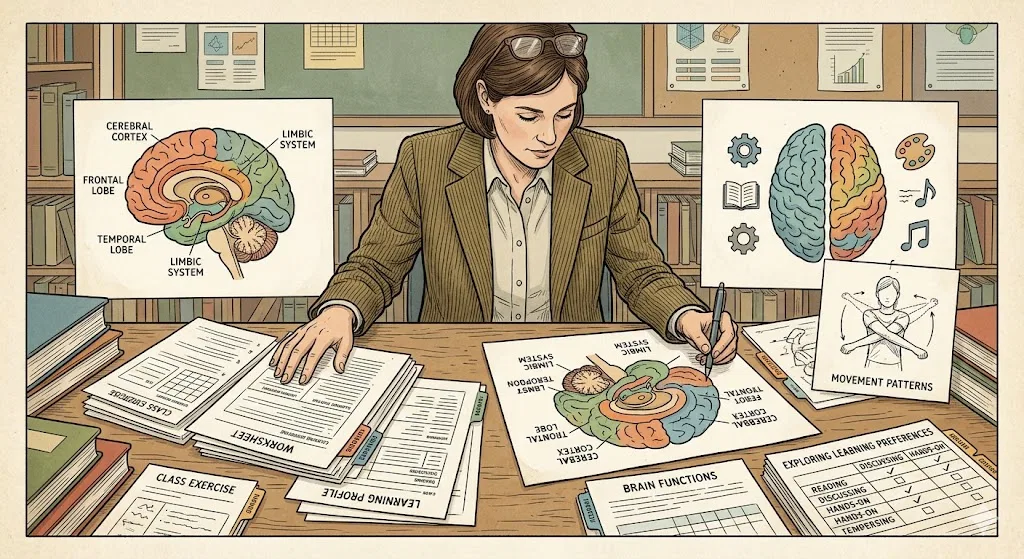
Neuromyths are brain-based claims about learning that sound scientific but oversimplify, distort or overextend what neuroscience actually shows. In schools, the most persistent examples include “visual, auditory and kinaesthetic learners”, “left-brain and right-brain pupils”, “Brain Gym” style claims about cross-body movements improving hemispheric integration, and the idea that short “critical periods” determine whether children can learn particular skills. They matter because they are not just harmless slogans: they can shape teacher training, classroom routines, resource spending and the labels placed on pupils.
The distinctive risk is that neuromyths often arrive wearing the clothes of professionalism. They are presented as ways to personalise teaching, respect difference, motivate pupils or bring cutting-edge science into the classroom. That is why they can be persuasive to conscientious teachers rather than only to poorly informed ones. Surveys and reviews repeatedly find that teachers may hold both accurate neuroscience knowledge and neuromyth beliefs at the same time, especially when a claim contains a small “kernel of truth” but adds an unsupported classroom prescription.[PMC]pmc.ncbi.nlm.nih.govby S Dekker · 2012 · Cited by 1291 — Results showed that on average, teachers believed 49% of the neuromyths, particularly myths relat…[PMC]pmc.ncbi.nlm.nih.govThe Persistence of Neuromyths in the Educational Settingsby M Torrijos-Muelas · 2021 · Cited by 273 — The findings present neuromyths…
Why brain language gives myths extra authority
A neuromyth rarely begins as pure nonsense. More often, it grows from a real scientific idea that has been compressed into a classroom rule. The brain is plastic, so a training product may imply that a few prescribed exercises can “rewire” learning. People differ in preferences and prior knowledge, so a worksheet may classify pupils as visual, auditory or kinaesthetic learners. The hemispheres of the brain do specialise in some functions, so a staff-development session may slide into claims about left-brain and right-brain children.
That slide from “there is a brain finding” to “therefore this classroom method works” is the central problem. The Organisation for Economic Co-operation and Development helped popularise concern about neuromyths in education through its work on neuroscience and learning, warning that misunderstandings of brain research could feed ineffective educational practice. Later research with teachers in the UK and the Netherlands found high interest in brain science, but also high endorsement of myths, with teachers believing an average of 49 per cent of the neuromyths included in the survey.[OECD]oecd.orgSource details in endnotes.
The appeal is easy to understand. Teachers face real classroom complexity: mixed attainment, limited time, behaviour pressures, special educational needs, parental expectations and policy demands. A “brain-based” tool can appear to offer a humane shortcut: diagnose the learner, match the strategy, unlock progress. The myth survives because it is emotionally and professionally attractive, not because teachers are careless.
This is why simply mocking neuromyths is counterproductive. Many are attached to values that educators rightly care about: inclusion, motivation, attention to individual differences and the belief that pupils can improve. The better correction is to separate the good value from the weak claim. Pupils do differ, but that does not mean they learn best when taught through a fixed sensory style. Movement can support attention and wellbeing, but that does not prove a commercial exercise sequence integrates brain hemispheres. Neuroscience can inform education, but it does not bypass the need for classroom trials, cognitive psychology and evidence about learning outcomes.[PubMed]pubmed.ncbi.nlm.nih.govSource details in endnotes.[Frontiers]frontiersin.orgThe following questions are examined: Does neuroscience training protect against…Read more…
The classroom myths teachers are most likely to meet
The best-known neuromyth in teacher training is learning styles: the claim that pupils learn better when instruction is matched to a preferred modality, such as visual, auditory or kinaesthetic. This is different from the modest and true claim that pupils may have preferences. A pupil may enjoy diagrams, discussion or hands-on activity. The unsupported leap is that diagnosing that preference and matching instruction to it reliably improves learning.
A major review by Pashler and colleagues found that the evidence needed to support learning-styles-based instruction was lacking: to prove the claim, studies would need to show that different kinds of learners benefit more from different matched forms of instruction, not merely that pupils report preferences. Later reviews have found belief in learning styles remains strikingly high among educators. One systematic review of 37 studies, covering 15,405 educators in 18 countries, found a weighted 89.1 per cent belief in matching instruction to learning styles, and 79.7 per cent reported using or intending to use such matching.[PubMed]pubmed.ncbi.nlm.nih.govSource details in endnotes.
The left-brain/right-brain myth is similarly resilient. It takes a real fact — some brain functions are lateralised — and turns it into a personality and teaching typology. In schools, this can become the idea that some pupils are naturally logical and analytical while others are creative and intuitive, and that teaching should be adapted around this supposed dominance. The problem is not that hemispheric specialisation is false; it is that complex learning uses distributed networks across the brain, and classroom achievement cannot be reliably sorted into left-brain and right-brain learner types. Reviews of neuromyth research identify hemispheric-dominance claims as among the most common misconceptions teachers encounter.[PMC]pmc.ncbi.nlm.nih.govOpen source on nih.gov.
“Brain Gym” and similar movement-based claims show how commercial packaging can strengthen a neuromyth. Short movement breaks may be useful for classroom management, attention or physical activity. The unsupported claim is more specific: that particular cross-body exercises improve learning by integrating the left and right hemispheres or increasing neural connections in a targeted way. Reviews describe these claims as a prominent example of programmes that move from plausible-sounding neuroscience to promises about preventing learning difficulties, improving creativity or raising intelligence.[Frontiers]frontiersin.orgThe following questions are examined: Does neuroscience training protect against…Read more…
Some myths are especially sensitive because they concern pupils with special educational needs and disabilities. Claims about “brain types”, retained reflexes, auditory or visual processing labels, or fixed developmental windows can sound compassionate because they offer an explanation for difficulty. But weak explanations can also narrow expectations, direct families towards expensive interventions, or distract from better-supported teaching, assessment and support. The Chartered College of Teaching notes that neuromyths can be particularly tempting in special educational needs contexts because teachers are seeking practical ways to understand complex learning profiles.[My College]my.chartered.collegeneuromyths about special educational needs what should teachers knowneuromyths about special educational needs what should teachers know
How teacher training can spread neuromyths
Neuromyths spread through teacher education when brain claims are presented as professional knowledge without enough attention to evidence quality. This can happen in initial teacher training, continuing professional development, school improvement packages, popular education books, consultancy sessions, posters, online courses and informal staffroom advice. The route is not always commercial, but commercial training gives myths an especially efficient pathway into practice.
A key finding from the literature is that general enthusiasm for neuroscience is not enough protection. In the UK-Netherlands teacher survey, interest in brain research was high, but teachers still endorsed many myths. Other studies have found that more general brain knowledge can coexist with more neuromyth belief, probably because educators who are most interested in neuroscience are also more exposed to brain-branded claims. Hughes and colleagues found that higher brain-knowledge scores and exposure to prior teacher training were associated with increased neuromyth belief, while specific in-service training in educational neuroscience was associated with better myth recognition.[PMC]pmc.ncbi.nlm.nih.govOpen source on nih.gov.
This creates an uncomfortable lesson for training providers: a module labelled “the brain and learning” can help or harm depending on how it is taught. A weak version gives teachers a list of attractive brain facts and classroom tips. A stronger version teaches the difference between neuroscience, cognitive psychology, classroom evidence and commercial translation. It also shows how to ask whether a claim has been tested with learning outcomes, in real educational contexts, against a meaningful comparison.
Pre-service teachers are a particular concern because early training can become a professional filter for later ideas. Research with 550 pre-service science teachers found that 10 neuromyths were endorsed by more than half of participants; learning styles and Brain Gym were endorsed by 93 per cent and 92 per cent respectively. The same study found that neuromyth endorsement was largely independent of professional knowledge, suggesting that simply adding more content is not the same as building better judgement.[Frontiers]frontiersin.orgThe following questions are examined: Does neuroscience training protect against…Read more…
Teacher training can also unintentionally preserve myths through assessment language. Trainees may be asked to demonstrate “meeting individual learning styles”, “using brain-based strategies” or “planning for multiple intelligences” because these phrases have become part of the professional vocabulary. Once a myth is embedded in forms, lesson-plan templates or observation rubrics, it stops looking like a claim and starts looking like a standard.
Why these myths change classroom practice
The practical cost of neuromyths is not only that teachers may believe something false. It is that the belief can redirect planning time, professional development money and pupil identity. A teacher who classifies a pupil as a kinaesthetic learner may spend effort converting tasks into movement-based activities when the more important question is whether the pupil understands the content, has sufficient background knowledge, receives feedback, practises retrieval or can transfer learning to a new problem.
Learning styles illustrate the opportunity cost clearly. The Education Endowment Foundation’s Teaching and Learning Toolkit states that there is very limited evidence for learning styles approaches, and warns that labelling pupils by a supposed style may undermine the belief that they can succeed through effort. That warning matters because a label intended to personalise teaching can become a ceiling: “I am not an auditory learner”, “I cannot learn from reading”, “maths is not my brain type.”[EEF]educationendowmentfoundation.org.ukSource details in endnotes.
The classroom effect is not always dramatic or visible. A school may not run a full learning-styles programme, but the idea can still shape smaller decisions: colour-coded learner profiles, seating plans, differentiated worksheets, revision advice, parent conversations or pupil self-descriptions. A 2024 study on why educators endorse learning styles found that belief in the myth can influence instructional choices, while educators may also choose learning-styles-aligned lessons because they seem engaging, inclusive or varied.[Frontiers]frontiersin.orgThe following questions are examined: Does neuroscience training protect against…Read more…
This distinction is important: variety is not the problem. Good teaching often uses speech, text, images, worked examples, practice, discussion, models and physical materials. The issue is the reason for choosing them. A diagram may be the best way to teach a geometry concept because the content is spatial, not because a pupil has been diagnosed as a visual learner. A hands-on activity may be useful in science because pupils need to observe a phenomenon, not because the class contains kinaesthetic learners. The practical correction is not “never vary instruction”; it is “match the representation to the content and learning goal, not to a fixed learner label.”

Commercial and professional pathways keep the myths alive
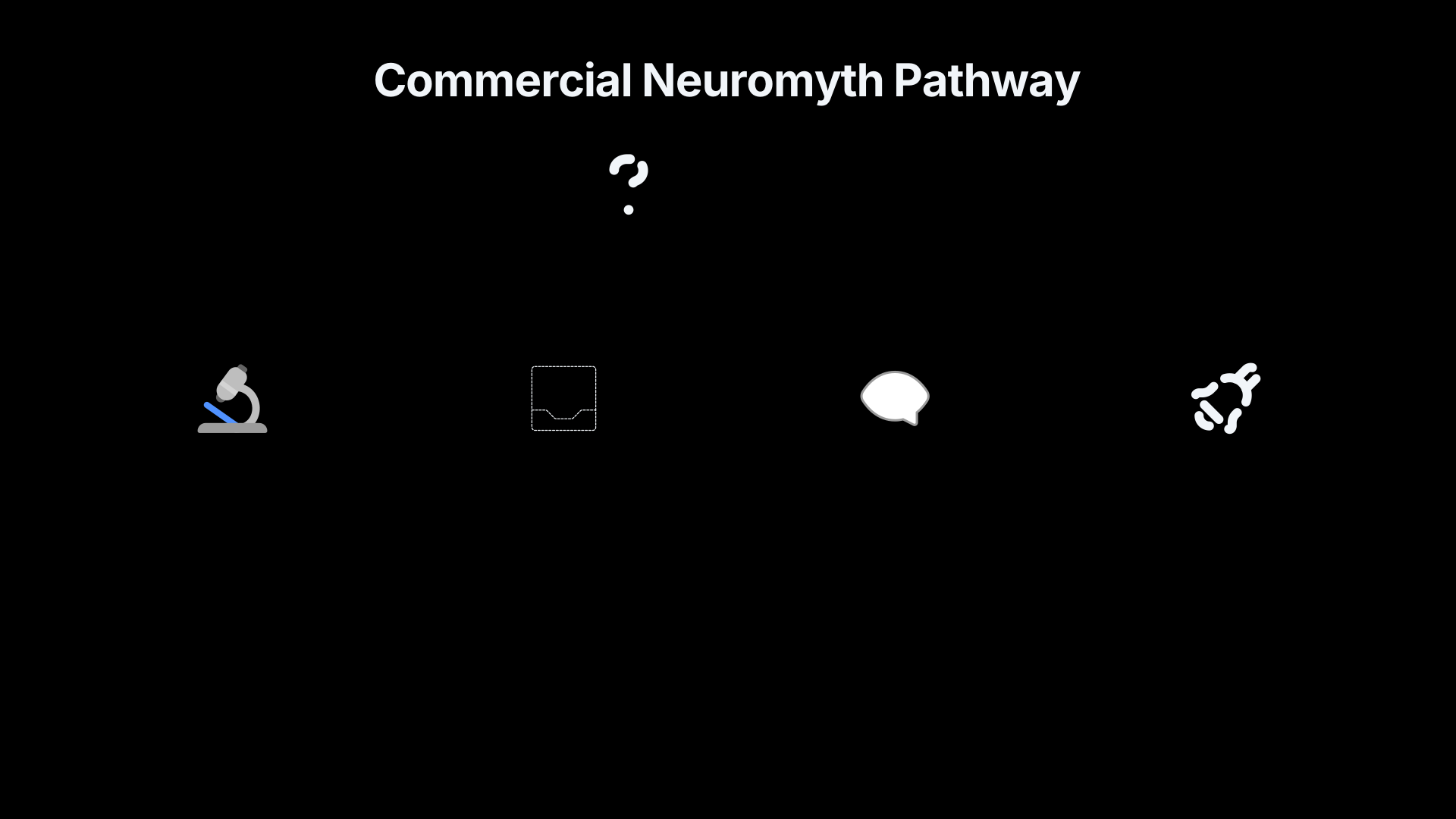
Neuromyths are commercially useful because they turn complex learning into a marketable promise. A school can buy a diagnostic questionnaire, a training day, a branded intervention, a set of posters or a pupil-profile package. The product feels actionable: it gives staff a vocabulary, a procedure and visible evidence that the school is personalising learning. That visibility can be appealing in systems where leaders must show improvement activity even when the underlying evidence is weak.
The commercial pathway often follows a recognisable pattern:
- A real problem is named. Pupils differ, some struggle to attend, and teachers need practical strategies.
- A scientific-sounding explanation is offered. Brain hemispheres, neural pathways, sensory preferences or critical windows are invoked.
- A simple diagnostic or routine is supplied. Pupils are sorted, exercises are prescribed, or lesson formats are matched.
- Evidence is blurred. Testimonials, neuroscience facts and classroom anecdotes are presented as if they prove learning gains.
- The claim becomes normalised. Once enough teachers have been trained, the language enters school culture.
Brain Gym-style claims are a useful example because movement itself is not the enemy. Schools have good reasons to value physical activity, active breaks and varied routines. The questionable step is the proprietary explanation that particular movements improve learning through specific brain-integration mechanisms. The myth is persuasive because the observable part — pupils moving and re-engaging — may feel real, while the hidden causal claim about the brain goes untested.[Frontiers]frontiersin.orgThe following questions are examined: Does neuroscience training protect against…Read more…
Professional culture can reinforce the same pattern without a commercial vendor. Teachers often share methods that appear to work in their classroom, and busy schools rely on trust. If a respected colleague says a learning-styles survey helped a difficult class, the claim may travel as practical wisdom. The correction therefore has to be respectful: the teacher may have improved relationships, varied instruction or made pupils feel noticed, even if the learning-styles theory used to explain the improvement was wrong.
What the evidence says about reducing neuromyths
The research on reducing neuromyth belief is more encouraging than a simple “myths never die” story, but it also warns against one-off debunking. A review of interventions to dispel neuromyths found that refutation-based approaches can reduce false beliefs, but raised questions about whether corrections last, whether they change classroom practice, and whether neuroscience training alone is enough.[Frontiers]frontiersin.orgThe following questions are examined: Does neuroscience training protect against…Read more…
A science-of-learning course for pre-service teachers found improvements in neuroscience literacy and reductions in neuromyth belief, suggesting that well-designed teacher education can help. However, the strongest versions do more than list myths. They teach why the myth was plausible, what the better explanation is, and how to evaluate future claims.[PMC]pmc.ncbi.nlm.nih.govby S Dekker · 2012 · Cited by 1291 — Results showed that on average, teachers believed 49% of the neuromyths, particularly myths relat…
The learning-styles literature offers a practical lesson. In the 2020 systematic review, four training studies that explained the lack of evidence for matching instruction to learning styles reduced belief from a weighted 78.4 per cent before training to 37.1 per cent afterwards. That is a large drop, but it still leaves many educators uncertain or partially convinced. It suggests that correction can work, but that durable change needs repeated reinforcement, better professional language and alternatives teachers can actually use.[Frontiers]frontiersin.orgThe following questions are examined: Does neuroscience training protect against…Read more…
The aim should not be to make teachers suspicious of all neuroscience. Educational neuroscience can be useful when it is careful about translation and works alongside psychology and classroom evidence. The goal is to build “evidence judgement”: the habit of asking what kind of claim is being made, what kind of evidence would support it, and whether the classroom recommendation follows from the science.
How educators can spot weak brain-based claims
A useful rule of thumb is that strong education claims become clearer when they move from brain language to classroom evidence. If a product says it “activates neural pathways”, the next question is not whether neural pathways exist; of course they do. The question is whether pupils learned more, retained more, transferred more or improved in a meaningful outcome compared with a reasonable alternative.
Teachers and school leaders can use a few practical checks before adopting a brain-branded approach:
- Look for the classroom claim, not just the brain fact. “The brain is plastic” is true but too broad to justify a specific programme. The evidence must support the actual teaching method being proposed.
- Ask whether the claim predicts better learning. A learning-styles questionnaire may identify preferences, but the key question is whether matching teaching to those preferences improves achievement.
- Separate engagement from learning. Pupils may enjoy an activity and still not learn the intended content better than they would through a simpler method.
- Watch for fixed learner labels. Claims that sort children into brain types, sensory types or intelligence types can narrow self-belief and teacher expectations.
- Prefer independent evidence over testimonials. Case studies and staff anecdotes can generate hypotheses, but they do not establish that a method works.
- Check whether the evidence uses pupils like yours. Laboratory findings, adult samples or neuroscience imaging results may not transfer directly to a Year 4 literacy intervention or a secondary maths lesson.
- Be wary of proprietary certainty. If a provider claims that mainstream science has missed a simple brain secret available through its training, scepticism is warranted.
These checks do not require every teacher to become a neuroscientist. They require a better boundary between inspiration and evidence. Brain science can inspire questions about attention, memory, sleep, stress, motivation and development. But a classroom intervention should be adopted because it improves learning or wellbeing in credible educational evidence, not because it has a colourful brain diagram attached.
Better replacements for neuromyth-based practice
Rejecting neuromyths should not leave teachers with less care for individual pupils. It should move personalisation onto firmer ground. Instead of assigning learning styles, teachers can use formative assessment to find out what pupils currently understand, where misconceptions sit, and what practice they need next. Instead of left-brain/right-brain labels, teachers can teach pupils that complex tasks often require multiple forms of thinking: explanation, representation, memory, language, reasoning and practice.
For classroom planning, a stronger alternative is to match the method to the material. Use diagrams when the content has spatial structure; use oral rehearsal when pupils need fluent explanation; use manipulatives when concrete representation helps pupils grasp an abstract idea; use retrieval practice when the goal is durable recall; use worked examples when novices need to see the steps of a problem. This preserves variety without pretending that each child has a fixed sensory channel.
For teacher training, the replacement is not a “neuromyth week” that briefly debunks common claims and then moves on. Better programmes embed evidence evaluation throughout training. Trainees should encounter examples of attractive but weak claims, learn the difference between preference and performance, practise reading intervention evidence, and discuss how myths can be attached to good intentions. Reviews of neuromyth interventions stress that reducing belief is only part of the task; the harder test is whether teachers then choose better-supported practices in real classrooms.[Frontiers]frontiersin.orgThe following questions are examined: Does neuroscience training protect against…Read more…
School leaders also have a role. They can audit professional development materials for unsupported brain claims, remove learning-styles language from lesson templates, avoid requiring trainees to label pupils by style, and make evidence discussion routine rather than punitive. The culture shift is subtle but important: teachers should not feel embarrassed for having encountered a neuromyth; they should feel equipped to retire it.
The real lesson for myths and misconceptions
Neuromyths show why misconceptions are so durable in professional settings. They are not merely false facts repeated by people who do not care about evidence. They are often attractive answers to real classroom problems, carried by scientific language, training systems, commercial products and professional goodwill.
The risk is not that every teacher who mentions the brain will damage learning. The risk is that schools may spend scarce time and trust on explanations that do not help pupils learn. The remedy is a more disciplined bridge between research and practice: welcome neuroscience where it is careful, reject labels that outrun the evidence, and judge classroom methods by what they help pupils understand, remember and do.
Amazon book picks
Further Reading
Books and field guides related to Why Brain Myths Spread in Schools. Use these as the next step if you want deeper reading beyond the article.
Why Don't Students Like School?
Explains evidence-based learning and counters popular misconceptions.
eBay marketplace picks
Marketplace Samples
Example marketplace items related to this page. Use the search link to explore similar finds on eBay.




Endnotes
1.
Source: pmc.ncbi.nlm.nih.gov
Link:https://pmc.ncbi.nlm.nih.gov/articles/PMC3475349/
Source snippet
by S Dekker · 2012 · Cited by 1291 — Results showed that on average, teachers believed 49% of the neuromyths, particularly myths relat...
2.
Source: pmc.ncbi.nlm.nih.gov
Link:https://pmc.ncbi.nlm.nih.gov/articles/PMC7835631/
Source snippet
The Persistence of Neuromyths in the Educational Settingsby M Torrijos-Muelas · 2021 · Cited by 273 — The findings present neuromyths...
3.
Source: oecd.org
Link:https://www.oecd.org/en/publications/2007/06/understanding-the-brain-the-birth-of-a-learning-science_g1gh76fd.html
4.
Source: pmc.ncbi.nlm.nih.gov
Link:https://pmc.ncbi.nlm.nih.gov/articles/PMC8548459/
5.
Source: my.chartered.college
Title: neuromyths about special educational needs what should teachers know
Link:https://my.chartered.college/impact_article/neuromyths-about-special-educational-needs-what-should-teachers-know/
6.
Source: educationendowmentfoundation.org.uk
Link:https://educationendowmentfoundation.org.uk/education-evidence/teaching-learning-toolkit/learning-styles
7.
Source: pmc.ncbi.nlm.nih.gov
Link:https://pmc.ncbi.nlm.nih.gov/articles/PMC9312647/
8.
Source: my.chartered.college
Link:https://my.chartered.college/impact_article/releasing-students-from-the-cognitive-straitjacket-of-visual-auditory-kinaesthetic-learning-styles/
9.
Source: my.chartered.college
Link:https://my.chartered.college/impact_article/teachers-understanding-of-neuromyths-a-role-for-educational-neuroscience-in-teacher-training/
10.
Source: youtube.com
Title: Neuromyths in Education
Link:https://www.youtube.com/watch?v=kR2M1W2XpP4
Source snippet
Debunking Neuromyths in the Classroom...
11.
Source: frontiersin.org
Link:https://www.frontiersin.org/journals/psychology/articles/10.3389/fpsyg.2021.719692/full
Source snippet
The following questions are examined: Does neuroscience training protect against...Read more...
12.
Source: pubmed.ncbi.nlm.nih.gov
Link:https://pubmed.ncbi.nlm.nih.gov/26162104/
13.
Source: frontiersin.org
Link:https://www.frontiersin.org/journals/education/articles/10.3389/feduc.2021.665752/full
14.
Source: frontiersin.org
Link:https://www.frontiersin.org/journals/education/articles/10.3389/feduc.2020.602451/full
15.
Source: frontiersin.org
Title: Frontiers Pre-service Science Teachers’ Neuroscience Literacy
Link:https://www.frontiersin.org/journals/human-neuroscience/articles/10.3389/fnhum.2019.00020/full
16.
Source: frontiersin.org
Title: Frontiers Why educators endorse a neuromyth: relationships among
Link:https://www.frontiersin.org/journals/psychology/articles/10.3389/fpsyg.2024.1407518/full
17.
Source: pubmed.ncbi.nlm.nih.gov
Link:https://pubmed.ncbi.nlm.nih.gov/34721171/
18.
Source: frontiersin.org
Link:https://www.frontiersin.org/journals/psychology/articles/10.3389/fpsyg.2020.591923/full
Additional References
19.
Source: educationalneuroscience.org.uk
Link:https://educationalneuroscience.org.uk/wordpress/resources/neuromyth-or-neurofact/children-have-different-learning-styles/
20.
Source: psychologicalscience.org
Link:https://www.psychologicalscience.org/news/releases/learning-styles-debunked-there-is-no-evidence-supporting-auditory-and-visual-learning-psychologists-say.html
21.
Source: researchgate.net
Link:https://www.researchgate.net/publication/233600402_Learning_Styles_Concepts_and_Evidence
22.
Source: uel.ac.uk
Link:https://www.uel.ac.uk/sites/default/files/a-reflection-on-the-principles-of-learning-styles.docx
23.
Source: gdoc.pub
Link:https://gdoc.pub/doc/e/2PACX-1vSYLiQNF3XCdGSl-Axe-Da_0qaJxayn0oy4YXm4gCitzLXIMJ7FiFyAUlKcRMJi_H03WjtF8hLUAyb_
24.
Source: structural-learning.com
Link:https://www.structural-learning.com/post/eef-teaching-learning-toolkit-guide
25.
Source: scispace.com
Link:https://scispace.com/pdf/educational-neuromyths-and-instructional-practices-the-case-12ess1im50.pdf
26.
Source: innerdrive.co.uk
Link:https://www.innerdrive.co.uk/blog/combat-neuromyths/
27.
Source: nifdi.org
Link:https://www.nifdi.org/what-is-di/88-news/kerry-hempenstall/814-neuroscience-and-education-where-to.html
28.
Source: sciencedirect.com
Link:https://www.sciencedirect.com/science/article/pii/S2211949324000097?dgcid=rss_sd_all
Topic Tree