Within Influencers
Why Creators Share Before They Check
Many creators share information without systematic verification, even when their audience treats the post like researched advice.
On this page
- What creator surveys reveal about verification habits
- How platform speed rewards unchecked certainty
- What practical fact checking routines can change
Page outline Jump by section
Introduction
Influencers and online creators have become major gateways to information, but many do not follow the verification routines traditionally associated with journalism, academic research or professional fact-checking. This matters because audiences often treat creator content as researched advice, even when it was produced quickly, based on limited checking, or drawn from unreliable sources. Recent international research suggests that systematic verification is far from standard practice among creators. The resulting gap does not necessarily stem from bad intentions. More often, it reflects platform incentives, time pressure, limited training and uncertainty about how to assess evidence. Yet when creators publish first and verify later, myths and misconceptions can gain credibility simply because they reached large audiences before anyone checked the claim. UNESCO[The United Nations Office at Geneva]ungeneva.orgThe United Nations Office at Geneva2/3 of digital content creators do not fact-check, UNESCO…The study found that 63 per cent of influ…

What Creator Surveys Reveal About Verification Habits
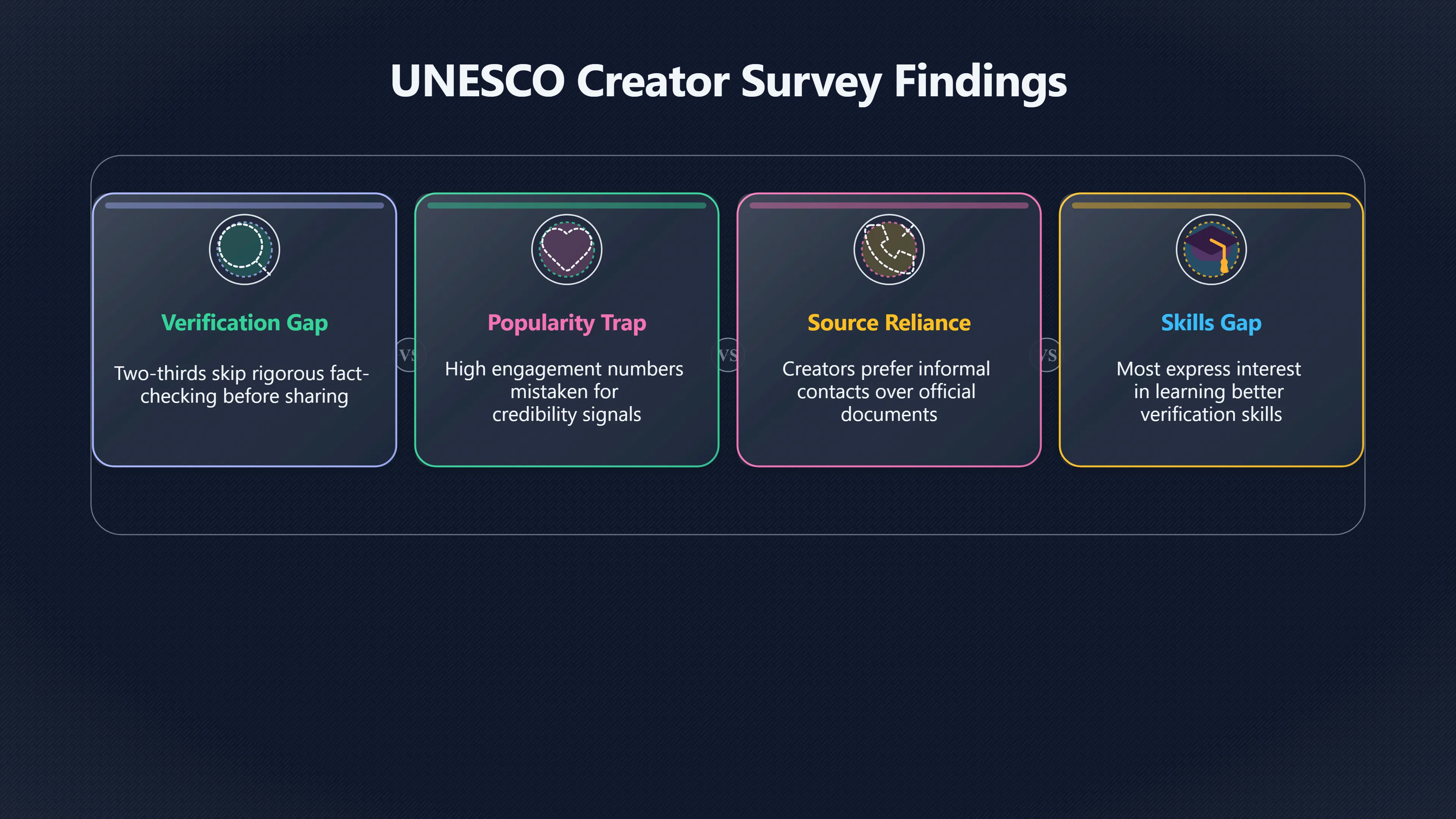
One of the clearest snapshots of creator behaviour comes from UNESCO’s global study of digital content creators. Surveying creators across dozens of countries, UNESCO found that roughly two-thirds did not conduct rigorous and systematic fact-checking before sharing information. At the same time, most expressed interest in learning better verification skills, suggesting that the problem is not simply indifference to accuracy but also a skills and workflow gap. UNESCO[The United Nations Office at Geneva]ungeneva.orgThe United Nations Office at Geneva2/3 of digital content creators do not fact-check, UNESCO…The study found that 63 per cent of influ…
The same research revealed another important pattern: creators often rely on personal experience, their own informal research, conversations with knowledgeable contacts or the apparent popularity of a source. Official documents, institutional publications and formal verification methods are used less consistently than many audiences might assume. In some cases, creators reported treating high engagement numbers as a signal of credibility, even though popularity and accuracy are not the same thing.[The Guardian]theguardian.comThe Guardian Online influencers need 'urgent' fact-checking trainingThe GuardianOnline influencers need 'urgent' fact-checking training…November 26, 2024 — 26 Nov 2024 — Research shows six in 10 social…[European Federation of Journalists]europeanjournalists.orgEuropean Federation of JournalistsUNESCO report highlights urgent need for media literacy…6 Dec 2024 — According to the study, digital…
This creates a mismatch between audience expectations and creator practices. A polished video, confident presentation and large following can make content appear thoroughly researched. Behind the scenes, however, the claim may have received little more scrutiny than a quick search, a trusted recommendation or a review of what other creators were already saying. UNESCO[UNU Campus Computing Centre]c3.unu.edubehind the screens the credibility challenge of digital content creatorsUNU Campus Computing CentreThe Credibility Challenge of Digital Content Creators10 Dec 2024 — With 63% of content creators admitting they…
The problem becomes especially significant when creators discuss health, science, finance or public affairs. Research on misinformation repeatedly shows that inaccurate information can spread rapidly online and influence beliefs and behaviour before corrections catch up. When creators act as information intermediaries, their verification habits become part of the information ecosystem itself.[PMC]pmc.ncbi.nlm.nih.govnih.govTrust, Media Credibility, Social Ties, and the Intention to Share…by P Majerczak · 2022 · Cited by 184 — This study expands on…[PMC]pmc.ncbi.nlm.nih.govnih.govTrust, Media Credibility, Social Ties, and the Intention to Share…by P Majerczak · 2022 · Cited by 184 — This study expands on…
Why Fast Publishing Often Wins Over Verification
The modern creator economy rewards speed. A creator who comments on a developing story within minutes may receive far more attention than someone who waits a day to verify the details. Platform algorithms frequently reward engagement, novelty and immediacy, creating pressure to publish before competitors do.[Yale Insights]insights.som.yale.eduhow social media rewards misinformationA majority of false stories are spread by a small number of frequent users, suggests a new study co-…Read more…
For many creators, verification carries costs while rapid publication brings rewards. Fact-checking requires time spent reading original sources, comparing claims, contacting experts or checking whether a statistic has been taken out of context. Those activities may delay posting and reduce the chance of capturing a trending topic. The economic incentives therefore push in the opposite direction from careful verification.
Another challenge is format. Short-form videos and rapid-fire posting encourage certainty and simplicity. Yet fact-checking often produces caveats, qualifications and uncertainty. A claim such as “research suggests a possible association, but the evidence remains mixed” is less likely to generate attention than “scientists have discovered the truth”. The result is that the platform environment can favour confident claims even when the evidence is incomplete.[Yale Insights]insights.som.yale.eduhow social media rewards misinformationA majority of false stories are spread by a small number of frequent users, suggests a new study co-…Read more…[USC Today]today.usc.edustudy reveals the key reason why fake news spreads on social media· Users could be…Read more…
Creators are also vulnerable to the same cognitive shortcuts as their audiences. If a claim comes from someone they trust, aligns with their existing beliefs or appears widely shared, it may feel credible enough to repost. Verification is often replaced by social proof: the assumption that many people sharing a claim must indicate reliability. UNESCO’s findings that creators sometimes use popularity as a credibility signal illustrate how this shortcut can become embedded in content production.[UNESCO]unesco.org2/3 of digital content creators do not check their facts before27 Nov 2024 — A UNESCO survey published today reveals that 62% do no…
The Difference Between Checking and Assuming
A common misunderstanding is that fact-checking simply means finding a source that agrees with a claim. In practice, verification is more demanding.
A creator may see a statistic repeated across multiple accounts and conclude that it has been confirmed. Yet all of those posts might trace back to the same unverified source. Similarly, quoting a study does not automatically validate a claim if the study’s findings are being exaggerated or misrepresented.
Reliable verification usually involves questions such as:
- Where did the claim originate?
- Is there a primary source rather than a repost or summary?
- Has the information been confirmed by multiple independent sources?
- Does the evidence actually support the conclusion being presented?
- Have credible experts challenged the interpretation?
Without these checks, creators can unknowingly amplify myths that appear credible on the surface but collapse under closer examination.
The distinction matters because many myths spread through chains of repetition rather than deliberate fabrication. Each person in the chain assumes someone earlier must have verified the information. Eventually the claim acquires the appearance of consensus despite lacking a solid evidential foundation. This pattern has been documented repeatedly in misinformation research and helps explain why false claims can persist even when corrections are available.[PMC]pmc.ncbi.nlm.nih.govnih.govTrust, Media Credibility, Social Ties, and the Intention to Share…by P Majerczak · 2022 · Cited by 184 — This study expands on…[PMC]pmc.ncbi.nlm.nih.govnih.govTrust, Media Credibility, Social Ties, and the Intention to Share…by P Majerczak · 2022 · Cited by 184 — This study expands on…

When Corrections Arrive Too Late
Verification failures become more consequential because corrections rarely travel as effectively as the original claim. By the time a creator realises a mistake, screenshots, reposts and derivative content may already have spread widely.
Research on information sharing shows that misinformation can gain momentum before fact-checks reach the same audience. Studies examining the spread of fact-checks online have found that corrective information faces its own visibility challenges, even when the correction is clear and well-supported.[PMC]pmc.ncbi.nlm.nih.govnih.govTrust, Media Credibility, Social Ties, and the Intention to Share…by P Majerczak · 2022 · Cited by 184 — This study expands on…
Audience loyalty can further complicate matters. Recent research on community fact-checking systems found that users who post misleading content do not necessarily lose followers after corrections are attached to their posts. In other words, being corrected does not automatically reduce a creator’s influence. Followers may continue to trust the creator despite documented errors.[arXiv]arxiv.orgarXiv Community Fact-Checks Do Not Break Follower LoyaltyCommunity Fact-Checks Do Not Break Follower LoyaltyMay 15, 2025…
This dynamic increases the importance of prevention. If corrections cannot reliably undo the effects of a misleading post, stronger verification before publication becomes more valuable than relying on corrections afterwards.
What Practical Fact-Checking Routines Can Change
The most effective response is not to expect every creator to become a professional investigator. Instead, the evidence points toward practical routines that reduce common verification failures.
Slow Down High-Stakes Claims
Not every post requires extensive research. However, health advice, scientific findings, financial guidance and public-interest claims deserve additional scrutiny. A simple delay to check original sources can prevent major errors from reaching large audiences.
Use Primary Sources Whenever Possible
Creators often rely on summaries, screenshots and second-hand interpretations. Moving one step closer to the original evidence—such as reading the study, official report or public document itself—reduces the risk of repeating someone else’s mistake.[UK Parliament]publications.parliament.ukUK Parliament Trusted voicesUK ParliamentTrusted voices - Culture, Media and Sport Committee12 Apr 2024 — Will Moy of Full Fact said that trustworthy fact-checking l…
Separate Experience From Evidence
Personal stories can be valuable, but they are not the same as general evidence. Responsible creators clearly distinguish between “this happened to me” and “this is what research shows”.
Show Sources Publicly
Linking to evidence allows audiences to inspect claims themselves. Transparency also creates accountability because viewers can evaluate whether the cited material actually supports the conclusion being presented. Fact-checking organisations routinely identify source transparency as a core element of trustworthy verification.[UK Parliament]publications.parliament.ukUK Parliament Trusted voicesUK ParliamentTrusted voices - Culture, Media and Sport Committee12 Apr 2024 — Will Moy of Full Fact said that trustworthy fact-checking l…
Correct Mistakes Prominently
Errors are inevitable. The key difference is whether corrections are visible, timely and easy to find. Creators who acknowledge mistakes publicly help reduce the long-term spread of misinformation and strengthen audience trust.
Why Verification Is Becoming a Creator Skill
The role of creators has expanded beyond entertainment. Many now function as commentators, educators, reviewers and explainers for audiences numbering in the hundreds of thousands or even millions. As that influence grows, the gap between audience expectations and creator verification practices becomes increasingly important.
Recent UNESCO initiatives reflect recognition of this shift. The organisation’s research found widespread interest among creators in learning media literacy and fact-checking skills, leading to dedicated training programmes aimed at improving verification practices before publication.[UNESCO]unesdoc.unesco.orgDigital Library Behind the screens: insights from digital content creatorscontent creators worldwide. The low prevalence of fact-checking among content creators highlights their vulnerability to misinformation a…[UNESCO]unesco.orgEmpowering Digital Content Creators as Trusted…As well as demonstrating that fact-checking is not the norm, the survey finds tha…
Within the broader story of myths and misconceptions, creator fact-checking gaps matter because they sit at the point where information becomes recommendation. A rumour seen by one person may remain insignificant. The same rumour repeated by a trusted creator can reach millions. The crucial question is often not whether the creator intended to mislead, but whether anyone checked the claim carefully before pressing publish. UNESCO[The United Nations Office at Geneva]ungeneva.orgThe United Nations Office at Geneva2/3 of digital content creators do not fact-check, UNESCO…The study found that 63 per cent of influ…
Amazon book picks
Further Reading
Books and field guides related to Why Creators Share Before They Check. Use these as the next step if you want deeper reading beyond the article.
Calling Bullshit
Bullshit isn’t what it used to be. Now, two science professors give us the tools to dismantle misinformation and think clearly in a world...

Scout Mindset
First published 2021. Subjects: Economics, Psychology, Cognition, Skepticism, Critical thinking.

Data Detective
First published 2021. Subjects: Statistics, Methodology, Social sciences, Statistical methods, Business.
A field guide to lies
First published 2016. Subjects: Critical thinking, Fallacies (Logic), Reasoning, Statistics, Social aspects.
eBay marketplace picks
Marketplace Samples
Example marketplace items related to this page. Use the search link to explore similar finds on eBay.


Endnotes
1.
Source: unesco.org
Link:https://www.unesco.org/en/articles/2/3-digital-content-creators-do-not-check-their-facts-sharing-want-learn-how-do-so-unesco-survey
Source snippet
2/3 of digital content creators do not check their facts before27 Nov 2024 — A UNESCO survey published today reveals that 62% do no...
2.
Source: unesdoc.unesco.org
Title: Digital Library Behind the screens: insights from digital content creators
Link:https://unesdoc.unesco.org/ark%3A/48223/pf0000392006
Source snippet
content creators worldwide. The low prevalence of fact-checking among content creators highlights their vulnerability to misinformation a...
3.
Source: unesco.org
Link:https://www.unesco.org/en/digital-content-creators
Source snippet
Empowering Digital Content Creators as Trusted...As well as demonstrating that fact-checking is not the norm, the survey finds tha...
4.
Source: c3.unu.edu
Title: behind the screens the credibility challenge of digital content creators
Link:https://c3.unu.edu/blog/behind-the-screens-the-credibility-challenge-of-digital-content-creators
Source snippet
UNU Campus Computing CentreThe Credibility Challenge of Digital Content Creators10 Dec 2024 — With 63% of content creators admitting they...
5.
Source: pmc.ncbi.nlm.nih.gov
Link:https://pmc.ncbi.nlm.nih.gov/articles/PMC10722559/
Source snippet
Social media users' perceptions about health mis - PMCby JP Stimpson · 2023 · Cited by 33 — Misinformation is false or inaccurate info...
6.
Source: pmc.ncbi.nlm.nih.gov
Link:https://pmc.ncbi.nlm.nih.gov/articles/PMC9910783/
Source snippet
Fake news, disinformation and misinformation in social mediaby E Aïmeur · 2023 · Cited by 1188 — This work aims to provide a comprehen...
7.
Source: insights.som.yale.edu
Title: how social media rewards misinformation
Link:https://insights.som.yale.edu/insights/how-social-media-rewards-misinformation
Source snippet
A majority of false stories are spread by a small number of frequent users, suggests a new study co-...Read more...
8.
Source: today.usc.edu
Title: study reveals the key reason why [fake news]({{ ‘fake-news/’ | relative_url }}) spreads on social media
Link:https://today.usc.edu/usc-study-reveals-the-key-reason-why-fake-news-spreads-on-social-media/
Source snippet
· Users could be...Read more...
9.
Source: pmc.ncbi.nlm.nih.gov
Link:https://pmc.ncbi.nlm.nih.gov/articles/PMC9188446/
Source snippet
Combating Misinformation by Sharing the Truth: a Study on...by J Li · 2022 · Cited by 101 — This research studies how different facto...
10.
Source: pmc.ncbi.nlm.nih.gov
Link:https://pmc.ncbi.nlm.nih.gov/articles/PMC8869166/
Source snippet
nih.govTrust, Media Credibility, Social Ties, and the Intention to Share...by P Majerczak · 2022 · Cited by 184 — This study expands on...
11.
Source: pmc.ncbi.nlm.nih.gov
Title: PMCAs Social Media Scales Back Fact-Checking, Can
Link:https://pmc.ncbi.nlm.nih.gov/articles/PMC13057141/
Source snippet
by W Glauser · 2026 — Fact-checking labels reduced belief in false information by nearly 28% and reduced misinformation sharing by rou...
12.
Source: arxiv.org
Title: arXiv Community Fact-Checks Do Not Break Follower Loyalty
Link:https://arxiv.org/abs/2505.10254
Source snippet
Community Fact-Checks Do Not Break Follower LoyaltyMay 15, 2025...
Published: May 15, 2025
13.
Source: publications.parliament.uk
Title: UK Parliament Trusted voices
Link:https://publications.parliament.uk/pa/cm5804/cmselect/cmcumeds/175/report.html
Source snippet
UK ParliamentTrusted voices - Culture, Media and Sport Committee12 Apr 2024 — Will Moy of Full Fact said that trustworthy fact-checking l...
14.
Source: unesco.org
Title: trains digital content creators become trusted voices online
Link:https://www.unesco.org/en/articles/unesco-trains-digital-content-creators-become-trusted-voices-online
Source snippet
UNESCO trains digital content creators to become trusted...18 Mar 2025 — Moving forward, they will emphasize the need to verify and sour...
15.
Source: unesco.org
Link:https://www.unesco.org/en/articles/shared-frontlines-unesco-bridges-gap-between-journalists-and-content-creators-age-doubt
Source snippet
UNESCO Bridges the Gap Between Journalists and26 Jan 2026 — UNESCO convenes journalists, fact-checkers, & influencers to confront disinfo...
16.
Source: unesco.org
Link:https://www.unesco.org/en/articles/joint-initiative-ministry-information-and-unesco-strengthen-fact-checking-and-combat-misinformation
Source snippet
Joint Initiative by the Ministry of Information and UNESCO toMar 11, 2026 — Strengthening fact-checking mechanisms and promoting Media an...
17.
Source: unesco.org
Title: fact checking quiet skill holding communities together
Link:https://www.unesco.org/en/articles/fact-checking-quiet-skill-holding-communities-together
Source snippet
Fact-checking: The quiet skill holding communities togetherFeb 4, 2026 — SM4P frames fact-checking as a peacebuilding skill, empowering S...
18.
Source: ungeneva.org
Link:https://www.ungeneva.org/en/news-media/news/2024/11/100747/23-digital-content-creators-do-not-fact-check-unesco-survey-reveals
Source snippet
The United Nations Office at Geneva2/3 of digital content creators do not fact-check, UNESCO...The study found that 63 per cent of influ...
19.
Source: theguardian.com
Title: The Guardian Online influencers need ‘urgent’ fact-checking training
Link:https://www.theguardian.com/media/2024/nov/26/online-influencers-need-urgent-fact-checking-training-warns-unesco
Source snippet
The GuardianOnline influencers need 'urgent' fact-checking training...November 26, 2024 — 26 Nov 2024 — Research shows six in 10 social...
Published: November 26, 2024
20.
Source: europeanjournalists.org
Link:https://europeanjournalists.org/blog/2024/12/06/unesco-report-highlights-urgent-need-for-media-literacy-training-for-digital-content-creators-who-report-the-news/
Source snippet
European Federation of JournalistsUNESCO report highlights urgent need for media literacy...6 Dec 2024 — According to the study, digital...
21.
Source: business-humanrights.org
Link:https://www.business-humanrights.org/pt/%C3%BAltimas-not%C3%ADcias/unesco-warns-that-online-influencers-urgently-need-fact-checking-training/
Source snippet
UNESCO warns that online influencers urgently need fact...Social media influencers need “urgent” help to check their facts before they b...
22.
Source: business-humanrights.org
Title: unesco warns that online influencers urgently need fact checking training
Link:https://www.business-humanrights.org/zh-hant/%E6%9C%80%E6%96%B0%E6%B6%88%E6%81%AF/unesco-warns-that-online-influencers-urgently-need-fact-checking-training/
Source snippet
UNESCO warns that online influencers urgently need fact...26 Nov 2024 — Unesco said its findings, which come from a survey of influencer...
23.
Source: business-humanrights.org
Title: unesco warns that online influencers urgently need fact checking training
Link:https://www.business-humanrights.org/en/latest-news/unesco-warns-that-online-influencers-urgently-need-fact-checking-training/
Source snippet
UNESCO warns that online influencers urgently need fact...Nov 26, 2024 — Social media influencers need “urgent” help to check their fact...
24.
Source: asianews.network
Title: unesco two thirds of content creators fail to verify facts
Link:https://asianews.network/unesco-two-thirds-of-content-creators-fail-to-verify-facts/
Source snippet
UNESCO: Two-thirds of content creators fail to verify facts3 Dec 2024 — The report, “Behind the Screens: Insight From Content Creators”...
Additional References
25.
Source: port.ac.uk
Link:https://www.port.ac.uk/news-events-and-blogs/news/new-research-unveils-the-dark-side-of-social-media-influencers-and-their-impact-on-marketing-and-consumer-behaviour
Source snippet
New research unveils the "dark side" of social media...24 Feb 2025 — A recent study by the University of Portsmouth systematically exami...
26.
Source: sydney.edu.au
Title: influencers promoting overwhelmingly misleading information
Link:https://www.sydney.edu.au/news-opinion/news/2025/02/27/–influencers-promoting–overwhelmingly–misleading-information-.html
Source snippet
social media is an open sewer of medical misinformation. “This is a public health crisis that exacerbates overdiagnosis and threatens the...
27.
Source: sciencedirect.com
Title: Why do people share (mis)information?
Link:https://www.sciencedirect.com/science/article/pii/S0747563224003212
Source snippet
Power motives in...by A Guinote · 2025 · Cited by 6 — Amidst this activity, misinformation, whether in the form of conspiracy theories...
28.
Source: youtube.com
Title: Spotting Misinformation: Tools for Online Creators
Link:https://www.youtube.com/watch?v=9hP95-k8H_c
Source snippet
These videos provide practical training and verification workflows specifically designed to help content creators address the fact-checki...
29.
Source: shieldvsdisinfo.com
Title: Influencers vs fact checking
Link:https://shieldvsdisinfo.com/educator-e-toolkit/influencers-vs-fact-checking/
Source snippet
SHIELDThis UNESCO report, “Behind the Screens,” aims to provide valuable insights into the world of digital content creators. The report...
30.
Source: facebook.com
Title: 🚨 Fact-checking gap alert!
Link:https://www.facebook.com/unescobangkok/posts/-fact-checking-gap-alert-two-thirds-of-digital-content-creators-admit-they-dont-/990596479776317/
Source snippet
Two-thirds of digital content...Two-thirds of digital content creators admit they don't verify information before sharing, according to...
31.
Source: reutersinstitute.[politics]({{ ‘politics/’ | relative_url }}). ox.ac.uk
Title: dnr executive
Link:https://reutersinstitute.politics.ox.ac.uk/digital-news-report/2025/dnr-executive-summary
Source snippet
Overview and key findings of the 2025 Digital News Report17 Jun 2025 — Accuracy and truth telling: Audiences would like journalists to fo...
32.
Source: academic.oup.com
Link:https://academic.oup.com/heapro/article/40/2/daaf023/8100645
Source snippet
OUP AcademicSocial media and the spread of misinformationby E Denniss · 2025 · Cited by 115 — Third, internet robots or 'bots' are known...
33.
Source: youtube.com
Title: How to verify information for journalists and creators
Link:https://www.youtube.com/watch?v=04d1e2N2Klc
Source snippet
Digital Literacy and Fact-Checking Techniques...
34.
Source: youtube.com
Title: Digital Literacy and Fact-Checking Techniques
Link:https://www.youtube.com/watch?v=b0a-hPqV3iY
Source snippet
Spotting Misinformation: Tools for Online Creators...
Topic Tree