Within Mythcraft
Why Myths Beat Nuance in a Sentence
Myths often win because short slogans travel better than the slower, more qualified truth.
On this page
- Brevity and memory
- Emotional payoff
- Making truth more usable
Page outline Jump by section
Introduction
Myths often beat accurate explanations because they are easier to carry. A slogan compresses a cause, villain, cure or rule into a sentence that feels complete; an accurate explanation often has to include conditions, uncertainty and missing context. That does not mean people prefer lies to truth. Research on misinformation suggests a more specific problem: repetition, fluency, emotional payoff and social sharing can make a short false claim feel familiar and useful before a slower correction has a chance to work. Repeated statements are often judged as more truthful than new ones, partly because they are easier to process, a pattern known as the illusory truth effect.[Journal of Cognition]journalofcognition.orgSource details in endnotes.
The practical lesson is not that accuracy must become simplistic. It is that truthful communication has to compete at the level where myths are strong: memory, usability and social transmission. A correction that merely says “that is false” leaves the myth’s compact story intact. A stronger explanation gives people a replacement sentence they can remember, plus enough reasoning to use it when the myth reappears in a new form. The goal is not to make truth as crude as the slogan, but to make the accurate account easier to retrieve than the misleading one.
Why short myths feel more convincing than long truths
A good myth is rarely just a factual error. It is a tiny explanation. “You only use 10 per cent of your brain” is not just wrong; it promises hidden potential. “Natural means safe” is not just incomplete; it offers a simple shopping rule. “They do not want you to know” is not evidence; it turns confusion into a story about suppression. These lines survive because they reduce effort. They tell the listener what happened, who benefits, what to feel and what to repeat next.
Cognitive fluency helps explain why this matters. In the standard illusory truth effect, people rate repeated statements as more true than new statements, even when some statements are false. One influential explanation is that repetition makes a statement easier to process, and people can misread that ease as a sign of truth. The Journal of Cognition review describes fluency, familiarity and source dissociation as related mechanisms: people may remember the claim more readily than where it came from, or may feel that it “rings true” without knowing why.[Journal of Cognition]journalofcognition.orgSource details in endnotes.
This gives slogans a structural advantage. They are brief enough to be repeated in headlines, captions, speeches, thumbnails, comments and casual conversation. The accurate explanation is often longer because reality contains exceptions: a risk may depend on dose, age, exposure, baseline health, measurement quality or trade-offs. The myth can say “X causes Y”. The explanation may need to say “X is associated with Y in this context, but the evidence is weaker in that one”. That extra care is what makes the explanation responsible, but it also makes it harder to quote.
There is a second advantage: slogans often fit the speed of everyday judgement. People are not always reading misinformation in a quiet, analytical state. They are scrolling, reacting, multitasking or deciding whether something is worth sharing. Research on social media sharing finds that people may share false or misleading news partly because their attention is focused on something other than accuracy at the moment of sharing. In experiments, subtle prompts that redirected attention to accuracy improved the quality of what people said they would share.[Nature]nature.comShifting attention to accuracy can reduce misinformation online | NatureShifting attention to accuracy can reduce misinformation online | Nature…
Brevity is powerful, but not the same as clarity
A short message can be clear, or it can be dangerously incomplete. The difference is whether it preserves the causal shape of the truth. “Antibiotics do not treat viruses” is short, accurate and useful. “Chemicals are bad” is short, inaccurate and misleading because it turns a category that includes everything from oxygen to caffeine into a fear cue. The problem is not brevity itself; the problem is compression that removes the part of the explanation that prevents misunderstanding.
Public communication tools recognise this tension. The CDC Clear Communication Index was designed to help writers make public messages easier to understand and use, while still attending to the state of the science, behaviour, numbers and risk. It is not a call to strip away substance; it is a framework for identifying the main message, making it legible and checking whether the reader can act on it.[CDC]cdc.govCDC Clear Communication Index: A Tool for Developing and Assessing CDC Public Communication Products—User Guide…
For myths and misconceptions, the useful test is not “Can this be said in fewer words?” but “What must stay in the sentence for the reader not to walk away with the wrong model?” A message about vaccine side effects, for example, may need to preserve the difference between common mild reactions, rare serious events and the risks of the disease itself. A message about climate change may need to preserve the difference between weather variability and long-term warming. A message about nutrition may need to preserve dose, substitution and overall diet rather than isolating one ingredient as magic or poison.
A truthful short line therefore works best as a doorway, not a substitute for the explanation. It gives the reader a usable handle:
- Myth-like compression: “If it is natural, it is safe.”
- Accurate compact version: “Natural does not guarantee safe; dose and evidence matter.”
- Explanation that supports it: Many natural substances can harm at sufficient dose, and many synthetic medicines are carefully tested for benefit and risk.
The compact version is still memorable, but it does not smuggle in the false rule. It helps people remember the correct organising principle.
Emotional payoff helps slogans travel
Many myths offer an emotional reward before they offer evidence. They can make the reader feel clever, wronged, protected, morally superior or newly awakened. That emotional payoff is one reason slogans spread so readily: a claim that gives people something to feel is easier to pass on than a claim that merely asks them to update a probability.
Large-scale research on online diffusion supports the importance of novelty and emotion. A major Science study of Twitter rumours from 2006 to 2017 found that false news diffused farther, faster, deeper and more broadly than true news across categories. The researchers reported that false news was more novel and that users responded to it with emotions such as surprise and disgust, while true news was more likely to evoke sadness, anticipation, joy and trust.[Science]science.orgSource details in endnotes. MIT’s summary of the study emphasised that falsehoods spread rapidly not only because of bots, but because humans were more likely to share them.[MIT News]news.mit.edustudy twitter false news travels faster true stories 0308study twitter false news travels faster true stories 0308
This matters for slogans because novelty and emotional charge can make a short line feel worth repeating. “Everything you know is wrong” is more exciting than “the evidence is mixed”. “This one trick changes everything” is more shareable than “the effect is small and depends on context”. Myths exploit the gap between what is interesting and what is warranted.
The emotional mechanism is especially visible in moralised claims. Research on moral-emotional language in online networks found that moral and emotional wording was associated with greater diffusion of political messages, with one study reporting increased spread for each additional moral-emotional word in messages about polarising issues.[PNAS]pnas.orgOpen source on pnas.org. This does not mean emotional language is always false, or that calm language is always true. It means communicators cannot ignore the social energy of a claim. A correction that is accurate but emotionally inert may fail to compete with a myth that gives people a clear feeling and a clear social role.
The ethical challenge is to give truth a legitimate emotional shape without copying manipulation. Accurate explanations can appeal to curiosity, care, fairness, safety or intellectual humility. They do not have to be bloodless. A good correction can say, in effect: “Here is why the claim feels satisfying, here is why it fails, and here is the better way to protect what you care about.”
Why “myth versus fact” can accidentally advertise the myth
Many correction pages put the myth in the largest, clearest words and the explanation underneath. That format feels tidy, but it can strengthen the wrong sentence if the reader remembers the myth more easily than the correction. This is not a reason to hide every false claim; sometimes people need to know exactly what is being corrected. The risk is that the correction becomes a distribution channel for the slogan.
The Debunking Handbook 2020 recommends that corrections should be prominent, should not rely on a bare retraction, and should provide a factual alternative that fills the gap left by the misinformation. It also advises leading with the fact when it is clear and sticky, warning that a myth is coming, explaining how the myth misleads, and finishing by reinforcing the fact.[Center for Climate Change Communication]climatechangecommunication.orgCenter for Climate Change Communication
That sequence matters because memory is not a filing cabinet in which “false” labels stay attached forever. People can remember the claim and forget the correction, remember the correction but still use the old story, or remember that something was disputed without remembering what replaced it. In continued influence research, misinformation can keep shaping reasoning after it has been retracted because it once helped explain the situation. The false claim may remain useful unless the correction supplies an alternative explanation that does the same explanatory work.[Center for Climate Change Communication]climatechangecommunication.orgCenter for Climate Change Communication
A weak correction says:
“The claim that the fire started because of gas cans is false.”
A stronger correction says:
“The fire was not caused by gas cans; investigators found evidence of faulty wiring, which explains where the fire began and why it spread.”
The second version gives the mind a replacement. It does not just remove the old cause; it repairs the story.
Making accurate explanations more memorable
Truth does not need to become a slogan in the shallow sense. It needs a memorable structure. The strongest accurate explanations often combine three layers: a compact takeaway, a causal explanation and a retrieval cue that helps the reader apply the idea later.
The compact takeaway should be short enough to repeat without becoming misleading. It should name the correct principle, not merely negate the myth. “Flu is caused by influenza viruses, not cold weather” is more useful than “cold weather does not cause flu”, because it gives the real causal agent. “Correlation is not causation” is memorable, but often too vague on its own; adding “look for mechanism, timing and alternative explanations” makes it more usable.
The causal explanation should answer the question the myth was answering. If the myth explains why someone got ill, why prices rose, why a group behaved badly or why a policy failed, the correction has to offer a better explanation of that same event. The Debunking Handbook’s guidance is explicit that a factual alternative should not be more complex than necessary and should have similar explanatory relevance to the misinformation.[Center for Climate Change Communication]climatechangecommunication.orgCenter for Climate Change Communication
The retrieval cue should help the reader recognise the pattern when the wording changes. A myth about a “miracle cure”, a “suppressed study” and a “secret detox” may look different on the surface, but all may rely on the same pattern: a simple cure, a hidden enemy and no reliable evidence. A good explanation gives readers that pattern, not just the answer to one example.
One useful format is:
Fact first: State the accurate claim plainly.
Why the myth is tempting: Explain the appeal without mocking the believer.
What breaks the myth: Identify the missing evidence, false cause, misleading comparison or exaggerated certainty.
Replacement explanation: Give the better account in a form the reader can reuse.
This works because it respects both accuracy and memory. It does not assume that people will keep a long explanation available forever. It gives them a compact line backed by a fuller model.
The social problem: truth must be easy to share before the myth wins
Misinformation is not only a belief problem; it is a circulation problem. During a crisis, people face an overload of claims, warnings, rumours and advice. The World Health Organization describes an infodemic as too much information, including false or misleading information, in digital and physical environments during a disease outbreak; it can cause confusion, encourage risky behaviour and undermine trust in health authorities.[World Health Organization]who.intInfodemic…
In that environment, accurate explanations lose if they are available only after the myth has become the default sentence. A public health agency, teacher, journalist or fact-checker may be correct, but late and hard to quote. The myth may already have become the line people use in group chats, comments and headlines.
Research on accuracy prompts suggests one reason to intervene before people share. Across experiments, prompts that made accuracy salient improved sharing discernment, largely by reducing intentions to share false headlines, with one Nature Communications analysis reporting about a 10 per cent reduction in false-news sharing intentions relative to control.[Nature]nature.comOpen source on nature.com. The important point for slogans is that many people do care about accuracy, but the design of the moment may not make accuracy the active concern. A catchy myth asks, “Will this get a reaction?” A better information environment asks, “Is this true enough to pass on?”
That is why accurate explanations need social packaging as well as scientific care. They need headlines that lead with the true claim, summaries that can be quoted without distortion, visuals that reinforce the correct model, and repeated exposure to the accurate sentence. Repetition is not only a tool of misinformation. Repeating the truth can make the correct account more familiar too, provided the repetition does not keep re-advertising the myth.
The honest trade-off: usable truth is simplified, not simplistic
Every public explanation simplifies. The question is whether it simplifies by preserving the right structure or by cutting away the safeguards that make the claim true. A slogan becomes misleading when it hides uncertainty that would change the reader’s decision, erases scale, turns a possibility into a probability, or replaces evidence with identity. A good explanation becomes memorable when it compresses around the correct principle.
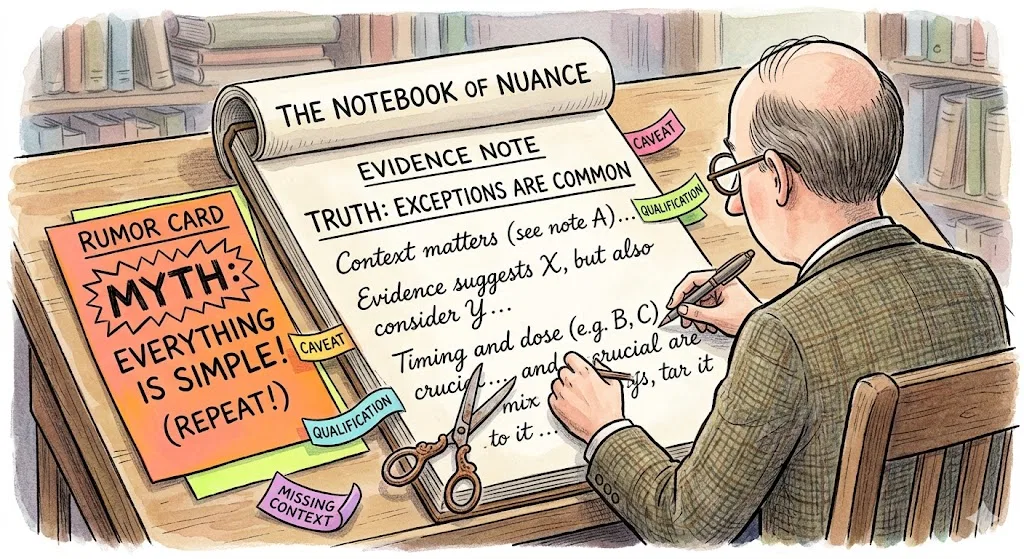
For myths and misconceptions, the best response is therefore not a longer paragraph every time. Sometimes the best response is a better sentence, followed by a short explanation that earns the sentence. “The dose makes the risk.” “Weather varies; climate trends.” “Anecdotes can raise questions, but they do not settle causes.” “False claims need replacements, not just retractions.” These lines are not complete research summaries, but they point in the right direction.
The deeper aim is to stop giving myths a monopoly on simplicity. People need accurate ideas they can remember under pressure, repeat without mangling, and use when a familiar false claim returns in a new costume. Nuance does not have to mean a fog of qualifications. At its best, nuance means knowing which distinction matters, saying it clearly, and making the true explanation easier to carry than the myth.
Amazon book picks
Further Reading
Books and field guides related to Why Myths Beat Nuance in a Sentence. Use these as the next step if you want deeper reading beyond the article.
Factfulness
Shows how simple narratives distort understanding and how to think more accurately.
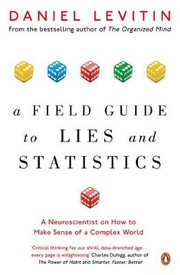
A field guide to lies
First published 2016. Subjects: Critical thinking, Fallacies (Logic), Reasoning, Statistics, Social aspects.
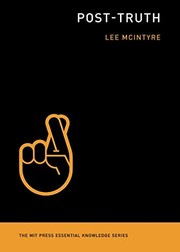
Post-truth
First published 2018. Subjects: Politics and government, In mass media, Public opinion, Mass media, Truth.

eBay marketplace picks
Marketplace Samples
Example marketplace items related to this page. Use the search link to explore similar finds on eBay.
Endnotes
1.
Source: nature.com
Title: Shifting attention to accuracy can reduce misinformation online | Nature
Link:https://www.nature.com/articles/s41586-021-03344-2
Source snippet
Shifting attention to accuracy can reduce misinformation online | Nature...
2.
Source: cdc.gov
Link:https://www.cdc.gov/ccindex/pdf/clear-communication-user-guide.pdf
Source snippet
CDC Clear Communication Index: A Tool for Developing and Assessing CDC Public Communication Products—User Guide...
3.
Source: news.mit.edu
Title: study twitter false news travels faster true stories 0308
Link:https://news.mit.edu/2018/study-twitter-false-news-travels-faster-true-stories-0308
4.
Source: pnas.org
Link:https://www.pnas.org/doi/10.1073/pnas.1618923114
5.
Source: climatechangecommunication.org
Title: Center for Climate Change Communication
Link:https://www.climatechangecommunication.org/wp-content/uploads/2023/09/DebunkingHandbook2020.pdf
6.
Source: who.int
Title: World Health Organization
Link:https://www.who.int/health-topics/infodemic
Source snippet
Infodemic...
7.
Source: nature.com
Link:https://www.nature.com/articles/s41467-022-30073-5
8.
Source: nature.com
Link:https://www.nature.com/articles/s44159-021-00006-y
9.
Source: ide.mit.edu
Title: Pennycook et al Shifting attention to accuracy
Link:https://ide.mit.edu/sites/default/files/publications/Pennycook%20et%20al%20-%20Shifting%20attention%20to%20accuracy.pdf
10.
Source: ide.mit.edu
Title: 2017 IDE Research Brief False News
Link:https://ide.mit.edu/wp-content/uploads/2018/12/2017-IDE-Research-Brief-False-News.pdf
11.
Source: pnas.org
Link:https://www.pnas.org/doi/10.1073/pnas.2216614120
12.
Source: pnas.org
Link:https://www.pnas.org/doi/abs/10.1073/pnas.1618923114?utm=
13.
Source: journalofcognition.org
Link:https://journalofcognition.org/articles/10.5334/joc.161
14.
Source: science.org
Link:https://www.science.org/doi/10.1126/science.aap9559
15.
Source: sciencedirect.com
Link:https://www.sciencedirect.com/science/article/am/pii/S2352250X23002282
16.
Source: sciencedirect.com
Link:https://www.sciencedirect.com/science/article/abs/pii/S2352250X23001811
17.
Source: sciencedirect.com
Link:https://www.sciencedirect.com/science/article/pii/S1364661321000516
18.
Source: sciencedirect.com
Link:https://www.sciencedirect.com/science/article/pii/S004727272500043X
19.
Source: sciencedirect.com
Link:https://www.sciencedirect.com/science/article/pii/S1566253524000782
20.
Source: digitalcommons.unl.edu
Link:https://digitalcommons.unl.edu/context/scholcom/article/1247/viewcontent/DebunkingHandbook2020.pdf
21.
Source: facebook.com
Link:https://www.facebook.com/WHOThailand/posts/what-is-an-infodemicinfodemic-information-epidemic-is-an-overabundance-of-inform/3831016243585903/
22.
Source: training.safestates.org
Title: cdc clear communication index
Link:https://training.safestates.org/ivpt-item/cdc-clear-communication-index/
23.
Source: ltrr.arizona.edu
Title: Debunking Handbook
Link:https://www.ltrr.arizona.edu/~katie/kt/natsgc/Debunking_Handbook.pdf
24.
Source: bristol.ac.uk
Title: debunking handbook
Link:https://www.bristol.ac.uk/news/2020/october/debunking-handbook-.html
Additional References
25.
Source: youtube.com
Title: The Illusory Truth Effect: Why Repetition Makes Myths Feel Real
Link:https://www.youtube.com/watch?v=F3wY2iY05qA
Source snippet
Why Simple Slogans Are More Persuasive Than Complex Facts...
26.
Source: youtube.com
Title: Why Simple Slogans Are More Persuasive Than Complex Facts
Link:https://www.youtube.com/watch?v=m4G1d2J8GgM
Source snippet
Cognitive Fluency and the Power of Memorable Messaging...
27.
Source: youtube.com
Title: How to Communicate Truth in an Era of Misinformation
Link:https://www.youtube.com/watch?v=N61Yw-6jS-Y
Source snippet
The Psychology of Why We Prefer Simple Stories Over Evidence...
28.
Source: youtube.com
Title: Cognitive Fluency and the Power of Memorable Messaging
Link:https://www.youtube.com/watch?v=vV7-D3Wd4x8
Source snippet
How to Communicate Truth in an Era of Misinformation...
29.
Source: researchgate.net
Link:https://www.researchgate.net/publication/362841654_I_Think_This_News_Is_Accurate_Endorsing_Accuracy_Decreases_the_Sharing_of_Fake_News_and_Increases_the_Sharing_of_Real_News
30.
Source: researchgate.net
Link:https://www.researchgate.net/publication/391015007To_be_continued_misinformation%27s_bizarre_adventure_beyond_memory_failures-_exploring_non-memory-based_mechanisms_driving_the_continued_influence_effect_CIE
31.
Source: facebook.com
Link:https://www.facebook.com/AmericanPsychologicalAssociation/posts/you-keep-seeing-the-same-claim-made-over-and-over-onlineso-it-must-be-true-right/1290086699819665/
32.
Source: scribd.com
Link:https://www.scribd.com/document/906176348/Emotion-Shapes-the-Diffusion-of-Moralized-Content-in-Social-Networks
33.
Source: zotero.org
Link:https://www.zotero.org/groups/2243448/library/items/NZ8K64E2
34.
Source: researchgate.net
Link:https://www.researchgate.net/publication/317947723_Emotion_shapes_the_diffusion_of_moralized_content_in_social_networks
Topic Tree