Within Mythcraft
When Both Sides Framing Misleads Readers
Giving weak claims equal weight with strong evidence can make a misconception look like a live debate.
On this page
- What false balance means
- How uncertainty gets exaggerated
- Better ways to show evidence weight
Page outline Jump by section
Introduction
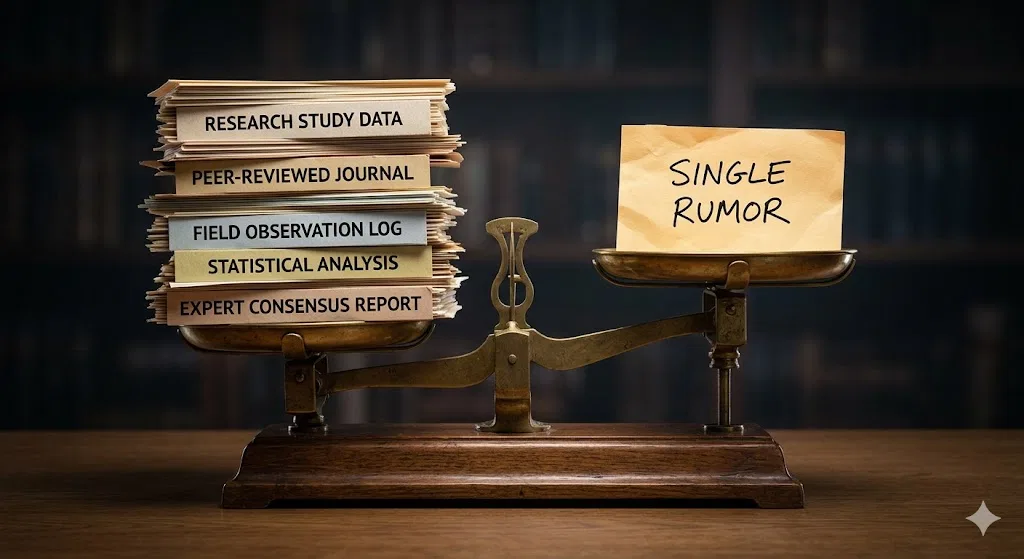
False balance happens when weak, unsupported or fringe claims are presented as if they deserve the same weight as a much stronger evidence base. It often begins as a well-meant attempt to be fair: quote one person “for” and one person “against”, give each side equal airtime, and let the audience decide. The problem is that this can make a settled or heavily one-sided question look like an open contest. In myths and misconceptions, that framing is powerful because it turns correction into spectacle: the false claim appears not as a failed claim, but as one “side” of a debate.
This does not mean minority views should never be reported. It means readers need to know what kind of minority claim they are seeing: a serious unresolved scientific disagreement, an early hypothesis, a political objection, a personal testimony, a commercial talking point, or a claim already tested and found wanting. Good reporting does not hide disagreement; it shows its weight.
What False Balance Means
False balance is not simply “including both sides”. It is including both sides in a way that misrepresents the strength, quality or relevance of the evidence behind them. The Association of Health Care Journalists defines false balance as using outlier voices to contradict facts or accepted evidence simply to provide “balance” to a story. That is why the problem is especially visible in health, science and climate reporting, where one position may be supported by large bodies of research while the opposing position rests on anecdotes, speculation, poor methods or conflicts of interest.[Association of Health Care Journalists]healthjournalism.orgAssociation of Health Care JournalistsFalse balance (false equivalence)This lapse in responsible reporting refers to using outliers' voic…
The danger is subtle. A report may be factually accurate in a narrow sense: one expert really did say one thing, and one dissenter really did say another. But the structure of the story can still mislead if it gives the dissenter equal prominence without explaining that the underlying evidential support is not equal. In that situation, balance becomes a form of distortion.
This is why “both sides” is a poor shortcut for fairness. Fairness to the reader means helping them understand proportion. If 95 researchers find one thing and two activists claim the opposite, a 50:50 format does not make the audience better informed. It hides the central fact: the dispute is not evenly divided at the level of evidence.
False balance is therefore different from ordinary debate coverage. In a live policy dispute, reasonable people may share the same evidence but disagree about values, priorities, costs or trade-offs. In a false-balance frame, the evidential foundation itself is misrepresented. The audience is led to believe there is more uncertainty, expert division or factual ambiguity than there really is.
How Weak Claims Gain the Look of a Live Debate
False balance works because it uses familiar signals of legitimacy. A studio debate, a quoted “sceptic”, a headline built around “critics say”, or a panel with one supporter and one opponent all suggest that the issue has two broadly comparable sides. Readers are used to politics being presented this way, so the format can smuggle that habit into topics where evidence is not evenly distributed.
A classic example is climate change coverage. Maxwell and Jules Boykoff’s influential study of US prestige-press coverage from 1988 to 2002 argued that journalistic norms of balanced reporting contributed to a gap between scientific discourse and public discourse on global warming. The finding was not that journalists invented climate scepticism; it was that routine professional habits helped make the public debate look less settled than the scientific literature was becoming.[ScienceDirect]sciencedirect.comBalance as bias: global warming and the US prestige pressby MT Boykoff · 2004 · Cited by 2926 — This paper demonstrates that…
That matters because scientific consensus is not a popularity contest. It is a signal that many independent lines of evidence have been tested, criticised, replicated and weighed. Cook and colleagues’ 2013 study examined 11,944 climate abstracts from 1991 to 2011 and found that, among papers expressing a position on human-caused global warming, 97.1% endorsed the consensus position. The exact percentage is less important than the structural point: a small rejection minority should not be framed as half of the expert landscape.[Brown Climate Social Science Network]cssn.orgSource details in endnotes.
The same pattern appeared in vaccine reporting. The discredited claim that the measles, mumps and rubella vaccine was linked to autism began with Andrew Wakefield’s 1998 Lancet paper, which was later retracted, with subsequent investigations and reviews finding serious scientific and ethical failures. Yet the media controversy lasted far longer than the evidence warranted, partly because the story was repeatedly framed as anxious parents and dissenting doctors versus medical authorities.[PMC]pmc.ncbi.nlm.nih.govPMCWeight-of-Evidence Strategies to Mitigate the InfluencePMCWeight-of-Evidence Strategies to Mitigate the Influence[PMC]pmc.ncbi.nlm.nih.govPMCWeight-of-Evidence Strategies to Mitigate the InfluencePMCWeight-of-Evidence Strategies to Mitigate the Influence
The result is not only confusion about facts. False balance can change what people think experts think. In an experiment on autism-vaccine coverage, Graham Dixon and Christopher Clarke randomly assigned 327 participants to different news articles. Readers exposed to a “balanced” presentation of claims for and against an autism-vaccine link were less certain that vaccines did not cause autism and more likely to believe experts were divided. Sage Journals[PubMed]pubmed.ncbi.nlm.nih.govSource details in endnotes.

How Uncertainty Gets Exaggerated
Uncertainty is normal in real evidence. Good science includes margins of error, confidence levels, changing estimates and unresolved details. False balance exploits that honesty by treating any uncertainty as though it cancels the larger conclusion.
This is a common route from uncertainty to misconception. A study may leave open a narrow question, such as the exact size of an effect, the best policy response, or the risk profile for a subgroup. A weak claim then reframes that uncertainty as if the whole topic is unsettled. The move is often rhetorical rather than evidential: “scientists are still debating details” becomes “scientists do not really know”.
Three mechanisms are especially important:
- Equal time implies equal support. If a programme gives one climate scientist and one climate-denial advocate the same slot without context, the audience may infer that expert opinion is evenly divided.
- Personal testimony competes emotionally with systematic evidence. A single vivid story can feel more persuasive than a large review, even when the review is far more reliable.
- Unchallenged claims linger. If a presenter, interviewer or article includes a false claim but does not correct it clearly, the audience may remember the claim more strongly than any later clarification.
Research on false-balance mitigation suggests that “weight-of-evidence” statements can help. These are explicit signals that tell readers where the evidence lies, rather than merely placing opposing claims side by side. Schmid and Betsch’s work on weight-of-evidence strategies reports that falsely balanced coverage can distort attitudes towards behaviours supported by science, while evidence-weighting can reduce that distortion.[PMC]pmc.ncbi.nlm.nih.govPMCWeight-of-Evidence Strategies to Mitigate the InfluencePMCWeight-of-Evidence Strategies to Mitigate the Influence
But weighting evidence is not a magic phrase added at the end. The entire report has to make proportion visible: who has relevant expertise, what evidence has been tested, how many studies point in each direction, whether the claim has survived review, and whether the minority position is scientifically credible or merely visible.
Why “Minority Claim” Does Not Always Mean “Wrong”
A minority claim is not automatically false. Many important ideas begin outside the mainstream. The problem is not minority status; it is unsupported minority status. A minority view deserves attention when it has credible evidence, clear methods, relevant expertise, and a real chance of changing the best current explanation.
That distinction is essential because “avoid false balance” can itself be misused. It should not become an excuse to ignore whistleblowers, emerging evidence, marginalised communities, early warnings or legitimate criticism of institutions. Some minority perspectives matter precisely because established authorities have missed something.
The test is not whether a claim is popular. The test is whether it is supportable. A responsible account asks:
- What evidence is the minority claim based on?
- Has it been independently checked?
- Does it address the strongest evidence against it?
- Are the sources qualified on the specific question?
- Are there conflicts of interest, ideological incentives or commercial motives?
- Is the disagreement about facts, values, policy, interpretation or personal experience?
This is why due weight is better than equal weight. The BBC’s own editorial material has recognised that due impartiality is “more than a simple matter of ‘balance’ between opposing viewpoints”, and BBC Trust science-impartiality reviews stressed that science coverage should not give undue attention to marginal opinion or equal weight to opinion and evidence. [downloads.bbc.co.uk+2downloads.bbc.co.uk]
UK broadcasting rules make a similar distinction. Ofcom’s Broadcasting Code requires news to be reported with due accuracy and due impartiality, while its guidance explains that due impartiality does not require an alternative viewpoint in every news story. In other words, impartiality is meant to be appropriate to the subject, not mechanically symmetrical.[www.ofcom.org.uk]ofcom.org.ukwww.ofcom.org.uk Section five: Due impartiality and due accuracywww.ofcom.org.uk Section five: Due impartiality and due accuracy
How False Balance Sustains Myths
False balance helps myths survive because it gives them a social role after their evidential role has collapsed. Once a claim is repeatedly presented as “controversial”, it can keep circulating even when the better evidence has moved on. The myth becomes a debate identity: people argue about whether the claim is being “suppressed”, whether authorities can be trusted, or whether the minority voice is brave rather than whether the claim is true.
This is why false balance is especially useful to misinformation. It does not need to prove the weak claim. It only needs to make the strong claim look less secure. In climate communication, that means shifting attention from “What does the evidence show?” to “Why are some people still unconvinced?” In vaccine communication, it means shifting attention from large safety studies to emotionally compelling anecdotes and suspicion of institutions.
False balance also creates a trap for corrections. When a myth is framed as one side of a debate, debunking can be misread as censorship or partisanship. The corrective voice looks like just another contestant. That is why clear evidence-weighting matters at the first presentation, not only after a misleading claim has spread.
The Canadian Association of Journalists’ 2024 statement on false balance puts the issue in ethical terms: journalism is evidence-based, and presenting opposing views as equally supported by evidence and expertise when one is not can mislead the public. That framing is useful because it treats false balance not as a stylistic flaw, but as a failure of verification and proportion.[Canadian Association of Journalists]caj.caFalse BalanceFalse Balance
Better Ways to Show Evidence Weight
Avoiding false balance does not require dull, one-sided writing. It requires clearer writing. Readers can handle uncertainty, disagreement and minority claims when the article tells them what kind of disagreement they are seeing.
A better approach usually includes four moves.
First, state the evidence-weighted conclusion early. If the best evidence strongly supports one conclusion, say so before introducing weaker objections. For example: “The evidence does not support a link between MMR and autism, although anti-vaccine campaigners continue to promote the claim.” That order matters because it prevents the weak claim from setting the frame.
Second, separate factual disputes from policy disputes. In climate coverage, the broad scientific basis of human-caused warming is not the same question as how quickly to decarbonise, which technologies to prioritise, or how to distribute costs. Ofcom guidance has treated the scientific principles behind anthropogenic global warming as broadly settled while distinguishing them from political and policy responses.[www.ofcom.org.uk]ofcom.org.ukOpen source on ofcom.org.uk.
Third, label source types plainly. “A peer-reviewed review”, “a small observational study”, “an advocacy group”, “a former minister”, “a parent’s account” and “a specialist in the field” are not interchangeable. Labels should not sneer at minority sources, but they should tell readers what kind of evidence or authority is being offered.
Fourth, challenge unsupported claims in the moment. A broadcaster or interviewer can include a controversial guest without creating false balance if inaccurate claims are tested, corrected and contextualised. A 2018 Ofcom ruling found that a BBC Radio 4 interview with Nigel Lawson breached accuracy rules because incorrect claims about climate change were not sufficiently challenged during or after the interview.[The Guardian]theguardian.comSource details in endnotes.
A useful rule is: include the claim only with the information needed to evaluate it. Unsupported minority claims should not float alone as memorable soundbites. They should be placed next to the evidence that shows their status.
What Readers Should Watch For
False balance is easiest to spot when a story gives equal shape to unequal evidence. The warning sign is not disagreement itself. It is disproportion.
A reader should be cautious when a report:
- presents a lone dissenter against a field of specialists without saying how representative each side is;
- treats a personal anecdote as a counterweight to large-scale evidence;
- uses “critics say” without identifying the critics’ expertise or evidence;
- frames a tested falsehood as a “controversy”;
- gives the impression that the truth lies halfway between a supported claim and an unsupported one;
- reports uncertainty about details as uncertainty about the main conclusion.
The best question is not “Did the article include both sides?” but “Did the article show how much support each side has?” A myth often survives by borrowing the clothing of fairness. Good evidence-aware reporting takes that clothing off and shows the reader what is underneath: the quality of the methods, the strength of the consensus, the relevance of the expertise, and the limits of what is still genuinely unknown.
Amazon book picks
Further Reading
Books and field guides related to When Both Sides Framing Misleads Readers. Use these as the next step if you want deeper reading beyond the article.
Calling Bullshit
Helps readers identify false equivalence, weak evidence and misleading presentations.
Bad Science
Shows how poor evidence and media framing distort public understanding of science and health.
Trust Me I'm Lying
Explains incentives that make distorted controversy and misleading framing profitable.
The Skeptics' Guide to the Universe
Builds general tools for weighing evidence rather than treating all claims equally.
eBay marketplace picks
Marketplace Samples
Example marketplace items related to this page. Use the search link to explore similar finds on eBay.


Endnotes
1.
Source: sciencedirect.com
Link:https://www.sciencedirect.com/science/article/pii/S0959378003000669
Source snippet
Balance as bias: global warming and the US prestige pressby MT Boykoff · 2004 · Cited by 2926 — This paper demonstrates that...
2.
Source: pmc.ncbi.nlm.nih.gov
Title: PMCWeight-of-Evidence Strategies to Mitigate the Influence
Link:https://pmc.ncbi.nlm.nih.gov/articles/PMC7528676/
3.
Source: downloads.bbc.co.uk
Link:https://downloads.bbc.co.uk/guidelines/editorialguidelines/pdfs/Editorial_Guidelines_in_full.pdf
4.
Source: downloads.bbc.co.uk
Link:https://downloads.bbc.co.uk/bbctrust/assets/files/pdf/our_work/science_impartiality/trust_conclusions.pdf
5.
Source: downloads.bbc.co.uk
Link:https://downloads.bbc.co.uk/bbctrust/assets/files/pdf/our_work/science_impartiality/science_impartiality_followup.pdf
6.
Source: ofcom.org.uk
Title: www.ofcom.org.uk Section five: Due impartiality and due accuracy
Link:https://www.ofcom.org.uk/tv-radio-and-on-demand/broadcast-standards/section-five-due-impartiality-accuracy
7.
Source: ofcom.org.uk
Link:https://www.ofcom.org.uk/siteassets/resources/documents/tv-radio-and-on-demand/broadcast-guidance/programme-guidance/broadcast-code-guidance/section5.pdf?v=328577
8.
Source: ofcom.org.uk
Link:https://www.ofcom.org.uk/siteassets/resources/documents/about-ofcom/foi/2024/may/broadcast-coverage-of-climate-energy-and-net-zero.pdf?v=356435
9.
Source: downloads.bbc.co.uk
Link:https://downloads.bbc.co.uk/bbctrust/assets/files/pdf/our_work/science_impartiality/science_impartiality.pdf
10.
Source: ofcom.org.uk
Link:https://www.ofcom.org.uk/siteassets/resources/documents/tv-radio-and-on-demand/broadcast-codes/2025/guidance-notes-section-five-due-impartiality-and-due-accuracy-and-undue-prominence-of-views-and-opinions.pdf?v=406322
11.
Source: fair.org
Title: Journalistic Balance as Global Warming Bias
Link:https://fair.org/home/journalistic-balance-as-global-warming-bias/
12.
Source: healthjournalism.org
Link:https://healthjournalism.org/glossary-terms/false-balance-false-equivalence/
Source snippet
Association of Health Care JournalistsFalse balance (false equivalence)This lapse in responsible reporting refers to using outliers' voic...
13.
Source: cssn.org
Link:https://cssn.org/wp-content/uploads/2020/12/Quantifying-the-consensus-on-anthropogenic-global-warming-in-the-scientific-literature-John-Cook.pdf
14.
Source: pubmed.ncbi.nlm.nih.gov
Link:https://pubmed.ncbi.nlm.nih.gov/23193194/
15.
Source: caj.ca
Title: False Balance
Link:https://caj.ca/wp-content/uploads/False-Balance.pdf
16.
Source: theguardian.com
Link:https://www.theguardian.com/environment/2018/apr/09/bbc-radio-4-broke-impartiality-rules-in-nigel-lawson-climate-change-interview
17.
Source: Wikipedia
Title: False balance
Link:https://en.wikipedia.org/wiki/False_balance
18.
Source: theguardian.com
Title: mps criticise bbc false balance climate change coverage
Link:https://www.theguardian.com/environment/2014/apr/02/mps-criticise-bbc-false-balance-climate-change-coverage
19.
Source: theguardian.com
Title: enforced veganism ofcom gb news flout accuracy rules say climate campaigners
Link:https://www.theguardian.com/environment/2025/oct/25/enforced-veganism-ofcom-gb-news-flout-accuracy-rules-say-climate-campaigners
20.
Source: dictionary.cambridge.org
Link:https://dictionary.cambridge.org/dictionary/english/false
21.
Source: gymglish.com
Link:https://www.gymglish.com/en/gymglish/english-translation/false
Additional References
22.
Source: youtube.com
Title: Truth or Trend: Tackling Medical Misinformation on Social Media
Link:https://www.youtube.com/watch?v=9ixY9pr9Fb8
Source snippet
These videos are relevant because they explore the concept of false balance in journalism, media bias, the impact of logical fallacies on...
23.
Source: youtube.com
Title: How a Group of Grandmothers Reclaimed Argentina’s Stolen Grandchildren
Link:https://www.youtube.com/watch?v=33_keJBtmn8
Source snippet
Truth or Trend: Tackling Medical Misinformation on Social Media...
24.
Source: youtube.com
Title: Critical Thinking and Logical Fallacies in Modern Discourse
Link:https://www.youtube.com/watch?v=Mhhr-UIRgjM
Source snippet
How a Group of Grandmothers Reclaimed Argentina's Stolen Grandchildren...
25.
Source: facebook.com
Link:https://www.facebook.com/radiotimes/posts/some-edits-were-made-so-the-content-was-compliant-with-bbc-editorial-guidelines-/740815628092359/
26.
Source: researchgate.net
Link:https://www.researchgate.net/publication/258186592_Heightening_Uncertainty_Around_Certain_Science_Media_Coverage_False_Balance_and_the_Autism-Vaccine_Controversy
27.
Source: researchgate.net
Link:https://www.researchgate.net/publication/304663753_Rethinking_balance_and_impartiality_in_journalism_How_the_BBC_attempted_and_failed_to_change_the_paradigm
28.
Source: facebook.com
Link:https://www.facebook.com/ThinkingPowers/posts/avoiding-bias-is-a-laudable-goal-but-there-arent-always-two-sides-to-every-story/620055799716703/
29.
Source: facebook.com
Link:https://www.facebook.com/ThinkingPowers/posts/avoiding-bias-is-a-laudable-goal-but-there-arent-always-two-sides-to-every-story/715392017252165/
30.
Source: slideshare.net
Link:https://www.slideshare.net/slideshow/bbc-editorialguidelineswholedocument/227928715
31.
Source: researchgate.net
Link:https://www.researchgate.net/publication/355382090_When_Fairness_is_Flawed_Effects_of_False_Balance_Reporting_and_Weight-of-Evidence_Statements_on_Beliefs_and_Perceptions_of_Climate_Change
Topic Tree
Follow this branch
Parent topic
MythcraftRelated pages 39
- Climate Debate Why Climate Science Looked More Divided Than It Was
- Due Impartiality Why Fairness Is Not Always Fifty Fifty
- Equal Airtime Does Equal Airtime Create False Certainty?
- Evidence Weighting What Does Fair Reporting Look Like Instead?
- Vaccine Coverage Can Balanced Reporting Make Vaccine Myths Stronger?