Within Neuromyths
Are children ever too late to learn?
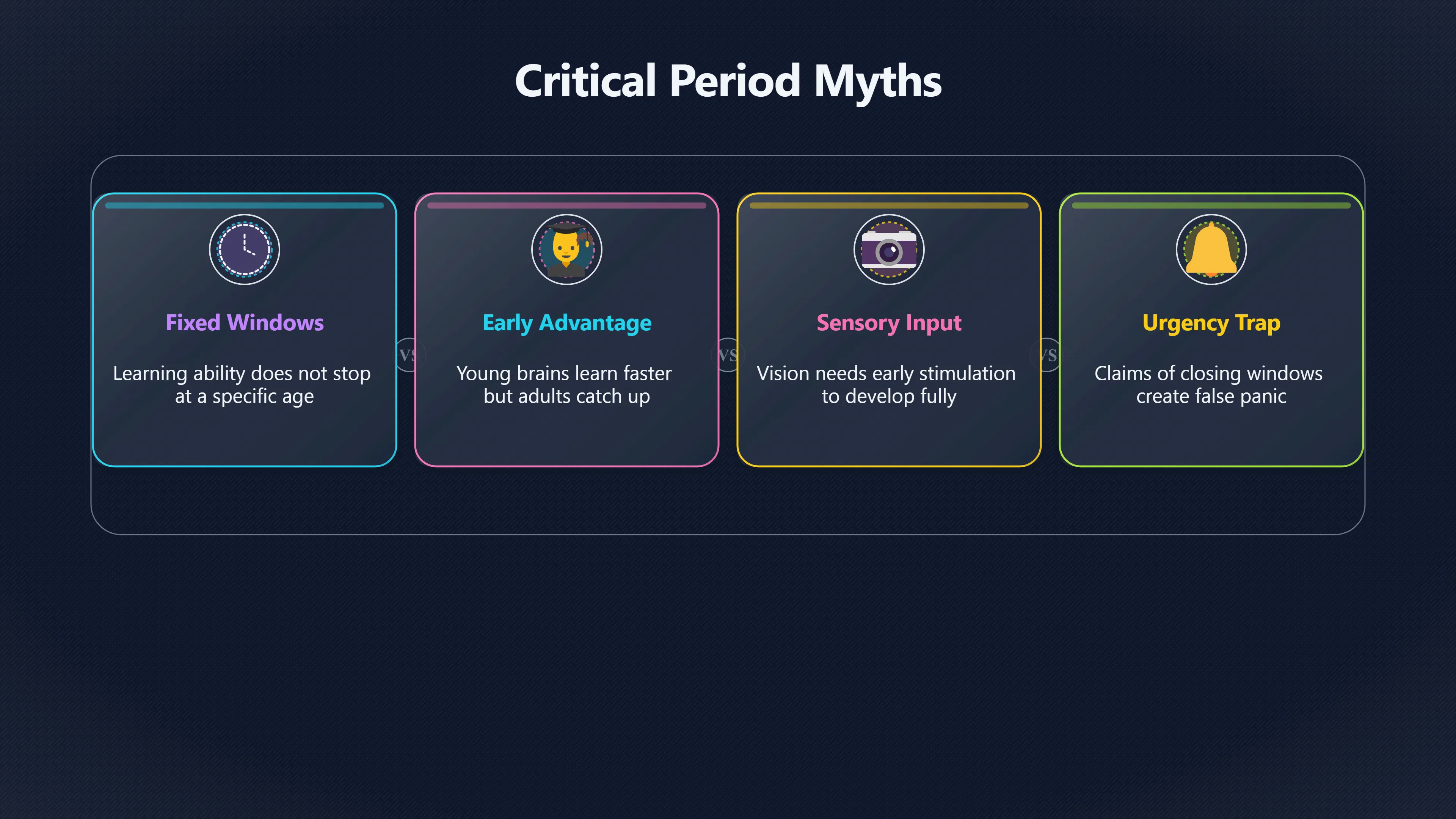
Critical period myths can make learning difficulties seem time-limited when development is usually more flexible and gradual.
On this page
- What critical periods mean in neuroscience
- How fixed window claims distort classroom decisions
- Why plasticity supports high expectations
Page outline Jump by section
Introduction
The idea of a “critical period” has become one of the most influential neuromyths in education. In its strongest classroom form, the claim is that children must learn particular skills within a narrow developmental window and that, once this window closes, major learning becomes impossible or severely limited. This belief can affect expectations about language learning, literacy intervention, special educational needs and educational recovery after early disadvantage.
 The problem is not that critical periods are entirely fictional. Neuroscience does identify some developmental windows during which certain experiences have unusually strong effects on the brain. The myth emerges when this finding is expanded into a general rule that learning is largely fixed by age, or that missed opportunities cannot be meaningfully recovered later. Research points to a more complicated picture: some abilities are especially sensitive to early experience, but human development remains plastic and responsive across much of life.[PubMed]pubmed.ncbi.nlm.nih.govSensitive periods in the development of the brain and behaviorby EI Knudsen · 2004 · Cited by 2605 — When the effect of experience…[PMC]pmc.ncbi.nlm.nih.govPMCLearning, neural plasticity and sensitive periodsNIHby EJ White · 2013 · Cited by 229 — Drawing on research in language development and music training, this review examines not onl…
What critical periods mean in neuroscience
In neuroscience, a critical or sensitive period refers to a stage of development when experience has an unusually powerful influence on the organisation of neural systems. The classic examples come from sensory development rather than classroom learning. Vision, for instance, depends on early sensory input. If certain forms of visual stimulation are absent during particular developmental stages, normal visual processing may not develop fully.[PubMed]pubmed.ncbi.nlm.nih.govSensitive periods in the development of the brain and behaviorby EI Knudsen · 2004 · Cited by 2605 — When the effect of experience…
Researchers increasingly distinguish between critical periods and sensitive periods. A strict critical period implies that a specific experience must occur within a narrow timeframe or normal development becomes impossible. A sensitive period is broader and more common: learning is easier, faster or more efficient during a particular phase, but development can still continue afterwards.[PubMed]pubmed.ncbi.nlm.nih.govSensitive periods in the development of the brain and behaviorby EI Knudsen · 2004 · Cited by 2605 — When the effect of experience…[rotel]rotel.pressbooks.pubRotel7.5: Sensitive and Critical Periods of Developmentpressbooks.pub7.5: Sensitive and Critical Periods of Development - rotelSensitive periods refer to the developmental time windows during… This distinction matters because educational discussions often collapse the two concepts into one. A scientific finding that early exposure helps learning may be transformed into a claim that later learning is futile. Yet the evidence supporting absolute deadlines is much weaker for most academic skills than popular accounts suggest.[ScienceDirect]sciencedirect.comScienceDirect Critical PeriodCritical Period - an overviewCritical periods are time points in development when experiences strongly influence neurogenesis, brain scul…
Why the idea became attractive in education
Critical-period language is powerful because it creates urgency. If a developmental window is closing, intervention appears immediately necessary. This reasoning has influenced debates about preschool education, parenting programmes, language exposure and educational support.
The appeal was reinforced by public discussions of early brain development, particularly claims that “the first three years” determine most future outcomes. Neuroscience research did demonstrate rapid brain development in infancy, but some educational and policy discussions went further, implying that later intervention could do little to change developmental trajectories. Critics have argued that this interpretation overstated the evidence and underestimated later plasticity.[Educational Neuroscience]educationalneuroscience.org.ukEducational NeuroscienceMost learning happens in the first 3 yearsThe first three years of life are a critical period for children's brai…[Kent Blogs]blogs.kent.ac.ukSource details in endnotes.
Are children ever too late to learn?
For most classroom learning, the answer is no.
Age matters. Young children often acquire certain skills more easily than older learners. Pronunciation in a second language is a well-known example. Early learners are more likely to develop native-like accents, while later learners often retain traces of their first language. However, this does not mean older learners cannot become highly proficient users of a language.[MIT News]news.mit.eduNews Cognitive scientists define critical period for learningMIT NewsCognitive scientists define critical period for learning…May 1, 2561 BE — An MIT study suggests children remain skilled at lea…[Wikipedia]WikipediaCritical period hypothesisCritical period hypothesis
Research on language learning illustrates why the myth persists. There is evidence that age affects aspects of language acquisition, yet the effects are gradual rather than cliff-like. An influential MIT study suggested that sensitivity to grammatical learning remains strong into adolescence, with declines occurring much later than many popular accounts assume. The study challenged simplistic claims that language learning capacity collapses after early childhood.[MIT News]news.mit.eduNews Cognitive scientists define critical period for learningMIT NewsCognitive scientists define critical period for learning…May 1, 2561 BE — An MIT study suggests children remain skilled at lea…
The same pattern appears across many educational domains. Early experience often helps. Intensive support delivered earlier is frequently more efficient. But “more efficient” is not the same as “only possible”. Educational myths often replace a probabilistic developmental advantage with a deterministic deadline.[National Academies]nationalacademies.orgNational Academies3 The Science of Early Learning and Brain DevelopmentThe principle that there are sensitive periods during early childh…
Language learning as a case study
Language is frequently cited as proof of critical-period theory, but even here the evidence is more nuanced than popular summaries suggest.
Research supports the view that younger learners often achieve more native-like phonology and grammatical processing. Yet adults remain capable of substantial vocabulary growth, complex language use and advanced second-language proficiency. Different components of language appear to show different developmental patterns rather than a single closing window.[2nblformosapublisher.org]nblformosapublisher.orgAge of Acquisition and the Brain: a Systematic Review of…27 May 2025 — Neurolinguistic research, using techniques like fMRI and EEG, i…
For teachers, the practical lesson is not that language teaching becomes pointless after a certain age. Instead, expectations, methods and outcomes may differ. Younger learners may acquire some features more naturally, while older learners may benefit from stronger metacognitive skills, explicit instruction and prior knowledge.[MIT McGovern Institute]mcgovern.mit.edufact or mythMIT McGovern InstituteDoes our ability to learn new things stop at a certain age?29 June 2018 — It is clear that a new language can be le…
How fixed-window claims distort classroom decisions
Neuromyths become educationally significant when they shape decisions about pupils.
One risk is that fixed-window thinking encourages premature pessimism. If teachers believe that literacy, language or cognitive development must happen by a specific age, struggling pupils may be viewed as having largely missed their chance. This can lower expectations precisely when sustained support is needed most.
A second risk involves intervention design. The genuine finding that early intervention is often beneficial can be distorted into the belief that later intervention is ineffective. In reality, many successful educational interventions target older children, adolescents and adults. Earlier support may reduce later difficulties, but delayed support still has value.[ScienceDirect]sciencedirect.comScienceDirect Critical PeriodCritical Period - an overviewCritical periods are time points in development when experiences strongly influence neurogenesis, brain scul…
The myth can also affect pupils with special educational needs and disabilities. Developmental differences are often interpreted through age-based milestones. When those milestones are treated as fixed biological deadlines, variation in developmental pathways may be misunderstood as evidence that improvement is no longer possible. Such assumptions can influence referral decisions, educational planning and expectations for progress.

The “first three years” misunderstanding
One of the most influential versions of the myth is the claim that most learning happens during the first three years of life.
This belief contains a kernel of truth. Early childhood is a period of rapid neural development. Experiences during infancy matter profoundly for health, attachment and learning. However, neuroscientists and developmental researchers have repeatedly argued that the popular interpretation exaggerates the permanence of early influences and underestimates later developmental change.[Educational Neuroscience]educationalneuroscience.org.ukEducational NeuroscienceMost learning happens in the first 3 yearsThe first three years of life are a critical period for children's brai…[Kent Blogs]blogs.kent.ac.ukSource details in endnotes.
The danger is not merely scientific inaccuracy. When parents, teachers or policymakers hear that development is largely determined by age three, they may conclude that later educational efforts are compensatory at best and futile at worst. The evidence does not support such a deterministic view.[Kent Blogs]blogs.kent.ac.ukSource details in endnotes.
Why plasticity supports high expectations
The strongest corrective to fixed-window myths is the concept of neuroplasticity: the brain’s capacity to change in response to experience.
Plasticity is not constant throughout life. Developmental stages matter. Young brains often reorganise more readily in response to certain experiences. Nevertheless, plasticity does not disappear after childhood. Learning, practice, feedback and environmental change continue to alter neural networks throughout adulthood. PMC[MIT McGovern Institute]mcgovern.mit.edufact or mythMIT McGovern InstituteDoes our ability to learn new things stop at a certain age?29 June 2018 — It is clear that a new language can be le…
This is one reason why educational outcomes are rarely determined by age alone. Motivation, quality of instruction, opportunity to practise, social support and prior knowledge all influence learning trajectories. A child who struggles early may improve substantially with effective intervention. An adult learner may acquire skills that were absent in childhood. The existence of developmental sensitivity does not eliminate the possibility of later growth.[PMC]pmc.ncbi.nlm.nih.govlife stress shifts critical periods and causes precocious…by J Poplawski · 2024 · Cited by 4 — The developing nervous system displays…
Some neuroscience research has even explored ways in which heightened periods of plasticity can be extended, modified or partially reopened, further undermining simplistic notions of permanently sealed developmental windows.[BOLD]boldscience.orgBOLDTurning back the learning clockBOLD1 Feb 2017 — Neurologist Takao Hensch discusses ways of reopening windows of heightened brain plasticity and making up for lost learn…
What teachers can reasonably take from the science
The most evidence-based position lies between two extremes.
Teachers should not assume that age is irrelevant. Early identification of hearing difficulties, language delays, visual problems or learning challenges can be highly valuable because some developmental systems are especially responsive during particular periods.[PubMed]pubmed.ncbi.nlm.nih.govSensitive periods in the development of the brain and behaviorby EI Knudsen · 2004 · Cited by 2605 — When the effect of experience…
At the same time, teachers should avoid treating developmental windows as irreversible deadlines. The scientific literature supports several more cautious conclusions:
- Early experiences matter, but they do not rigidly determine later outcomes.
- Some skills are easier to acquire at particular ages, but later learning remains possible.
- Sensitive periods are more common than absolute critical periods.
- Educational support retains value even after early developmental opportunities have been missed.
- High expectations are generally more consistent with contemporary evidence on plasticity than assumptions of fixed ability. MIT McGovern Institute[PubMed]pubmed.ncbi.nlm.nih.govSensitive periods in the development of the brain and behaviorby EI Knudsen · 2004 · Cited by 2605 — When the effect of experience…[PMC]pmc.ncbi.nlm.nih.gov9, We only use 10% of our brain. 10, Children mustThe Persistence of Neuromyths in the Educational Settingsby M Torrijos-Muelas · 2021 · Cited by 271 — There are critical periods in ch…

Why the myth survives
The critical-period myth persists because it combines a real scientific idea with a compelling educational message. Teachers know that early intervention often helps. Parents worry about missed opportunities. Policymakers want clear guidance about when resources matter most.
The difficulty is that neuroscience rarely delivers such simple deadlines. Development involves interacting biological, cognitive and environmental processes that unfold over years rather than within a single closing window. Reviews of neuromyths in education continue to find widespread belief in statements suggesting that children can no longer learn certain things after specific ages, even though the evidence is usually more qualified. PMC[Frontiers]frontiersin.orgFrontiersThe Persistence of Neuromyths in the Educational Settingsby M Torrijos-Muelas · 2021 · Cited by 259 — Five years later, the OECD…
The most accurate educational message is therefore neither “timing does not matter” nor “it is too late”. Development is shaped by sensitive periods, but it is also shaped by continuing plasticity. That combination supports urgency without fatalism: earlier help is often better, yet meaningful learning remains possible long after a supposed window has closed.[PubMed]pubmed.ncbi.nlm.nih.govSensitive periods in the development of the brain and behaviorby EI Knudsen · 2004 · Cited by 2605 — When the effect of experience…[PMC]pmc.ncbi.nlm.nih.govby S Dekker · 2012 · Cited by 1288 — The OECD's Brain and Learning project (2002) emphasized that many misconceptions about the brain…
Amazon book picks
Further Reading
Books and field guides related to Are children ever too late to learn?. Use these as the next step if you want deeper reading beyond the article.
The Brain That Changes Itself
Directly addresses neuroplasticity and learning beyond early windows.
Make It Stick
Supports the idea that learning remains possible through effective methods.
Why Don't Students Like School?
Counters simplistic assumptions about learning and development.

Livewired
First published 2020. Subjects: Physiology, Internal medicine, Brain, Neuroplasticity, Learning.
eBay marketplace picks
Marketplace Samples
Example marketplace items related to this page. Use the search link to explore similar finds on eBay.




Endnotes
1.
Source: pmc.ncbi.nlm.nih.gov
Title: PMCLearning, neural plasticity and sensitive periods
Link:https://pmc.ncbi.nlm.nih.gov/articles/PMC3834520/
Source snippet
NIHby EJ White · 2013 · Cited by 229 — Drawing on research in language development and music training, this review examines not onl...
2.
Source: sciencedirect.com
Title: ScienceDirect Critical Period
Link:https://www.sciencedirect.com/topics/psychology/critical-period
Source snippet
Critical Period - an overviewCritical periods are time points in development when experiences strongly influence neurogenesis, brain scul...
3.
Source: sciencedirect.com
Link:https://www.sciencedirect.com/science/article/abs/pii/S0885200602001655
Source snippet
Are critical periods critical for early childhood education?by DB Bailey Jr · 2002 · Cited by 130 — In this article I review...
4.
Source: news.mit.edu
Title: News Cognitive scientists define critical period for learning
Link:https://news.mit.edu/2018/cognitive-scientists-define-critical-period-learning-language-0501
Source snippet
MIT NewsCognitive scientists define critical period for learning...May 1, 2561 BE — An MIT study suggests children remain skilled at lea...
Published: May 1, 2561
5.
Source: Wikipedia
Title: Critical period hypothesis
Link:https://en.wikipedia.org/wiki/Critical_period_hypothesis
6.
Source: mcgovern.mit.edu
Title: fact or myth
Link:https://mcgovern.mit.edu/2018/06/29/fact-or-myth/
Source snippet
MIT McGovern InstituteDoes our ability to learn new things stop at a certain age?29 June 2018 — It is clear that a new language can be le...
Published: June 2018
7.
Source: nblformosapublisher.org
Link:https://nblformosapublisher.org/index.php/jeda/article/view/131
Source snippet
Age of Acquisition and the Brain: a Systematic Review of...27 May 2025 — Neurolinguistic research, using techniques like fMRI and EEG, i...
Published: May 2025
8.
Source: sciencedirect.com
Link:https://www.sciencedirect.com/science/article/abs/pii/S0222961717301095
Source snippet
Brain plasticity and early development: Implications for...by E Inguaggiato · 2017 · Cited by 105 — This property, called b...
9.
Source: boldscience.org
Title: BOLDTurning back the learning clock
Link:https://boldscience.org/turning-back-the-learning-clock/
Source snippet
BOLD1 Feb 2017 — Neurologist Takao Hensch discusses ways of reopening windows of heightened brain plasticity and making up for lost learn...
10.
Source: pmc.ncbi.nlm.nih.gov
Link:https://pmc.ncbi.nlm.nih.gov/articles/PMC11687811/
Source snippet
life stress shifts critical periods and causes precocious...by J Poplawski · 2024 · Cited by 4 — The developing nervous system displays...
11.
Source: pmc.ncbi.nlm.nih.gov
Title: 9, We only use 10% of our brain. 10, Children must
Link:https://pmc.ncbi.nlm.nih.gov/articles/PMC7835631/
Source snippet
The Persistence of Neuromyths in the Educational Settingsby M Torrijos-Muelas · 2021 · Cited by 271 — There are critical periods in ch...
12.
Source: pmc.ncbi.nlm.nih.gov
Link:https://pmc.ncbi.nlm.nih.gov/articles/PMC3475349/
Source snippet
by S Dekker · 2012 · Cited by 1288 — The OECD's Brain and Learning project (2002) emphasized that many misconceptions about the brain...
13.
Source: Wikipedia
Link:https://en.wikipedia.org/wiki/Language
Source snippet
LanguageLanguage is a structured system of communication that consists of grammar and vocabulary. It is the primary means by which hum...
14.
Source: Wikipedia
Link:https://en.wikipedia.org/wiki/Neuroscience
Source snippet
NeuroscienceNeuroscience is the scientific study of the nervous system (the brain, spinal cord, and peripheral nervous system), its fu...
15.
Source: Wikipedia
Title: Critical period
Link:https://en.wikipedia.org/wiki/Critical_period
Source snippet
Critical periodA critical period is a maturational stage in the lifespan of an organism during which the nervous system is especially...
16.
Source: sciencedirect.com
Link:https://www.sciencedirect.com/science/article/pii/S2211949323000224
Source snippet
Misconceptions about neurodevelopment by Italian teachers.by E Bei · 2024 · Cited by 41 — Background: Neuromyths are commonly held miscon...
17.
Source: direct.mit.edu
Title: Investigating Critical Period Effects in Language
Link:https://direct.mit.edu/tacl/article/doi/10.1162/tacl_a_00725/127669/Investigating-Critical-Period-Effects-in-Language
Source snippet
Critical Period Effects in Language...by I Constantinescu · 2025 · Cited by 25 — Critical period effects in humans are typically interpr...
18.
Source: pubmed.ncbi.nlm.nih.gov
Link:https://pubmed.ncbi.nlm.nih.gov/15509387/
Source snippet
Sensitive periods in the development of the brain and behaviorby EI Knudsen · 2004 · Cited by 2605 — When the effect of experience...
19.
Source: nationalacademies.org
Link:https://www.nationalacademies.org/read/27429/chapter/5
Source snippet
National Academies3 The Science of Early Learning and Brain DevelopmentThe principle that there are sensitive periods during early childh...
20.
Source: rotel.pressbooks.pub
Title: Rotel7.5: Sensitive and Critical Periods of Development
Link:https://rotel.pressbooks.pub/biologicalpsychology1/chapter/sensitive-and-critical-periods-of-development/
Source snippet
pressbooks.pub7.5: Sensitive and Critical Periods of Development - rotelSensitive periods refer to the developmental time windows during...
21.
Source: educationalneuroscience.org.uk
Link:https://www.educationalneuroscience.org.uk/resources/neuromyth-or-neurofact/most-learning-happens-in-the-first-3-years/
Source snippet
Educational NeuroscienceMost learning happens in the first 3 yearsThe first three years of life are a critical period for children's brai...
22.
Source: blogs.kent.ac.uk
Link:https://blogs.kent.ac.uk/parentingculturestudies/files/2011/09/Special-briefing-on-The-Myth.pdf
23.
Source: frontiersin.org
Link:https://www.frontiersin.org/journals/psychology/articles/10.3389/fpsyg.2020.591923/full
Source snippet
FrontiersThe Persistence of Neuromyths in the Educational Settingsby M Torrijos-Muelas · 2021 · Cited by 259 — Five years later, the OECD...
24.
Source: educationalneuroscience.org.uk
Link:https://educationalneuroscience.org.uk/wordpress/resources/neuromyth-or-neurofact/most-learning-happens-in-the-first-3-years/
25.
Source: linguee.com.br
Link:https://www.linguee.com.br/ingles-portugues/traducao/critical.html
Source snippet
Tradução em portuguêscritical adjetivo— · críticas adj · críticos adj · crítico adj · crucial adj · Exemplos: critical thinking s—. pensa...
26.
Source: frontiersin.org
Link:https://www.frontiersin.org/journals/psychology/articles/10.3389/fpsyg.2017.01314/full
Source snippet
Dispelling the Myth: Training in Education or Neuroscience...by K Macdonald · 2017 · Cited by 454 — Neuromyths are misconceptions about...
27.
Source: frontiersin.org
Link:https://www.frontiersin.org/journals/psychology/articles/10.3389/fpsyg.2012.00429/full
Source snippet
Neuromyths in Education: Prevalence and Predictors of...by S Dekker · 2012 · Cited by 1254 — The OECD's Brain and Learning project (2002...
28.
Source: frontiersin.org
Link:https://www.frontiersin.org/journals/molecular-neuroscience/articles/10.3389/fnmol.2022.1057539/full
Source snippet
The critical periods of cerebral plasticity: A key aspect in...by J Tran The · 2022 · Cited by 8 — “Critical periods” of cerebral develo...
29.
Source: blogs.ucl.ac.uk
Title: ucl.ac.uk Neuromyths in Education
Link:https://blogs.ucl.ac.uk/cdld/2021/12/10/neuromyths-in-education/
Source snippet
in Education - UCL BlogsDec 10, 2021 — – Example: Critical Period Theory – States that learning depends on synaptic growth and the first...
30.
Source: boldscience.org
Title: Neuromyths in education
Link:https://boldscience.org/neuromyths-in-education/
Source snippet
BOLD16 Oct 2017 — Researchers need to determine the role of neuromyths in the classroom, and how to stop their potentially damaging effec...
Additional References
31.
Source: oecd.org
Link:https://www.oecd.org/en.html
Source snippet
The Organisation for Economic Co-operation and...The OECD designs international standards and guidelines for development co-operat...
32.
Source: oecd.org
Link:https://www.oecd.org/en/publications/understanding-the-brain-the-birth-of-a-learning-science_9789264029132-en.html
Source snippet
Understanding the Brain: The Birth of a Learning ScienceThis book provides new insights about learning by synthesising existing and emerg...
33.
Source: researchgate.net
Link:https://www.researchgate.net/publication/232536239_Neuromyths_in_Education_Prevalence_and_Predictors_of_Misconceptions_among_Teachers
Source snippet
(PDF) Neuromyths in Education: Prevalence and...The OECD's Brain and Learning project (2002) emphasized that many misconceptions about t...
34.
Source: science-teaching.org
Link:https://science-teaching.org/research/influence-of-neuromyths-in-the-educational-environment
Source snippet
Influence of neuromyths in the educational environmentEducational neuromyths are simplifications, misunderstandings, or misinterpretation...
35.
Source: eujournal.org
Link:https://eujournal.org/index.php/esj/article/view/8774/8386
Source snippet
Neuromyths in Education and DevelopmentThese myths about the brain have persisted in all cognitive, social and environmental levels, ofte...
36.
Source: oecd.org
Link:https://www.oecd.org/content/dam/oecd/en/publications/reports/2007/06/understanding-the-brain-the-birth-of-a-learning-science_g1gh76fd/9789264029132-en.pdf
Source snippet
Understanding the Brain: The Birth of a Learning ScienceCritical or sensitive periods in neuronal development – have strong significance...
37.
Source: neurosciencenews.com
Title: Neuroscience News Critical Period for Language Learning Identified
Link:https://neurosciencenews.com/critical-period-language-learning-8930/
Source snippet
Neuroscience NewsCritical Period for Language Learning IdentifiedMay 1, 2018 — Summary: Researchers report the critical period of languag...
Published: May 1, 2018
38.
Source: simplypsychology.org
Link:https://www.simplypsychology.org/critical-period.html
Source snippet
evels of plasticity in the brain before neural connections become more solidified and...Read more...
39.
Source: researchgate.net
Title: 393752907 Critical and Sensitive Periods in Brain Development
Link:https://www.researchgate.net/publication/393752907_Critical_and_Sensitive_Periods_in_Brain_Development
Source snippet
(PDF) Critical and Sensitive Periods in Brain Development16 Jul 2025 — Critical periods are times during which specific environmental exp...
40.
Source: cis.org.au
Link:https://www.cis.org.au/publication/knowledge-is-power-what-do-teachers-believe-about-learning/
Source snippet
pheric dominance suggest teachers do self-report incorporating myths...Read more...
Topic Tree