Within Algorithms
When Myths Become a Business Model
When attention can become followers, revenue or influence, creators have incentives to package myths in repeatable, engaging forms.
On this page
- How visibility converts into money and status
- Why repeatable myth templates perform well
- Governance problems around ads, creators and unreliable material
Page outline Jump by section
Introduction
Online myths do not spread only because people believe them. They also spread because, on many platforms, attention can be converted into followers, advertising revenue, sponsorship deals, subscriptions, affiliate sales and political influence. When creators discover that sensational claims reliably attract views, they may begin producing them repeatedly, turning myth-making from an occasional activity into a predictable content strategy.
 This does not mean every creator who discusses controversial topics is acting in bad faith. However, research on misinformation, influencer marketing and platform incentives shows that a relatively small number of highly active accounts often account for a disproportionate share of misleading content, while financial and status rewards can encourage continued production. The result is a feedback loop: myths generate engagement, engagement increases visibility, and visibility can create income and influence.[Yale Insights]insights.som.yale.eduhow social media rewards misinformationA majority of false stories are spread by a small number of frequent users, suggests a new study co-…Read more…
How Visibility Converts into Money and Status
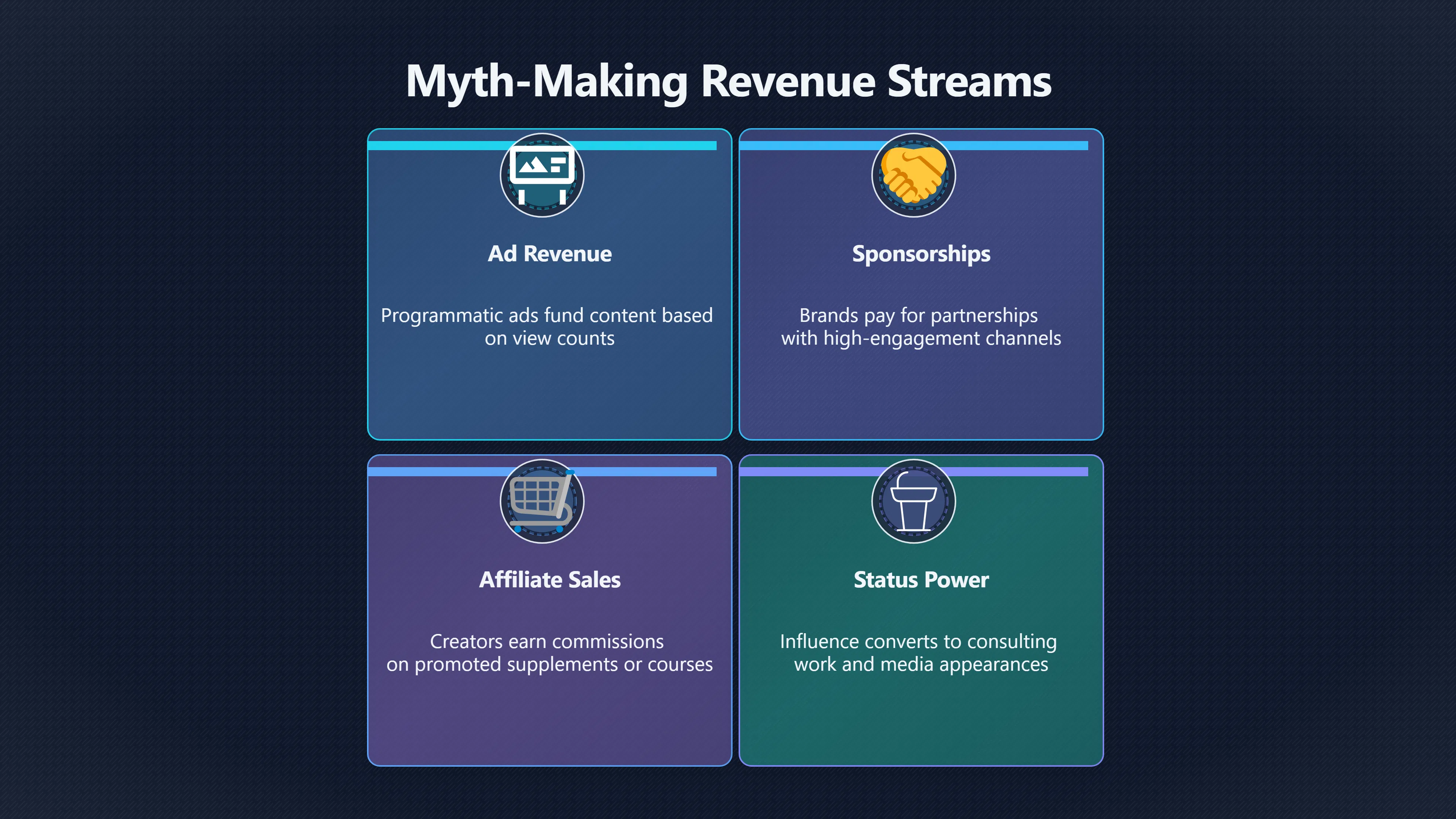
The creator economy rewards attention. On platforms such as YouTube, TikTok, Facebook and Instagram, visibility can be monetised through several channels:
- Advertising revenue linked to views or watch time.
- Sponsorships and brand partnerships.
- Subscription memberships and donations.
- Affiliate marketing commissions.
- Sales of courses, books, supplements or other products.
- Growth in personal influence that can later be converted into media appearances, consulting work or political opportunities.
A creator does not necessarily need a myth to be true for it to be profitable. What matters commercially is whether the claim attracts audiences. Sensational stories, conspiracy narratives and dramatic “hidden truth” content often encourage longer viewing, repeated sharing and stronger emotional reactions than cautious explanations. Those audience responses can increase algorithmic visibility and therefore monetisation opportunities.[SIEPR]Szned via advertising,examine how financing misinformation affects the advertisers…Read more[UVA Darden School of Business]darden.virginia.eduUVA Darden School of BusinessThe Role of Advertisers and Platforms in Monetizing…by W Ahmad · Cited by 22 — The financial motivation t…
Research on the broader “disinformation economy” has found that misinformation is frequently supported by advertising systems that automatically place commercial adverts alongside content. Studies examining misinformation websites and digital advertising have shown that programmatic advertising can unintentionally channel revenue towards unreliable publishers because ad placement is often driven by traffic and engagement rather than content quality.[SIEPR]Szned via advertising,examine how financing misinformation affects the advertisers…Read more[Heinz College]heinz.cmu.eduHeinz CollegeFirms' Desire for Ad Revenue Tied to Inadvertently…The study found that advertising on misinformation websites is pervasi…
Status can be as important as money. Large audiences create social authority. A creator who becomes known as the person exposing alleged secrets, cover-ups or forbidden knowledge may gain influence even when factual accuracy is weak. Influence itself can later become a source of revenue through speaking engagements, partnerships or new commercial ventures.[blogs.hanken.fi]blogs.hanken.fithe disinformation economy4 Jun 2025 — My research on the overlap between digital advertising and fake news suggests that the financial incentives of the disinform…
Why Repeatable Myth Templates Perform Well
Many successful myth-based creators do not rely on a single false claim. Instead, they develop repeatable formats that can be applied again and again.
Typical templates include:
- “What they don’t want you to know.”
- “The truth hidden by experts.”
- “This simple cure is being suppressed.”
- “Mainstream media won’t tell you this.”
- “Everything you were taught is wrong.”
These formats have commercial advantages. They are easy to produce, emotionally engaging and adaptable to new events. Once an audience accepts the creator’s basic worldview, every new story can be framed as further evidence of the same narrative.
Research into influencer-driven misinformation has identified creators who combine myth-like claims with product marketing, particularly in health and wellness spaces. In some cases, misleading claims about vaccines, illnesses or treatments were linked to sales of alternative remedies, supplements or lifestyle products. The myth creates attention and trust among followers; the commercial offer captures value from that trust. International Journal of Communication[2opb]opb.orgthink out loud uw study social media influencers misinformationUW study reveals how social media influencers profit from…Mar 18, 2024 — The study looked at three Instagram influencers who spread va…
The economics of content production also matter. Producing careful investigative reporting is expensive and time-consuming. Producing speculation, conspiratorial interpretation or recycled viral claims is often cheaper. When platforms reward engagement at scale, creators may find that high-volume myth production generates a better financial return than slower, evidence-based work.[blogs.hanken.fi]blogs.hanken.fithe disinformation economy4 Jun 2025 — My research on the overlap between digital advertising and fake news suggests that the financial incentives of the disinform…[EDMO]edmo.euWhat is the Disinformation Economy?And how to counter it)13 Jun 2025 — The financial incentives of the disinformation economy are staggering; fake news websites rake in re…
AI and the Expansion of Myth Production
Generative artificial intelligence has lowered the cost of creating large amounts of content. Images, voiceovers, scripts and videos can now be produced rapidly, making it easier to generate endless variations of sensational narratives.
Recent reporting and research have raised concerns that creator reward programmes may unintentionally encourage AI-generated misinformation because payment systems are frequently tied to view counts and engagement. Critics argue that when revenue is linked to attention, creators have incentives to produce emotionally compelling content at scale, even when accuracy is uncertain.[Axios]axios.comWith Tik Tok creator program, AI-sped misinformation paysThe program pays creators based on "qualified views" and RPM (revenue per thousand views), incentivizing high engagement — something ofte…
The concern is not merely theoretical. Investigations have identified networks of channels producing large volumes of misleading or fabricated content while attracting substantial audiences and, in some cases, monetisation opportunities.[The Guardian]theguardian.comfake anti labour video billion views youtube 2025A study by nonprofit Reset Tech revealed these channels collectively amassed 5.3 million subscribers and produced 56,000 videos, with Sta…

Why Audiences Reward Myth-Making
Financial incentives work because they interact with audience psychology.
Myths often provide features that are valuable in competitive attention markets:
- Novelty: surprising claims attract curiosity.
- Identity reinforcement: audiences enjoy content that confirms existing beliefs.
- Emotional intensity: anger, fear and excitement encourage sharing.
- Narrative simplicity: myths often provide clear villains and heroes.
- Community belonging: followers gain social rewards by participating in a shared narrative.
Research on misinformation sharing suggests that repeated engagement can become habitual. Once audiences routinely reward certain types of content with clicks, comments and shares, creators receive continuous signals that the format is working. The economic reward is therefore built on behavioural reward.[USC Today]today.usc.eduUSC TodayStudy reveals key reason why fake news spreads on social…Jan 17, 2023 — Experimenting with different scenarios to see why fak…
For creators, this can produce a gradual shift in incentives. Even individuals who begin with genuine curiosity may discover that dramatic claims outperform nuanced explanations. Over time, content strategies can evolve towards what attracts attention rather than what best reflects available evidence.
Governance Problems Around Ads, Creators and Unreliable Material
The monetisation of myth-making creates a governance challenge because responsibility is distributed across multiple actors.

Platforms
Platforms typically argue that they do not wish to reward harmful misinformation. Many have introduced policies that remove, reduce or demonetise certain categories of false content. YouTube, for example, maintains misinformation policies covering areas such as elections, public health and other topics associated with significant harm.[Google Help]support.google.comHelp Misinformation policiesGoogle HelpMisinformation policies - YouTube HelpCertain types of misleading or deceptive content with serious risk of egregious harm are…
However, enforcement remains difficult. Researchers and regulators have repeatedly questioned whether automated moderation systems can consistently identify misleading material, especially when creators adapt their language or avoid direct factual claims. Studies and audits suggest that harmful or misleading content can continue circulating even after policy changes.[Digitally Right]digitallyright.orgOther platforms, such as.Read moreDigitally RightMisinformation on YouTube: High Profits, Low ModerationIt is not always necessary to remove all misinformation; however, u…
Advertisers
Many advertisers do not intentionally support misinformation. Yet programmatic advertising systems often buy placements automatically across vast networks of sites and channels. Research has shown that advertising frequently appears on misinformation outlets because the underlying systems prioritise audience reach and efficiency rather than detailed editorial review.[SIEPR]Szned via advertising,examine how financing misinformation affects the advertisers…Read more
This creates a market failure: brands may unknowingly finance content they would not publicly endorse.
Creators
Creators occupy a complicated position. Some deliberately exploit myths because they are profitable. Others may sincerely believe the claims they promote. Governance becomes difficult because platforms must distinguish between deception, opinion, speculation, error and legitimate dissent.
A system that punishes every controversial claim risks suppressing legitimate debate. A system that rewards all engagement regardless of quality risks subsidising myth production. The challenge is therefore not merely removing falsehoods but designing incentives that reduce the financial advantages of producing them.
The Policy Question: Should Attention Be Monetised Without Reliability Checks?
The central governance issue is whether platforms should continue allowing attention alone to determine financial rewards.
Several approaches have been proposed:
- Stronger demonetisation of repeatedly misleading creators.
- Greater transparency around creator revenue and sponsorship arrangements.
- Improved advertiser controls over where adverts appear.
- Independent auditing of recommendation and monetisation systems.
- Friction measures that reduce the spread of repeatedly debunked claims.
- Expanded use of fact-checking and contextual information rather than outright removal.
Supporters argue these measures would weaken the business incentives behind myth-making. Critics worry about errors, bias and excessive concentration of power in platform moderation systems.[cmpf.eui.eu]cmpf.eui.eudemonetisation of disinformationDe)monetisation of Disinformation: Can the actions of large…26 Mar 2024 — This blog explores the business of disinformation and expos… ScienceDirect What is increasingly clear is that myths thrive not only because they are believed[sciencedirect.com]sciencedirect.comcreators would incorporate controversial content to strategically generate engagement [1], [2]. As underlined by the case of disinformati…, but because they can be profitable. In modern social media environments, the economic architecture surrounding attention often determines which stories are repeated, refined and amplified. As long as visibility can be converted into money and status, myth-making will remain attractive to at least some creators, making monetisation policy a central part of any effort to reduce online misconceptions. Yale Insights[SIEPR]Szned via advertising,examine how financing misinformation affects the advertisers…Read more
eBay marketplace picks
Marketplace Samples
Example marketplace items related to this page. Use the search link to explore similar finds on eBay.



Endnotes
1.
Source: insights.som.yale.edu
Title: how social media rewards misinformation
Link:https://insights.som.yale.edu/insights/how-social-media-rewards-misinformation
Source snippet
A majority of false stories are spread by a small number of frequent users, suggests a new study co-...Read more...
2.
Source: siepr.stanford.edu
Link:https://siepr.stanford.edu/publications/working-paper/role-advertisers-and-platforms-monetizing-misinformation-descriptive-and
Source snippet
ned via advertising,examine how financing misinformation affects the advertisers...Read more...
3.
Source: edmo.eu
Title: What is the Disinformation Economy?
Link:https://edmo.eu/blog/what-is-the-disinformation-economy-and-how-to-counter-it/
Source snippet
(And how to counter it)13 Jun 2025 — The financial incentives of the disinformation economy are staggering; [fake news]({{ 'fake-news/' | relative_url }}) websites rake in re...
4.
Source: blogs.hanken.fi
Title: the disinformation economy
Link:https://blogs.hanken.fi/research/2025/06/04/the-disinformation-economy/
Source snippet
4 Jun 2025 — My research on the overlap between digital advertising and fake news suggests that the financial incentives of the disinform...
5.
Source: cmpf.eui.eu
Title: demonetisation of disinformation
Link:https://cmpf.eui.eu/demonetisation-of-disinformation/
Source snippet
(De)monetisation of Disinformation: Can the actions of large...26 Mar 2024 — This blog explores the business of disinformation and expos...
6.
Source: opb.org
Title: think out loud uw study social media influencers misinformation
Link:https://www.opb.org/article/2024/03/18/think-out-loud-uw-study-social-media-influencers-misinformation/
Source snippet
UW study reveals how social media influencers profit from...Mar 18, 2024 — The study looked at three Instagram influencers who spread va...
7.
Source: sciencedirect.com
Link:https://www.sciencedirect.com/science/article/abs/pii/S0305048325001537
Source snippet
creators would incorporate controversial content to strategically generate engagement [1], [2]. As underlined by the case of disinformati...
8.
Source: axios.com
Title: With Tik Tok creator program, AI-sped misinformation pays
Link:https://www.axios.com/2024/03/26/tik-tok-creator-program-ai-misinformation
Source snippet
The program pays creators based on "qualified views" and RPM (revenue per thousand views), incentivizing high engagement — something ofte...
9.
Source: today.usc.edu
Link:https://today.usc.edu/usc-study-reveals-the-key-reason-why-fake-news-spreads-on-social-media/
Source snippet
USC TodayStudy reveals key reason why fake news spreads on social...Jan 17, 2023 — Experimenting with different scenarios to see why fak...
10.
Source: support.google.com
Title: Help Misinformation policies
Link:https://support.google.com/youtube/answer/10834785?hl=en
Source snippet
Google HelpMisinformation policies - YouTube HelpCertain types of misleading or deceptive content with serious risk of egregious harm are...
11.
Source: sciencedirect.com
Link:https://www.sciencedirect.com/science/article/pii/S0267364922000814
Source snippet
The curious case of regulating false news on Googleby C Tan · 2022 · Cited by 19 — In this article, I highlight key features of selected...
12.
Source: sciencedirect.com
Title: Do you believe it?
Link:https://www.sciencedirect.com/science/article/abs/pii/S0040162524007480
Source snippet
Examining user engagement with fake...by N Chaudhuri · 2025 · Cited by 13 — However, not all users engage with fake news similarly; thos...
13.
Source: youtube.com
Title: The Business of Misinformation: How Falsehoods Become Profitable
Link:https://www.youtube.com/watch?v=0hKqC5D4-7A
Source snippet
Why Rage-Bait and Misinformation Are So Profitable for Creators...
14.
Source: youtube.com
Title: Why Rage-Bait and Misinformation Are So Profitable for Creators
Link:https://www.youtube.com/watch?v=2x34m-i722o
Source snippet
How the Creator Economy Incentivizes Sensationalism...
15.
Source: youtube.com
Title: How the Creator Economy Incentivizes Sensationalism
Link:https://www.youtube.com/watch?v=l4gH14J121k
Source snippet
The Economics of Conspiracy Theories on Social Media...
16.
Source: youtube.com
Title: The Economics of Conspiracy Theories on Social Media
Link:https://www.youtube.com/watch?v=O15e6x8W8pE
Source snippet
Why Platforms Struggle to Stop Profitable Misinformation...
17.
Source: youtube.com
Title: Why Platforms Struggle to Stop Profitable Misinformation
Link:https://www.youtube.com/watch?v=Xh0Yp_X5D8k
18.
Source: darden.virginia.edu
Link:https://www.darden.virginia.edu/sites/default/files/inline-files/2415%20Eesley%2C%20Chuck.pdf
Source snippet
UVA Darden School of BusinessThe Role of Advertisers and Platforms in Monetizing...by W Ahmad · Cited by 22 — The financial motivation t...
19.
Source: heinz.cmu.edu
Link:https://www.heinz.cmu.edu/media/2024/June/firms-desire-for-ad-revenue-tied-to-inadvertently-financing-online-misinformation-outlets
Source snippet
Heinz CollegeFirms' Desire for Ad Revenue Tied to Inadvertently...The study found that advertising on misinformation websites is pervasi...
20.
Source: ijoc.org
Link:https://ijoc.org/index.php/ijoc/article/view/21128/4494
Source snippet
International Journal of CommunicationView of Vaccine Misinformation for Profitby RE Moran · 2024 · Cited by 31 — Vaccine Misinformation...
21.
Source: theguardian.com
Title: fake anti labour video billion views youtube 2025
Link:https://www.theguardian.com/technology/2025/dec/13/fake-anti-labour-video-billion-views-youtube-2025
Source snippet
A study by nonprofit Reset Tech revealed these channels collectively amassed 5.3 million subscribers and produced 56,000 videos, with Sta...
22.
Source: digitallyright.org
Title: Other platforms, such as.Read more
Link:https://digitallyright.org/wp-content/uploads/2025/09/Misinformation-on-YouTube-High-Profits-Low-Moderation.pdf
Source snippet
Digitally RightMisinformation on YouTube: High Profits, Low ModerationIt is not always necessary to remove all misinformation; however, u...
23.
Source: transparency.meta.com
Link:https://transparency.meta.com/en-gb/policies/community-standards/misinformation/
Source snippet
Transparency CentreMeta regularly publishes reports to give our community visibility into Community Standards enforcement, government r...
Additional References
24.
Source: thecjid.org
Link:https://thecjid.org/wp-content/uploads/2024/12/Impact-of-Financial-Incentives.DAIDAC.pdf
25.
Source: sydney.edu.au
Title: influencers promoting overwhelmingly misleading information
Link:https://www.sydney.edu.au/news-opinion/news/2025/02/27/–influencers-promoting–overwhelmingly–misleading-information-.html
Source snippet
social media is an open sewer of medical misinformation. “This is a public health crisis that exacerbates overdiagnosis and threatens the...
26.
Source: publications.parliament.uk
Title: UK Parliament Disinformation and ‘fake news’: Final Report
Link:https://publications.parliament.uk/pa/cm201719/cmselect/cmcumeds/1791/1791.pdf
Source snippet
UK ParliamentDisinformation and 'fake news': Final Report - Parliament UK18 Feb 2019 — This is the Final Report in an inquiry on disinfor...
27.
Source: en.dismislab.com
Title: misinformation on youtube high profits low moderation
Link:https://en.dismislab.com/misinformation-on-youtube-high-profits-low-moderation/
Source snippet
on YouTube: High profits, low moderation10 Jul 2024 — This research further investigates how YouTube allows the monetization of misinform...
28.
Source: carlosdiazruiz.com
Title: how do digital platforms profit from disinformation
Link:https://www.carlosdiazruiz.com/blog/how-do-digital-platforms-profit-from-disinformation
Source snippet
7 Dec 2025 — A research paper published in the journal New Media & Society shows the digital market for online advertising produces the f...
29.
Source: mdpi.com
Link:https://www.mdpi.com/2227-7390/13/23/3815
Source snippet
Content Value Dynamics in Digital Platforms: Strategic...by B Bian · 2025 — A high advertising intensity will reduce user experience and...
30.
Source: pmc.ncbi.nlm.nih.gov
Title: PMCSocial media and the spread of misinformation
Link:https://pmc.ncbi.nlm.nih.gov/articles/PMC11955583/
Source snippet
Keywords: misinformation, social media, disinformation...Read more...
31.
Source: rmit.edu.au
Title: tiktok information
Link:https://www.rmit.edu.au/news/media-releases-and-expert-comments/2023/october/tiktok-information
Source snippet
People increasingly turn to influencers for information, and...16 Oct 2023 — “There have been reports of disinformation and fake news be...
32.
Source: academic.oup.com
Link:https://academic.oup.com/heapro/article/40/2/daaf023/8100645
Source snippet
media and the spread of misinformationby E Denniss · 2025 · Cited by 114 — Third, internet robots or 'bots' are known to automate the pub...
33.
Source: pmc.ncbi.nlm.nih.gov
Link:https://pmc.ncbi.nlm.nih.gov/articles/PMC10520039/
Source snippet
by DA Broniatowski · 2023 · Cited by 7 — [https://www.bbc.com/future/article/20190528-i-was-a-macedonian-fake-news-writer](https://www.bbc.com/future/article/20190528-i-was-a-macedonian-fake-news-writer) (2019)...
- Sz
Topic Tree