Within Timing
Can a correction spread the myth further?
Some rumours need public correction, while others are better handled quietly before a wider audience sees them.
On this page
- How to judge whether a claim is still too small
- Targeted replies, platform reports and community correction
- When public rebuttal becomes the safer choice
Page outline Jump by section
Introduction
Correcting a rumour is not always a simple matter of publishing the facts. Sometimes a public rebuttal gives a fringe claim its largest audience. The challenge is to distinguish between a rumour that is already spreading and one that remains largely confined to a small community. In the first case, correction may reduce harm. In the second, a prominent correction can inadvertently act as free publicity.
 Research on misinformation suggests that the greatest risk is not usually that corrections make people believe a claim more strongly. Large reviews have found little evidence for widespread “backfire effects” in which corrections systematically strengthen false beliefs. However, there is a separate and more practical concern: corrections can expose new audiences to a rumour and increase familiarity with it. The key decision is therefore not whether correction works at all, but whether a correction will reach more people than the rumour itself.[PMC]pmc.ncbi.nlm.nih.govThe backfire effect after correcting misinformation is strongly…by B Swire-Thompson · 2022 · Cited by 102 — A significant drawback…[PMC]pmc.ncbi.nlm.nih.govSearching for the Backfire Effect: Measurement and Design…by B Swire-Thompson · 2020 · Cited by 418 — A backfire effect is when peo…
Can a correction spread the myth further?
The amplification problem arises because attention is a limited resource. When journalists, officials, influencers or fact-checkers respond publicly to a rumour, they often repeat the claim in order to refute it. That repetition can increase awareness even among people who had never encountered the rumour before.
Researchers studying misinformation have long noted that familiarity affects perceived plausibility. Repeated exposure can make a statement feel more familiar and therefore more credible, even when people later struggle to remember whether it was true or false. This concern led to debates about whether fact-checking might accidentally strengthen myths through repetition. While recent evidence suggests that strong familiarity-based backfire effects are uncommon, familiarity itself remains an important consideration when deciding how visibly to correct a claim. PMC[springer]link.springer.comcorrections spread misinformation to new audiences…by UKH Ecker · 2020 · Cited by 203 — Misinformation often continues to influence in… The practical question is therefore: if you publish a correction today, how many people will learn about the rumour for the first time through the correction rather than through the original falsehood?
How to judge whether a claim is still too small
A useful starting point is to assess reach before responding publicly.
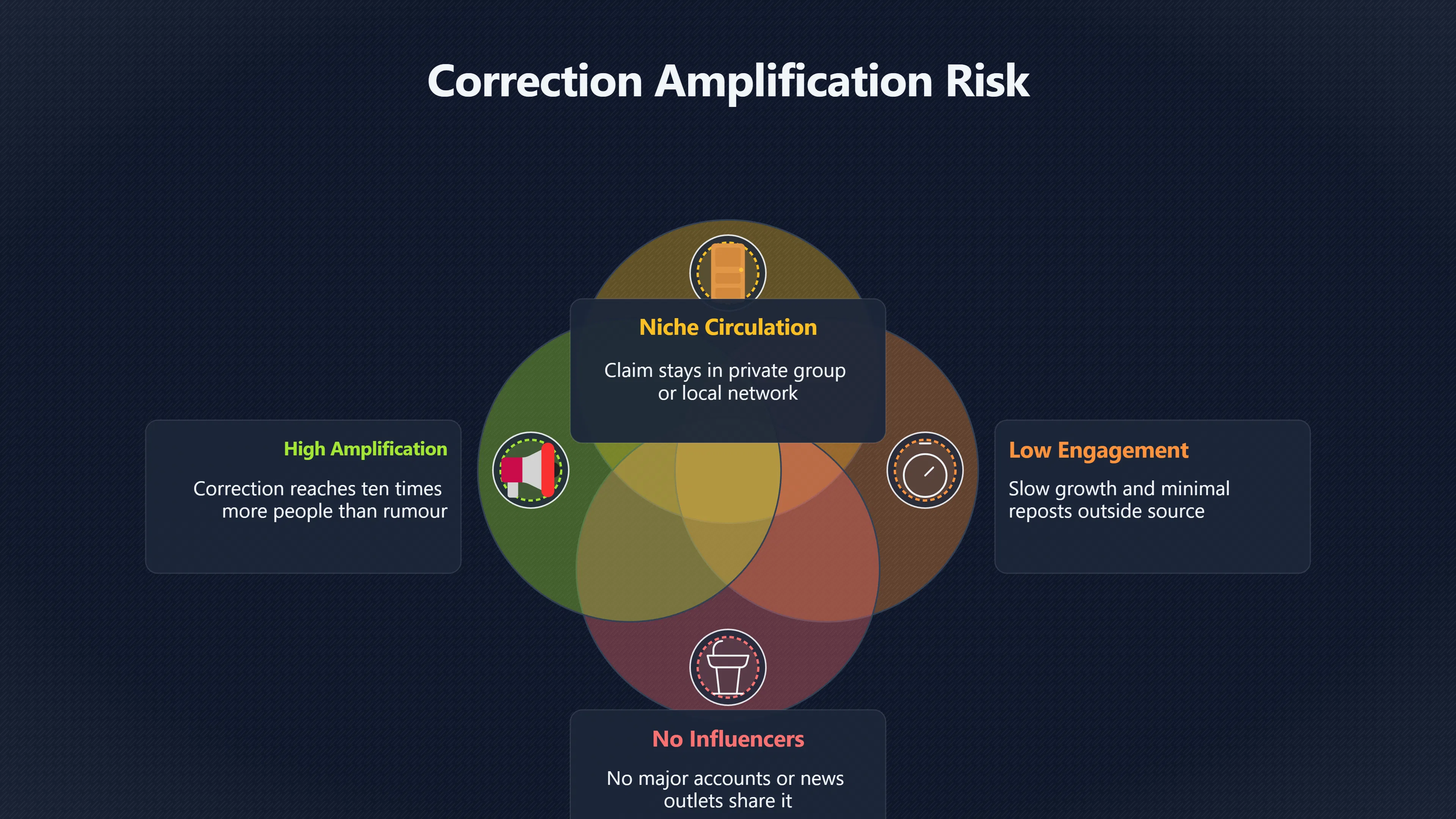
A rumour may still be too small for a major rebuttal when:
- It is circulating only in a niche forum, private group or limited local network.
- Engagement remains low and growth is slow.
- The claim has not been picked up by influential accounts, news outlets or public figures.
- Searches, reposts and references remain minimal outside the original community.
In these situations, a high-profile correction may transform an obscure rumour into a wider public conversation.
Professional fact-checkers often make similar judgements. Research into fact-checking prioritisation shows that organisations routinely assess potential harm, likely spread and public visibility before deciding which claims deserve substantial resources. Not every false claim receives a public fact-check because attention itself can become a vector for dissemination.[arXiv]arxiv.orgMisinformation as a harm: structured approaches for fact-checking prioritizationDecember 18, 2023…
A useful rule is to compare the expected audience of the correction with the current audience of the rumour. If the correction is likely to reach ten times as many people as the original claim, amplification risk is high.
Targeted replies, platform reports and community correction
When a rumour remains limited in scope, quieter interventions may be more effective than a public campaign.
Direct responses in the affected community
If misinformation is circulating within a specific online group, workplace, school or neighbourhood network, correcting it inside that community may prevent wider spread without drawing unnecessary attention.
The correction reaches the people who need it most while avoiding a broader audience that would otherwise be unaware of the claim.
Platform reporting and moderation tools
For clearly false or harmful content, reporting mechanisms, moderation systems and platform policies can sometimes reduce visibility without generating additional publicity.
This approach is particularly relevant when the rumour has little public traction but poses potential harm if amplified.

Community correction
Research on social correction suggests that ordinary users who challenge false claims within conversations can reduce misinformation’s spread. A brief correction attached directly to a misleading post often reaches the relevant audience without creating a new, standalone piece of content that could boost visibility.[Davidson College]davidson.eduDavidson CollegeResearch Finds Simple Corrections Can Slow Spread of…Oct 2, 2024 — Research Finds Simple Corrections Can Slow Spread o…
The goal in these cases is containment rather than broad public persuasion.
When public rebuttal becomes the safer choice
Amplification concerns diminish once a rumour has already escaped its original niche.
A public rebuttal becomes more defensible when one or more of the following conditions apply:
- The claim is spreading rapidly across multiple networks.
- Major accounts, media outlets or public figures are sharing it.
- The rumour concerns health, safety, elections, emergencies or other high-stakes topics.
- People are already changing behaviour because of the false claim.
- Silence would leave the rumour largely uncontested.
At this stage, the costs of inaction often exceed the risks of amplification.
An important insight from misinformation research is that corrections generally reduce belief in false claims, even if they do not eliminate misinformation entirely. Reviews and meta-analyses consistently find that debunking has positive effects on accuracy beliefs. The question becomes less about avoiding attention and more about ensuring that the correction reaches the same audiences as the rumour. Nature[Joint Research Centre]joint-research-centre.ec.europa.euJoint Research CentreMisinformation and disinformation: both prebunking and…25 Oct 2024 — Misinformation and disinformation: both preb…
Signs that amplification risk is being overestimated
Fear of amplification can sometimes become an excuse for inaction.
One reason is that the idea of a correction making things worse has often been linked to the broader “backfire effect” debate. Yet extensive reviews of the literature have found that strong backfire effects appear much rarer than early discussions suggested. Most corrections either help or have little effect; they do not usually increase belief in the misinformation.[PMC]pmc.ncbi.nlm.nih.govThe backfire effect after correcting misinformation is strongly…by B Swire-Thompson · 2022 · Cited by 102 — A significant drawback…[PMC]pmc.ncbi.nlm.nih.govSearching for the Backfire Effect: Measurement and Design…by B Swire-Thompson · 2020 · Cited by 418 — A backfire effect is when peo…
Another reason is that rumours rarely remain static. A claim that appears marginal today can become mainstream tomorrow if it is adopted by influential actors or connected to a breaking news event. Waiting indefinitely to avoid amplification can leave the field open for the rumour to grow without challenge.
The more useful question is not “Could a correction spread the rumour?” but “Is the rumour already spreading enough that a correction is needed?”
A practical decision test
Before issuing a public correction, communicators can ask four questions:
- How large is the current audience?
Is the rumour genuinely widespread or mostly confined to a niche?
- What is the harm if it spreads?
High-risk claims justify intervention earlier than trivial ones.
- Will the correction reach mostly new people or affected people?
If most readers would learn about the rumour for the first time from the correction, amplification risk is substantial.
- What happens if nobody responds?
If silence allows the rumour to become the dominant explanation, public correction may be the safer option.
The strongest responses often combine proportionality with timing: use targeted measures while a rumour remains small, but shift to visible public correction once the claim has achieved significant reach or poses meaningful harm. The objective is not to rebut every rumour publicly. It is to ensure that the response attracts less attention than the falsehood would attract if left alone.

eBay marketplace picks
Marketplace Samples
Example marketplace items related to this page. Use the search link to explore similar finds on eBay.



Endnotes
1.
Source: pmc.ncbi.nlm.nih.gov
Link:https://pmc.ncbi.nlm.nih.gov/articles/PMC9283209/
Source snippet
The backfire effect after correcting misinformation is strongly...by B Swire-Thompson · 2022 · Cited by 102 — A significant drawback...
2.
Source: pmc.ncbi.nlm.nih.gov
Link:https://pmc.ncbi.nlm.nih.gov/articles/PMC7462781/
Source snippet
Searching for the Backfire Effect: Measurement and Design...by B Swire-Thompson · 2020 · Cited by 418 — A backfire effect is when peo...
3.
Source: link.springer.com
Link:https://link.springer.com/article/10.1186/s41235-020-00241-6
Source snippet
corrections spread misinformation to new audiences...by UKH Ecker · 2020 · Cited by 203 — Misinformation often continues to influence in...
4.
Source: arxiv.org
Link:https://arxiv.org/abs/2312.11678
Source snippet
Misinformation as a harm: structured approaches for fact-checking prioritizationDecember 18, 2023...
Published: December 18, 2023
5.
Source: davidson.edu
Link:https://www.davidson.edu/news/2024/10/02/research-finds-simple-corrections-can-slow-spread-misinformation-online
Source snippet
Davidson CollegeResearch Finds Simple Corrections Can Slow Spread of...Oct 2, 2024 — Research Finds Simple Corrections Can Slow Spread o...
6.
Source: arxiv.org
Link:https://arxiv.org/abs/2403.04852
7.
Source: nature.com
Link:https://www.nature.com/articles/s41562-025-02294-3
Source snippet
A meta-analysis of correction effects in science-relevant...by MS Chan · 2025 — We specified changes to codes for negative misinfo...
8.
Source: nature.com
Link:https://www.nature.com/articles/s44159-021-00006-y
Source snippet
The psychological drivers of misinformation belief and its...by UKH Ecker · 2022 · Cited by 1892 — Misinformation has been identified as...
9.
Source: joint-research-centre.ec.europa.eu
Link:https://joint-research-centre.ec.europa.eu/jrc-news-and-updates/misinformation-and-disinformation-both-prebunking-and-debunking-work-fighting-it-2024-10-25_en
Source snippet
Joint Research CentreMisinformation and disinformation: both prebunking and...25 Oct 2024 — Misinformation and disinformation: both preb...
Additional References
10.
Source: climatechangecommunication.org
Link:https://www.climatechangecommunication.org/wp-content/uploads/2023/09/DebunkingHandbook2020.pdf
Source snippet
Debunking HandbookMisinformation is false information that is spread either by mistake or with [intent]({{ 'intent/' | relative_url }}) to mislead. When there is intent to...
11.
Source: misinforeview.hks.harvard.edu
Link:https://misinforeview.hks.harvard.edu/article/correcting-campaign-misinformation-experimental-evidence-from-a-two-wave-panel-study/
Source snippet
evidence from a two-wave panel studyby L Horvath · 2024 · Cited by 1 — The fact check itself, featuring both an explanatory text and a gr...
12.
Source: kff.org
Link:https://www.kff.org/health-information-trust/from-margins-to-mainstream-how-amplification-may-be-giving-misinformation-new-reach/
Source snippet
How Amplification May Be Giving Misinformation New ReachOct 9, 2025 — Efforts to correct misinformation can unintentionally amplify it by...
13.
Source: research-information.bris.ac.uk
Title: can corrections spread misinformation to new audiences testing fo
Link:https://research-information.bris.ac.uk/en/publications/can-corrections-spread-misinformation-to-new-audiences-testing-fo/
Source snippet
corrections spread misinformation to new audiences...by UKH Ecker · 2020 · Cited by 202 — Misinformation often continues to influence in...
14.
Source: firstdraftnews.org
Title: the psychology of misinformation why its so hard to correct
Link:https://firstdraftnews.org/articles/the-psychology-of-misinformation-why-its-so-hard-to-correct/
Source snippet
disinformation, information disorder, misinformation, visual misinformation. Why does our psychology make misinformation so hard to corre...
15.
Source: impact.stanford.edu
Title: you know its [fake news]({{ ‘fake-news/’ | relative_url }}) it still affects what you believe
Link:https://impact.stanford.edu/article/you-know-its-fake-news-it-still-affects-what-you-believe
Source snippet
Know It's Fake News; It Still Affects What You BelieveJun 30, 2022 — My research addresses whether misinformation we already recognize as...
16.
Source: lindau-nobel.org
Link:https://www.lindau-nobel.org/blog-fact-checking-an-effective-weapon-against-misinformation/
Source snippet
Fact-Checking – An Effective Weapon Against...4 May 2018 — As independent checks, they are a way to tackle misinformation...
Published: May 2018
17.
Source: lse.ac.uk
Link:https://www.lse.ac.uk/granthaminstitute/wp-content/uploads/2018/04/Bob-Ward-Debunking-myths-EGU-April-2018.pdf
Source snippet
3. Identify the most important part of the myth or fake news.Read more...
18.
Source: researchbriefings.files.parliament.uk
Link:https://researchbriefings.files.parliament.uk/documents/POST-PN-0719/POST-PN-0719.pdf
Source snippet
parliament.ukDisinformation: sources, spread and impact25 Apr 2024 — Content can be created as disinformation and unknowingly shared as m...
19.
Source: normalcurves.com
Title: the backfire effect can fact checking make false beliefs stronger
Link:https://www.normalcurves.com/the-backfire-effect-can-fact-checking-make-false-beliefs-stronger/
Source snippet
The “backfire effect” claims that debunking myths can actually make false beliefs stronger.Read more...
Topic Tree