Within Politics
How to Correct Myths Without Starting a Fight
Corrections work better when they let people reconsider a claim without feeling humiliated, attacked, or expelled from their group.
On this page
- Why aggressive corrections trigger defensiveness
- How shared values lower the temperature
- Practical wording that separates facts from identity
Page outline Jump by section
Introduction
Correcting a political myth is not only a question of presenting better evidence. In many cases, the real obstacle is identity threat. When people feel that a correction is trying to embarrass them, expose them as gullible, or push them outside their political community, they often become defensive before they even evaluate the facts. Research on misinformation and identity-protective cognition suggests that corrections are more effective when they reduce social threat and allow people to reconsider a claim without feeling personally attacked.[SSRN]papers.ssrn.comMisconceptions, Misinformation, and the Logic of Identity-…by DM Kahan 2017 Cited by 582 Identity protective cognition refer…[Semantic Scholar]semanticscholar.orgMisinformation and Identity-Protective Cognition2 Oct 2017 This paper synthesizes existing work on misinformation relating to policy-re…
 This is why low-conflict corrections matter. They do not abandon accuracy or avoid disagreement. Instead, they separate the factual claim from the person’s dignity, status and group belonging. In politically polarised environments, that distinction can determine whether a correction is heard as useful information or as a social challenge.
Why aggressive corrections trigger defensiveness
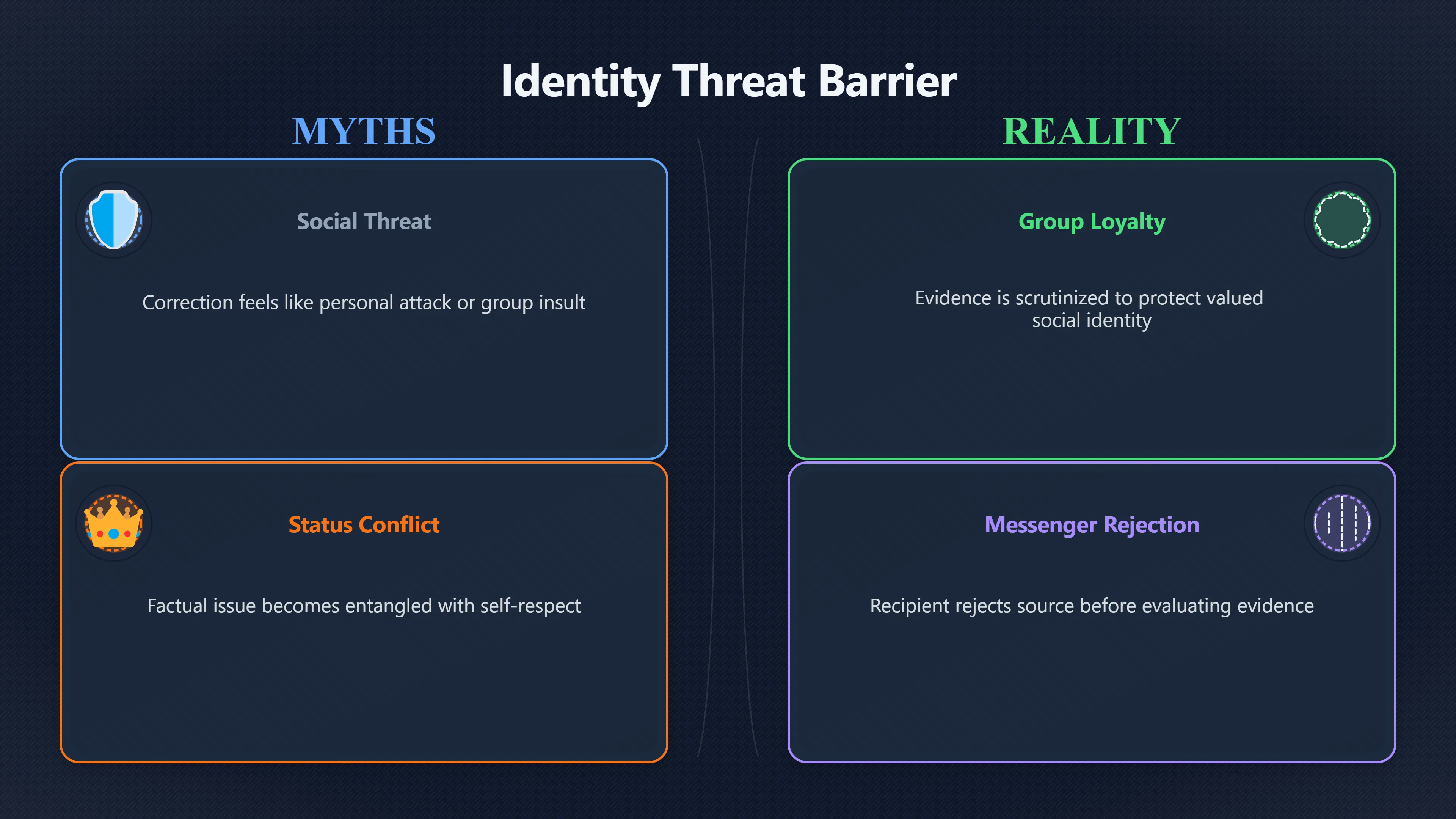
Many failed corrections share the same pattern: they frame the conversation as a contest between intelligent people and foolish people, or between good citizens and bad citizens. Once a correction takes that form, the factual issue becomes entangled with self-respect and group loyalty.
Research associated with identity-protective cognition finds that people often assess evidence in ways that protect valued social identities. When a factual correction threatens those identities, resistance can increase even when the evidence is strong. The problem is not simply ignorance. People may selectively trust information that aligns with their group while scrutinising information that appears to come from a hostile camp.[SSRN]papers.ssrn.comMisconceptions, Misinformation, and the Logic of Identity-…by DM Kahan 2017 Cited by 582 Identity protective cognition refer…[Fondation Descartes]fondationdescartes.orgFalse ideas, fake information, and the logic of identity-…This 2017 article is a preparatory work proposed by social scientist Dan Kah…
Aggressive corrections can create several problems at once:
- They imply that accepting the correction means admitting personal failure.
- They signal that political opponents are the source of truth.
- They increase the social cost of changing one’s mind.
- They turn a factual discussion into a status conflict.
This dynamic helps explain why public shaming campaigns often produce mixed results. Even when the correction is factually accurate, the recipient may focus on defending identity rather than evaluating evidence.
Researchers studying political fact-checking have also found that contextual cues can influence how corrections are received. Information that activates group-based assumptions or political narratives can undermine acceptance of corrective information by encouraging scepticism toward the correction itself.[R. Kelly Garrett]rkellygarrett.comGarrett et al. Undermining Corrective Effects1Kelly GarrettUndermining the Corrective Effects of MediaBased Political…June 13, 2013 by RK Garrett Cited by 250 Media-based fac…
The result is that people may reject not only the specific correction but also the messenger.
How shared values lower the temperature
Low-conflict correction works by creating a path to accuracy that does not require social surrender.
One common approach is value affirmation. Rather than opening with a direct accusation or contradiction, the correction begins by acknowledging a concern, principle or goal that both sides share. This reduces the perception that the conversation is a battle between opposing tribes.
For example, a correction about election misinformation may begin by recognising that election integrity matters. A correction about public health misinformation may acknowledge concerns about government accountability or personal autonomy before addressing the factual claim itself.
The psychological logic is straightforward. If people feel their values are recognised, they are less likely to interpret corrective information as an attack on who they are. Research on misinformation consistently finds that corrections interact with social and affective factors, not just information quality. Worldviews, trust relationships and perceived threats all influence whether new information is accepted.[Nature]nature.comThe psychological drivers of misinformation belief and its…by UKH Ecker 2022 Cited by 1916 In this Review, we describe the…
This does not mean affirming false claims. It means separating the underlying concern from the inaccurate conclusion.
A low-conflict correction might communicate:
- “Your concern is understandable, but this specific claim is not supported.”
- “People across different political views care about this issue.”
- “Wanting accountability is reasonable; the evidence on this particular point looks different.”
These messages allow someone to retain a valued identity while revising a factual belief.
Practical wording that separates facts from identity
The language used in corrections can affect whether people experience them as invitations or confrontations.
Studies examining misinformation correction on social media have identified the importance of relational concerns and politeness norms. Corrections that preserve social relationships can be received differently from those that openly challenge competence or character.[International Journal of Communication]ijoc.orgview FileInternational Journal of CommunicationStrategies for Polite Misinformation Correctionby P Malhotra 2022 Cited by 46 One gap in misi…
Several communication choices tend to reduce identity threat.
Focus on the claim, not the person
High-conflict wording:
- “You’ve fallen for propaganda.”
- “Only uninformed people believe this.”
Low-conflict wording:
- “This claim has been disputed by multiple sources.”
- “The available evidence points in a different direction.”
The second approach keeps attention on the information rather than the individual’s intelligence or morality.

Replace humiliation with curiosity
Questions can sometimes create space for reconsideration without forcing immediate public retreat.
Examples include:
- “Where did that figure originally come from?”
- “Have you seen the updated information on this?”
- “What do you make of this evidence?”
Curiosity does not guarantee agreement, but it often reduces the pressure to defend a position instantly.
Acknowledge uncertainty where it exists
Overstated certainty can create new trust problems. When evidence is genuinely mixed, admitting limits can increase credibility.
For example:
- “There is still debate about some aspects of this issue, but this specific claim appears unsupported.”
- “The broader concern is real, although the viral story about it is inaccurate.”
This approach avoids the impression that correction requires total agreement with an opposing political worldview.
Why messenger and tone often matter as much as evidence
People rarely encounter corrections as isolated facts. They encounter them through social relationships.
A correction from a trusted member of the same political, religious or cultural community may create less identity threat than the identical correction delivered by a perceived opponent. Research on misinformation repeatedly finds that source credibility and group trust affect whether corrective messages are accepted.[Wikipedia]WikipediaSource details in endnotes.
This does not mean that only in-group messengers can succeed. However, it helps explain why corrections often work better when they avoid signalling contempt for the audience.
The same factual statement can produce different reactions depending on whether it communicates:
- “People like you are the problem.”
- “People like us should look at this evidence.”
The second formulation reduces the implication that accepting the correction requires abandoning group membership.
Research on politically charged misinformation has also found promising results from narrative-based corrective approaches. Rather than presenting a correction as a direct confrontation, these approaches embed factual information within stories that provide emotional resolution and reduce defensive processing.[PMC]pmc.ncbi.nlm.nih.govPMCUsing narratives to correct politically charged healthby HM Lillie 2024 Cited by 10 This study investigated the efficacy of a narrative corrective with a relief ending for correcting…
Low-conflict correction is not the same as avoiding disagreement
A common misunderstanding is that reducing identity threat requires avoiding hard conversations. The evidence suggests something more precise.
Effective correction still involves identifying false claims, presenting evidence and challenging inaccuracies. What changes is the social framing. The goal is to make factual revision psychologically possible rather than socially costly.
Research reviews generally find that factual corrections help more often than they harm, and dramatic backfire effects appear less common than once feared. However, correction effectiveness depends heavily on context, including wording, presentation and audience investment in the issue.[Carnegie Endowment]carnegieendowment.orgcountering disinformation effectively an evidence based policy guideCarnegie EndowmentCountering Disinformation Effectively: An Evidence-Based…31 Jan 2024 A large body of research indicates that fact…[PMC]pmc.ncbi.nlm.nih.govPMCCorrection format has a limited role when debunkingby B Swire-Thompson 2021 Cited by 79 Abstract. Given that being misinformed can have negative ramifications, finding optimal cor…
When a myth has become linked to political identity, a successful correction often sends two messages simultaneously:
- The claim is inaccurate.
- Accepting that fact does not require losing dignity, values or belonging.
That combination helps explain why low-conflict approaches can sometimes succeed where aggressive debunking fails. They recognise that political myths are not only beliefs about the world. They are often tied to social identities, and people are more willing to reconsider a claim when doing so does not feel like a public defeat.[SSRN]papers.ssrn.comMisconceptions, Misinformation, and the Logic of Identity-…by DM Kahan 2017 Cited by 582 Identity protective cognition refer…[Semantic Scholar]semanticscholar.orgMisinformation and Identity-Protective Cognition2 Oct 2017 This paper synthesizes existing work on misinformation relating to policy-re…
Amazon book picks
Further Reading
Books and field guides related to How to Correct Myths Without Starting a Fight. Use these as the next step if you want deeper reading beyond the article.
Crucial Conversations
First published 2001. Subjects: Nonfiction, Business, Communication, Gespräch, Business Communication.


Scout Mindset
First published 2021. Subjects: Economics, Psychology, Cognition, Skepticism, Critical thinking.
eBay marketplace picks
Marketplace Samples
Example marketplace items related to this page. Use the search link to explore similar finds on eBay.

Endnotes
1.
Source: papers.ssrn.com
Link:https://papers.ssrn.com/sol3/papers.cfm?abstract_id=2973067
Source snippet
Misconceptions, Misinformation, and the Logic of Identity-...by DM Kahan 2017 Cited by 582 Identity protective cognition refer...
2.
Source: nature.com
Link:https://www.nature.com/articles/s44159-021-00006-y
Source snippet
The psychological drivers of misinformation belief and its...by UKH Ecker 2022 Cited by 1916 In this Review, we describe the...
3.
Source: Wikipedia
Link:https://en.wikipedia.org/wiki/Misinformation
4.
Source: pmc.ncbi.nlm.nih.gov
Title: PMCUsing narratives to correct politically charged health
Link:https://pmc.ncbi.nlm.nih.gov/articles/PMC11358629/
Source snippet
by HM Lillie 2024 Cited by 10 This study investigated the efficacy of a narrative corrective with a relief ending for correcting...
5.
Source: pmc.ncbi.nlm.nih.gov
Title: PMCCorrection format has a limited role when debunking
Link:https://pmc.ncbi.nlm.nih.gov/articles/PMC8715407/
Source snippet
by B Swire-Thompson 2021 Cited by 79 Abstract. Given that being misinformed can have negative ramifications, finding optimal cor...
6.
Source: semanticscholar.org
Link:https://www.semanticscholar.org/paper/Misinformation-and-Identity-Protective-Cognition-Kahan/06c54da8033d3449a283722d367b0856de4b10dc
Source snippet
Misinformation and Identity-Protective Cognition2 Oct 2017 This paper synthesizes existing work on misinformation relating to policy-re...
7.
Source: fondationdescartes.org
Link:https://www.fondationdescartes.org/en/2020/06/les-idees-fausses-les-fausses-informations-et-la-logique-du-raisonnement-pour-proteger-son-identite/
Source snippet
False ideas, fake information, and the logic of identity-...This 2017 article is a preparatory work proposed by social scientist Dan Kah...
8.
Source: rkellygarrett.com
Title: Garrett et al. Undermining Corrective Effects1
Link:https://rkellygarrett.com/wp-content/uploads/2014/05/Garrett-et-al.-Undermining-Corrective-Effects1.pdf
Source snippet
Kelly GarrettUndermining the Corrective Effects of MediaBased Political...June 13, 2013 by RK Garrett Cited by 250 Media-based fac...
Published: June 13, 2013
9.
Source: ijoc.org
Title: view File
Link:https://ijoc.org/index.php/ijoc/article/viewFile/18361/3762
Source snippet
International Journal of CommunicationStrategies for Polite Misinformation Correctionby P Malhotra 2022 Cited by 46 One gap in misi...
10.
Source: carnegieendowment.org
Title: countering disinformation effectively an evidence based policy guide
Link:https://carnegieendowment.org/russia-eurasia/research/2024/01/countering-disinformation-effectively-an-evidence-based-policy-guide
Source snippet
Carnegie EndowmentCountering Disinformation Effectively: An Evidence-Based...31 Jan 2024 A large body of research indicates that fact...
11.
Source: ijoc.org
Link:https://ijoc.org/index.php/ijoc/article/download/23090/4890/88302
Source snippet
International Journal of CommunicationWhen Corrections Failby Y Song 2025 Cited by 2 This study evaluates the effectiveness of 3 mi...
12.
Source: rkellygarrett.com
Title: Garrett and Weeks Promise and peril of real time corrections
Link:https://rkellygarrett.com/wp-content/uploads/2014/05/Garrett-and-Weeks-Promise-and-peril-of-real-time-corrections.pdf
Source snippet
The Promise and Peril of Real-Time Corrections to Politicalby RK Garrett 2013 Cited by 231 When misinformation is corrected immedia...
Additional References
13.
Source: research-information.bris.ac.uk
Link:https://research-information.bris.ac.uk/files/298563464/Ecker_v4_TSshorten_UE_clean.pdf
14.
Source: jpe.ox.ac.uk
Link:https://www.jpe.ox.ac.uk/papers/dilemmas-of-political-correctness/
Source snippet
of Political Correctnessby D Moller Cited by 94 Political correctness, as I argue, is an important attempt to advance the legitimate...
15.
Source: researchgate.net
Link:https://www.researchgate.net/publication/247317334_The_continued_influence_of_misinformation_in_memory_What_makes_a_correction_effective
Source snippet
In a dynamic world, information in [memory]({{ 'memory/' | relative_url }}) is frequently outdated, corrected, or replaced.Read more...
16.
Source: scispace.com
Link:https://scispace.com/pdf/misconceptions-misinformation-and-the-logic-of-identity-mpc3ka7t6o.pdf
Source snippet
eptions of and misinfor- mation about decision-relevant science.Read more...
17.
Source: facebook.com
Link:https://www.facebook.com/groups/1509838572657723/posts/3532022283772665/
Source snippet
designed to cast doubt on their integrity; it does not have...Read more...
18.
Source: modernconsciousness.com
Title: It’s the courage to disagree without being
Link:https://modernconsciousness.com/dignity-lost-and-found-navigating-political-discourse-with-respect/
Source snippet
Dignity Lost and Found: Navigating Political Discourse with...25 Nov 2024 Dignity is the quiet strength of living in alignment with yo...
19.
Source: ofcom.org.uk
Title: rea online misinformation
Link:https://www.ofcom.org.uk/siteassets/resources/documents/research-and-data/online-research/online-nation/2021/rea-online-misinformation.pdf?v=326529
Source snippet
Rapid Evidence Assessment on Online Misinformation and...9 Jun 2021 The review is focused on studies that measure the effectiveness of...
20.
Source: sites.dartmouth.edu
Title: Vidigal Jerit Pol Comm 1
Link:https://sites.dartmouth.edu/jerit/files/2022/08/VidigalJerit_PolComm-1.pdf
Source snippet
Dartmouth SitesIssue Importance and the Correction of Misinformationby R Vidigal 2022 Cited by 35 Even partisans have been shown to...
21.
Source: youtube.com
Title: 7 Strategies To Stop Being So Defensive
Link:https://www.youtube.com/watch?v=thPuQxYeWw0
Source snippet
How to have difficult conversations without being defensive How to Handle Defensiveness in Communication: Tips for Healthier Conversation...
22.
Source: youtube.com
Title: How to Handle Defensiveness in Communication: Tips for Healthier Conversations
Link:https://www.youtube.com/watch?v=sELt0_QfR0U
Source snippet
Try THIS the Next Time You Have an Uncomfortable Conversation...
Topic Tree