Within False Info
Why intent changes the right response
The same false claim can need a correction, an investigation, or both, depending on whether error or deception is driving it.
On this page
- Why false is not enough
- Signals of mistake versus deception
- Matching responses to intent
Page outline Jump by section
Introduction
A false claim is not always the same kind of problem. Two people can share the exact same inaccurate statement, yet one may be mistaken while the other is deliberately trying to mislead. That difference in intent changes what a useful response looks like. A person acting in good faith may need correction, context and better information. A coordinated actor spreading a known falsehood may require investigation, disruption, transparency measures or sanctions instead. UNESCO and other information-disorder frameworks distinguish misinformation from disinformation primarily through intent: misinformation is false information shared without a deliberate aim to deceive, while disinformation involves intentional deception.[UNESCO]unesco.orgWhat is Disinformation? Meaning, Definition.Misinformation has a neutral or good underlying intent, whereas disinformation is defin…[UNESCO]unesco.orgWhat is Misinformation? Meaning, Definition.Misinformation is false information that is shared inadvertently, without meaning to ca…
 This distinction matters because responses that work for honest error can fail against organised manipulation. Equally, responses designed for hostile actors can unfairly target ordinary people who are confused, misinformed or relying on poor sources. Understanding intent does not mean guessing what is inside someone’s mind. It means examining how a false claim is being created, amplified and used, then matching the response to the underlying mechanism.
Why false is not enough
When people first encounter a false claim, the most obvious question is whether it is true. For public responses, however, another question quickly becomes important: why is it being spread?
A mistaken claim often emerges from normal weaknesses in human information processing. People rely on memory shortcuts, trusted social networks, familiar narratives and emotional reactions. Someone may repeat an outdated statistic, misunderstand a scientific study or share a dramatic image without checking its origin. The central problem is informational failure.
Disinformation operates differently. The falsehood is often only one part of a larger strategy. The goal may be political influence, financial gain, harassment, social division or confusion itself. First Draft’s information-disorder framework describes disinformation as intentionally false content designed to cause harm, often motivated by influence, profit or disruption.[First Draft]firstdraftnews.orgFirst Draft Understanding Information disorderDisinformation is content that is intentionally false and designed to cause harm. It is motivated by three…Read more…
This difference changes the practical objective. If the source is mistaken, the goal is usually to improve understanding. If the source is deceptive, the goal may be to expose manipulation, reduce reach, identify networks or increase accountability. Treating both situations identically can miss the real cause of the problem.
A useful comparison is public health. If contaminated water results from a broken pipe, the response focuses on repair and prevention. If contamination results from deliberate sabotage, authorities still protect the water supply, but they also investigate perpetrators and strengthen security. The contamination matters in both cases, yet the cause changes the response.
Signals of mistake versus deception
Intent is difficult to prove directly. Researchers, journalists and investigators rarely have access to a person’s private motives. Instead, they look for patterns that make deliberate deception more or less likely.
No single signal is decisive, but several indicators often appear together.
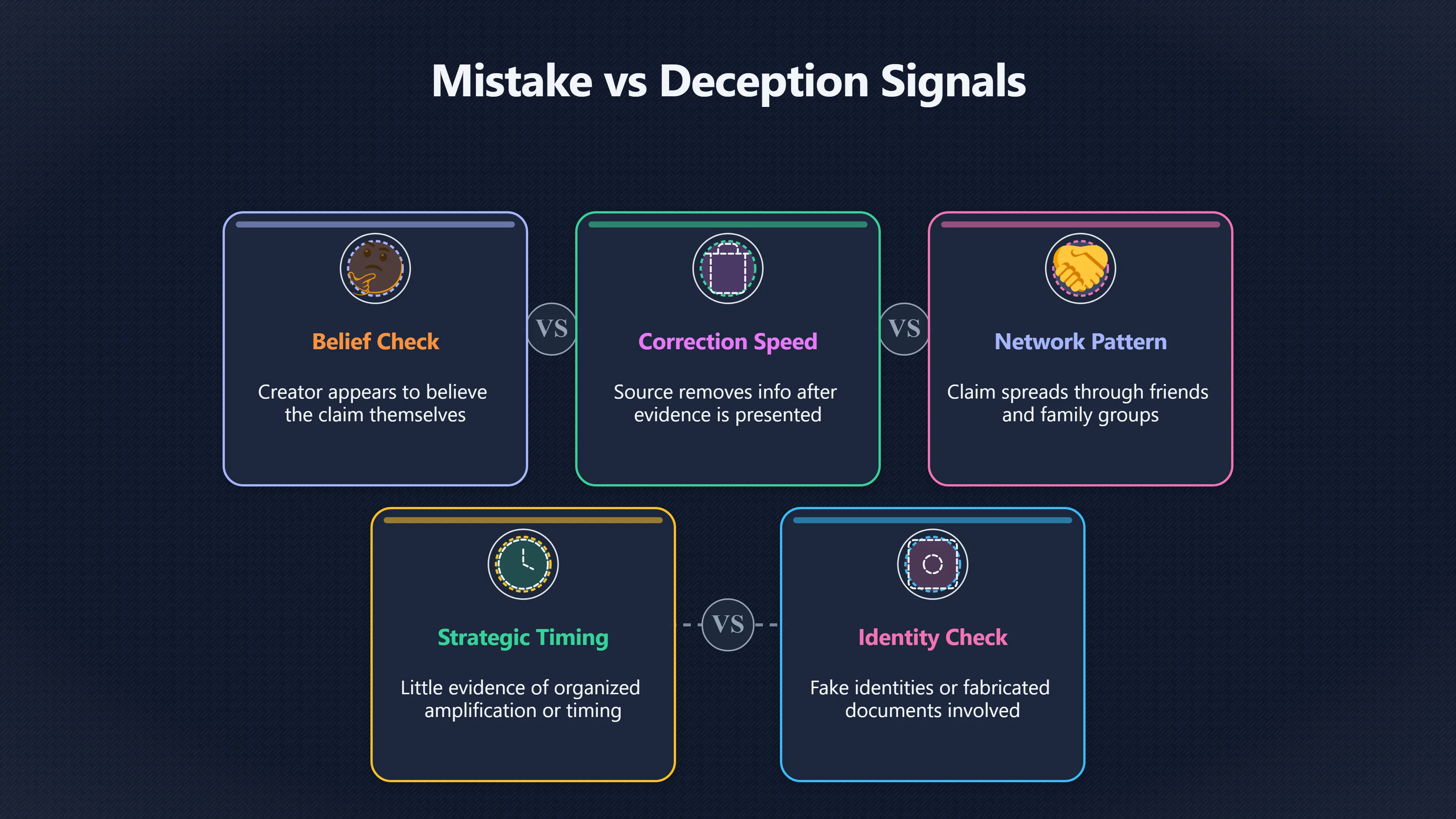
Signs that suggest ordinary misinformation
- The person appears to believe the claim themselves.
- The source corrects or removes the information after evidence is presented.
- The claim spreads through friends, family groups or community networks rather than coordinated accounts.
- Errors seem consistent with misunderstanding, confusion or poor sourcing.
- There is little evidence of strategic timing or organised amplification.
Signs that suggest disinformation[unesco.org]unesco.orgWhat is Misinformation? Meaning, Definition.Misinformation is false information that is shared inadvertently, without meaning to ca…
- Evidence shows the creator knew the claim was false.
- The same narrative appears simultaneously across coordinated accounts.
- Fake identities, impersonation or fabricated documents are involved.
- The content is repeatedly reposted despite corrections.
- Financial, political or ideological incentives are visible.
- Amplification appears automated or centrally organised.
Research on information disorder increasingly emphasises that identifying disinformation requires looking beyond the truth or falsity of a single post. Investigators often analyse networks, coordination patterns, funding structures, timing and amplification strategies rather than focusing only on individual claims.[arXiv]arxiv.orgDisambiguating Disinformation: Extending Beyond the Veracity of Online ContentJune 26, 2022…
This is why fact-checking alone sometimes fails to address organised campaigns. A false statement may be corrected, yet the network responsible for distributing it continues producing new variations of the same narrative.
Why corrections work differently depending on intent
Correcting misinformation is not as simple as saying “that is false”. Decades of research on the continued influence effect show that people can continue relying on inaccurate information even after it has been retracted. False claims often leave a mental gap if the correction removes the story without replacing it.[PMC]pmc.ncbi.nlm.nih.govPMCCan you believe it?An investigation into the impact of… - PMCby UKH Ecker · 2021 · Cited by 208 — The continued influence effect refers to the finding th…[2digitalcommons.chapman.edu]digitalcommons.chapman.eduA Meta-Analytic Examination of the Continued Influence of…by N Walter · 2019 · Cited by 649 — A meta-analysis was conducted to examine…
Studies repeatedly find that corrections become more effective when they provide an alternative explanation rather than a bare denial.[openaccess.city.ac.uk]openaccess.city.ac.ukMisinformation often has a continuing influence on event-related reasoning even when it is clearly and credibly corrected;.Read more…[2appstate.figshare.com]appstate.figshare.comcontinued influence effect: The persistence of misinformation…Read more…
For example:
- A rumour says a factory closed because of sabotage.
- A correction simply states that sabotage did not occur.
- A stronger correction explains that a documented equipment failure caused the shutdown and provides supporting evidence.
The second correction replaces the missing explanation. This helps people update their understanding rather than leaving uncertainty behind.
When misinformation is being shared in good faith, these corrective approaches can substantially reduce harm. The audience is often receptive because the primary obstacle is misunderstanding rather than hostility.
Disinformation campaigns present a harder challenge. Actors intentionally spreading falsehoods may ignore corrections, alter narratives when challenged or produce new misleading claims faster than fact-checkers can respond. In those cases, the audience may still benefit from corrections, but additional interventions become necessary because the source is not attempting to become accurate.
Matching responses to intent
The most effective responses generally align with the mechanism driving the false information.
When the problem is misunderstanding
If a claim spreads because people are confused, uncertain or relying on weak evidence, responses tend to focus on information quality.
Useful approaches include:
- Rapid fact-checking.
- Clear explanations using plain language.
- Providing sources and supporting evidence.
- Explaining how the mistake occurred.
- Updating information as facts change.
- Encouraging verification habits rather than punishment.
Research into misinformation correction suggests that credibility, clarity and alternative explanations all improve the chances that people will revise their beliefs. Springer Link[2openaccess.city.ac.uk]openaccess.city.ac.ukMisinformation often has a continuing influence on event-related reasoning even when it is clearly and credibly corrected;.Read more…
An aggressive response can sometimes backfire. If people feel attacked for making an honest mistake, they may become defensive and less willing to accept corrections.
When the problem is organised deception
Disinformation often requires a broader response because the falsehood is part of a deliberate system.
Potential responses include:
- Investigating originators and networks.
- Identifying coordinated behaviour.
- Exposing fake accounts and impersonation.
- Increasing platform transparency.
- Limiting artificial amplification.
- Strengthening election, crisis or public-health safeguards.
- Applying legal or institutional accountability where appropriate.
In these situations, correcting individual claims remains useful, but the larger objective becomes reducing the effectiveness of the manipulation campaign itself. First Draft and related information-disorder frameworks emphasise that harmful falsehoods frequently operate through coordinated ecosystems rather than isolated posts.[First Draft]firstdraftnews.orgFirst Draft Understanding Information disorderDisinformation is content that is intentionally false and designed to cause harm. It is motivated by three…Read more…[First Draft]firstdraftnews.orgFirst Draft Understanding Information disorderDisinformation is content that is intentionally false and designed to cause harm. It is motivated by three…Read more…

The same claim can move between categories
One reason intent-based responses are challenging is that misinformation and disinformation often overlap.
A fabricated story may begin as deliberate disinformation. Once it enters public circulation, ordinary people may encounter it, believe it and share it sincerely. At that stage, the same claim is being spread through both deception and mistake simultaneously.
UN sources and information-disorder researchers frequently note this transition. Deliberate falsehoods can become embedded in public discussion and continue spreading through people who no longer recognise their deceptive origins.[United Nations]un.orgited NationsHate Speech, MIS- AND DISINFORMATIONMisinformation can be rooted in disinformation as deliberate lies and misleading narrat…
This creates a two-level problem:
- The original deceptive actors may require investigation and disruption.
- The wider public may require explanation and correction.
Focusing only on the audience ignores the organisers. Focusing only on the organisers ignores the ordinary people who have absorbed the claim.
Why intent remains controversial
Although the misinformation-disinformation distinction is widely used, intent is not always easy to determine. Critics point out that proving motivation can be difficult, especially online. A person may appear deceptive while actually being mistaken, or claim innocence while knowingly spreading falsehoods.
Because of this uncertainty, many investigators look for evidence of behaviour rather than relying entirely on stated motives. Patterns such as coordination, repetition after correction, hidden sponsorship and strategic timing can provide stronger evidence than personal declarations alone.[arXiv]arxiv.orgDisambiguating Disinformation: Extending Beyond the Veracity of Online ContentJune 26, 2022…
The challenge is balancing two risks:
- Assuming every false statement is malicious.
- Assuming every false statement is accidental.
The first can turn ordinary disagreement into suspicion. The second can allow organised manipulation to operate unchecked.
Intent therefore functions less as a moral label and more as a practical diagnostic tool. It helps identify what kind of intervention is most likely to work.
The key implementation lesson
The most important question is not simply whether information is false. It is what process produced and sustained the falsehood.
If confusion, misunderstanding and poor information are driving the problem, correction and education are often the most effective tools. If deception, coordination and manipulation are driving it, investigation and systemic intervention become increasingly important. The same inaccurate claim can require both approaches at different stages of its life cycle.
That is why intent remains central to modern discussions of misinformation and disinformation. It does not change whether a claim is true or false, but it changes what society needs to do about it.
Amazon book picks
Further Reading
Books and field guides related to Why intent changes the right response. Use these as the next step if you want deeper reading beyond the article.
The Constitution of Knowledge
Examines how different information failures require different responses.
Factfulness
Highlights how many false beliefs stem from misunderstanding rather than deception.

Scout Mindset
First published 2021. Subjects: Economics, Psychology, Cognition, Skepticism, Critical thinking.
eBay marketplace picks
Marketplace Samples
Example marketplace items related to this page. Use the search link to explore similar finds on eBay.




Endnotes
1.
Source: unesco.org
Link:https://www.unesco.org/en/tags/disinformation-0
Source snippet
What is Disinformation? Meaning, Definition.Misinformation has a neutral or good underlying intent, whereas disinformation is defin...
2.
Source: unesco.org
Link:https://www.unesco.org/en/query-list/m/misinformation
Source snippet
What is Misinformation? Meaning, Definition.Misinformation is false information that is shared inadvertently, without meaning to ca...
3.
Source: arxiv.org
Link:https://arxiv.org/abs/2206.12915
Source snippet
Disambiguating Disinformation: Extending Beyond the Veracity of Online ContentJune 26, 2022...
Published: June 26, 2022
4.
Source: arxiv.org
Link:https://arxiv.org/abs/2406.09343
5.
Source: pmc.ncbi.nlm.nih.gov
Title: PMCCan you believe it?
Link:https://pmc.ncbi.nlm.nih.gov/articles/PMC7810102/
Source snippet
An investigation into the impact of... - PMCby UKH Ecker · 2021 · Cited by 208 — The continued influence effect refers to the finding th...
6.
Source: digitalcommons.chapman.edu
Link:https://digitalcommons.chapman.edu/cgi/viewcontent.cgi?article=1061&context=comm_articles
Source snippet
A Meta-Analytic Examination of the Continued Influence of...by N Walter · 2019 · Cited by 649 — A meta-analysis was conducted to examine...
7.
Source: openaccess.city.ac.uk
Link:https://openaccess.city.ac.uk/28822/1/ConnorDesai%26Reimers2022.pdf
Source snippet
Misinformation often has a continuing influence on event-related reasoning even when it is clearly and credibly corrected;.Read more...
8.
Source: appstate.figshare.com
Link:https://appstate.figshare.com/articles/thesis/Interventions_to_Limit_the_Continued_Influence_Effect_Across_Contexts/30334174/1/files/58815109.pdf
Source snippet
continued influence effect: The persistence of misinformation...Read more...
9.
Source: link.springer.com
Link:https://link.springer.com/article/10.3758/s13421-023-01402-w
Source snippet
Springer LinkThe impact of misinformation corrections on source perceptionsby V Westbrook · 2023 · Cited by 26 — Research on the continue...
10.
Source: unesco.org
Link:https://www.unesco.org/en/query-list/d/disinformation
Source snippet
having intention to deceive. Explore further with...Read more...
11.
Source: unesco.org
Title: What is Misinformation?
Link:https://www.unesco.org/en/tags/misinformation-0
Source snippet
Meaning, Definition.Misinformation is false information that is shared inadvertently, without meaning to cause harm. The terms misinforma...
12.
Source: unesco.org
Link:https://www.unesco.org/mil4teachers/en/module4/unit2
Source snippet
Unit 2: The Misinformation and Disinformation Ecosystem11 Apr 2024 — Distinguish the different types of false and misleading content, i.e...
13.
Source: unesco.org
Link:https://www.unesco.org/mil4teachers/en/module4
Source snippet
disinformation, misinformation, and mal-information including conspiracy theories.... UNESCO discourages the term [fake news]({{ 'fake-news/' | relative_url }}), on the basi...
14.
Source: firstdraftnews.org
Title: First Draft Understanding Information disorder
Link:https://firstdraftnews.org/long-form-article/understanding-information-disorder/
Source snippet
Disinformation is content that is intentionally false and designed to cause harm. It is motivated by three...Read more...
15.
Source: firstdraftnews.org
Link:https://firstdraftnews.org/wp-content/uploads/2019/10/Information_Disorder_Digital_AW.pdf
Source snippet
First DraftUnderstanding Information Disorder - First Draft NewsOct 16, 2019 — When disinformation is shared it often turns into misinfor...
16.
Source: un.org
Link:https://www.un.org/sites/un2.un.org/files/notohate_fact_sheets_en.pdf
Source snippet
ited NationsHate Speech, MIS- AND DISINFORMATIONMisinformation can be rooted in disinformation as deliberate lies and misleading narrat...
17.
Source: firstdraftnews.org
Link:https://firstdraftnews.org/
Source snippet
impact of misinformation on elections...Read more...
18.
Source: ohchr.org
Link:https://www.ohchr.org/sites/default/files/Documents/Issues/Expression/disinformation/5-Others/UNESCO.docx
Source snippet
unescoIt is also recognised that like the term “fake news”, the term “disinformation” can be instrumentalised to designate a vast range o...
19.
Source: Wikipedia
Title: Fake news
Link:https://en.wikipedia.org/wiki/Fake_news
Source snippet
Fake newsFake news is false or misleading information (misinformation, disinformation, propaganda, and hoaxes) claiming the aesthetics...
20.
Source: Wikipedia
Link:https://en.wikipedia.org/wiki/Disinformation
Source snippet
DisinformationMisinformation can be used to create disinformation when known misinformation is purposefully and intentionally dissemin...
21.
Source: etd.ohiolink.edu
Link:https://etd.ohiolink.edu/acprod/odb_etd/ws/send_file/send?accession=osu1638809124303347&disposition=inline
Source snippet
ohiolink.edu1 Mechanisms in Continued Influence of Misinformationby VL Westbrook · 2022 · Cited by 1 — Research on the CIE has shown that...
Additional References
22.
Source: pubmed.ncbi.nlm.nih.gov
Link:https://pubmed.ncbi.nlm.nih.gov/40086022/
Source snippet
an alternative explanation improves...by S Guo · Cited by 5 — The continued influence effect of misinformation (CIE) occurs when misinfo...
23.
Source: medium.com
Link:https://medium.com/1st-draft/information-disorder-part-1-the-essential-glossary-19953c544fe3
Source snippet
Information Disorder, Part 1: The Essential GlossaryThey are increasingly being used as powerful vehicles of disinformation. Misinformati...
24.
Source: medium.com
Link:https://medium.com/1st-draft/information-disorder-part-3-useful-graphics-2446c7dbb485
Source snippet
Information Disorder, Part 3: Useful Graphics | by First DraftMisinformation · Disinformation · Fake News. 218. 218... Agents of disinfo...
25.
Source: apa.org
Link:https://www.apa.org/topics/journalism-facts/misinformation-disinformation
Source snippet
Misinformation and disinformationMisinformation is false or inaccurate information—getting the facts wrong. Disinformation is false infor...
26.
Source: princetonlibrary.org
Link:https://princetonlibrary.org/guides/misinformation-disinformation-malinformation-a-guide/
Source snippet
Misinformation, Disinformation & Malinformation: A GuideWardle cofounded First Draft News, a collaborative project to “fight misinformati...
27.
Source: scispace.com
Link:https://scispace.com/pdf/the-continued-influence-of-misinformation-in-memory-what-4tijzg1jh2.pdf
Source snippet
The continued influence of misinformation in memoryIn the next sections, we consider several alternative explanations for the continued i...
28.
Source: unric.org
Link:https://unric.org/en/unric-library-backgrounder-information-integrity/
Source snippet
UNRIC Library Backgrounder: Information IntegrityMisinformation can be rooted in disinformation as deliberate lies and misleading narrati...
29.
Source: edoc.coe.int
Link:https://edoc.coe.int/en/media/7495-information-disorder-toward-an-interdisciplinary-framework-for-research-and-policy-making.html
Source snippet
disorder: Toward an interdisciplinary framework...This report provides a new framework for policy-makers, legislators, researchers, tech...
30.
Source: researchgate.net
Link:https://www.researchgate.net/publication/391015007To_be_continued_misinformation%27s_bizarre_adventure_beyond_memory_failures-_exploring_non-memory-based_mechanisms_driving_the_continued_influence_effect_CIE
Source snippet
(PDF) To be continued: misinformation's bizarre adventure...18 Nov 2025 — The Continued Influence Effect (CIE) refers to the persistent...
31.
Source: pmc.ncbi.nlm.nih.gov
Title: Journalism, Fake News & Disinformation (Paris: Unesco) London: Media
Link:https://pmc.ncbi.nlm.nih.gov/articles/PMC11724212/
Source snippet
and Combating Misinformation - PMC - NIHby NL Bragazzi · 2024 · Cited by 19 — The Distinction Among Misinformation, Disinformation, Malin...
Topic Tree