Within Media Literacy
Why one lesson is rarely enough
Media literacy can be taught, but one-off lessons are weaker than repeated practice across changing platforms and formats.
On this page
- What short media literacy interventions can improve
- Why habits fade under pressure and overload
- How synthetic media raises the training bar
Page outline Jump by section
Introduction
Media literacy is often presented as a way to prevent myths and misconceptions before they spread. The evidence suggests that it can help, but there is an important limitation: one lesson is rarely enough. People may learn useful skills from a workshop, classroom activity, or online game, yet those skills compete with habits, emotions, social pressures, and rapidly changing media environments. The challenge is not simply teaching people how to evaluate information once. It is helping them do it repeatedly, under real-world conditions, across different platforms and formats. Research increasingly shows that media literacy works best when it is treated as an ongoing practice rather than a one-time intervention.[ResearchGate]researchgate.netResearchGate(PDF) Media Literacy Interventions Improve Resilience to…September 18, 2024 — This study finds that media literacy interve…
What short media literacy interventions can improve
Short interventions are not useless. In fact, many studies find measurable improvements in people’s ability to recognise misleading content, identify manipulation techniques, and resist some forms of misinformation after training.
A large meta-analysis covering dozens of experimental studies found that media literacy interventions generally improve resilience to misinformation. Participants became better at distinguishing reliable from unreliable information and less likely to share false content. These findings help explain why schools, libraries, news organisations, and public agencies continue to invest in media literacy programmes.[ResearchGate]researchgate.netResearchGate(PDF) Media Literacy Interventions Improve Resilience to…September 18, 2024 — This study finds that media literacy interve…
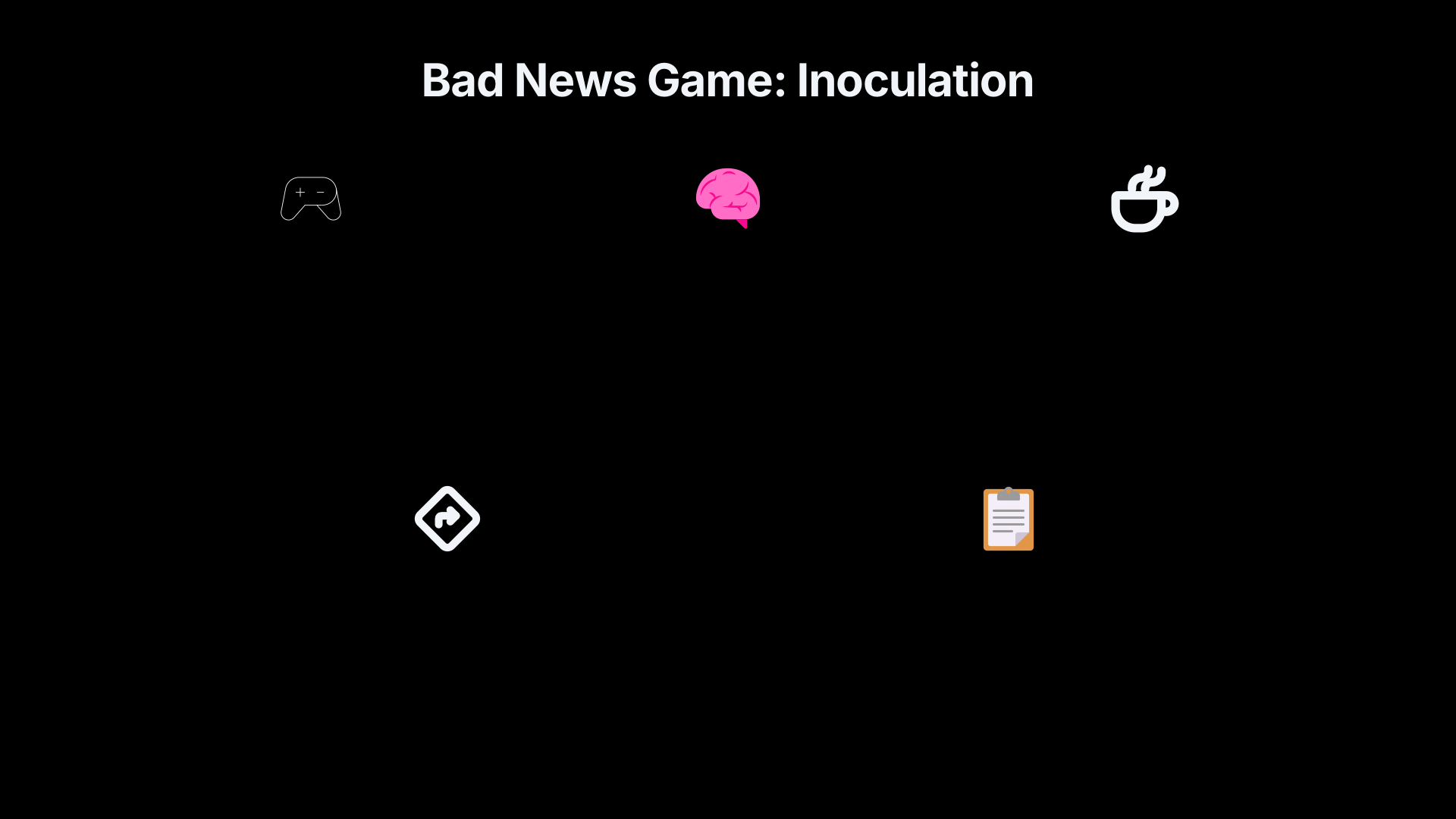
Researchers have also tested “prebunking” and inoculation approaches, which expose people to weakened examples of manipulation before they encounter them in the wild. Interactive tools and games such as Bad News have shown that people can learn to recognise techniques like fearmongering, impersonation, conspiracy framing, and emotional manipulation.[Nature]nature.comFake news game confers psychological resistance against…by J Roozenbeek · 2019 · Cited by 1043 — The rapid spread of “fake news”…[Cambridge Repository]repository.cam.ac.ukThe rapid spread of online misinformation poses an increasing risk to societies worldwide. To help counter this, we developed a 'fake new…
Classroom studies likewise suggest that students can improve their ability to identify manipulative social media content after structured activities and games. These improvements demonstrate that media literacy skills are teachable rather than fixed traits.[Taylor & Francis Online]tandfonline.comAlthough the serious game Bad News has been used to inoculate citizens against misinformation, it has not been formally evaluated…Read…
The key question, however, is not whether learning occurs. It is how long the learning lasts and whether it transfers into everyday behaviour.
Why habits fade under pressure and overload
The main weakness of one-off lessons is that recognising misinformation is not purely a knowledge problem. It is also a habit problem.
In controlled settings, participants often have time to think carefully. Real-world information environments are different. People encounter content while distracted, tired, emotionally engaged, or under social pressure to react quickly. The skills taught during a single session may not automatically appear when those conditions change.
Recent research on misinformation interventions highlights this challenge. Educational efforts can produce positive effects, but maintaining those effects over time is harder than achieving them initially. Studies examining longer-term outcomes often find that gains weaken unless skills are reinforced or revisited.[PMC]pmc.ncbi.nlm.nih.govPMCGame-based inoculation versus graphic-basedby B Hu · 2023 · Cited by 22 — Researchers have effectively increased the public's resilience to misinformation using online toolkits…
This pattern resembles other forms of learning. A person who attends one driving lesson does not become a confident driver. Someone who studies a language once does not become fluent. Media literacy involves repeated judgement calls in complex environments. Without practice, people tend to revert to faster mental shortcuts.
There is also evidence that some interventions may not work as cleanly as early enthusiasm suggested. Certain studies of misinformation games found improvements in scepticism but questioned whether participants became genuinely better at distinguishing true from false information. In some cases, people became more inclined to distrust information generally. These findings do not show that media literacy fails; they show that skill development requires careful reinforcement and refinement rather than assuming a single exposure will create lasting resilience.[PubMed]pubmed.ncbi.nlm.nih.govGamified inoculation interventions do not improve…by A Modirrousta-Galian · 2023 · Cited by 179 — Across the studies, when compa…[PMC]pmc.ncbi.nlm.nih.govPMCInvestigating the long-term impact of misinformationby T Nygren · 2025 · Cited by 11 — This study examines the long-term effects of educational interventions aimed at improving upper-sec…
Why repetition matters more than information
Repeated practice helps because it shifts media literacy from conscious knowledge to routine behaviour.
When people repeatedly check sources, compare claims across outlets, investigate authors, and pause before sharing, these actions become easier to perform under pressure. The goal is not memorising a checklist. The goal is building automatic habits that can survive the speed and distraction of digital platforms.
Research on inoculation approaches increasingly points toward the value of multiple exposures and continuing engagement. Newer work argues that resilience against misinformation is strengthened when people encounter repeated opportunities to practise recognising manipulation techniques rather than receiving a single “dose” of training.[arXiv]arxiv.orgEffective Yet Ephemeral Propaganda Defense: There Needs to Be More than One-Shot Inoculation to Enhance Critical ThinkingMarch 11, 2025…
This matters because misinformation itself is not static. A person who learns to recognise a misleading Facebook post may later encounter manipulated videos, AI-generated images, deceptive influencer content, or coordinated campaigns on entirely different platforms. Repetition helps people abstract the underlying techniques rather than memorising examples tied to one platform or moment.[MDPI]mdpi.comIn the context of the growing…
In this sense, media literacy is less like learning a fact and more like exercising a skill. Skills strengthen through use and weaken through neglect.
How synthetic media raises the training bar
The rise of synthetic media and generative artificial intelligence has made repeated practice even more important.
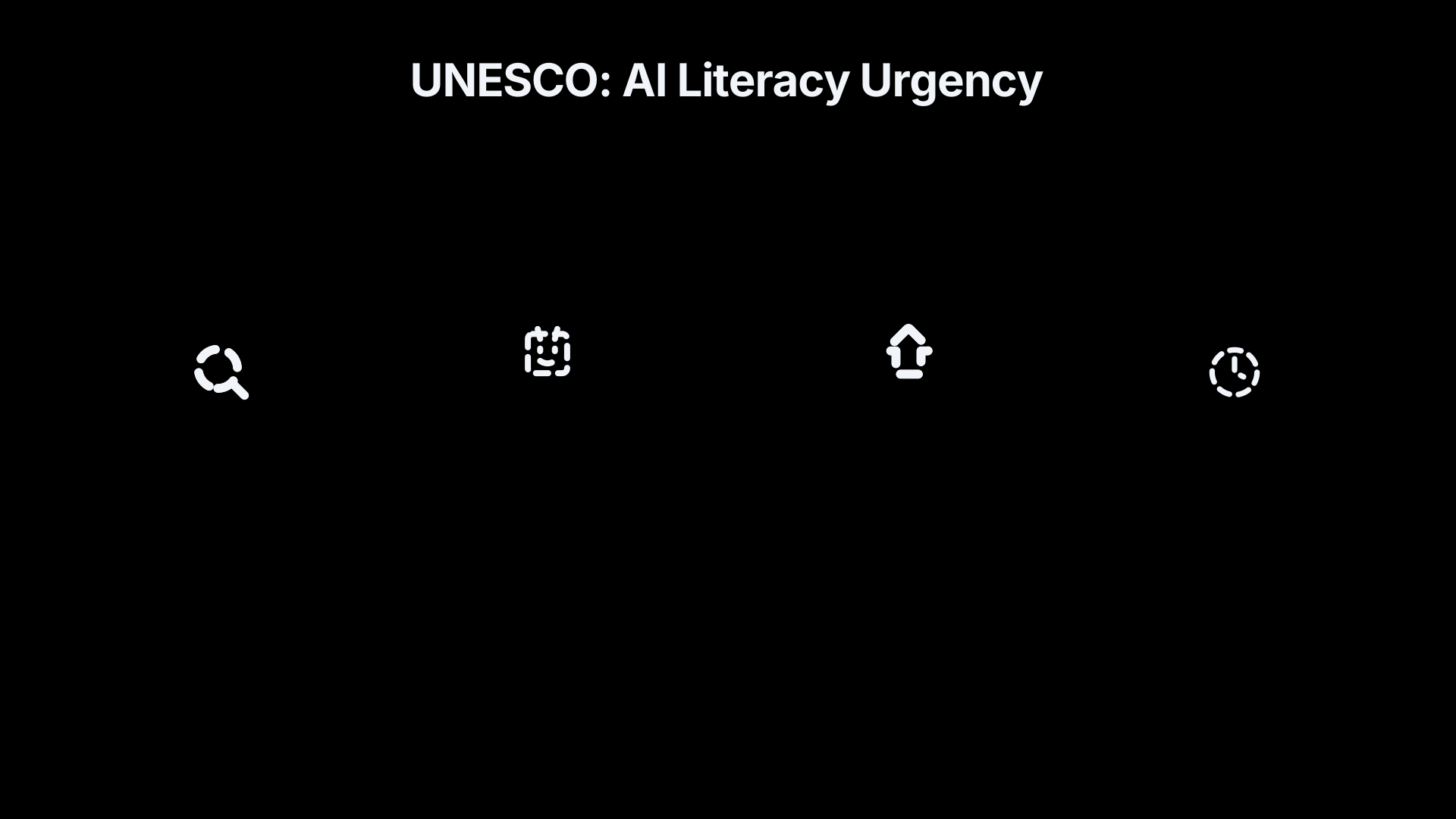
Older media literacy lessons often focused on suspicious headlines, unreliable websites, or obvious signs of manipulation. Today’s information environment increasingly includes realistic AI-generated text, cloned voices, fabricated photographs, and convincing deepfake videos. These forms of content can appear credible even to informed audiences.[UNESCO]unesco.orgdeepfakes and crisis knowingDeepfakes and the crisis of knowing27 Oct 2025 — Survey data across eight countries shows prior exposure to deepfakes increases bel…[UNESCO]unesco.orgAI can make mistakes: Why media literacy matters more…24 Oct 2025 — The effects are already visible: fake content spreads rapidl…
UNESCO and other international organisations have argued that media and information literacy must evolve alongside these technologies. The challenge is no longer simply spotting crude fabrications. Citizens must learn to verify claims in environments where synthetic content can imitate authentic evidence. UNESCO[UNESCO Documentation]unesdoc.unesco.orgDocumentation User empowerment through media and information literacyUNESCO 2022a). Research has shown, for instance, that AI tools and deepfakes, including those that use GAI, have generated disinformatio…
This creates a moving target for educators. Techniques that worked well five years ago may not address today’s manipulation methods. Deepfakes, voice cloning, and AI-generated news-like content require new forms of verification behaviour and new examples in training programmes. Continuous practice allows people to update their skills as the information ecosystem changes.[UNESCO]unesco.orgguidance generative ai education and researchGuidance for generative AI in education and research7 Sept 2023 — UNESCO's first global guidance on GenAI in education aims to supp…[ResearchGate]researchgate.netResearchGate(PDF) Media Literacy Interventions Improve Resilience to…September 18, 2024 — This study finds that media literacy interve…
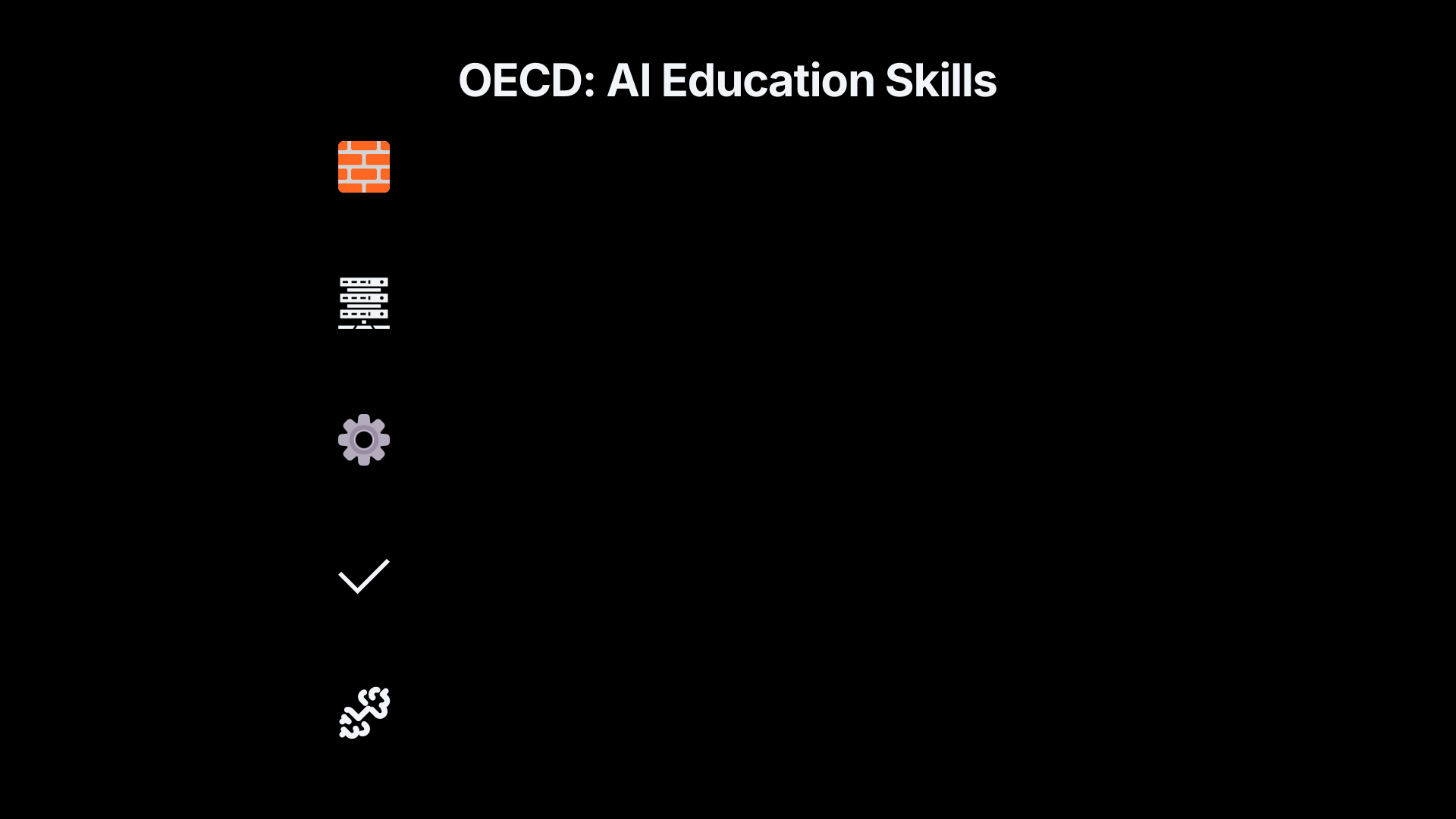
The challenge is amplified by the sheer volume of content. Generative AI can produce misinformation at a scale and speed that were previously impossible. In such environments, resilience depends less on remembering individual warnings and more on maintaining durable habits of verification. PMC[OECD]oecd.orgArtificial intelligence and education and skillsWe need to encourage research on using generative AI and promote forward-looking guidance…
Media literacy as ongoing resilience rather than a one-time fix
A common misconception is that media literacy programmes either work or do not work. The evidence points to a more nuanced conclusion. Short interventions can improve resistance to misinformation, but lasting protection depends on reinforcement, repetition, and adaptation to changing media conditions.[ResearchGate]researchgate.netResearchGate(PDF) Media Literacy Interventions Improve Resilience to…September 18, 2024 — This study finds that media literacy interve…
The most realistic view is to treat media literacy as a resilience strategy. Like physical fitness, it is not something acquired permanently after a single session. It requires continued use, periodic refreshers, and exposure to new challenges. As myths, misinformation tactics, and synthetic media evolve, the strongest defence is not one memorable lesson but a sustained habit of critical engagement with information.[Cogitatio Press]cogitatiopress.comCogitatio PressMedia Literacy as Resilience: A Conceptual Frameworkby O Pasitselska · 2026 · Cited by 1 — Media literacy interventions im…[UNESCO Institute for Lifelong Learning]unesco.orgdeepfakes and crisis knowingDeepfakes and the crisis of knowing27 Oct 2025 — Survey data across eight countries shows prior exposure to deepfakes increases bel…
Amazon book picks
Further Reading
Books and field guides related to Why one lesson is rarely enough. Use these as the next step if you want deeper reading beyond the article.
How to Read a Book
Rating: 4.0/5 from 41 Google Books ratings
Promotes active evaluation and deeper engagement with information.
eBay marketplace picks
Marketplace Samples
Example marketplace items related to this page. Use the search link to explore similar finds on eBay.




Endnotes
1.
Source: researchgate.net
Link:https://www.researchgate.net/publication/384101489_Media_Literacy_Interventions_Improve_Resilience_to_Misinformation_A_Meta-Analytic_Investigation_of_Overall_Effect_and_Moderating_Factors
Source snippet
ResearchGate(PDF) Media Literacy Interventions Improve Resilience to...September 18, 2024 — This study finds that media literacy interve...
Published: September 18, 2024
2.
Source: nature.com
Link:https://www.nature.com/articles/s41599
Source snippet
Fake news game confers psychological resistance against...by J Roozenbeek · 2019 · Cited by 1043 — The rapid spread of “[fake news]({{ 'fake-news/' | relative_url }})”...
3.
Source: inoculation.science
Link:https://inoculation.science/inoculation-games/
Source snippet
Interactive GamesA short, free-to-play online game in which players learn how political misinformation is produced...
4.
Source: pmc.ncbi.nlm.nih.gov
Title: PMCGame-based inoculation versus graphic-based
Link:https://pmc.ncbi.nlm.nih.gov/articles/PMC10390387/
Source snippet
by B Hu · 2023 · Cited by 22 — Researchers have effectively increased the public's resilience to misinformation using online toolkits...
5.
Source: pmc.ncbi.nlm.nih.gov
Title: PMCInvestigating the long-term impact of misinformation
Link:https://pmc.ncbi.nlm.nih.gov/articles/PMC12240385/
Source snippet
by T Nygren · 2025 · Cited by 11 — This study examines the long-term effects of educational interventions aimed at improving upper-sec...
6.
Source: pmc.ncbi.nlm.nih.gov
Title: PMCMixed News about the [Bad News Game]({{ ‘bad-news-game/’ | relative_url }})
Link:https://pmc.ncbi.nlm.nih.gov/articles/PMC10573624/
Source snippet
Keywords: Fake news, social media, gameified inoculation, Bad...Read more...
7.
Source: arxiv.org
Link:https://arxiv.org/abs/2503.16497
Source snippet
Effective Yet Ephemeral Propaganda Defense: There Needs to Be More than One-Shot Inoculation to Enhance Critical ThinkingMarch 11, 2025...
Published: March 11, 2025
8.
Source: mdpi.com
Link:https://www.mdpi.com/2673-5172/6/4/188
Source snippet
In the context of the growing...
9.
Source: unesco.org
Title: deepfakes and crisis knowing
Link:https://www.unesco.org/en/articles/deepfakes-and-crisis-knowing
Source snippet
Deepfakes and the crisis of knowing27 Oct 2025 — Survey data across eight countries shows prior exposure to deepfakes increases bel...
10.
Source: unesco.org
Link:https://www.unesco.org/en/articles/ai-can-make-mistakes-why-media-literacy-matters-more-ever
Source snippet
AI can make mistakes: Why media literacy matters more...24 Oct 2025 — The effects are already visible: fake content spreads rapidl...
11.
Source: unesco.org
Title: guidance generative ai education and research
Link:https://www.unesco.org/en/articles/guidance-generative-ai-education-and-research
Source snippet
Guidance for generative AI in education and research7 Sept 2023 — UNESCO's first global guidance on GenAI in education aims to supp...
12.
Source: unesdoc.unesco.org
Title: Documentation User empowerment through media and information literacy
Link:https://unesdoc.unesco.org/ark%3A/48223/pf0000388547
Source snippet
(UNESCO 2022a). Research has shown, for instance, that AI tools and deepfakes, including those that use GAI, have generated disinformatio...
13.
Source: researchgate.net
Link:https://www.researchgate.net/publication/399500225_New_challenges_for_media_literacy_in_the_age_of_artificial_intelligence_deepfake_synthetic_media_and_credibility
Source snippet
The question is pressing because the deepfake phenomenon in its more poisonous...Read more...
14.
Source: oecd.org
Link:https://www.oecd.org/en/topics/artificial-intelligence-and-education-and-skills.html
Source snippet
Artificial intelligence and education and skillsWe need to encourage research on using generative AI and promote forward-looking guidance...
15.
Source: uil.unesco.org
Title: webinar misinformation empowerment media literacy youth and adults age ai
Link:https://www.uil.unesco.org/en/articles/webinar-misinformation-empowerment-media-literacy-youth-and-adults-age-ai
Source snippet
UNESCO Institute for Lifelong LearningMedia literacy for youth and adults in the age of AI19 May 2026 — On 19 May 2026, the UNESCO Instit...
Published: May 2026
16.
Source: mdpi.com
Link:https://www.mdpi.com/2075-4698/15/6/155
Source snippet
Fighting Disinformation: How to Measure the Impact of Preby P Verhalle · 2025 · Cited by 2 — Roozenbeek and Van der Linden (2019) [12] us...
17.
Source: unesco.org
Link:https://www.unesco.org/en/articles/fighting-disinformation-unesco-trains-judicial-professionals-fact-checking-and-countering
Source snippet
Fighting Disinformation: UNESCO Trains Judicial...Jan 26, 2026 — The workshop focused on addressing Disinformation through fact-checking...
18.
Source: cogitatiopress.com
Link:https://www.cogitatiopress.com/mediaandcommunication/article/download/11458/4989
Source snippet
Cogitatio PressMedia Literacy as Resilience: A Conceptual Frameworkby O Pasitselska · 2026 · Cited by 1 — Media literacy interventions im...
19.
Source: repository.cam.ac.uk
Link:https://www.repository.cam.ac.uk/items/a86cd1c0-a966-49cd-87c2-d0e64e700021
Source snippet
The rapid spread of online misinformation poses an increasing risk to societies worldwide. To help counter this, we developed a 'fake new...
20.
Source: tandfonline.com
Link:https://www.tandfonline.com/doi/full/10.1080/15391523.2024.2338451
Source snippet
Although the serious game Bad News has been used to inoculate citizens against misinformation, it has not been formally evaluated...Read...
21.
Source: pubmed.ncbi.nlm.nih.gov
Link:https://pubmed.ncbi.nlm.nih.gov/36996156/
Source snippet
Gamified inoculation interventions do not improve...by A Modirrousta-Galian · 2023 · Cited by 179 — Across the studies, when compa...
22.
Source: tandfonline.com
Link:https://www.tandfonline.com/doi/full/10.1080/0144929X.2023.2267700
Source snippet
Taylor & Francis OnlineFull article: Striking the balance between fake and realby M Hameleers · 2023 · Cited by 28 — We conclude that the...
23.
Source: tandfonline.com
Link:https://www.tandfonline.com/doi/full/10.1080/15405702.2026.2619473
Source snippet
Taylor & Francis OnlineInoculation theory as a design approach to game-based...by N Henderson · 2026 — A growing number of misinformatio...
24.
Source: unesco.org.uk
Link:https://unesco.org.uk/resources/guidance-for-generative-ai-in-education-and-research
Source snippet
UNESCO in the UKGuidance for generative AI in education and researchThe publication offers concrete recommendations for policy-makers and...
25.
Source: youtube.com
Link:https://www.youtube.com/watch?v=4jN0ASk959Y
Source snippet
UNESCO is empowering citizens with Media and Information Literacy skills to better comprehend and engage with Generative Artificial Intel...
Additional References
26.
Source: linkedin.com
Link:https://www.linkedin.com/posts/sander-van-der-linden-156a08203_prebunking-inoculation-badnews-activity-7461018385804591104-p4Lt
Source snippet
#prebunking #inoculation #badnews | Sander van der LindenIt reveals the techniques used to spread misinformation. He's been testing it na...
27.
Source: diplomacy.edu
Link:https://www.diplomacy.edu/wp-content/uploads/DD-report.pdf
Source snippet
Decoding Disinformation: Lessons from case studiesThe challenges relate not only to misinformation fuelled by factual errors or fabricate...
28.
Source: theguardian.com
Link:https://www.theguardian.com/media/2024/nov/26/online-influencers-need-urgent-fact-checking-training-warns-unesco
Source snippet
According to a survey by Unesco, two-thirds of content creators do not verify the accuracy of their information before sharing, leaving b...
29.
Source: pmc.ncbi.nlm.nih.gov
Link:https://pmc.ncbi.nlm.nih.gov/articles/PMC12351547/
Source snippet
by A Romanishyn · 2025 · Cited by 23 — Keywords: AI, disinformation, deepfake, policy recommendation, AI... deepfakes, have become on...
30.
Source: eurozine.com
Link:https://www.eurozine.com/ai-media-literacy-and-the-next-generation/
Source snippet
AI, Media Literacy, and the Next Generation12 Jun 2025 — Fact-checkers struggled to counter the disinformation effectively...
31.
Source: edtechnz.org.nz
Title: if we dont teach our young people ai literacy who will
Link:https://edtechnz.org.nz/2025/06/24/if-we-dont-teach-our-young-people-ai-literacy-who-will/
Source snippet
deepfakes, data privacy and anonymisation, and the difference between misinformation and disinformation. A central focus of the programme...
32.
Source: osf.io
Link:https://osf.io/download/n6dkx/
Source snippet
Diverse Communities: Social and Motivational Considerations in...Read more...
33.
Source: fondationdescartes.org
Link:https://www.fondationdescartes.org/en/2020/01/the-fake-news-game-actively-inoculating-against-the-risk-of-misinformation/
Source snippet
The Fake News Game: Actively Inoculating Against...The rapid spread of online misinformation poses an increasing risk to societies world...
34.
Source: school-education.ec.europa.eu
Title: guidance generative ai education and research
Link:https://school-education.ec.europa.eu/en/discover/publications/guidance-generative-ai-education-and-research
Source snippet
for generative AI in education and research5 Apr 2024 — UNESCO's first global guidance on generative artificial intelligence (GenAI) in e...
35.
Source: linkedin.com
Title: Generative AI and Media Literacy in an Age of Misinformation
Link:https://www.linkedin.com/pulse/generative-ai-media-literacy-age-misinformation-michael-maring-t4yue
Source snippet
Abstract Generative artificial intelligence presents new challenges and opportunities for media literacy education...
Topic Tree