Within Mythcraft
Why Common Sense Gets Falling Objects Wrong
Some false beliefs last because everyday experience seems to confirm them until the hidden conditions are made clear.

On this page
- The intuitive model
- Air resistance and hidden conditions
- Using examples to rebuild understanding
Page outline Jump by section
Introduction
The belief that heavier objects fall faster is one of the best examples of a misconception that survives because ordinary experience seems to support it. A stone really does reach the ground before a feather, and a full water bottle often seems to drop more decisively than an empty one. The correction is not that everyday observation is useless; it is that everyday falling usually happens in air, where shape, surface area, drag and terminal velocity can hide the simpler rule. In free fall, where gravity is the only significant force, objects fall with the same acceleration regardless of mass. NASAs educational material states this plainly: in a vacuum, size, shape and weight do not determine the acceleration of a falling object.[NASA]www1.grc.nasa.govIn a vacuum, a beach ball falls at the same rate as an airliner.Read moreFree Fall without Air Resistance | Glenn Research Center18 Jul 2024 All objects, regardless of size or shape or weight, free fall w…
This makes the misconception especially instructive. It is not a childish error so much as a reasonable first model drawn from incomplete conditions. The better model has to explain both facts at once: why a hammer and a feather fall together in a vacuum, and why a feather drifts slowly through air on Earth.[NASA Science]science.nasa.govScience The Apollo 15 Hammer-Feather DropNASA ScienceThe Apollo 15 Hammer-Feather DropJuly 16, 2018 20 Jul 2015 A live demonstration for the television cameras. He held out a…
Why the intuitive model feels right
The intuitive rule is simple: heavier objects feel as though they have more gravity in them, so they should fall faster. That impression is reinforced by countless daily comparisons. A coin drops quickly; a receipt flutters. A pebble lands before a dry leaf. A dense ball seems less bothered by the air than a light, broad object. These examples are real, but they bundle several variables together: mass, shape, density, surface area and air resistance all change at once.[PMC]pmc.ncbi.nlm.nih.govPMCAn understanding of falling bodies across schoolingPMCAn understanding of falling bodies across schooling
Physics education research shows why this belief is durable. A 2023 study of 953 participants across levels of schooling and experience found that falling-body reasoning is not captured by one simple misconception. People may rely on several conceptual resources, including the idea that heavier objects fall faster, that larger or wider objects fall faster, or that air matters only in special cases. The authors note that observations seeming to show heavier objects falling faster are hard to contradict because they can genuinely be made in ordinary atmospheric conditions.[PMC]pmc.ncbi.nlm.nih.govPMCAn understanding of falling bodies across schoolingPMCAn understanding of falling bodies across schooling
That is why simply saying all objects fall at the same rate can also mislead. A reader who has watched paper fall more slowly than a pen knows that statement cannot describe every visible fall on Earth. The accurate version is narrower and stronger: when air resistance is absent or negligible, mass alone does not make one object accelerate faster than another.[The Physics Classroom]physicsclassroom.comSource details in endnotes.
What free fall actually says
In physics, free fall has a stricter meaning than moving downwards. It means the object is falling under the influence of gravity alone, with no significant air resistance, lift, thrust or support force. Under that condition, objects near Earths surface share the same gravitational acceleration, commonly given as about 9.8 metres per second squared. The Physics Classroom summarises the point by distinguishing true free fall from cases where air resistance becomes important.[The Physics Classroom]physicsclassroom.comSource details in endnotes.
The reason mass cancels out is central to the correction. A heavier object does experience a greater gravitational force. But it also has greater inertia: it is harder to accelerate by the same proportion. In Newtonian terms, the increase in gravitational pull and the increase in resistance to acceleration scale together, so the acceleration comes out the same when gravity is the only significant force. A technical discussion of Galileos thought experiment describes this as the pairing of greater gravitational mass with greater inertial mass.[arXiv]arxiv.orgSource details in endnotes.
This is the hidden step the everyday intuition misses. More weight is not automatically more acceleration. Force matters, but acceleration depends on force relative to mass. A heavy object has more gravitational force pulling it down, but that same larger mass means the force has more object to accelerate. In ideal free fall, those two facts balance.[NASA]www1.grc.nasa.govFree Falling Objects | Glenn Research CenterFree Falling Objects | Glenn Research Center - NASA20 Nov 2023 So, all objects, regardless of size or shape or weight, free fall wi…
Air resistance is the missing condition
Air resistance, or drag, is the upward force caused by an object moving through air. It depends strongly on speed and on how the object presents itself to the air. A flat sheet of paper has a large area relative to its weight, so air can slow it dramatically. Crumple the same paper and it falls much faster, even though its mass has barely changed. That one comparison is often more useful than a heavy-versus-light example because it separates shape from weight.[WIRED]wired.comdo heavier objects really fall fasterdo heavier objects really fall faster
NASAs explanation of falling with air resistance describes how drag increases as velocity increases. Eventually, for some falling objects, drag can equal weight. At that point there is no net force, acceleration becomes zero, and the object continues at a constant terminal velocity. This is why skydivers, feathers and broad sheets of paper do not simply keep accelerating in the way an ideal free-fall calculation would predict.[GRC NASA]grc.nasa.govSource details in endnotes.
This also explains the part of the misconception that contains a grain of truth. In air, if two objects have the same size and shape but different masses, the heavier one often reaches a higher terminal velocity and may hit the ground first. The heavier object needs a larger drag force to balance its larger weight, so it must usually move faster before drag catches up. Physics Classrooms teaching material makes this point explicitly: with air resistance included, more massive objects can fall faster, but not because mass changes the gravitational acceleration rule in vacuum.[The Physics Classroom]physicsclassroom.comSource details in endnotes.

The hammer and feather made the hidden condition visible
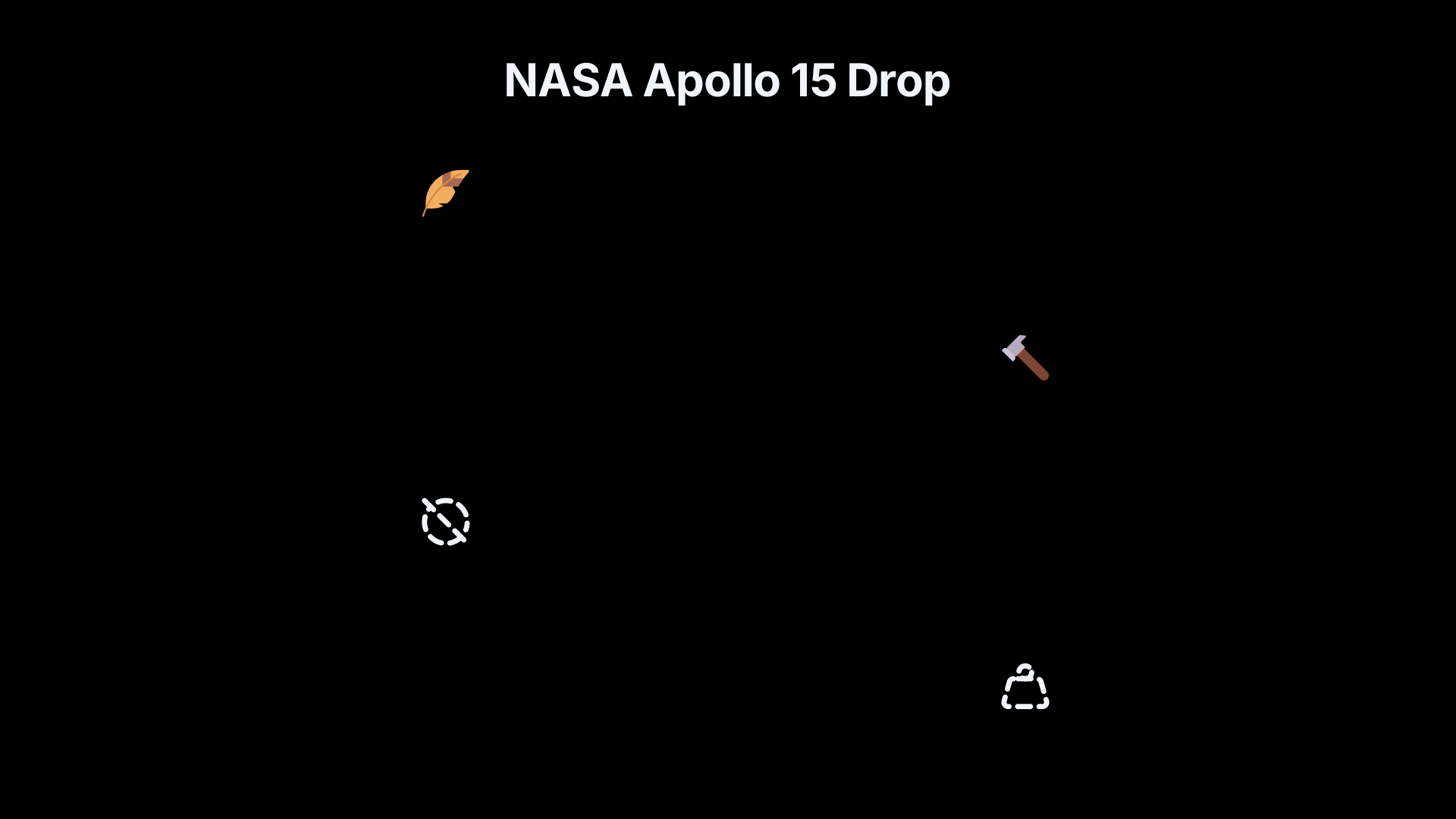
The Apollo 15 hammer-and-feather drop remains the cleanest popular demonstration because it removed the condition that usually confuses the issue. On the Moon in 1971, Commander David Scott dropped a geological hammer and a feather at the same time. With essentially no lunar atmosphere, there was no meaningful air resistance, and the two objects reached the lunar surface together. NASA presents the demonstration as a vivid confirmation of Galileos conclusion that objects released together fall at the same rate regardless of mass when air resistance is absent.[NASA Science]science.nasa.govScience The Apollo 15 Hammer-Feather DropNASA ScienceThe Apollo 15 Hammer-Feather DropJuly 16, 2018 20 Jul 2015 A live demonstration for the television cameras. He held out a…
The demonstration works because it uses an extreme contrast. A hammer and a feather are not just different in mass; on Earth they behave very differently because the feather has so much surface area relative to its weight. On the Moon, that familiar difference disappears. The result does not say feathers behave like hammers on Earth. It says Earths air is doing much more work than common sense usually notices.[NASA Science]science.nasa.govScience The Apollo 15 Hammer-Feather DropNASA ScienceThe Apollo 15 Hammer-Feather DropJuly 16, 2018 20 Jul 2015 A live demonstration for the television cameras. He held out a…
The same idea can be shown without space travel by using vacuum chambers, low-drag objects or carefully chosen classroom drops. The American Physical Society describes classroom experiments designed to help students see that mass is not the decisive factor in ideal falling, while shape and air resistance explain many everyday differences.[American Physical Society]aps.orgSource details in endnotes.
Galileos lesson is subtler than the tower story
The popular story says Galileo dropped two objects from the Leaning Tower of Pisa and proved Aristotle wrong. The real history is more complicated. NASA notes that Galileo used inclined-plane experiments to slow motion down enough to measure it, finding that the relationship between distance and time was the same regardless of the balls mass. NASAs Astronomy Picture of the Day also notes that many historians are sceptical of the famous tower-drop story as a literal event.[NASA]science.nasa.govScience The Apollo 15 Hammer-Feather DropNASA ScienceThe Apollo 15 Hammer-Feather DropJuly 16, 2018 20 Jul 2015 A live demonstration for the television cameras. He held out a…
The more important lesson is not whether the tower scene happened exactly as retold. Galileos lasting contribution was to replace an intuitive ranking of heavier falls faster with an analysis of acceleration under controlled conditions. Inclined planes, smooth grooves and repeated timing measurements helped separate gravitys effect from the messy details of air and friction.[Wikipedia]WikipediaTwo New SciencesTwo New Sciences
This matters for misconceptions because the correction was not just a better slogan. It required a better experiment. Ordinary life mixes variables together; the scientific move was to isolate them. Once air resistance and friction are controlled or removed, the mass-based intuition loses its apparent support.[NASA]www1.grc.nasa.govFalling Object with Air Resistance | Glenn Research Center18 Jul 2024 When drag is equal to weight, there is no net external force…
Rebuilding the model with better examples
A good correction keeps both halves of the evidence. It does not ask the reader to deny that a feather falls slowly through air. It asks them to notice which condition changed.
A useful sequence is:
- Two similar balls, different masses. A basketball and a bowling ball, or two dense balls of similar size, tend to land at nearly the same time from ordinary classroom heights because drag is small compared with their weight. This makes the mass alone explanation start to wobble.[WIRED]wired.comdo heavier objects really fall fasterdo heavier objects really fall faster
- One sheet of paper, two shapes. A flat sheet and a crumpled sheet have nearly the same mass, but the crumpled one falls faster. This shows that shape and area can dominate the result.[WIRED]wired.comdo heavier objects really fall fasterdo heavier objects really fall faster
- A feather and hammer without air. The Apollo 15 demonstration removes drag almost entirely, so the dramatic everyday contrast disappears.[NASA Science]science.nasa.govScience The Apollo 15 Hammer-Feather DropNASA ScienceThe Apollo 15 Hammer-Feather DropJuly 16, 2018 20 Jul 2015 A live demonstration for the television cameras. He held out a…
Together, those examples build the replacement explanation: gravity gives falling objects the same acceleration when it acts alone; air resistance changes the net force; objects with different shapes, areas and masses can therefore behave differently in the atmosphere.[The Physics Classroom]physicsclassroom.comSource details in endnotes.
The corrected rule
The corrected rule is not weight never matters. It is: mass does not by itself make an object accelerate faster in free fall, but mass can affect falling behaviour in air because drag and terminal velocity depend on the objects whole design. This wording avoids both common mistakes: the everyday myth that heavy things always fall faster, and the oversimplified classroom memory that everything always falls together no matter what.[The Physics Classroom]physicsclassroom.comSource details in endnotes.
That is why this misconception belongs in a broader discussion of myths and misunderstandings. It survives because it is partly anchored in real experience. The problem is not that common sense sees nothing; it sees a real pattern but assigns it to the wrong cause. Once the hidden condition is named, the puzzle becomes coherent: stones beat feathers on Earth because air matters, while hammers and feathers fall together in a vacuum because mass is not the deciding factor in free fall.[NASA Science]science.nasa.govScience The Apollo 15 Hammer-Feather DropNASA ScienceThe Apollo 15 Hammer-Feather DropJuly 16, 2018 20 Jul 2015 A live demonstration for the television cameras. He held out a…
Amazon book picks
Further Reading
Books and field guides related to Why Common Sense Gets Falling Objects Wrong. Use these as the next step if you want deeper reading beyond the article.

A Brief History of Time
First published 1988. Subjects: Cosmologie, Temps (durée), Espace-temps, Vulgarisation scientifique, Univers.

Six Easy Pieces
First published 1994. Subjects: Physics, Física, Obras de divulgación, Natuurkunde, Long Now Manual for Civilization.
The Character of Physical Law
First published 1965. Subjects: Physics, Addresses, essays, lectures, Wetenschapsfilosofie, Natuurwetten, Histoire.
Physics for Future Presidents
First published 2008. Subjects: Social aspects, Physics, Science and state, Popular works, Science in mass media.
eBay marketplace picks
Marketplace Samples
Example marketplace items related to this page. Use the search link to explore similar finds on eBay.




Endnotes
1.
Source: www1.grc.nasa.gov
Title: In a vacuum, a beach ball falls at the same rate as an airliner.Read more
Link:https://www1.grc.nasa.gov/beginners-guide-to-aeronautics/free-fall-without-air-resistance/
Source snippet
Free Fall without Air Resistance | Glenn Research Center18 Jul 2024 All objects, regardless of size or shape or weight, free fall w...
2.
Source: www1.grc.nasa.gov
Title: Free Falling Objects | Glenn Research Center
Link:https://www1.grc.nasa.gov/beginners-guide-to-aeronautics/free-falling-objects/
Source snippet
Free Falling Objects | Glenn Research Center - NASA20 Nov 2023 So, all objects, regardless of size or shape or weight, free fall wi...
3.
Source: science.nasa.gov
Title: Science The Apollo 15 Hammer-Feather Drop
Link:https://science.nasa.gov/resource/the-apollo-15-hammer-feather-drop/
Source snippet
NASA ScienceThe Apollo 15 Hammer-Feather DropJuly 16, 2018 20 Jul 2015 A live demonstration for the television cameras. He held out a...
Published: July 16, 2018
4.
Source: www1.grc.nasa.gov
Link:https://www1.grc.nasa.gov/beginners-guide-to-aeronautics/falling-object-with-air-resistance/
Source snippet
Falling Object with Air Resistance | Glenn Research Center18 Jul 2024 When drag is equal to weight, there is no net external force...
5.
Source: pmc.ncbi.nlm.nih.gov
Title: PMCAn understanding of falling bodies across schooling
Link:https://pmc.ncbi.nlm.nih.gov/articles/PMC10249391/
6.
Source: wired.com
Title: do heavier objects really fall faster
Link:https://www.wired.com/2013/10/do-heavier-objects-really-fall-faster/
7.
Source: arxiv.org
Link:https://arxiv.org/html/2304.06860v2
8.
Source: grc.nasa.gov
Link:https://www.grc.nasa.gov/www/k-12/VirtualAero/BottleRocket/airplane/falling.html
9.
Source: nasa.gov
Title: 50 years ago apollo 15 on the moon at hadley apennine
Link:https://www.nasa.gov/history/50-years-ago-apollo-15-on-the-moon-at-hadley-apennine/
10.
Source: nasa.gov
Link:https://www.nasa.gov/specials/apollo50th/missions.html
11.
Source: www1.grc.nasa.gov
Title: Motion of Free Falling Object | Glenn Research Center
Link:https://www1.grc.nasa.gov/beginners-guide-to-aeronautics/motion-of-free-falling-object/
12.
Source: apod.nasa.gov
Link:https://apod.nasa.gov/apod/ap111101.html
13.
Source: Wikipedia
Title: Two New Sciences
Link:https://en.wikipedia.org/wiki/Two_New_Sciences
14.
Source: Wikipedia
Title: Galileo’s Leaning Tower of Pisa experiment
Link:https://en.wikipedia.org/wiki/Galileo%27s_Leaning_Tower_of_Pisa_experiment
15.
Source: grc.nasa.gov
Link:https://www.grc.nasa.gov/www/k-12/VirtualAero/BottleRocket/airplane/ffall.html
16.
Source: pwg.gsfc.nasa.gov
Link:https://pwg.gsfc.nasa.gov/stargaze/Sfall.htm
17.
Source: nasa.gov
Link:https://www.nasa.gov/wp-content/uploads/2017/10/617743main_nasa-usg_lunar_historic_sites_reva-508.pdf
18.
Source: assets.science.nasa.gov
Title: educator guide real world preparing for a soft landing
Link:https://assets.science.nasa.gov/content/dam/science/cds/eclips/assets/documents/educator-guide-real-world-preparing-for-a-soft-landing.pdf
19.
Source: grc.nasa.gov
Link:https://www.grc.nasa.gov/www/k-12/VirtualAero/BottleRocket/airplane/mofall508.html
20.
Source: grc.nasa.gov
Link:https://www.grc.nasa.gov/www/k-12/VirtualAero/BottleRocket/airplane/mofall.html
21.
Source: pds.nasa.gov
Link:https://pds.nasa.gov/datasearch/keyword-search/search.jsp?fq=&fq=&fq=&q=%5BSite%3A+Kunghac.com%5D%2Candroid+%E3%83%8F%E3%83%83%E3%82%AD%E3%83%B3%E3%82%B0+%E3%82%84%E3%82%8A%E6%96%B9%2Cteamviewer+%E3%83%8F%E3%83%83%E3%82%AD%E3%83%B3%E3%82%B0%2Cihg+%E3%82%B5%E3%82%A4%E3%83%90%E3%83%BC+%E6%94%BB%E6%92%83%2C%E5%B0%8F%E5%B3%B6+%E3%83%97%E3%83%AC%E3%82%B9+%E3%83%A9%E3%83%B3%E3%82%B5%E3%83%A0%2C%E3%83%A9%E3%82%A4%E3%83%B3+%E3%81%AE+%E3%83%8F%E3%83%83%E3%82%AD%E3%83%B3%E3%82%B0%2C%E3%82%B5%E3%82%A4%E3%83%90%E3%83%BC+%E4%BC%81%E6%A5%AD+%E3%81%A8+%E3%81%AF%2Cviasat+%E3%82%B5%E3%82%A4%E3%83%90%E3%83%BC+%E6%94%BB%E6%92%83%2C%E3%82%AB%E3%83%AC%E3%83%B3%E3%83%80%E3%83%BC+%E3%81%8C+%E3%83%8F%E3%83%83%E3%82%AD%E3%83%B3%E3%82%B0%2C%E5%86%85%E9%96%A3+%E5%BA%9C+%E3%82%B5%E3%82%A4%E3%83%90%E3%83%BC+%E6%94%BB%E6%92%83%2C%E3%82%B9%E3%83%9E%E3%83%9B+%E3%83%8F%E3%83%83%E3%82%AD%E3%83%B3%E3%82%B0+%E3%81%A8+%E3%81%AF%2C&start=100
22.
Source: grc.nasa.gov
Link:https://www.grc.nasa.gov/www/k-12/VirtualAero/BottleRocket/airplane/termv.html
23.
Source: ntrs.nasa.gov
Link:https://ntrs.nasa.gov/api/citations/19770026282/downloads/19770026282.pdf
24.
Source: imagine.gsfc.nasa.gov
Title: space travel
Link:https://imagine.gsfc.nasa.gov/ask_astro/space_travel.html
25.
Source: grc.nasa.gov
Link:https://www.grc.nasa.gov/www/k-12/BGP/newton1a.html
26.
Source: physicsclassroom.com
Link:https://www.physicsclassroom.com/class/newtlaws/Lesson-3/Free-Fall-and-Air-Resistance
27.
Source: physicsclassroom.com
Title: The Physics Classroom Air Resistance and Terminal Velocity
Link:https://www.physicsclassroom.com/Teacher-Toolkits/Terminal-Velocity/Terminal-Velocity-Complete-ToolKit
28.
Source: physicsclassroom.com
Title: The Physics Classroom Terminal Velocity
Link:https://www.physicsclassroom.com/getattachment/Teacher-Toolkits/Terminal-Velocity/Terminal-Velocity-PDF-Version/TerminalVelocity.pdf?disposition=inline&ext=.pdf
29.
Source: aps.org
Link:https://www.aps.org/learning-resources/falling-physics
30.
Source: direct.physicsclassroom.com
Title: Air Resistance
Link:https://direct.physicsclassroom.com/mop/NewtonsLaws/Air-Resistance
Additional References
31.
Source: youtube.com
Link:http://www.youtube.com/watch?v=7BLBpFQ8GZc
Source snippet
Heavier objects fall faster debunked hammer and feather vacuum Objects with different masses fall at the same rate #physics The Science Fact...
32.
Source: youtube.com
Title: Brian Cox visits the world’s biggest vacuum | Human Universe
Link:http://www.youtube.com/watch?v=E43-CfukEgs
Source snippet
Coin and a feather falling in a vacuum! Who wins? #science #physics #interesting #stem...
33.
Source: youtube.com
Title: David Scott does the feather hammer experiment on the moon | Science News
Link:http://www.youtube.com/watch?v=Oo8TaPVsn9Y
Source snippet
Why All Objects Fall at the Same Speed in a Vacuum: The Truth About Gravity...
34.
Source: youtube.com
Title: Why All Objects Fall at the Same Speed in a Vacuum: The Truth About Gravity
Link:http://www.youtube.com/watch?v=8YYlvLldM0k
Source snippet
Brian Cox visits the world's biggest vacuum | Human Universe - BBC...
35.
Source: youtube.com
Title: Objects with different masses fall at the same rate #physics
Link:http://www.youtube.com/watch?v=MG_znWM5ETk
Source snippet
David Scott does the feather hammer experiment on the moon | Science News...
36.
Source: researchgate.net
Link:https://www.researchgate.net/publication/332782489_Student_teachers%27_misconceptions_about_gravity
37.
Source: researchgate.net
Link:https://www.researchgate.net/publication/371175342_An_understanding_of_falling_bodies_across_schooling_and_experience_based_on_the_conceptual_prevalence_framework
38.
Source: physicsclassroom.com
Link:https://www.physicsclassroom.com/Physics-Video-Tutorial/Newtons-Laws/Air-Resistance-and-Terminal-Velocity/Teaching-Resources
39.
Source: physicsclassroom.com
Link:https://www.physicsclassroom.com/Physics-Video-Tutorial/Newtons-Laws/Air-Resistance-and-Terminal-Velocity/Video
40.
Source: languageandlearninglab.com
Link:https://www.languageandlearninglab.com/wp-content/uploads/Do-objects-of-different-weight-fall-at-the-same-time-Updating-naive-beliefs-about-free-falling-objects-from-fictional-and-informational-books-in.pdf
Topic Tree