Within Concept Change
Why Corrections Need Better Explanations
Students need a better model they can use across examples, diagrams, predictions, and unfamiliar cases.
On this page
- What a replacement explanation must do
- Why memorised facts collapse in new contexts
- Revisiting the same concept across cases
Page outline Jump by section
Introduction
Correcting a science misconception is rarely a matter of swapping one sentence for another. Students often abandon a wrong answer during a lesson, only to return to it later when they face a diagram, prediction task or unfamiliar example. The reason is simple: the original idea was doing explanatory work. It helped the learner make sense of the world. Unless teaching provides a replacement explanation that works better, the old model remains available and often reappears.
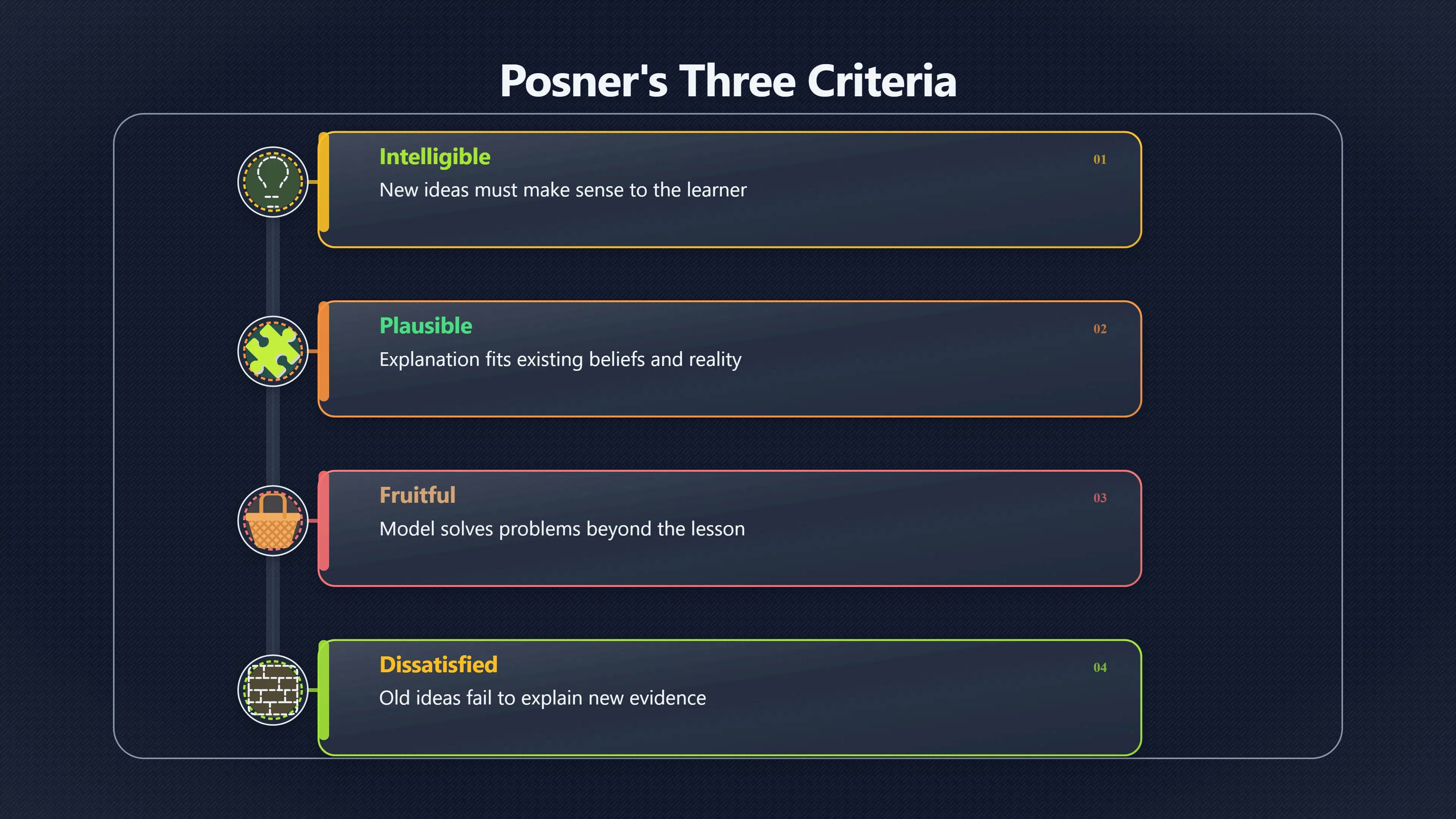
 Research on conceptual change has repeatedly shown that learners do not simply store scientific facts alongside existing beliefs. They interpret new information through what they already think they know. For a correction to last, the new explanation must become more useful than the old one: clearer, more convincing and more powerful across different situations. Posner and colleagues famously argued that successful conceptual change depends on learners finding a new conception intelligible, plausible and fruitful.[eClass UOA]eclass.uoa.grUsually scientific work is doneAccommodation of a scientific conception: Toward a theory…August 22, 2006 — by GJ POSNER · Cited by 10835 — Contemporary vie…[Eurasia Journal]ejmste.coman overview of conceptual changetheories 4082Posner et al. (1982), the scientific conception must also be intelligible, plausible, and fruitful for successful conceptual change to occur…
Why Corrections Need Better Explanations
Many misconceptions survive because they explain something real, even if the explanation is scientifically wrong.
A student who believes heavier objects fall faster is trying to account for everyday observations. A stone does seem to reach the ground before a feather. Simply stating that all objects accelerate equally under gravity leaves an explanatory gap. The learner still has a working story for what they see and no equally usable replacement for interpreting the world.
Conceptual change research has consistently found that learners evaluate new ideas partly by whether those ideas help them make sense of problems. A scientific explanation must therefore do more than contradict an existing belief. It must offer a stronger way of understanding observations, predictions and relationships. Posner’s framework describes this as fruitfulness: the new conception should help solve problems and generate successful explanations beyond the immediate lesson. Eurasia Journal[2eClass UOA]eclass.uoa.grUsually scientific work is doneAccommodation of a scientific conception: Toward a theory…August 22, 2006 — by GJ POSNER · Cited by 10835 — Contemporary vie…
This is why some corrections appear successful during assessment but disappear later. Students may memorise the accepted answer without adopting the underlying model. In effect, they possess two explanations at once: the school answer and the personal explanation. Depending on the context, they switch between them. Research has noted that learners can use scientific language in formal settings while reverting to intuitive beliefs in everyday reasoning.[IJIET]ijiet.orgAnalyzing with Posner's Conceptual Change Model and…Therefore, how to enhance students' conceptual knowledge to the ―plausible‖ o…
The key implementation question is not whether students can repeat the correct statement. It is whether the new explanation has become their preferred tool for understanding phenomena.
What a Replacement Explanation Must Do
A replacement explanation becomes durable when it performs functions that the misconception previously performed.
It must explain the original observations
Students need to see how the scientific account handles the evidence that originally supported their misconception.
Consider seasonal change. The “Earth is closer to the Sun in summer” explanation fits everyday experience because distance from a heat source usually affects temperature. A successful replacement does not merely say this idea is wrong. It shows how axial tilt changes sunlight angle and day length, and how those factors produce seasonal temperature patterns more effectively than distance does.
The scientific model therefore absorbs the observations that once supported the misconception while explaining additional evidence that the misconception cannot handle.
It must work across multiple examples
A replacement explanation becomes stronger when students can use it repeatedly.
For example, understanding electric current as a conserved flow rather than something “used up” in circuit components helps explain bulb brightness, parallel circuits, battery behaviour and current measurements. The new model becomes attractive because it solves a growing range of problems.
Posner’s description of a fruitful conception captures this point. Students are more likely to adopt an explanation when it proves useful beyond a single question or demonstration. Eurasia Journal[2eClass UOA]eclass.uoa.grUsually scientific work is doneAccommodation of a scientific conception: Toward a theory…August 22, 2006 — by GJ POSNER · Cited by 10835 — Contemporary vie…
It must fit a coherent network of ideas
Misconceptions rarely exist in isolation.
A learner’s ideas about force, motion and energy often support one another. Replacing a single belief may require showing how the new explanation connects with a broader scientific framework.
Research on conceptual ecology emphasises that concepts sit within larger systems of beliefs and assumptions. A replacement explanation therefore succeeds more often when students can see how it links to other scientific ideas they already trust. Eurasia Journal[2eClass UOA]eclass.uoa.grUsually scientific work is doneAccommodation of a scientific conception: Toward a theory…August 22, 2006 — by GJ POSNER · Cited by 10835 — Contemporary vie…
Why Memorised Facts Collapse in New Contexts
One of the clearest signs that conceptual change has not occurred is failure to transfer knowledge.
Students may correctly answer a familiar textbook question yet struggle when the same concept appears in a different form. This happens because factual recall and explanatory understanding are not the same thing.
The National Research Council’s synthesis of learning research argued that students can learn information for tests while still relying on prior conceptions outside the classroom. If those original ideas remain active, they often re-emerge when the learner encounters a novel situation.[San Diego County Office of Education]sdcoe.netSan Diego County Office of EducationKey Findings from How People LearnA fundamental insight about learning is that new understandings are…
A common example appears in mechanics. Students may learn the statement that objects continue moving without a force. Yet when asked to predict what happens after a thrown ball leaves a hand, many still reason as if motion requires a continuing push. The memorised fact exists, but the underlying explanatory model has not been replaced.
This pattern helps explain why misconceptions often seem “fixed” during instruction and then return months later. The scientific answer has been stored, but the intuitive explanation remains cognitively useful.
Research on prior knowledge suggests that learning depends heavily on how new information is integrated into existing mental structures. When the new information remains disconnected, transfer is weak and misconceptions persist beneath the surface. [EEF]
The problem of parallel explanations
Students frequently maintain two competing explanations.
They may know that natural selection involves differential survival and reproduction, yet still describe evolution as organisms deliberately changing because they “need” a trait. They may know that particles are in constant motion, yet continue imagining diffusion as individual particles deciding where to go.
Conceptual change researchers have noted that learners often alternate between intuitive and scientific frameworks depending on the context. The goal is therefore not merely introducing a scientific explanation but making it the explanation students reach for first.[IJIET]ijiet.orgAnalyzing with Posner's Conceptual Change Model and…Therefore, how to enhance students' conceptual knowledge to the ―plausible‖ o…
Revisiting the Same Concept Across Cases
Replacement explanations become stable when learners use them repeatedly across varied situations.
A single successful lesson rarely creates lasting conceptual change. Students need opportunities to test the same explanatory model in different settings, including settings that do not obviously resemble one another.
For example, a process-based understanding of heat transfer becomes stronger when students apply it to metal spoons, house insulation, weather systems and biological temperature regulation. The concept stops being tied to one classroom example and becomes a general explanatory resource.
Research on conceptual change increasingly emphasises transfer, application and knowledge restructuring rather than one-off correction events. Learners need repeated opportunities to recognise that the same scientific principle can organise many different phenomena.[PagePlace]api.pageplace.deInternational Handbook of Research on Conceptual ChangeConceptual change research investigates the processes through which learn…[Cambridge University Press & Assessment]cambridge.orgCambridge University Press & AssessmentA History of Conceptual Change Research (Chapter 6)Effective learning requires conceptual change…
Revisiting through prediction
Prediction tasks are especially powerful because they force students to use their explanatory model.
When learners predict an outcome before observing it, they reveal which explanation they genuinely trust. If the scientific model repeatedly produces better predictions than the misconception, the new explanation gains credibility.
This process matters because conceptual change is partly about usefulness. Students are more likely to retain an explanation that consistently helps them anticipate what will happen.
Revisiting through representations
Scientific ideas also need to survive movement between representations.
Students may understand a concept verbally but fail when they encounter a graph, diagram, simulation or real-world scenario. A durable replacement explanation should work across all of these forms.
For instance, understanding seasons requires interpreting globes, sunlight diagrams, maps, temperature patterns and observations from different hemispheres. Each representation provides another opportunity to strengthen the scientific model and weaken reliance on the earlier misconception.
Why Better Explanations Outcompete Old Ones
The most successful science corrections do not simply attack misconceptions. They make those misconceptions unnecessary.
When learners discover that a scientific explanation accounts for more evidence, predicts more accurately and works across more contexts, the old explanation gradually loses value. The replacement becomes the easier and more productive way to think.
This is why conceptual change is often described as reconstruction rather than correction. Learners are not merely deleting information. They are adopting a new explanatory system that helps them understand the world more effectively. Research from conceptual change traditions consistently points to this shift: lasting learning occurs when the new conception is not only accepted but becomes the learner’s preferred framework for reasoning, prediction and explanation.[PagePlace]api.pageplace.deInternational Handbook of Research on Conceptual ChangeConceptual change research investigates the processes through which learn…[Eurasia Journal]ejmste.coman overview of conceptual changetheories 4082Posner et al. (1982), the scientific conception must also be intelligible, plausible, and fruitful for successful conceptual change to occur…[ScienceDirect]sciencedirect.comScienceDirect Conceptual Change TheoryConceptual Change Theory - an overviewFor conceptual change to occur, learners must be dissatisfied with existing conceptions and view sc…
Amazon book picks
Further Reading
Books and field guides related to Why Corrections Need Better Explanations. Use these as the next step if you want deeper reading beyond the article.
Why Don't Students Like School?
Explores how explanations become meaningful knowledge.
How people learn
First published 1999. Subjects: Learning, Psychology of Learning, Research, Social aspects, Social aspects of Learning.
eBay marketplace picks
Marketplace Samples
Example marketplace items related to this page. Use the search link to explore similar finds on eBay.
Endnotes
1.
Source: eclass.uoa.gr
Title: Usually scientific work is done
Link:https://eclass.uoa.gr/modules/document/file.php/PHS122/%CE%91%CF%81%CE%B8%CF%81%CE%B1/Posner_Strike_Hewson_Gertzog.pdf
Source snippet
Accommodation of a scientific conception: Toward a theory...August 22, 2006 — by GJ POSNER · Cited by 10835 — Contemporary vie...
Published: August 22, 2006
2.
Source: sciencedirect.com
Title: ScienceDirect Conceptual Change Theory
Link:https://www.sciencedirect.com/topics/psychology/conceptual-change-theory
Source snippet
Conceptual Change Theory - an overviewFor conceptual change to occur, learners must be dissatisfied with existing conceptions and view sc...
3.
Source: ijiet.org
Link:https://www.ijiet.org/vol6/732-M04.pdf
Source snippet
Analyzing with Posner's Conceptual Change Model and...Therefore, how to enhance students' conceptual knowledge to the ―plausible‖ o...
4.
Source: api.pageplace.de
Link:https://api.pageplace.de/preview/DT0400.9781136578212_A24435677/preview-9781136578212_A24435677.pdf
Source snippet
International Handbook of Research on Conceptual ChangeConceptual change research investigates the processes through which learn...
5.
Source: sciencedirect.com
Title: ScienceDirect How does prior knowledge affect learning?
Link:https://www.sciencedirect.com/science/article/pii/S1041608025001207
Source snippet
A review of 16...by M Schneider · 2025 · Cited by 29 — We give an integrative review of 16 learning processes mediating the effects of p...
6.
Source: cambridge.org
Link:https://www.cambridge.org/core/books/cambridge-handbook-of-the-learning-sciences/history-of-conceptual-change-research/CA7E946570188227A907AD683E2DAC25
Source snippet
Cambridge University Press & AssessmentA History of Conceptual Change Research (Chapter 6)Effective learning requires conceptual change...
7.
Source: sciencedirect.com
Link:https://www.sciencedirect.com/science/article/abs/pii/0959475294900175
Source snippet
A theory of conceptual change for learning science conceptsby MTH Chi · 1994 · Cited by 1951 — The theory of conceptual change in this ar...
8.
Source: ejmste.com
Title: an overview of conceptual changetheories 4082
Link:https://www.ejmste.com/download/an-overview-of-conceptual-changetheories-4082.pdf
Source snippet
Posner et al. (1982), the scientific conception must also be intelligible, plausible, and fruitful for successful conceptual change to occur...
9.
Source: sdcoe.net
Link:https://www.sdcoe.net/ngss/evidence-based-practices/key-findings-from-how-people-learn
Source snippet
San Diego County Office of EducationKey Findings from How People LearnA fundamental insight about learning is that new understandings are...
10.
Source: histoforum.net
Title: Conceptual Change
Link:https://histoforum.net/2020/Conceptual%20Change.pdf
Source snippet
by A van der Kaap — Posner, G.J., Strike, K.A., Hewson, P.W., & Gertzog, W.A. (1982) Accomodation of a scientidic conception: Toward a th...
Additional References
11.
Source: researchoutreach.org
Link:https://researchoutreach.org/wp-content/uploads/2022/04/Patrice-Potvin-1.pdf
Source snippet
Conceptual changeOften referred to as misconceptions, these representations are personal models or theories borrowed or developed by lear...
12.
Source: mrbartonmaths.com
Link:https://mrbartonmaths.com/resourcesnew/8.%20Research/Explicit%20Instruction/How%20Do%20I%20Get%20My%20Students%20Over%20Their%20Alternative%20Conceptions.pdf
Source snippet
How Do I Get My Students Over Their Alternative...by J Lucariello · Cited by 73 — However, several instructional strategies have proven...
13.
Source: peer.asee.org
Title: predictors and mediators of conceptual change a systematic literature review
Link:https://peer.asee.org/predictors-and-mediators-of-conceptual-change-a-systematic-literature-review.pdf
Source snippet
and Mediators of Conceptual Changeby OP Olaogun · 2024 — The process by which misconceptions are remediated or replaced with scientifical...
14.
Source: nationalacademies.org
Link:https://www.nationalacademies.org/read/5287/chapter/5
Source snippet
Descriptions and examples of some common misconceptions in science. Methods to identify misconceptions.Read more...
15.
Source: youtube.com
Link:https://www.youtube.com/watch?v=Jcww5lug7DQ
Source snippet
Conceptual Change Theory and Inquiry LearningConceptual Change Theory which is one particular constructivist referenced approach to teach...
16.
Source: scite.ai
Title: Representation of the conceptual change model in science
Link:https://scite.ai/reports/10.1002/%28SICI%291098-237X%28199606%2980%3A3%3C317%3A%3AAID-SCE3%3E3.0.CO%3B2-H
Source snippet
Abstract: A key principle of the Conceptual Change Model is that before learners can consider the plausibility or fruitfulness of a new c...
17.
Source: educationendowmentfoundation.org.uk
Link:https://educationendowmentfoundation.org.uk/news/eef-blog-ecf-exploring-the-evidence-prior-knowledge-and-pupil-misconceptions
Source snippet
elop misconceptions, particularly if new ideas are introduced too quickly.Read more...
18.
Source: my.chartered.college
Link:https://my.chartered.college/impact_article/misconceptions-p-prims-and-bridging-[analogies
Source snippet
chartered.collegeMisconceptions, p-prims and bridging analogies in Physics...by G Jones — Misconceptions research has been of great net...
19.
Source: apa.org
Link:https://www.apa.org/education-career/k12/misconceptions
Source snippet
s (content knowledge areas) and there is a common set of alternative conceptions...
20.
Source: researchgate.net
Link:https://www.researchgate.net/publication/227102350_Conceptual_change_A_discussion_of_theoretical_methodological_and_practical_challenges_for_science_education
Source snippet
n various other content domains, have played a significant role in research...
Topic Tree