Within Algorithms
Can Angry Replies Help Myths Spread?
Angry replies can make a false post look important to a ranking system even when many users are trying to reject it.
On this page
- How hostile engagement becomes a ranking signal
- Why corrections and rebuttals can feed the same loop
- Design choices that separate attention from endorsement
Page outline Jump by section
Introduction
Can angry replies help myths spread? In many cases, yes. A common assumption is that hostile comments weaken a false claim because they challenge it. Yet on many social platforms, a large volume of comments can also act as a signal that a post is attracting attention. If ranking systems measure engagement more reliably than they measure agreement, a false or misleading post may gain visibility even when much of the audience is arguing against it. The result is a paradox: people trying to correct a myth can sometimes help make it look important, active or relevant to the platforms recommendation system. Research on engagement-driven ranking, outrage, and misinformation repeatedly points to this tension between attention and endorsement.[ScienceDirect]sciencedirect.commisinformation exploits users' impulses to share moral outrage [52]. A combination of anger and disgust, moral outrage is typically exper…[2ifo Institut]ifo.deifo InstitutRanking for Engagement: How Social Media Algorithms…by F Germano Cited by 16 This paper investigates the dynamic feedb…

How hostile engagement becomes a ranking signal
Most large social platforms must decide which of millions of posts deserve additional visibility. To do this, they often rely on behavioural signals such as comments, replies, reactions, shares, watch time and other forms of interaction. These signals are easier to measure than the motive behind them.
A ranking system can usually detect that users are engaging. It may be far less certain whether they are approving, mocking, disputing or warning others. When a false claim attracts hundreds or thousands of angry responses, the platform may register intense activity before it understands the sentiment behind that activity. As a result, the post can appear more relevant than a quieter, more accurate correction.[ifo Institut]ifo.deifo InstitutRanking for Engagement: How Social Media Algorithms…by F Germano Cited by 16 This paper investigates the dynamic feedb…[ScienceDirect]sciencedirect.commisinformation exploits users' impulses to share moral outrage [52]. A combination of anger and disgust, moral outrage is typically exper…
This dynamic is especially powerful because outrage is not passive. People often feel compelled to respond, quote, argue or alert friends. Research on misinformation and moral outrage suggests that emotionally charged content attracts attention and interaction, creating conditions that favour wider circulation.[Science]science.orgMisinformation exploits outrage to spread onlineby KL McLoughlin 2024 Cited by 113 Because outrage is associated with increa…[ScienceDirect]sciencedirect.comRanking for engagement: How social media algorithms fuel…by F Germano 2026 Cited by 14 Social media are at the cent…
A simple example illustrates the mechanism:
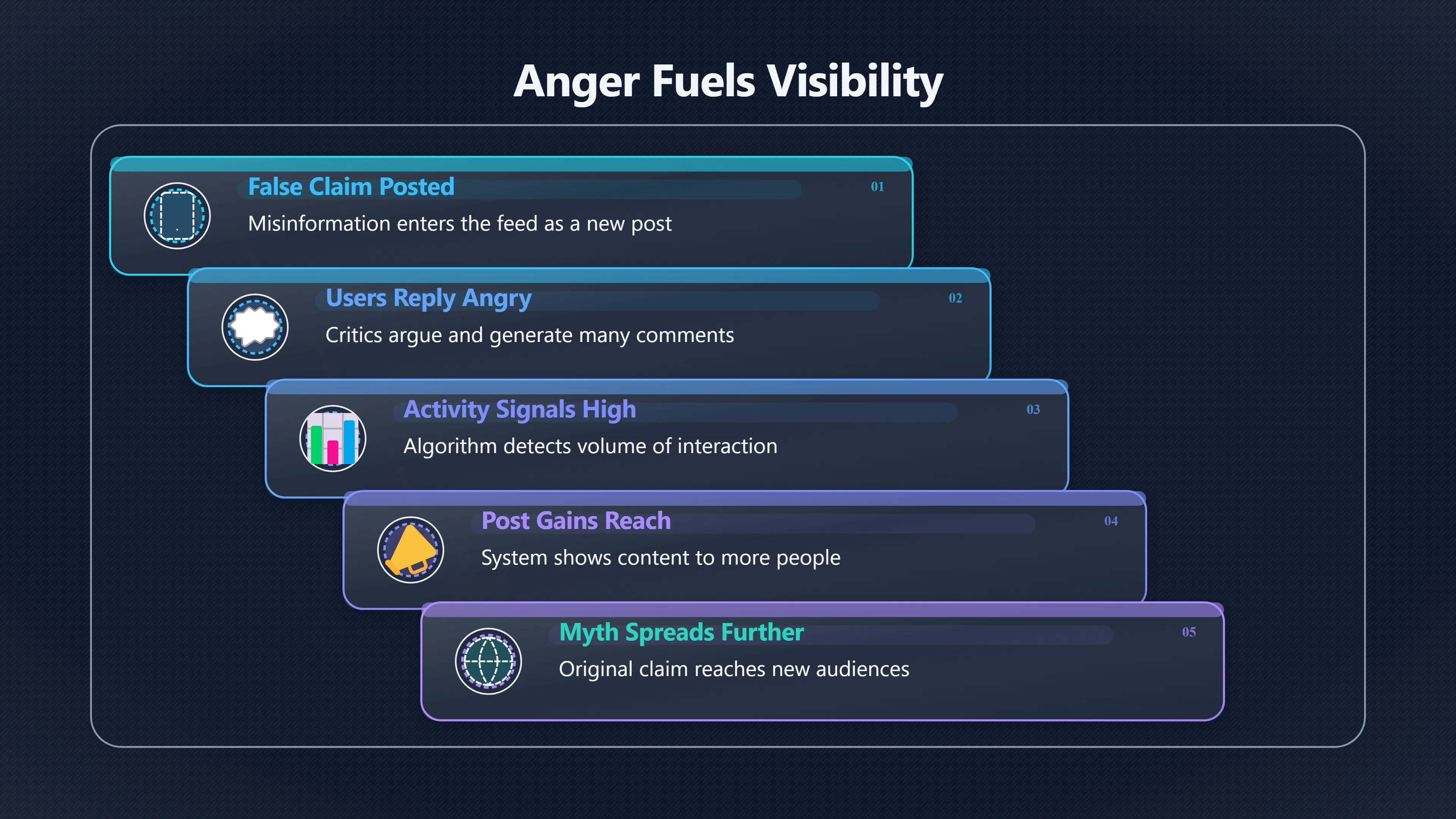
- A false claim is posted.
- Users recognise it as false and reply angrily.
- The growing comment count signals high activity.
- The platform shows the post to more users.
- More users arrive and join the argument.
- Visibility increases further.
The important point is that the algorithm does not necessarily need to believe the claim. It only needs to detect unusually strong engagement.
Why corrections and rebuttals can feed the same loop
The problem is not that corrections are harmful in themselves. Accurate rebuttals remain one of the most important tools against misinformation. The difficulty is that rebuttals often occur in the same engagement space as the original claim.
A correction posted as a reply still adds another interaction. A long argument thread still signals sustained attention. A user quote-posting a myth to condemn it may introduce the claim to an entirely new audience. In engagement-based systems, these actions can contribute to the visibility of the original content even while opposing it.[ifo Institut]ifo.deifo InstitutRanking for Engagement: How Social Media Algorithms…by F Germano Cited by 16 This paper investigates the dynamic feedb…
Research on online behaviour has found that people frequently engage with content they dislike. A 2024 study described a confrontation effect, in which users are often motivated to interact with posts that challenge or anger them rather than simply ignoring them. From a ranking perspective, disagreement can therefore produce many of the same measurable signals as support.[Tulane University News]news.tulane.edurage clicks study shows how political outrage fuels social media engagementTulane University NewsRage clicks: Study shows how political outrage fuels social…9 Oct 2024 A new Tulane University study explains…
This helps explain why myths can appear larger than they really are. A casual observer may encounter a highly active post and infer that it is important, influential or widely believed. In reality, much of the activity may consist of criticism. However, the visibility created by that criticism can still expose more people to the original claim.
An additional complication is that exposure itself matters. Even when readers reject a false statement, repeated encounters can increase familiarity. A claim that constantly reappears in debates, rebuttals and arguments may become more memorable simply because it is seen so often.
Why outrage is especially powerful
Not all engagement is equal. Anger and moral outrage tend to generate rapid, expressive responses.
Researchers studying misinformation have argued that false claims often exploit emotional reactions, particularly outrage directed at perceived wrongdoing. Outrage encourages users to comment immediately, share with others and participate in public disputes. These behaviours generate exactly the forms of activity that engagement-driven systems often reward.[Science]science.orgMisinformation exploits outrage to spread onlineby KL McLoughlin 2024 Cited by 113 Because outrage is associated with increa…
Evidence from platform studies also suggests that engagement-based ranking can disproportionately amplify emotionally charged content. Analyses of social media recommendation systems have found stronger amplification for content expressing anger and intergroup hostility than for calmer material.[Knight First Amendment Institute]knightcolumbia.orgKnight First Amendment InstituteEngagement, User Satisfaction, and the Amplification of…by S Milli Cited by 3 Our study reveals th…
The consequence is not that every angry discussion spreads misinformation. Rather, emotionally charged myths have a built-in advantage in environments where attention is a key ranking input. They provoke reactions from supporters and opponents simultaneously, creating a larger engagement pool than many accurate but less emotionally provocative posts.
A notable example: weighting reactions and comments
Internal documents disclosed during scrutiny of Facebook’s ranking systems drew attention to how engagement signals can unintentionally favour inflammatory content. Reporting based on those documents described periods when certain emotional reactions received substantially greater weighting than a simple like. Internal concerns reportedly noted that posts generating anger often accumulated comments and reactions at unusually high rates, helping them gain prominence in feeds.[The Washington Post]washingtonpost.comhow facebook algorithm worksThe Washington PostHere's how Facebook's algorithm worksOct 26, 2021 [Five points for anger, one for a 'like': How Facebook's formula f…[The Washington Post]washingtonpost.comhow facebook algorithm worksThe Washington PostHere's how Facebook's algorithm worksOct 26, 2021 [Five points for anger, one for a 'like': How Facebook's formula f…
The broader lesson extends beyond any single platform. Whenever ranking systems place substantial weight on interaction volume, emotionally charged myths may gain an advantage because they attract participation from both believers and critics.
Design choices that separate attention from endorsement
The challenge for platforms is distinguishing people are talking about this from people support this.
Several design approaches attempt to reduce the confusion:
- Quality and credibility signals: Ranking systems can include measures of source reliability rather than relying primarily on raw engagement.[Axios]axios.comFacebook to rank news quality as part of fake news fightThis initiative is part of a broader effort to foster meaningful interactions on the platform, moving away from passive content consumpti…
- Downranking disputed content: Platforms may reduce distribution after fact-checks or other trust-and-safety reviews, limiting the effect of engagement alone.
- Sentiment-aware analysis: More sophisticated systems can attempt to distinguish approval from criticism, although this remains technically difficult at scale.
- Reducing the weight of inflammatory reactions: Internal debates at major platforms have centred on whether certain reactions or engagement signals create unintended incentives for provocative content.[The Washington Post]washingtonpost.comhow facebook algorithm worksThe Washington PostHere's how Facebook's algorithm worksOct 26, 2021 [Five points for anger, one for a 'like': How Facebook's formula f…
- Community fact-checking layers: Community notes and similar systems can provide context, although research suggests they may also trigger more negative and outraged replies, highlighting the difficulty of separating corrective behaviour from engagement effects.[arXiv]arxiv.orgSource details in endnotes.
The central design question is whether a platform treats attention as a proxy for value. If comments, replies and reactions are interpreted mainly as evidence of relevance, then outrage can become a visibility engine for myths. If ranking systems better distinguish endorsement from dispute, the incentive for false claims to thrive on angry engagement becomes weaker.
Why this mechanism matters for myths
Many people assume that public criticism naturally suppresses false claims. In social media environments, the relationship is more complicated. A myth does not always benefit because people believe it. Sometimes it benefits because people cannot resist arguing with it.
That distinction matters when evaluating how misinformation spreads. Engagement metrics measure activity, not truth. When ranking systems rely heavily on those metrics, hostile comments can unintentionally help transform a dubious claim from a small falsehood into a widely seen topic. The myth gains reach not because it won the argument, but because it succeeded in capturing attention.[ifo Institut]ifo.deifo InstitutRanking for Engagement: How Social Media Algorithms…by F Germano Cited by 16 This paper investigates the dynamic feedb…[ScienceDirect]sciencedirect.comThe search resultedEmotion detection for misinformation: A reviewby Z Liu 2024 Cited by 110 The specific query used was as follows: (emotion OR sentim…

eBay marketplace picks
Marketplace Samples
Example marketplace items related to this page. Use the search link to explore similar finds on eBay.




Endnotes
1.
Source: sciencedirect.com
Link:https://www.sciencedirect.com/science/article/abs/pii/S2352250X23002154
Source snippet
misinformation exploits users' impulses to share moral outrage [52]. A combination of anger and disgust, moral outrage is typically exper...
2.
Source: ifo.de
Link:https://www.ifo.de/en/cesifo/publications/2026/working-paper/ranking-engagement-how-social-media-algorithms-fuel-misinformation
Source snippet
ifo InstitutRanking for Engagement: How Social Media Algorithms...by F Germano Cited by 16 This paper investigates the dynamic feedb...
3.
Source: sciencedirect.com
Link:https://www.sciencedirect.com/science/article/pii/S0047272726000253
Source snippet
Ranking for engagement: How social media algorithms fuel...by F Germano 2026 Cited by 14 Social media are at the cent...
4.
Source: arxiv.org
Link:https://arxiv.org/abs/2509.18440
5.
Source: news.tulane.edu
Title: rage clicks study shows how political outrage fuels social media engagement
Link:https://news.tulane.edu/pr/rage-clicks-study-shows-how-political-outrage-fuels-social-media-engagement
Source snippet
Tulane University NewsRage clicks: Study shows how political outrage fuels social...9 Oct 2024 A new Tulane University study explains...
6.
Source: time.com
Link:https://time.com/6097704/facebook-instagram-wall-street-journal/
Source snippet
The "Facebook Files" exposes several critical issues: an internal program known as XCheck exempts high-profile users from moderation rule...
7.
Source: axios.com
Title: Facebook to rank news quality as part of [fake news]({{ ‘fake-news/’ | relative_url }}) fight
Link:https://www.axios.com/2018/01/19/facebook-to-rank-news-quality-1516395007
Source snippet
This initiative is part of a broader effort to foster meaningful interactions on the platform, moving away from passive content consumpti...
8.
Source: arxiv.org
Link:https://arxiv.org/abs/2409.08829
Source snippet
Community Fact-Checks Trigger Moral Outrage in Replies to Misleading Posts on Social MediaSeptember 13, 2024...
Published: September 13, 2024
9.
Source: facebook.com
Link:https://www.facebook.com/groups/2204512110/posts/10160435540082111/
Source snippet
that divisive, anger-provoking content generates massive...Read more...
10.
Source: facebook.com
Link:https://www.facebook.com/
Source snippet
log in or sign upCreate an account or log into Facebook. Connect with friends, family and other people you know. Share photos...
11.
Source: facebook.com
Link:https://www.facebook.com/NorthwesternU/posts/a-mix-of-content-in-your-feed-means-less-toxicity-engagement-based-algorithms-am/1422786266543360/
Source snippet
ify outrage and toxic political content...
12.
Source: facebook.com
Link:https://www.facebook.com/Prof.Yuval.Noah.Harari/posts/social-media-algorithms-quickly-learned-how-to-drive-engagement-hate-fear-and-an/1486183576197817/
Source snippet
nger... misinformation, outrage, and fear. The platforms'...Read more...
13.
Source: facebook.com
Title: ‘s algorithms predicting real-life interactions Ok
Link:https://www.facebook.com/groups/1143251116647159/posts/1367315594240709/
Source snippet
Facebook's algorithms are getting scary. Less than an hour after I responded to a post regarding unusual aspects of socially interacting...
14.
Source: facebook.com
Link:https://www.facebook.com/groups/dullmensclub/posts/1359098968079974/
Source snippet
uld not advise doing this long-term as that way lies madness.Read more...
15.
Source: sciencedirect.com
Title: The search resulted
Link:https://www.sciencedirect.com/science/article/pii/S1566253524000782
Source snippet
[Emotion]({{ 'emotion/' | relative_url }}) detection for misinformation: A reviewby Z Liu 2024 Cited by 110 The specific query used was as follows: (emotion OR sentim...
16.
Source: ifo.de
Title: cesifo1 wp10011
Link:https://www.ifo.de/DocDL/cesifo1_wp10011.pdf
Source snippet
CESifo Working Paper No. 10011by F Germano Cited by 16 Social media are at the center of countless debates on polarization, misinform...
17.
Source: science.org
Link:https://www.science.org/doi/10.1126/science.adl2829
Source snippet
Misinformation exploits outrage to spread onlineby KL McLoughlin 2024 Cited by 113 Because outrage is associated with increa...
18.
Source: knightcolumbia.org
Link:https://knightcolumbia.org/content/engagement-user-satisfaction-and-the-amplification-of-divisive-content-on-social-media
Source snippet
Knight First Amendment InstituteEngagement, User Satisfaction, and the Amplification of...by S Milli Cited by 3 Our study reveals th...
19.
Source: washingtonpost.com
Title: how facebook algorithm works
Link:https://www.washingtonpost.com/technology/interactive/2021/how-facebook-algorithm-works/
Source snippet
The Washington PostHere's how Facebook's algorithm worksOct 26, 2021 [Five points for anger, one for a 'like': How Facebook's formula f...
20.
Source: washingtonpost.com
Link:https://www.washingtonpost.com/technology/2021/10/26/facebook-angry-emoji-algorithm/
Source snippet
The Washington PostFive points for anger, one for a 'like': How Facebook's...26 Oct 2021 Starting in 2017, Facebook's ranking algorith...
21.
Source: Wikipedia
Link:https://en.wikipedia.org/wiki/Facebook
Source snippet
FacebookFacebook is an American social networking service owned by the American technology conglomerate Meta Platforms. It was founded...
Additional References
22.
Source: niemanlab.org
Link:https://www.niemanlab.org/2021/10/more-internal-documents-show-how-facebooks-algorithm-prioritized-anger-and-posts-that-triggered-it/
Source snippet
misinformation, spam, or forms of clickbait.... Facebook's reaction to this latest finding linking its algorithm and the prioritizing a...
23.
Source: pmc.ncbi.nlm.nih.gov
Link:https://pmc.ncbi.nlm.nih.gov/articles/PMC11894805/
Source snippet
by S Milli 2025 Cited by 235 11381142. 17. Srba I, et al. 2023. Auditing YouTube's recommendation algorithm for misinformation...
24.
Source: library.hbs.edu
Title: hate spreads faster on twitter evidence from 44 news outlets
Link:https://www.library.hbs.edu/working-knowledge/hate-spreads-faster-on-twitter-evidence-from-44-news-outlets
Source snippet
Spreads Faster on Twitter: Evidence from 44 News...13 Jul 2021 Social networks have used a similar notification strategy to stem misin...
25.
Source: wsj.com
Title: Facebook Tried to Make Its Platform a Healthier Place
Link:https://www.wsj.com/tech/facebook-algorithm-change-zuckerberg-11631654215
Source snippet
Sep 15, 2021 ... algorithm to reward outrage and lies. Mr. Zuckerberg resisted some... MSI ranking isn't actually rewarding content t...
26.
Source: bse.eu
Title: Ranking for Engagement: How Social Media Algorithms
Link:https://bse.eu/research/working-papers/ranking-for-engagement-how-social-media-algorithms-fuel-misinformation-and-polarization
Source snippet
Social media are at the center of countless debates on polarization, misinformation, and even the state of democracy in various parts of...
27.
Source: emerald.com
Link:https://www.emerald.com/oir/article/46/3/422/318338/Prevalence-of-anger-engaged-in-sadness-engagement
Source snippet
e., emotional tweets) and different information types (i.e., misinformation...
28.
Source: medium.com
Link:https://medium.com/%40jcai9638/the-wrathful-algorithm-how-facebook-and-youtube-amplify-user-anger-for-traffic-and-profit-f1b6f9a0d49f
Source snippet
This implies the algorithm favours posts that stir...Read more...
29.
Source: reddit.com
Link:https://www.reddit.com/r/science/comments/1ot7opj/a_study_finds_that_flagging_misinformation_on/
Source snippet
impossible to combat, which is itself disinformation...
30.
Source: tandfonline.com
Link:https://www.tandfonline.com/doi/full/10.1080/10584609.2024.2350416
Source snippet
misinformation. A particular case is Donald Trump, who, as a... Research has established that emotions such as anger and anxiety can inc...
31.
Source: econstor.eu
Title: cesifo1 wp10011
Link:https://www.econstor.eu/bitstream/10419/338267/1/cesifo1_wp10011.pdf
Source snippet
Ranking for engagement: How social media algorithms fuel...by F Germano 2026 Cited by 16 Social media are at the center of countle...
Topic Tree