Within Teacher Corrections
How Teacher Training Can Keep Myths Gone
Durable correction needs pre-checks, clear refutation, replacement practices, follow-up coaching and audits of old materials.
On this page
- Start with real teaching decisions
- Build correction into planning and coaching
- Audit materials that keep myths alive
Page outline Jump by section
Introduction
Teacher training does not keep myths corrected simply by presenting better information. Educational myths survive because they become embedded in lesson plans, assessment templates, staff discussions, commercial resources and professional habits. Effective training therefore has to do more than debunk a claim once. It must change the decisions teachers make, provide credible alternatives, reinforce those alternatives over time, and remove the organisational structures that allow the myth to reappear. Research on neuromyths, conceptual change and professional learning consistently shows that belief correction is possible, but that gains are often weakened when training ends, materials remain unchanged, or teachers receive no follow-up support.[Frontiers]frontiersin.orgAre refutation-based interventions effective at dispellingterventions to Dispel Neuromyths in Educational Settings…by L Rousseau · 2021 · Cited by 74 — The following questions are e… ScienceDirect The design challenge is therefore a governance challenge as much as a knowledge challenge: how schools[sciencedirect.com]sciencedirect.comCorrecting Neuromyths: A Comparison of Different Types…by MPG Lithander · 2021 · Cited by 40 — Results showed that all th…, training providers and education systems can build correction into ongoing practice rather than treating it as a one-off workshop.

Start With Real Teaching Decisions
Many myth-correction programmes fail because they focus on abstract beliefs rather than everyday teaching choices. Teachers rarely make decisions about “learning styles” or “left-brain learners” in the abstract. They decide how to group pupils, how to design a lesson, which intervention to purchase, or how to explain learning difficulties.
Training is more likely to produce durable change when it begins with these decisions and works backwards. Instead of asking whether participants agree with a statement, trainers can present authentic planning scenarios and ask what action they would take. The misconception is then examined within the context in which it normally influences behaviour.
For example, a session on learning styles should not stop at explaining that matching instruction to a preferred style lacks supporting evidence. It should also address practical questions such as:
- How should teachers respond when pupils say they are “visual learners”?
- How should lessons be adapted for complex content?
- Which evidence-based alternatives should replace learning-style questionnaires?
- How should schools discuss learner differences without creating fixed labels?
This approach matters because reductions in myth endorsement do not automatically translate into changes in intended classroom practice. Researchers reviewing neuromyth interventions have repeatedly identified a gap between corrected beliefs and altered teaching behaviour.[Frontiers]frontiersin.orgAre refutation-based interventions effective at dispellingterventions to Dispel Neuromyths in Educational Settings…by L Rousseau · 2021 · Cited by 74 — The following questions are e…
Pre-check Existing Assumptions
Strong training begins by identifying which myths are already influencing decisions. This serves two purposes.
First, it reveals whether participants actually hold the misconception. Second, it surfaces the specific reasoning that supports it. Different teachers may endorse the same myth for different reasons.
A teacher who believes in learning styles because pupils express preferences requires a different corrective explanation from a teacher who encountered the concept during initial teacher education. Studies suggest that myths often spread through teacher preparation programmes, instructional materials, peer networks and popular educational media rather than through direct engagement with research.[ScienceDirect]sciencedirect.comCorrecting Neuromyths: A Comparison of Different Types…by MPG Lithander · 2021 · Cited by 40 — Results showed that all th…
Diagnostic activities, short surveys and planning discussions therefore become part of the correction process rather than merely a way of measuring outcomes.
Build Correction Into Planning and Coaching
A recurring finding in misconception research is that correction is strongest when it combines explicit refutation with a replacement explanation. Simply saying that a belief is wrong leaves a gap that the original myth can easily reoccupy. Refutation-based approaches work best when they explain why the myth is appealing, identify the error and provide a more accurate model of learning.[Frontiers]frontiersin.orgAre refutation-based interventions effective at dispellingterventions to Dispel Neuromyths in Educational Settings…by L Rousseau · 2021 · Cited by 74 — The following questions are e…
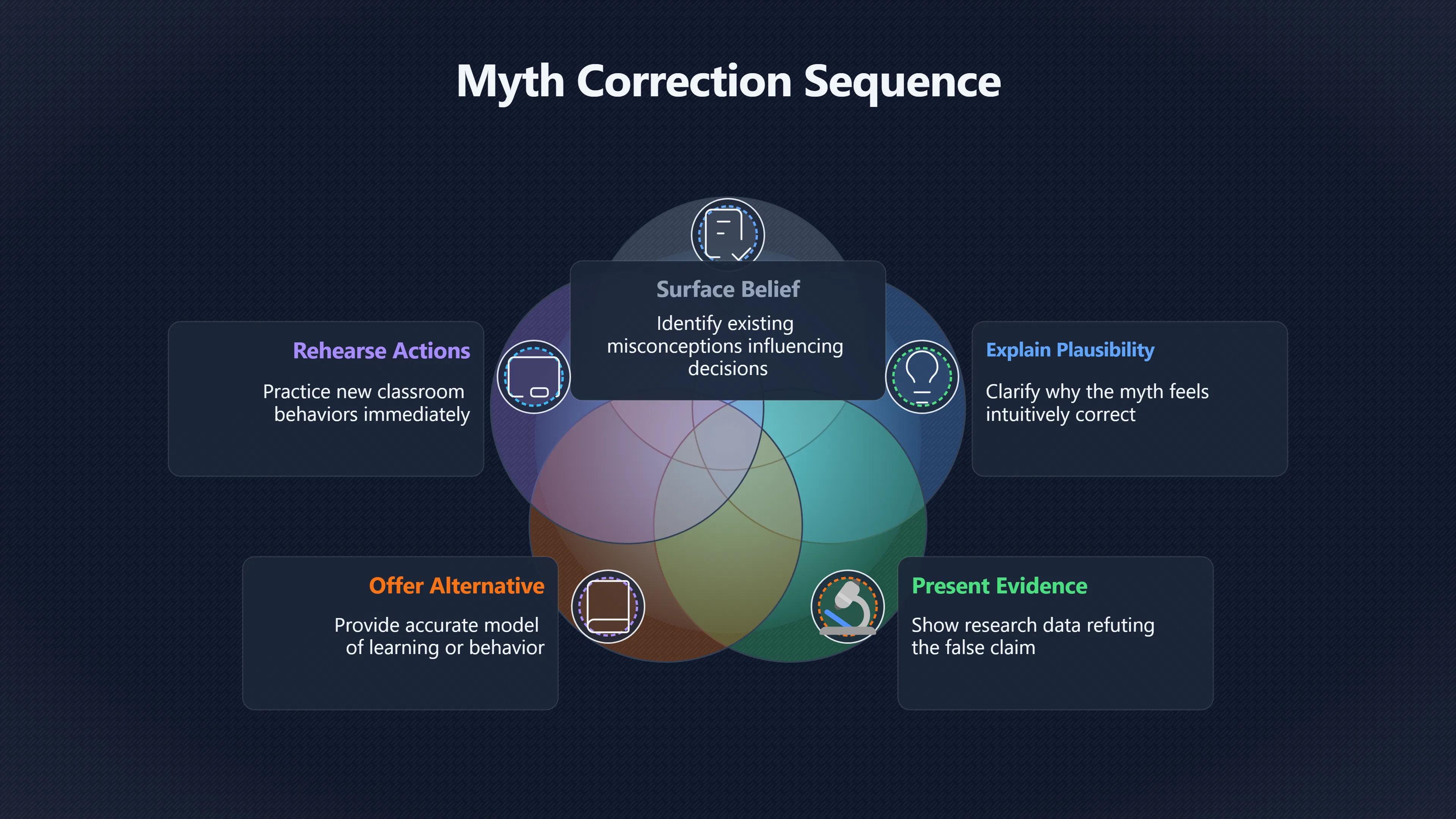
Teacher training should therefore follow a structured sequence:
- Surface the misconception.
- Explain why it appears plausible.
- Present the evidence against it.
- Offer an alternative explanation.
- Rehearse alternative classroom actions.
- Revisit the issue after implementation.
Research on refutation texts and neuromyth correction shows that this structure can reduce false beliefs for weeks or months after training, although reinforcement remains important.[ScienceDirect]sciencedirect.comCorrecting Neuromyths: A Comparison of Different Types…by MPG Lithander · 2021 · Cited by 40 — Results showed that all th…
Move From Workshops to Coaching Cycles
The most important design shift is to treat correction as an ongoing coaching issue rather than a single training event.
After an initial session, coaches, mentors or instructional leaders can review lesson plans, observe classrooms and discuss whether old assumptions have reappeared. This matters because intuitive explanations are often resilient even after teachers can correctly answer survey questions. Studies have found that corrected misconceptions may continue to influence reasoning despite explicit feedback and improved factual knowledge.[PMC]pmc.ncbi.nlm.nih.govby MPG Lithander · 2024 · Cited by 3 — The results demonstrate that feedback can be used to update beliefs in neuromyths, but these be…
Effective coaching questions include:
- What evidence supports this instructional choice?
- What alternative explanation of learning is guiding the lesson?
- Are any pupil labels driving expectations?
- Which research-informed strategy has replaced the previous practice?
The goal is not surveillance but reinforcement. Repeated retrieval of the corrected explanation strengthens the likelihood that it becomes the default interpretation when teachers encounter future claims.
Use Spaced Reinforcement
Belief correction should be revisited over time rather than concentrated into a single session.
Research on educational misconceptions suggests that immediate improvements are common but can fade. Reviews of neuromyth interventions note that short-term gains often require continuing support if they are to remain stable.[Frontiers]frontiersin.orgAre refutation-based interventions effective at dispellingterventions to Dispel Neuromyths in Educational Settings…by L Rousseau · 2021 · Cited by 74 — The following questions are e…
Practical reinforcement mechanisms include:
- Follow-up discussions several weeks after training.
- Short myth-check activities during staff meetings.
- Evidence updates embedded into professional learning communities.
- Reflection prompts linked to lesson planning.
- Periodic re-assessment of common misconceptions.
The objective is to normalise evidence checking as part of professional culture rather than as a special intervention.

Audit Materials That Keep Myths Alive
One of the strongest reasons myths persist is that organisations often continue distributing materials that contain them.
A school may train staff to abandon learning styles while simultaneously providing planning templates that ask teachers to identify visual, auditory and kinaesthetic learners. Teacher education programmes may discuss evidence-based instruction while assigning readings that repeat unsupported claims.
Several studies have highlighted the continuing presence of myths in teacher preparation, training materials and educational discourse, helping explain why misconceptions remain widespread despite years of criticism.[Education Next]educationnext.orgEducation NextThe Stubborn Myth of “Learning Styles”April 7, 2020 — 7 Apr 2020 — There is no evidence that designing lessons that appeal…[nature]nature.comEducational myths among teachers: prevalence and…by Y Tunga · 2025 · Cited by 1 — Results indicated that educational myths are common… A durable correction strategy therefore includes a systematic audit.
Identify High-Risk Documents
Priority targets include:
- Induction materials.
- Professional development slides.[facebook.com]facebook.comght as fact in teacher education and professional development and even…
- Intervention purchasing guides.
- Lesson-planning templates.
- Observation rubrics.
- Behaviour and inclusion guidance.
- Assessment documentation.
The purpose is not merely to remove incorrect statements. It is to identify where organisational processes still assume the myth is true.
For example, if a school abandons learning styles, associated pupil categorisation forms should disappear as well. If teachers are taught that ability is malleable, performance-management systems should avoid language that reinforces fixed assumptions about learners.

Create Approved Replacements
Removing a myth without replacing the underlying tool can create confusion.
Every retired practice should be paired with a preferred alternative. If a learning-styles inventory is withdrawn, teachers need guidance on evidence-informed approaches such as retrieval practice, dual coding where appropriate, explicit instruction, formative assessment or adaptive support based on demonstrated learning needs rather than presumed styles.[EEF]educationendowmentfoundation.org.ukthe learning needs of young people. Instead…Read more…
Replacement resources make it easier for teachers to act on corrected knowledge and reduce pressure to revert to familiar habits.
Make Evidence Evaluation Part of Professional Culture
The most resilient correction programmes do not focus solely on individual myths. They strengthen teachers’ ability to evaluate future claims.
This is important because educational myths change over time. A school that successfully addresses learning styles may later encounter unsupported claims about brain training, commercial interventions or exaggerated interpretations of neuroscience.
Research suggests that greater exposure to neuroscience, cognitive psychology and evidence-informed professional learning can reduce susceptibility to some misconceptions, although knowledge alone is not sufficient. PMC[My College]my.chartered.collegechartered.collegeTeachers' understanding of neuromyths: A role for…20 Sept 2022 — Debunking neuromyths through training in educational…
Training should therefore include routines such as:
- Examining the quality of evidence behind educational claims.
- Distinguishing research findings from marketing language.
- Checking whether effects have been replicated.
- Looking for plausible mechanisms rather than persuasive anecdotes.
- Asking what evidence would change one’s mind.
Importantly, evidence evaluation should be linked to actual school decisions rather than taught as a generic critical-thinking exercise. Research examining neuromyth correction suggests that broad appeals to “think critically” are less effective than targeted engagement with specific claims and evidence.[niot.org.uk]niot.org.ukneuromyths in the classroom and the role of critical thinkingHalf the group received basic…
What Successful Training Looks Like
Teacher training that keeps myths gone is characterised by five linked features:
- It begins with real instructional decisions rather than abstract beliefs.
- It uses explicit refutation and replacement explanations.
- It embeds correction into coaching and planning routines.
- It audits and updates materials that continue to transmit myths.
- It develops ongoing evidence-evaluation habits across the organisation.
When these elements operate together, correction becomes part of institutional practice rather than a temporary change in opinion. That shift—from myth debunking to system redesign—is what gives educational corrections their best chance of lasting.[dash.harvard.edu]dash.harvard.eduDispelling the Myth: Training in Education or Neuroscience…by K Macdonald · 2017 · Cited by 455 — The goal of this study was to provid…[Frontiers]frontiersin.orgAre refutation-based interventions effective at dispellingterventions to Dispel Neuromyths in Educational Settings…by L Rousseau · 2021 · Cited by 74 — The following questions are e…[ScienceDirect]sciencedirect.comCorrecting Neuromyths: A Comparison of Different Types…by MPG Lithander · 2021 · Cited by 40 — Results showed that all th…
Amazon book picks
Further Reading
Books and field guides related to How Teacher Training Can Keep Myths Gone. Use these as the next step if you want deeper reading beyond the article.
Why Don't Students Like School?
Useful foundation for myth-resistant teacher training.
Teach Like a Champion 3.0
Demonstrates how training translates into classroom routines.
eBay marketplace picks
Marketplace Samples
Example marketplace items related to this page. Use the search link to explore similar finds on eBay.



Endnotes
1.
Source: sciencedirect.com
Link:https://www.sciencedirect.com/science/article/abs/pii/S2211368121000140
Source snippet
Correcting Neuromyths: A Comparison of Different Types...by MPG Lithander · 2021 · Cited by 40 — Results showed that all th...
2.
Source: pmc.ncbi.nlm.nih.gov
Link:https://pmc.ncbi.nlm.nih.gov/articles/PMC11508907/
Source snippet
by MPG Lithander · 2024 · Cited by 3 — The results demonstrate that feedback can be used to update beliefs in neuromyths, but these be...
3.
Source: sciencedirect.com
Link:https://www.sciencedirect.com/science/article/abs/pii/S2211949324000164
Source snippet
Where did pre-service teachers, teachers, and the general...by LSR Sazaka · 2024 · Cited by 12 — Participants showed over 5...
4.
Source: nature.com
Link:https://www.nature.com/articles/s41599-025-05470-y
Source snippet
Educational myths among teachers: prevalence and...by Y Tunga · 2025 · Cited by 1 — Results indicated that educational myths are common...
5.
Source: educationendowmentfoundation.org.uk
Link:https://educationendowmentfoundation.org.uk/education-evidence/teaching-learning-toolkit/learning-styles
Source snippet
the learning needs of young people. Instead...Read more...
6.
Source: pmc.ncbi.nlm.nih.gov
Link:https://pmc.ncbi.nlm.nih.gov/articles/PMC5366351/
Source snippet
nih.govEvidence-Based Higher Education – Is the Learning Styles...by PM Newton · 2017 · Cited by 470 — The basic idea behind the use of...
7.
Source: pmc.ncbi.nlm.nih.gov
Link:https://pmc.ncbi.nlm.nih.gov/articles/PMC9312647/
Source snippet
by RA Ferreira · 2022 · Cited by 51 — Overall, these results suggest that the SoL course significantly improved overall neuroscience l...
8.
Source: niot.org.uk
Title: neuromyths in the classroom and the role of critical thinking
Link:https://niot.org.uk/insights/neuromyths-in-the-classroom-and-the-role-of-critical-thinking
Source snippet
Half the group received basic...
9.
Source: sciencedirect.com
Link:https://www.sciencedirect.com/science/article/abs/pii/S2211949325000183
Source snippet
Belief in neuromyths among primary school teachersby OC Adiguzel · 2025 · Cited by 2 — The persistence of neuromyths among teachers under...
10.
Source: dash.harvard.edu
Link:https://dash.harvard.edu/bitstreams/7312037e-932b-6bd4-e053-0100007fdf3b/download
Source snippet
Dispelling the Myth: Training in Education or Neuroscience...by K Macdonald · 2017 · Cited by 455 — The goal of this study was to provid...
11.
Source: frontiersin.org
Title: Are refutation-based interventions effective at dispelling
Link:https://www.frontiersin.org/journals/psychology/articles/10.3389/fpsyg.2021.719692/full
Source snippet
terventions to Dispel Neuromyths in Educational Settings...by L Rousseau · 2021 · Cited by 74 — The following questions are e...
12.
Source: educationnext.org
Link:https://www.educationnext.org/stubborn-myth-learning-styles-state-teacher-license-prep-materials-debunked-theory/
Source snippet
Education NextThe Stubborn Myth of “Learning Styles”April 7, 2020 — 7 Apr 2020 — There is no evidence that designing lessons that appeal...
Published: April 7, 2020
13.
Source: my.chartered.college
Link:https://my.chartered.college/impact_article/teachers-understanding-of-neuromyths-a-role-for-educational-neuroscience-in-teacher-training/
Source snippet
chartered.collegeTeachers' understanding of neuromyths: A role for...20 Sept 2022 — Debunking neuromyths through training in educational...
Additional References
14.
Source: scispace.com
Link:https://scispace.com/pdf/educational-neuromyths-and-instructional-practices-the-case-12ess1im50.pdf
Source snippet
Educational Neuromyths and Instructional PracticesMany studies report that those educational neuromyths which are prevailing among teache...
15.
Source: innerdrive.co.uk
Link:https://www.innerdrive.co.uk/blog/combat-neuromyths/
Source snippet
Neuromyths and how to combat them: An educator's guideNeuromyths are misconceptions about how the brain functions and learns. These myths...
16.
Source: efsupit.ro
Link:https://efsupit.ro/images/stories/july2024/Art%20190.pdf
Source snippet
Abstract: Neuromyths are misconceptions arising from misinterpreted or biased data, often lacking scientific evidence and.Read more...
17.
Source: facebook.com
Title: dispelling the myth training in education or neuroscience decreases but does not
Link:https://www.facebook.com/SmartSpeechTherapyLlc/posts/dispelling-the-myth-training-in-education-or-neuroscience-decreases-but-does-not/10156401242212290/
Source snippet
Dispelling the Myth: Training in Education or Neuroscience...27 May 2018 — Intervention results are variable: One research group found t...
Published: May 2018
18.
Source: lthechat.com
Title: 186 debunking neuromyths in education what psychology really tells us
Link:https://lthechat.com/2020/10/11/lthechat186-debunking-neuromyths-in-education-what-psychology-really-tells-us/
Source snippet
#LTHEchat185: Debunking Neuromyths in Education:...11 Oct 2020 — Recent research has suggested that among college-level staff, 97% and 7...
19.
Source: cis.org.au
Title: knowledge is power what do teachers believe about learning
Link:https://www.cis.org.au/publication/knowledge-is-power-what-do-teachers-believe-about-learning/
Source snippet
Knowledge is power: What do teachers believe about...30 Oct 2025 — Specific studies on certain neuromyths such as learning styles and he...
20.
Source: discovery.ucl.ac.uk
Title: Tolmie Issue paper Chartered College of Teaching
Link:https://discovery.ucl.ac.uk/id/eprint/10156236/1/Tolmie_Issue%20paper-Chartered%20College%20of%20Teaching.pdf
Source snippet
ucl.ac.ukTeachers' understanding of neuromyths: A role for educational...by Y Arslan · 2022 · Cited by 9 — Debunking neuromyths through...
21.
Source: facebook.com
Link:https://www.facebook.com/groups/sharingbestpractice/posts/2567351220265040/
Source snippet
ght as fact in teacher education and professional development and even...
22.
Source: facebook.com
Link:https://www.facebook.com/edutopia/posts/-myth-busted-tailoring-instruction-to-students-preferred-learning-styles-has-no-/1040843741414906/
Source snippet
Watch to see what other learning myths it's time to ditch.Read more...
23.
Source: theeffortfuleducator.com
Title: fighting the good fight against neuromyths
Link:https://theeffortfuleducator.com/2019/09/16/fighting-the-good-fight-against-neuromyths/
Source snippet
Fighting the Good Fight...Against Neuromyths16 Sept 2019 — Specifically, the study investigated (1) “the neuromyths held by the trainees...
Topic Tree