Within Fact Checks
When Platforms Reward Myths Over Accuracy
Ranking, recommendation, monetisation, and moderation choices can either amplify myths or make reliable context easier to find.
On this page
- How engagement systems amplify falsehoods
- What context and provenance signals can change
- Why systemic risk rules matter
Page outline Jump by section
Introduction
Fact-checking can correct individual false claims, but it often struggles when the design of a platform rewards the very conditions that allow myths to spread. Ranking systems, recommendation algorithms, advertising models and content-sharing features determine what people see, what gains visibility and which voices attract attention. When those systems prioritise engagement, novelty or emotional reaction over reliability, fact-checks can arrive too late or reach too few people to counter the original claim effectively.
 This is why myths and misconceptions are not only a problem of inaccurate information. They are also a governance problem. The effectiveness of fact-checking depends heavily on whether platforms make reliable context easy to find, slow the spread of dubious content and provide meaningful signals about where information came from. When platform incentives point in the opposite direction, corrections become one tool operating against a much larger system.[Taylor & Francis Online]tandfonline.comTaylor & Francis Online What Is the Problem with Misinformation?Fact-checking as…by O Westlund · 2024 · Cited by 45 — KEYWORDS: Fact-checking · misinformation · disinformation · sociotechnical · pl…
How Engagement Systems Amplify Falsehoods
Modern social platforms rarely show content in simple chronological order. Instead, recommendation systems predict which posts are most likely to generate clicks, comments, shares or watch time. This creates a structural challenge for fact-checking because emotionally charged, surprising or identity-affirming claims often outperform cautious explanations.
Research on misinformation exposure suggests that interventions can reduce harmful content, but their effectiveness declines rapidly if action is delayed until after misinformation has already begun spreading widely. By the time a fact-check appears, many users may already have encountered, shared or remembered the original claim.[OUP Academic]academic.oup.comOUP AcademicMeasuring receptivity to misinformation at scale on a social…by CK Tokita · 2024 · Cited by 19 — Our paper provides a more…
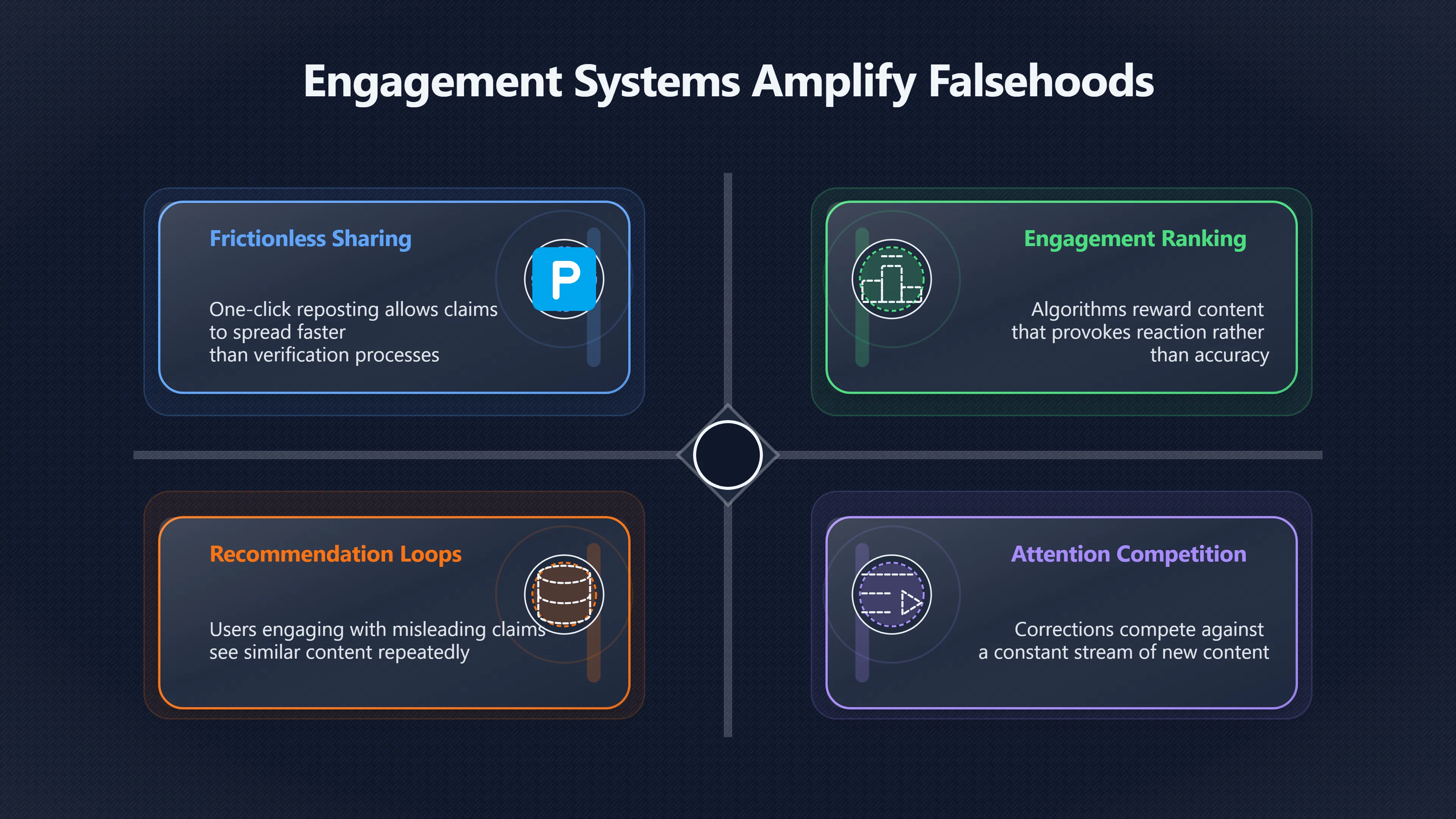
Several design features can weaken corrective efforts:
- Frictionless sharing: One-click reposting allows claims to spread faster than verification processes.
- Engagement-based ranking: Algorithms reward content that provokes reaction rather than accuracy.
- Recommendation loops: Users who engage with one misleading claim may be shown similar content repeatedly.
- Attention competition: Corrections compete against a constant stream of new content rather than appearing in a dedicated verification environment.
The problem is not necessarily that platforms intend to promote misinformation. Rather, systems optimised for engagement can inadvertently reward content characteristics that myths often possess: simplicity, emotional appeal and certainty. Researchers and regulators increasingly describe misinformation as a systemic platform risk rather than merely a collection of false posts.[arXiv]arxiv.orgAuditing Recommender Systems – Putting the DSA into practice with a risk-scenario-based approachFebruary 9, 2023…
Why Labels Alone Often Struggle
Fact-check labels can help, but their impact depends on how they are integrated into platform design.
Past platform experiments found that highly visible warning symbols sometimes produced unintended effects, including reinforcing attention to disputed material. Some companies shifted towards providing additional context and related information instead of relying solely on warning labels.[Time]time.comThe red warning icon, intended to combat misinformation, occasionally reinforced readers' beliefs and led to more sharing of disputed con…
This highlights a broader lesson: fact-checking is not simply about attaching a warning to a post. Its effectiveness depends on whether ranking systems also reduce amplification, whether users encounter corrective information before sharing, and whether trustworthy sources receive greater visibility.
What Context and Provenance Signals Can Change
A major weakness of many online environments is that users often see content detached from its origin. Screenshots, clips and reposted claims can circulate far beyond the context in which they were created. Fact-checkers may eventually identify the source, but platform design can make that source difficult for ordinary users to evaluate.
One response is the development of provenance signals—indicators that help users understand where content came from and whether it has been altered. These include source information, publication history, authenticity metadata and labels for AI-generated media.
Industry initiatives such as the Coalition for Content Provenance and Authenticity (C2PA) seek to create verifiable records attached to digital content. Major platforms have begun experimenting with content credentials and AI-generated content labels.[spec.c2pa.org]spec.c2pa.orgMeta Joins C2PA Steering CommitteeMeta has leveraged C2PA's Content Credentials to inform the labeling of AI images across Facebook, Inst…
However, provenance systems are not a complete solution. Critics note several limitations:
- Metadata may be stripped when content is copied or reposted.
- Users may not notice or understand authenticity indicators.
- Labelling systems can be applied inconsistently.
- Provenance records help establish origin but do not automatically determine whether a claim is true.[The Verge]theverge.comThe Verge Does Big Tech actually care about fighting AI slop?Instagram head Adam Mosseri recently raised concerns about AI eroding authenticity and suggested labeling real media. While C2PA — backed…
Even with these limitations, provenance signals can strengthen fact-checking by reducing ambiguity. When users can quickly identify a source, see whether media has been altered and access contextual information, myths have less opportunity to exploit uncertainty.

Designing for Context Instead of Virality
Platforms can support fact-checking more effectively when they prioritise context at key moments:
- Showing source information before resharing.
- Surfacing related reporting alongside viral claims.
- Providing explanations for why content is being recommended.
- Making corrections visible to audiences who saw the original claim.
- Highlighting trustworthy sources during rapidly evolving events.
These changes do not require platforms to decide every disputed issue themselves. Instead, they alter the information environment so that verification becomes easier and misleading claims gain less advantage from speed and emotional appeal.
Why Systemic-Risk Rules Matter
A growing policy debate asks whether platform governance should focus less on individual pieces of content and more on the systems that distribute them.
The European Union’s Digital Services Act (DSA) reflects this shift. Rather than treating misinformation solely as a moderation problem, the DSA requires very large platforms to assess and mitigate systemic risks associated with their services, including risks connected to information integrity, recommender systems and public discourse. It also introduces transparency requirements around recommendation systems and risk-management processes.[Digital Strategy]digital-strategy.ec.europa.euDigital StrategyThe Digital Services Act | Shaping Europe's digital futureThe Digital Services Act helps to make the online environment s…
This approach recognises a key limitation of fact-checking. If a platform continually promotes misleading material because its ranking system rewards engagement above all else, correcting individual posts may have limited impact. Governance efforts therefore increasingly examine questions such as:
- How are recommendation systems designed?
- What content receives algorithmic amplification?
- How quickly can harmful misinformation spread?
- Are researchers able to study platform effects?
- What evidence exists that mitigation measures work?
The focus shifts from removing every false statement to understanding whether platform architecture systematically increases the visibility of misleading information.[Knight-Georgetown Institute]kgi.georgetown.eduKnight-Georgetown InstituteSystemic Risk Assessment under the Digital Services ActMay 15, 2025 — This brief provides an overview of emerg…
Fact-Checking Works Better When Platforms Change the Incentives
The central lesson is that fact-checking is most effective when supported by platform design rather than expected to compensate for it. A correction can address a specific falsehood, but it cannot easily overcome recommendation systems that repeatedly reward sensational content, sharing mechanisms that favour speed over reflection or interfaces that obscure the origins of information.
When platforms provide stronger context, clearer provenance, more transparent recommendation systems and meaningful safeguards against systemic risks, fact-checking becomes part of a broader information ecosystem rather than a reactive clean-up operation. In that environment, myths face more obstacles before they spread, and reliable information has a better chance of reaching people first.[efcsn.com]efcsn.comPlatforms recognize that disinformation is a big systemic…12 Apr 2025 — The law is clear in the EU: disinformation is a systemic risk…[Digital Strategy]digital-strategy.ec.europa.euDigital StrategyThe Digital Services Act | Shaping Europe's digital futureThe Digital Services Act helps to make the online environment s…[3cmpf.eui.eu]cmpf.eui.euRisk in the Digital Services Act and AI Act: implications for…by E Blog — The DSA places media freedom, pluralism, and disinformation…
Amazon book picks
Further Reading
Books and field guides related to When Platforms Reward Myths Over Accuracy. Use these as the next step if you want deeper reading beyond the article.
The Chaos Machine
'The Chaos Machine is an essential book for our times' - Ezra Klein The Chaos Machine is the story of how the world was driven mad by soc...
Calling Bullshit
Bullshit isn’t what it used to be. Now, two science professors give us the tools to dismantle misinformation and think clearly in a world...
Likewar
Social media has been weaponized, as state hackers and rogue terrorists have seized upon Twitter and Facebook to create chaos and destruc...
The Constitution of Knowledge
Arming Americans to defend the truth from today's war on facts In what could be the timeliest book of the year, Rauch aims to arm his rea...
eBay marketplace picks
Marketplace Samples
Example marketplace items related to this page. Use the search link to explore similar finds on eBay.


Endnotes
1.
Source: academic.oup.com
Link:https://academic.oup.com/pnasnexus/article/3/10/pgae396/7754768
Source snippet
OUP AcademicMeasuring receptivity to misinformation at scale on a social...by CK Tokita · 2024 · Cited by 19 — Our paper provides a more...
2.
Source: arxiv.org
Link:https://arxiv.org/abs/2302.04556
Source snippet
Auditing Recommender Systems -- Putting the DSA into practice with a risk-scenario-based approachFebruary 9, 2023...
Published: February 9, 2023
3.
Source: cmpf.eui.eu
Link:https://cmpf.eui.eu/risk-in-the-digital-services-act-and-ai-act/
Source snippet
Risk in the Digital Services Act and AI Act: implications for...by E Blog — The DSA places media freedom, pluralism, and disinformation...
4.
Source: time.com
Link:https://time.com/5077002/facebook-fake-news-articles/
Source snippet
The red warning icon, intended to combat misinformation, occasionally reinforced readers' beliefs and led to more sharing of disputed con...
5.
Source: spec.c2pa.org
Link:https://spec.c2pa.org/post/meta_pr/
Source snippet
Meta Joins C2PA Steering CommitteeMeta has leveraged C2PA's Content Credentials to inform the labeling of AI images across Facebook, Inst...
6.
Source: arxiv.org
Link:https://arxiv.org/abs/2604.24890
7.
Source: kgi.georgetown.edu
Link:https://kgi.georgetown.edu/research-and-commentary/systemic-risk-assessment-under-the-digital-services-act/
Source snippet
Knight-Georgetown InstituteSystemic Risk Assessment under the Digital Services ActMay 15, 2025 — This brief provides an overview of emerg...
Published: May 15, 2025
8.
Source: arxiv.org
Link:https://arxiv.org/abs/2505.01122
9.
Source: efcsn.com
Link:https://efcsn.com/policy/platforms-recognize-that-disinformation-is-a-big-systemic-risk-now-they-should-act-accordingly/
Source snippet
Platforms recognize that disinformation is a big systemic...12 Apr 2025 — The law is clear in the EU: disinformation is a systemic risk...
10.
Source: eu-digital-services-act.com
Link:https://www.eu-digital-services-act.com/
Source snippet
Efforts to counter disinformation were originally justified as protecting democratic processes and public safety. Over time...Read more...
11.
Source: tandfonline.com
Title: Taylor & Francis Online What Is the Problem with Misinformation?
Link:https://www.tandfonline.com/doi/full/10.1080/1461670X.2024.2357316
Source snippet
Fact-checking as...by O Westlund · 2024 · Cited by 45 — KEYWORDS: Fact-checking · misinformation · disinformation · sociotechnical · pl...
12.
Source: theverge.com
Title: The Verge Does Big Tech actually care about fighting AI slop?
Link:https://www.theverge.com/ai-artificial-intelligence/882956/ai-deepfake-detection-labels-c2pa-instagram-youtube
Source snippet
Instagram head Adam Mosseri recently raised concerns about AI eroding authenticity and suggested labeling real media. While C2PA — backed...
13.
Source: theverge.com
Link:https://www.theverge.com/tech/891933/meta-oversight-board-ai-labels-deepfake-c2pa-facebook-instagram
Source snippet
This criticism follows an investigation into a fake AI-generated video depicting alleged damage in Israel that circulated on Meta's platf...
14.
Source: digital-strategy.ec.europa.eu
Link:https://digital-strategy.ec.europa.eu/en/policies/digital-services-act
Source snippet
Digital StrategyThe Digital Services Act | Shaping Europe's digital futureThe Digital Services Act helps to make the online environment s...
15.
Source: digital-strategy.ec.europa.eu
Title: dsa vlops
Link:https://digital-strategy.ec.europa.eu/en/policies/dsa-vlops
Source snippet
Digital StrategyDSA: Very large online platforms and search engines10 Mar 2026 — The DSA classifies platforms or search engines that have...
16.
Source: facebook.com
Link:https://www.facebook.com/openai/posts/ok-the-first-slide-isnt-real-but-the-second-one-is-weve-added-a-new-tool-to-help/1518870093367929/
Source snippet
OpenAIC2PA, short for Coalition for Content Provenance and Authenticity... Fact-Checking: Encourage fact-checking by referring to reliable...
17.
Source: facebook.com
Link:https://www.facebook.com/globalgoalsUN/posts/combat-global-disinformation-misinformation-and-the-misuse-of-ai-generated-conte/1301886201985777/
Source snippet
c opinion, influence elections, or even create fraudulent...
18.
Source: facebook.com
Link:https://www.facebook.com/WITNESS/posts/the-c2pa-is-developing-a-standard-to-trace-the-authenticity-and-provenance-of-im/10162072761500329/
19.
Source: digital-strategy.ec.europa.eu
Title: dsa codes conduct
Link:https://digital-strategy.ec.europa.eu/en/policies/dsa-codes-conduct
Source snippet
of conduct under the Digital Services Act10 Mar 2026 — Under the Digital Services Act (DSA), voluntary codes of conduct can address onlin...
20.
Source: Wikipedia
Title: European Union
Link:https://en.wikipedia.org/wiki/European_Union
Source snippet
European UnionThe European Union (EU) is a political and economic union of 27 member states that are located primarily in Europe. The...
21.
Source: reutersinstitute.[politics]({{ ‘politics/’ | relative_url }}). ox.ac.uk
Link:https://reutersinstitute.politics.ox.ac.uk/journalism-media-and-technology-trends-and-predictions-2026
Source snippet
ox.ac.ukJournalism, media, and technology trends and predictions...12 Jan 2026 — See also associated terms such as watermarking, attesta...
Additional References
22.
Source: nature.com
Link:https://www.nature.com/nature-index/topics/l4/fact-checking-practices-in-digital-media
Source snippet
Fact-Checking Practices in Digital MediaMisinformation: Inaccurate or misleading information spread without malicious intent. Disinformat...
23.
Source: publications.parliament.uk
Link:https://publications.parliament.uk/pa/cm5901/cmselect/cmsctech/441/report.html
Source snippet
Parliament UKSocial media, misinformation and harmful algorithmsIn this report, we consider disinformation to be a sub-category of misinf...
24.
Source: wired.com
Link:https://www.wired.com/story/why-is-facebook-so-afraid-of-checking-facts
Source snippet
Facebook has taken some measures to limit its reach, including applying fact-checks with notable hesitation. This hesitation stems partly...
25.
Source: GOV.UK
Link:https://www.gov.uk/eu-eea
Source snippet
in the EU and EEAThe European Union (EU) is an economic and political union of 27 countries. It operates an internal (or single) market...
26.
Source: european-union.europa.eu
Link:https://european-union.europa.eu/index_en
Source snippet
Union: Your gateway to the EU, News, HighlightsDiscover how the EU functions, its principles, priorities; find out about its history and...
27.
Source: youtube.com
Link:https://www.youtube.com/user/eutube
Source snippet
European CommissionDive deeper into the innerworkings of the EU with this new YouTube series. · Is Europe the Same as the EU? Most People...
28.
Source: cambridge.org
Title: Platform Responsibility in the European Union (Chapter 3)Disinformation
Link:https://www.cambridge.org/core/books/defeating-disinformation/platform-responsibility-in-the-european-union/AA3D55C57B0F6A7C18F5CAEF25146557
Source snippet
Another subject area, where the EU has promoted platform self-regulation, is the fight against disinformation. In September 2018, the Eur...
Published: September 2018
29.
Source: carnegieendowment.org
Title: countering disinformation effectively an evidence based policy guide
Link:https://carnegieendowment.org/russia-eurasia/research/2024/01/countering-disinformation-effectively-an-evidence-based-policy-guide
Source snippet
Countering Disinformation Effectively: An Evidence-Based...31 Jan 2024 — For these and other reasons, a growing number of experts reject...
30.
Source: misinforeview.hks.harvard.edu
Title: fact checking fact checkers a data driven approach
Link:https://misinforeview.hks.harvard.edu/article/fact-checking-fact-checkers-a-data-driven-approach/
Source snippet
harvard.edu“Fact-checking” fact checkers: A data-driven approachby S Lee · 2023 · Cited by 62 — In response, automated fact-checking tech...
31.
Source: britannica.com
Link:https://www.britannica.com/topic/European-Union
Source snippet
omic, social, and security policies common to its 27 member countries...
Topic Tree