Within Slogans
Why repetition makes myths feel true
Repetition can make a false claim feel familiar and believable, even when people have seen corrections before.
On this page
- The illusory truth effect in plain language
- Why fluency can be mistaken for accuracy
- How corrections can avoid repeating the myth too much
Page outline Jump by section
Introduction
Many myths survive not because the evidence for them is strong, but because the claims are familiar. A statement that is heard again and again can begin to feel true even when it is false and even when people have previously seen a correction. Psychologists call this the illusory truth effect: repetition increases the perceived truthfulness of a claim. Research has found that repeated statements are more likely to be judged as true than new statements, including misinformation, fake news headlines and even claims that contradict what people already know.[PubMed]pubmed.ncbi.nlm.nih.govThe illusory truth effect: A review of how repetition…by J Udry · 2024 · Cited by 117 — Repetition increases belief in informati… ScienceDirect This mechanism helps explain why memorable slogans often outperform accurate explanations. Repetition does not usually provide new evidence[sciencedirect.com]sciencedirect.comThe illusory truth effect: A review of how repetition…by J Udry · 2024 · Cited by 119 — Repetition increases belief in in…, but it changes how a claim feels. The more familiar a statement becomes, the easier it is to process, recall and recognise. That feeling of ease can be mistaken for a sign of accuracy.

The illusory truth effect in plain language
The basic finding is surprisingly simple: people tend to rate repeated information as more believable than information they encounter for the first time. This pattern was first identified decades ago and has been replicated many times across different kinds of statements and audiences.[PubMed]pubmed.ncbi.nlm.nih.govThe illusory truth effect: A review of how repetition…by J Udry · 2024 · Cited by 117 — Repetition increases belief in informati…[Springer Link]link.springer.comSpringer LinkThe effects of repetition frequency on the illusory truth effectby A Hassan · 2021 · Cited by 404 — This finding is known as…
Imagine seeing the same claim in a headline, hearing it in a conversation and then encountering it again in a social media post. Even if none of those appearances provide evidence, the claim gradually becomes familiar. Later, when asked whether it is true, part of the mind recognises it and responds with a subtle sense of certainty.
Importantly, repetition does not only affect obscure facts. Reviews of the research show that repeated exposure can increase belief in misinformation, conspiracy claims and implausible statements. In some studies, the effect appears even when people possess relevant knowledge that should help them reject the false claim.[PubMed]pubmed.ncbi.nlm.nih.govThe illusory truth effect: A review of how repetition…by J Udry · 2024 · Cited by 117 — Repetition increases belief in informati… ScienceDirect The result is a powerful advantage for myths. A false statement that circulates widely may gain credibility simply through repeated exposure[sciencedirect.com]sciencedirect.comThe illusory truth effect: A review of how repetition…by J Udry · 2024 · Cited by 119 — Repetition increases belief in in…, regardless of its evidential quality.
Why fluency can be mistaken for accuracy
The leading explanation centres on processing fluency. Repeated information is easier for the brain to handle because it has been encountered before. Researchers argue that people often use this feeling of ease as a mental shortcut when judging truth.[PMC]pmc.ncbi.nlm.nih.govFurthermore, we aimed to examine whether…Read more…[Springer Link]link.springer.comSpringer LinkThe effects of repetition frequency on the illusory truth effectby A Hassan · 2021 · Cited by 404 — This finding is known as…
In everyday life, fluency is often a useful signal. Familiar roads are easier to navigate. Frequently encountered facts are often true. Because familiarity and truth are commonly correlated, people learn to treat easy processing as a rough indicator of reliability. The problem arises when repetition creates fluency without providing evidence.[Springer Link]link.springer.comSpringer LinkThe effects of repetition frequency on the illusory truth effectby A Hassan · 2021 · Cited by 404 — This finding is known as…
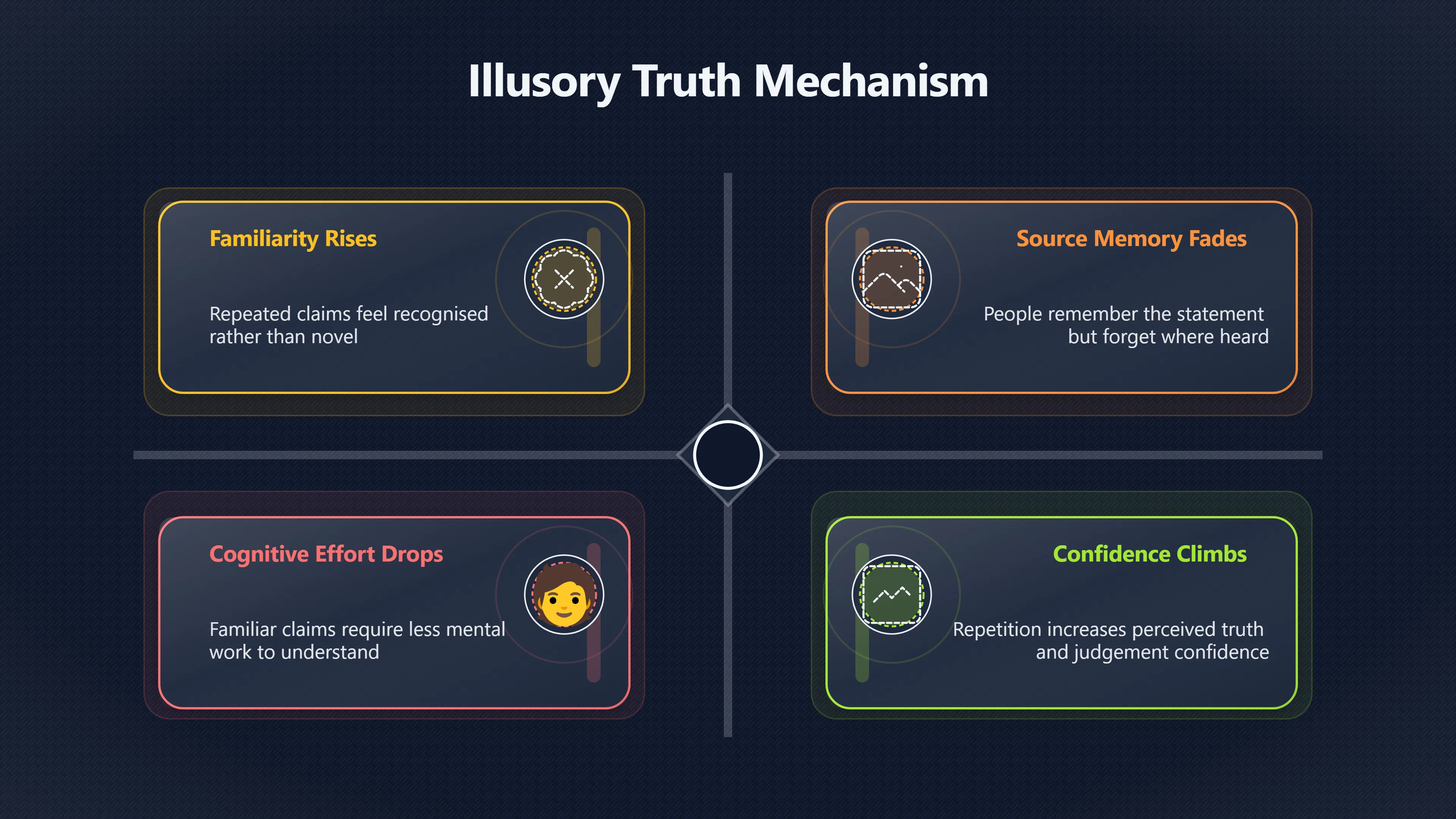
Several related processes reinforce the effect:
- Familiarity increases. The claim feels recognised rather than novel.
- Source memory fades. People may remember the statement but forget where they heard it.
- Cognitive effort decreases. Familiar claims require less mental work to understand.
- Confidence rises. Repetition can increase not only perceived truth but also confidence in that judgement.[PubMed]pubmed.ncbi.nlm.nih.govThe illusory truth effect: A review of how repetition…by J Udry · 2024 · Cited by 117 — Repetition increases belief in informati…[PMC]pmc.ncbi.nlm.nih.govFurthermore, we aimed to examine whether…Read more…
This helps explain why myths often become easier to recognise before they become easier to question. Recognition is fast. Verification is slower.
Why knowing the facts is not always enough
Many people assume that false claims work only because audiences lack information. The evidence suggests a more complicated picture.
Studies have found illusory truth effects among participants who already possessed relevant knowledge. Familiarity can sometimes compete with, and occasionally outweigh, factual knowledge during quick judgements. Researchers have repeatedly observed that warnings and awareness of repetition do not completely eliminate the effect. Vanderbilt University[wikipedia]WikipediaIllusory truth effectIllusory truth effect - WikipediaThe illusory truth effect (also known as the illusion of truth effect… Despite this warning, the p… This does not mean knowledge is useless. People with stronger knowledge generally perform better overall. However, truth judgements are influenced by multiple signals at once. Familiarity is one of those signals, and it can still affect evaluation even when evidence points in another direction.[PubMed]pubmed.ncbi.nlm.nih.govThe illusory truth effect: A review of how repetition…by J Udry · 2024 · Cited by 117 — Repetition increases belief in informati…
That is why myths can persist after being debunked. Once a claim becomes familiar, the correction has to compete not only with the content of the myth but also with the mental advantage created by repetition.

A real-world example: repeated misinformation
The effect is not confined to laboratory trivia questions. Research has shown that repetition can increase belief in misinformation and can also make people more willing to share it with others. Even a single additional exposure can have measurable effects.[PMC]pmc.ncbi.nlm.nih.govFurthermore, we aimed to examine whether…Read more…
A recent study of climate-related claims found that repeated exposure increased perceived credibility for both accurate scientific statements and misleading climate-denial claims. The mechanism did not depend on the claim being true; repetition itself increased perceived plausibility.[The Guardian]theguardian.comThe research, published in Plos One, was led by Mary Jiang from the Australian National University and highlighted the "illusory truth…
This creates a difficult communication environment. Accurate information benefits from repetition, but so do falsehoods. The contest is often not between evidence and no evidence. It is between two messages competing for attention, memory and familiarity.

How corrections can avoid repeating the myth too much
The existence of the illusory truth effect has sometimes led to worries that correcting misinformation might backfire by repeating the false claim. The evidence does not support a simple rule of “never mention the myth”.
Research on debunking suggests that corrections are generally effective and that strong corrections usually outweigh any familiarity boost created by mentioning the falsehood. Large reviews have found little support for the idea that corrections routinely make misinformation stronger.[PMC]pmc.ncbi.nlm.nih.govFurthermore, we aimed to examine whether…Read more…[Center for Climate Change Communication]climatechangecommunication.orgCenter for Climate Change CommunicationDebunking HandbookThus, while repeating misinformation generally increases familiarity and truth r…
What matters is how the correction is structured.
Effective corrections typically:
- Lead with the accurate information rather than dwelling on the myth.
- Provide a clear replacement explanation instead of leaving a gap.
- Repeat the factual account enough that it becomes memorable.
- Avoid turning the myth itself into the most prominent or memorable part of the message.[Center for Climate Change Communication]climatechangecommunication.orgCenter for Climate Change CommunicationDebunking HandbookThus, while repeating misinformation generally increases familiarity and truth r…
In practical terms, a correction works best when it gives people something true to remember, not merely something false to reject.
Why repetition remains a challenge
The illusory truth effect does not mean people are irrational or incapable of evaluating evidence. It reflects a shortcut that normally helps people navigate an information-rich world. Familiar information is often reliable, so the brain learns to treat familiarity as a useful clue.[Springer Link]link.springer.comSpringer LinkThe effects of repetition frequency on the illusory truth effectby A Hassan · 2021 · Cited by 404 — This finding is known as…
The difficulty arises when repetition becomes detached from accuracy. Modern media environments allow a claim to be encountered repeatedly across platforms, conversations and headlines regardless of whether it is true. Each exposure can increase familiarity, making the statement feel progressively more credible.[PubMed]pubmed.ncbi.nlm.nih.govThe illusory truth effect: A review of how repetition…by J Udry · 2024 · Cited by 117 — Repetition increases belief in informati…[PMC]pmc.ncbi.nlm.nih.govFurthermore, we aimed to examine whether…Read more…
For myths and misconceptions, this mechanism is especially important. A memorable slogan gains strength every time it is repeated. An accurate explanation must not only be correct; it must also become familiar enough to compete. The challenge is therefore not merely to provide evidence, but to ensure that truthful explanations are encountered, remembered and repeated often enough to feel as recognisable as the myths they replace.
Amazon book picks
Further Reading
Books and field guides related to Why repetition makes myths feel true. Use these as the next step if you want deeper reading beyond the article.
Factfulness
Shows how simple narratives distort understanding and how to think more accurately.
Thinking, Fast and Slow
Provides cognitive foundations for fluency and familiarity effects.
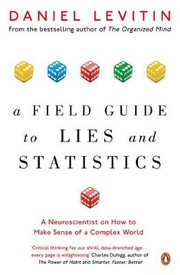
A field guide to lies
First published 2016. Subjects: Critical thinking, Fallacies (Logic), Reasoning, Statistics, Social aspects.

eBay marketplace picks
Marketplace Samples
Example marketplace items related to this page. Use the search link to explore similar finds on eBay.



Endnotes
1.
Source: sciencedirect.com
Link:https://www.sciencedirect.com/science/article/abs/pii/S2352250X23001811
Source snippet
The illusory truth effect: A review of how repetition...by J Udry · 2024 · Cited by 119 — Repetition increases belief in in...
2.
Source: pmc.ncbi.nlm.nih.gov
Link:https://pmc.ncbi.nlm.nih.gov/articles/PMC8116821/
Source snippet
This finding is known as the illusory truth effect.Read more...
3.
Source: link.springer.com
Link:https://link.springer.com/article/10.1186/s41235-021-00301-5
Source snippet
Springer LinkThe effects of repetition frequency on the illusory truth effectby A Hassan · 2021 · Cited by 404 — This finding is known as...
4.
Source: Wikipedia
Title: Illusory truth effect
Link:https://en.wikipedia.org/wiki/Illusory_truth_effect
Source snippet
Illusory truth effect - WikipediaThe illusory truth effect (also known as the illusion of truth effect... Despite this warning, the p...
5.
Source: pmc.ncbi.nlm.nih.gov
Link:https://pmc.ncbi.nlm.nih.gov/articles/PMC4816661/
Source snippet
On Known Unknowns: Fluency and the Neural Mechanisms of...by WC Wang · 2016 · Cited by 136 — Recent work suggests that this processin...
6.
Source: pmc.ncbi.nlm.nih.gov
Link:https://pmc.ncbi.nlm.nih.gov/articles/PMC11143013/
Source snippet
People not only judge repeatedly perceived information as more likely being true (the so-called truth effect) they also tend to be more c...
7.
Source: news.vanderbilt.edu
Title: illusory-truth effect
Link:https://news.vanderbilt.edu/2020/10/06/study-shows-that-repeated-statements-are-more-often-judged-to-be-true-regardless-of-a-persons-age-or-prior-knowledge/
Source snippet
Vanderbilt UniversityStudy shows that repeated statements are more often judged to be...October 6, 2020 — Study shows that repeated stat...
Published: October 6, 2020
8.
Source: pmc.ncbi.nlm.nih.gov
Link:https://pmc.ncbi.nlm.nih.gov/articles/PMC10636596/
Source snippet
The illusory truth effect leads to the spread of misinformationby V Vellani · 2023 · Cited by 121 — Here, we test whether and how a si...
9.
Source: pmc.ncbi.nlm.nih.gov
Link:https://pmc.ncbi.nlm.nih.gov/articles/PMC9283209/
Source snippet
Furthermore, we aimed to examine whether...Read more...
10.
Source: pmc.ncbi.nlm.nih.gov
Title: PMCCorrection format has a limited role when debunking
Link:https://pmc.ncbi.nlm.nih.gov/articles/PMC8715407/
Source snippet
by B Swire-Thompson · 2021 · Cited by 79 — The current paper investigated how altering the format of corrections influences people's s...
11.
Source: sciencedirect.com
Link:https://www.sciencedirect.com/science/article/abs/pii/S001002772300241X
Source snippet
The illusory truth effect requires semantic coherence...by J Udry · 2023 · Cited by 14 — Repeated exposure to information increases its'...
12.
Source: sciencedirect.com
Link:https://www.sciencedirect.com/science/article/abs/pii/S0010027721002389
Source snippet
Truth feels easy: Knowing information is true enhances...by LS Nahon · 2021 · Cited by 13 — Discussion centers on the current explanatio...
13.
Source: sciencedirect.com
Title: Hearing a statement now and believing the opposite later
Link:https://www.sciencedirect.com/science/article/abs/pii/S0022103114001516
Source snippet
illusion of truth effect is highly robust and frequently replicated... true compared to new statements, a phenomenon known as the illuso...
14.
Source: sciencedirect.com
Link:https://www.sciencedirect.com/science/article/am/pii/S2352250X23002282
Source snippet
On the role of memory in misinformation correctionsby PL Kemp · 2024 · Cited by 26 — These findings show that fact-checks that repeat mis...
15.
Source: link.springer.com
Link:https://link.springer.com/article/10.3758/s13423-025-02836-w
Source snippet
repetition increase perceived truth equally for...by SM Bowes · 2026 — The illusory truth effect: A review of how repetition increases b...
16.
Source: link.springer.com
Link:https://link.springer.com/article/10.3758/s13415-025-01266-4
Source snippet
face of illusory truth: Repetition of information elicits...by A Stump · 2025 · Cited by 3 — Our data demonstrate that repetition result...
17.
Source: pubmed.ncbi.nlm.nih.gov
Link:https://pubmed.ncbi.nlm.nih.gov/38113667/
Source snippet
The illusory truth effect: A review of how repetition...by J Udry · 2024 · Cited by 117 — Repetition increases belief in informati...
18.
Source: theguardian.com
Link:https://www.theguardian.com/australia-news/article/2024/aug/08/repeating-climate-denial-claims-makes-them-seem-more-credible-australian-led-study-finds
Source snippet
The research, published in *Plos One*, was led by Mary Jiang from the Australian National University and highlighted the "illusory truth...
19.
Source: climatechangecommunication.org
Link:https://www.climatechangecommunication.org/wp-content/uploads/2023/09/DebunkingHandbook2020.pdf
Source snippet
Center for Climate Change CommunicationDebunking HandbookThus, while repeating misinformation generally increases familiarity and truth r...
20.
Source: annieduke.substack.com
Title: the illusory truth effect
Link:https://annieduke.substack.com/p/the-illusory-truth-effect
Source snippet
Illusory Truth Effect - by Annie Duke - SubstackAugust 30, 2023 — The more something is repeated, the more true it feels...
Published: August 30, 2023
21.
Source: thedecisionlab.com
Title: Illusory truth effect
Link:https://thedecisionlab.com/biases/illusory-truth-effect
Source snippet
The Decision LabThe illusory truth effect, also known as the illusion of truth, describes how when we hear the same false information rep...
22.
Source: psychologytoday.com
Link:https://www.psychologytoday.com/us/basics/illusory-truth-effect
23.
Source: ebsco.com
Link:https://www.ebsco.com/research-starters/psychology/illusory-truth-effect
Source snippet
Illusory truth effect | Psychology | Research StartersThe illusory truth effect is a cognitive phenomenon where repeated exposure to fals...
Additional References
24.
Source: nature.com
Link:https://www.nature.com/nature-index/topics/l4/cognitive-fluency-and-judgments-of-truth
Source snippet
Cognitive Fluency and Judgments of TruthThis phenomenon underpins the illusory truth effect, wherein mere repetition of a claim increases...
25.
Source: merriam-webster.com
Link:https://www.merriam-webster.com/dictionary/illusory
Source snippet
ILLUSORY Definition & Meaningillusory implies a false impression based on deceptive resemblance or faulty observation, or influenced by e...
26.
Source: psychologytoday.com
Link:https://www.psychologytoday.com/gb/basics/illusory-truth-effect
Source snippet
Illusory Truth EffectStudies show that repetition increases the perception of validity—even when people start out knowing that the inform...
27.
Source: reddit.com
Link:https://www.reddit.com/r/science/comments/1fryhzw/repeating_a_claim_can_make_it_seem_more/
Source snippet
Repeating a claim can make it seem more believable—an...When false claims are repeated, we start to believe they are true, suggest...
28.
Source: arno.uvt.nl
Link:https://arno.uvt.nl/show.cgi?fid=161900
Source snippet
Is The Effect of the Illusory Truth Effect on Conspiracy...We found repetition to insignificantly increase truth judgments of conspiracy...
29.
Source: psychotricks.com
Title: The Psychology of Belief: Understanding the Illusory Truth Effect
Link:https://psychotricks.com/illusory-truth-effect/
Source snippet
November 21, 2025 — The Illusory Truth Effect is a cognitive bias describing the human tendency to rate information as more valid or trut...
Published: November 21, 2025
30.
Source: effectiviology.com
Link:https://effectiviology.com/familiarity-backfire-effect/
Source snippet
member misinformation better, and to remember it as being true.Read more...
31.
Source: normalcurves.com
Title: the backfire effect can fact checking make false beliefs stronger
Link:https://www.normalcurves.com/the-backfire-effect-can-fact-checking-make-false-beliefs-stronger/
Source snippet
The “backfire effect” claims that debunking myths can actually make false beliefs stronger.Read more...
32.
Source: facebook.com
Title: American Psychological Association
Link:https://www.facebook.com/AmericanPsychologicalAssociation/posts/you-keep-seeing-the-same-claim-made-over-and-over-onlineso-it-must-be-true-right/1290086699819665/
Source snippet
January 13, 2026 — The illusory truth effect, also known as the illusion of truth, describes how when we hear the same [false info]({{ 'false-info/' | relative_url }})...
Published: January 13, 2026
33.
Source: philosophytalk.org
Title: say it enough theyll believe it
Link:https://philosophytalk.org/blog/say-it-enough-theyll-believe-it/
Source snippet
Say it Enough, They'll Believe ItNov 20, 2020 — Most psychologists think the illusory truth effect reflects “processing fluency.” In othe...
Topic Tree