Within Mythcraft
Does Debunking Really Make Myths Stronger?
Clear corrections usually reduce false belief, even though badly designed debunking can still fail.
On this page
- Where the fear came from
- What later evidence suggests
- How to correct without amplifying
Page outline Jump by section
Introduction
The fear behind the “backfire effect” is simple: if a communicator repeats a myth in order to correct it, the repetition may make the myth feel more familiar, more memorable, and ultimately more believable. That fear has influenced journalists, health communicators, educators and fact-checkers, sometimes making them reluctant to name the false claim they are trying to fix.
The best current evidence is more reassuring. Backfire can happen in limited or poorly understood circumstances, especially where people distrust the correction itself, but it is not the normal result of clear debunking. Reviews, replications and large experiments generally find that factual corrections improve belief accuracy rather than making false beliefs stronger. The practical lesson is not “never correct myths”. It is: correct them carefully, make the truth more prominent than the falsehood, and give readers a usable replacement explanation.[ScienceDirect]sciencedirect.comSource details in endnotes.[ScienceDirect]sciencedirect.comOpen source on sciencedirect.com.
Where the Fear Came From
The backfire effect became widely discussed after political misinformation studies suggested that some people, when shown corrections that challenged their worldview, became more committed to the false belief. A particularly influential case was Brendan Nyhan and Jason Reifler’s work on political misperceptions, including claims about weapons of mass destruction in Iraq and US tax cuts. Their 2010 paper reported several instances where corrections failed, and some where corrected participants appeared to move further in the wrong direction.[ResearchGate]researchgate.netResearch Gate(PDF) When Corrections Fail: The Persistence of PoliticalResearch Gate(PDF) When Corrections Fail: The Persistence of Political
That finding landed at the perfect moment for a memorable communication warning. It seemed to explain a familiar experience: correcting someone online can feel futile, especially when the topic is political, moralised or identity-laden. The idea also fitted with a real psychological mechanism, the “illusory truth effect”, in which repeated information can feel more believable simply because it is familiar. From there, the concern grew into a broader rule of thumb: avoid repeating myths because debunking may accidentally strengthen them.[PLOS]journals.plos.orgSource details in endnotes.
The problem is that this rule compressed several different worries into one slogan. There is a difference between a correction that fails to persuade, a correction whose effect fades over time, a correction that changes factual belief but not behaviour, and a correction that truly increases belief in the myth above where it would otherwise have been. Only the last of these is a genuine backfire effect. Later research suggests that many correction fears are really about limited impact, memory decay, distrust or poor design, not about debunking routinely making misinformation stronger.[ScienceDirect]sciencedirect.comSource details in endnotes.
What Later Evidence Suggests
The strongest correction to the backfire story is empirical: researchers have repeatedly tried to find robust backfire effects and have usually failed. In a large study of political corrections, Thomas Wood and Ethan Porter ran five experiments with more than 10,100 participants and tested 52 issues where backfire might have been expected. They reported no corrections capable of producing backfire, concluding that citizens generally heed factual information even when it challenges their ideological commitments.[SSRN]papers.ssrn.comOpen source on ssrn.com.
More recent reviews reach a similar conclusion. Swire-Thompson, DeGutis and Lazer describe the backfire effect as a major concern for science communicators and fact-checkers, but conclude that backfire effects are not a robust empirical phenomenon. Porter and Wood’s later review of factual corrections likewise finds that corrections improve belief accuracy across countries, political beliefs and demographic groups, while instances of backfire are “exceedingly rare” and may sometimes be artefacts of research design.[ScienceDirect]sciencedirect.comSource details in endnotes.
This does not mean corrections are magic. Nyhan’s later assessment in PNAS argues that the durability of political misperceptions is better explained by other forces: correction effects may be partial, may decay, and may be overwhelmed by repeated elite cues or media environments that keep the false claim alive. In other words, myths often persist not because correction makes them stronger, but because correction is brief while the misleading story is socially reinforced, emotionally useful or repeatedly supplied by trusted sources.[PNAS]pnas.orgOpen source on pnas.org.
The evidence is also clearer when researchers separate different forms of “backfire”. The familiarity version says that merely repeating a myth during correction makes it more believable. Vaccine-misinformation research published in PLOS One notes why this concern seemed plausible, but also reports a failure to replicate familiarity- or fear-driven backfire effects. A separate series of three experiments on standalone corrections found no backfire immediately or after a one-week delay, though it did find mixed evidence that scepticism toward the correction itself may be a risk factor worth studying further.[PLOS]journals.plos.orgSource details in endnotes.
The overall picture is therefore nuanced but practical. Clear corrections usually help. They may not fully erase a misconception, and they may not automatically change attitudes or behaviour. But the old fear that fact-checking normally “feeds the myth” is too strong. The bigger danger is often the opposite: leaving a false claim unnamed, uncorrected and unchallenged because communicators overestimate the risk of backfire.[ScienceDirect]sciencedirect.comSource details in endnotes.

Why Bad Debunking Can Still Fail
The backfire myth should not be replaced with a new myth that any correction will work. Poorly designed debunking can still disappoint, confuse or miss the audience. A correction may fail if it is too vague, arrives too late, comes from a source the audience already rejects, or only says “that is false” without explaining what actually happened.
One important distinction is between belief accuracy and broader persuasion. Corrections often make people more accurate about a specific claim, but related attitudes and behaviours can be more resistant. Someone may accept that a particular viral image was miscaptioned while still distrusting the institution mentioned in the correction. Someone may learn that a health claim is false but continue to feel anxious because the correction did not address the underlying fear. Porter and Wood’s review notes that correction effects are real but not permanent, and that they often affect belief accuracy more than downstream attitudes or behaviours.[ScienceDirect]sciencedirect.comSource details in endnotes.
Another failure mode is leaving a mental gap. Many myths do explanatory work: they tell people who caused an event, why something happened, or what they should avoid. Removing the myth without giving a replacement explanation can leave the original story available in memory. This is why many correction guides recommend explaining not only that a claim is wrong, but why it is wrong and what better account should replace it. The American Psychological Association advises that corrections should be prominent alongside the misinformation so accurate information is stored and retrieved with it.[American Psychological Association]apa.orgmisinformation recommendationsmisinformation recommendations
Trust also matters. The 2023 standalone-corrections study found low risk of backfire where people were not sceptical of the correction, but mixed evidence of possible backfire under deliberately scepticism-inducing conditions. That does not revive the broad backfire panic; it narrows the concern. The risky situation is not simply “a myth was repeated”. It is more likely to be a correction that the audience interprets as suspicious, manipulative, hostile or poorly justified.[Springer Link]link.springer.comSource details in endnotes.
How to Correct Without Amplifying
Good correction design treats the myth as the problem to be replaced, not the star of the message. The aim is to make the accurate claim more memorable, easier to retrieve and more useful than the false one. The practical guidance from the evidence is straightforward.
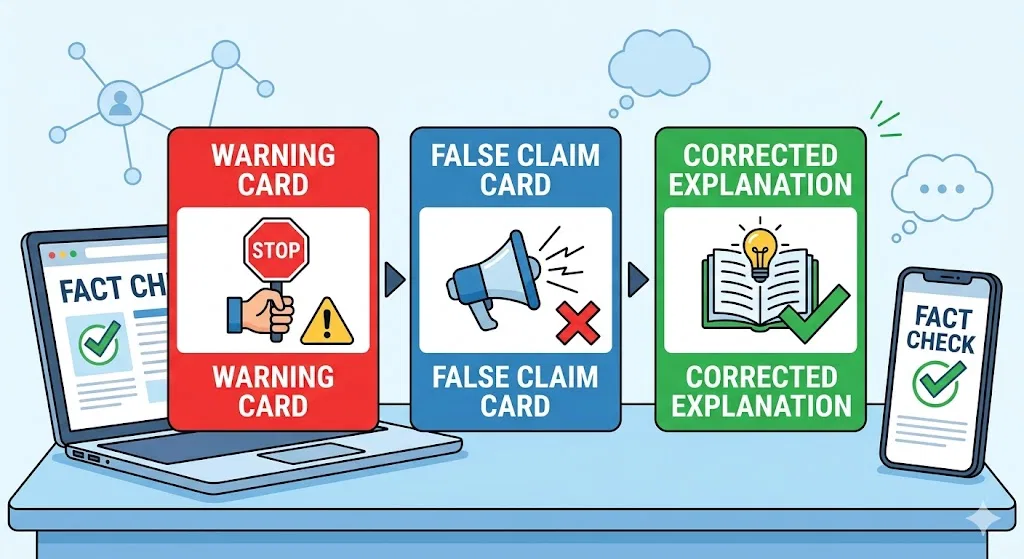
Lead with the truth. A useful correction should give readers the accurate claim early, not make them wade through the myth first. For example, instead of opening with “Does the flu vaccine give you flu?”, a clearer correction starts with “The flu vaccine cannot give you flu because it does not contain a live flu virus capable of causing infection.” The myth can still be named, but the true claim should frame the message.
Name the myth only as much as needed. Avoid evasive corrections that never say what is being corrected, because readers may not know which claim is false. But also avoid turning the myth into a catchy headline, repeated slogan or shareable image. The evidence does not support panic about any repetition, but unnecessary repetition still gives the false claim more space than it deserves.[PLOS]journals.plos.orgSource details in endnotes.
Explain the mistake, not just the verdict. “False” is less useful than “false because…”. A strong debunk might explain that a viral graph used the wrong denominator, that an old video was presented as new, or that a quote was cut off before the sentence that changed its meaning. This gives the audience a reason to abandon the myth and a method for spotting similar errors later.
Offer a replacement story. If a myth explains why an event happened, the correction should provide the better explanation. For instance, if a false rumour blames a public-health symptom on a vaccine ingredient, a stronger correction explains the ordinary cause, the timing confusion and the safety evidence. Without a replacement, people may remember that something was disputed but still rely on the original explanation when reasoning later.
Keep the correction easy to process. One reason myths spread is that they are simple. Corrections should not become so overloaded that the reader remembers only the original claim. Research comparing correction formats suggests that format alone is not the decisive factor when key correction ingredients are present, which is useful news: communicators do not need one rigid template, but they do need clarity, relevance and enough explanation to replace the error.[PMC]pmc.ncbi.nlm.nih.govPMCCorrection format has a limited role when debunkingPMCCorrection format has a limited role when debunking
The Better Rule of Thumb
The most useful replacement for the backfire myth is not “debunk everything instantly” but “correct clearly when the false claim is likely to matter”. A correction is most worth making when the myth is circulating, consequential, plausible to the audience, or likely to shape decisions. In those cases, silence can allow the false claim to remain the only available explanation.
A good correction does three things at once: it identifies the false claim, reduces its appeal, and gives the reader a better account to use instead. The fear of amplification is worth respecting as a design constraint, but not as a reason for paralysis. The evidence points away from blanket avoidance and towards better correction craft: truth first, myth handled carefully, explanation supplied, and trust treated as part of the message rather than an afterthought.
Amazon book picks
Further Reading
Books and field guides related to Does Debunking Really Make Myths Stronger?. Use these as the next step if you want deeper reading beyond the article.
Mistakes Were Made (but Not by Me) Third Edition
Explains resistance to correction and self-justification.

Scout Mindset
First published 2021. Subjects: Economics, Psychology, Cognition, Skepticism, Critical thinking.
eBay marketplace picks
Marketplace Samples
Example marketplace items related to this page. Use the search link to explore similar finds on eBay.



Endnotes
1.
Source: sciencedirect.com
Link:https://www.sciencedirect.com/science/article/pii/S2211368120300516
2.
Source: sciencedirect.com
Link:https://www.sciencedirect.com/science/article/abs/pii/S2352250X23001604
3.
Source: link.springer.com
Link:https://link.springer.com/article/10.1186/s41235-023-00492-z
4.
Source: researchgate.net
Title: Research Gate(PDF) When Corrections Fail: The Persistence of Political
Link:https://www.researchgate.net/publication/225336846_When_Corrections_Fail_The_Persistence_of_Political_Misperceptions
5.
Source: journals.plos.org
Link:https://journals.plos.org/plosone/article?id=10.1371%2Fjournal.pone.0281140
6.
Source: papers.ssrn.com
Link:https://papers.ssrn.com/sol3/papers.cfm?abstract_id=2819073
7.
Source: pnas.org
Link:https://www.pnas.org/doi/10.1073/pnas.1912440117
8.
Source: link.springer.com
Link:https://link.springer.com/chapter/10.1007/978-3-031-27789
9.
Source: pmc.ncbi.nlm.nih.gov
Title: PMCCorrection format has a limited role when debunking
Link:https://pmc.ncbi.nlm.nih.gov/articles/PMC8715407/
10.
Source: papers.ssrn.com
Title: SSRN ID3095103 code1700852
Link:https://papers.ssrn.com/sol3/Delivery.cfm/SSRN_ID3095103_code1700852.pdf?abstractid=2819073&mirid=1
11.
Source: pnas.org
Link:https://www.pnas.org/doi/10.1073/pnas.2104235118
12.
Source: sciencedirect.com
Link:https://www.sciencedirect.com/science/article/pii/S2352250X23001574
13.
Source: sciencedirect.com
Link:https://www.sciencedirect.com/science/article/pii/S0167811626000261
14.
Source: sciencedirect.com
Link:https://www.sciencedirect.com/science/article/pii/S0010027725000307
15.
Source: researchgate.net
Link:https://www.researchgate.net/publication/358440351_The_backfire_effect_after_correcting_misinformation_is_strongly_associated_with_reliability
16.
Source: researchgate.net
Title: 318458573 The limitations of the backfire effect
Link:https://www.researchgate.net/publication/318458573_The_limitations_of_the_backfire_effect
17.
Source: researchgate.net
Link:https://www.researchgate.net/publication/350778736_Why_the_backfire_effect_does_not_explain_the_durability_of_political_misperceptions
18.
Source: researchgate.net
Title: 398530790 Factual Corrections Concerns and Current Evidence
Link:https://www.researchgate.net/publication/398530790_Factual_Corrections_Concerns_and_Current_Evidence
19.
Source: researchgate.net
Link:https://www.researchgate.net/scientific-contributions/Thomas-J-Wood-2095272898
20.
Source: researchgate.net
Link:https://www.researchgate.net/publication/370712520_To_Debunk_or_Not_to_Debunk_Correcting_MisInformation
21.
Source: apa.org
Title: misinformation recommendations
Link:https://www.apa.org/topics/journalism-facts/misinformation-recommendations
22.
Source: cssh.northeastern.edu
Title: backfire effects
Link:https://cssh.northeastern.edu/nulab/backfire-effects/
23.
Source: cjr.org
Title: the backfire effect
Link:https://www.cjr.org/behind_the_news/the_backfire_effect.php
Additional References
24.
Source: fullfact.org
Link:https://fullfact.org/media/uploads/backfire_report_fullfact.pdf
25.
Source: osf.io
Link:https://osf.io/preprints/psyarxiv/qrm69
26.
Source: climatechangecommunication.org
Link:https://www.climatechangecommunication.org/wp-content/uploads/2023/09/DebunkingHandbook2020.pdf
27.
Source: edmo.eu
Link:https://edmo.eu/
28.
Source: facebook.com
Link:https://www.facebook.com/uni.lu/posts/have-you-ever-tried-to-correct-someone-who-shared-fake-news-online-it-rarely-goe/1447453670755961/
29.
Source: benedmo.eu
Link:https://benedmo.eu/wp-content/uploads/2022/12/D16_-Recommendations-on-effectiveness-of-fact-checkers_website-version-1-1.pdf
30.
Source: cambridge.org
Link:https://www.cambridge.org/core/journals/italian-political-science-review-rivista-italiana-di-scienza-politica/article/politicians-misinformation-its-correction-and-partisanship-in-italy/F36A37F90B2C83A4D18DEE818369547B
31.
Source: facebook.com
Link:https://www.facebook.com/AmericanPsychologicalAssociation/posts/psychologists-are-working-to-understand-the-effects-of-misinformation-and-how-it/1080266017468402/
32.
Source: facebook.com
Link:https://www.facebook.com/AmericanPsychologicalAssociation/videos/fact-checking-what-is-the-backfire-effect/2382988448569590/
33.
Source: iweps.be
Link:https://www.iweps.be/wp-content/uploads/2024/03/KS-GQ-22-003-EN-N.pdf
Topic Tree