Within Debunking
When should a correction repeat the myth?
A debunk should identify a myth only when readers need that label to understand the correction.
On this page
- Why readers sometimes need the myth named
- How warning labels change the reading frame
- When repeating a rumour gives it needless reach
Page outline Jump by section
Introduction
A correction does not always need to repeat the false claim it is trying to undo. In many cases, the safest and clearest approach is to state the fact, explain the evidence, and move on. But some rumours become so widespread, specific, or confusing that readers cannot understand the correction unless they know exactly which claim is being addressed.
 The challenge is that naming a falsehood has two competing effects. It can help readers connect the correction to a rumour they have already encountered. At the same time, repetition can make a claim feel more familiar, and familiarity is one cue people use when judging what seems true. Research on misinformation and the “illusory truth effect” shows that repeated exposure can increase perceived accuracy, even when the information is false.[PMC]pmc.ncbi.nlm.nih.govThis finding is known as the illusory truth effect…[ScienceDirect]sciencedirect.comThe illusory truth effect: A review of how repetition…by J Udry · 2024 · Cited by 122 — Overall, the illusory truth effec…
The practical question is not whether a correction should ever repeat a myth. It is when the benefit of naming the false claim outweighs the risk of giving it extra attention and reach.
Why readers sometimes need the myth named
A correction that never identifies the false claim can become too vague to be useful. Readers may know that “something online is wrong” without understanding what is being corrected.
This problem appears most clearly when a rumour has a distinctive claim attached to it. If people have repeatedly seen a statement such as “a photo was generated by artificial intelligence” or “a vaccine contains a particular ingredient”, a correction that simply says “the information circulating online is inaccurate” may not connect with the belief already stored in memory.
Research on the continued influence effect suggests that misinformation often keeps shaping reasoning even after it has been retracted. People may remember the original claim and fail to link a generic correction to it. PMC[Sage Journals]journals.sagepub.comSage JournalsA Meta-Analytic Examination of the Continued Influence…22 Jun 2019 — A meta-analysis was conducted to examine the extent…
In practice, naming the myth becomes more important when:
- The false claim is already widely known among the intended audience.
- Multiple rumours are circulating and readers need to know which one is being addressed.
- The correction concerns a precise factual assertion rather than a vague narrative.
- Readers are likely to have encountered the myth before seeing the correction.
In those situations, avoiding any mention of the falsehood can create a matching problem. The reader cannot easily connect the correction to the belief that needs updating.
The goal is not to spotlight the rumour. It is to help the audience identify it so the correction can replace it.
How warning labels change the reading frame
When a correction does repeat a false claim, the surrounding language matters.
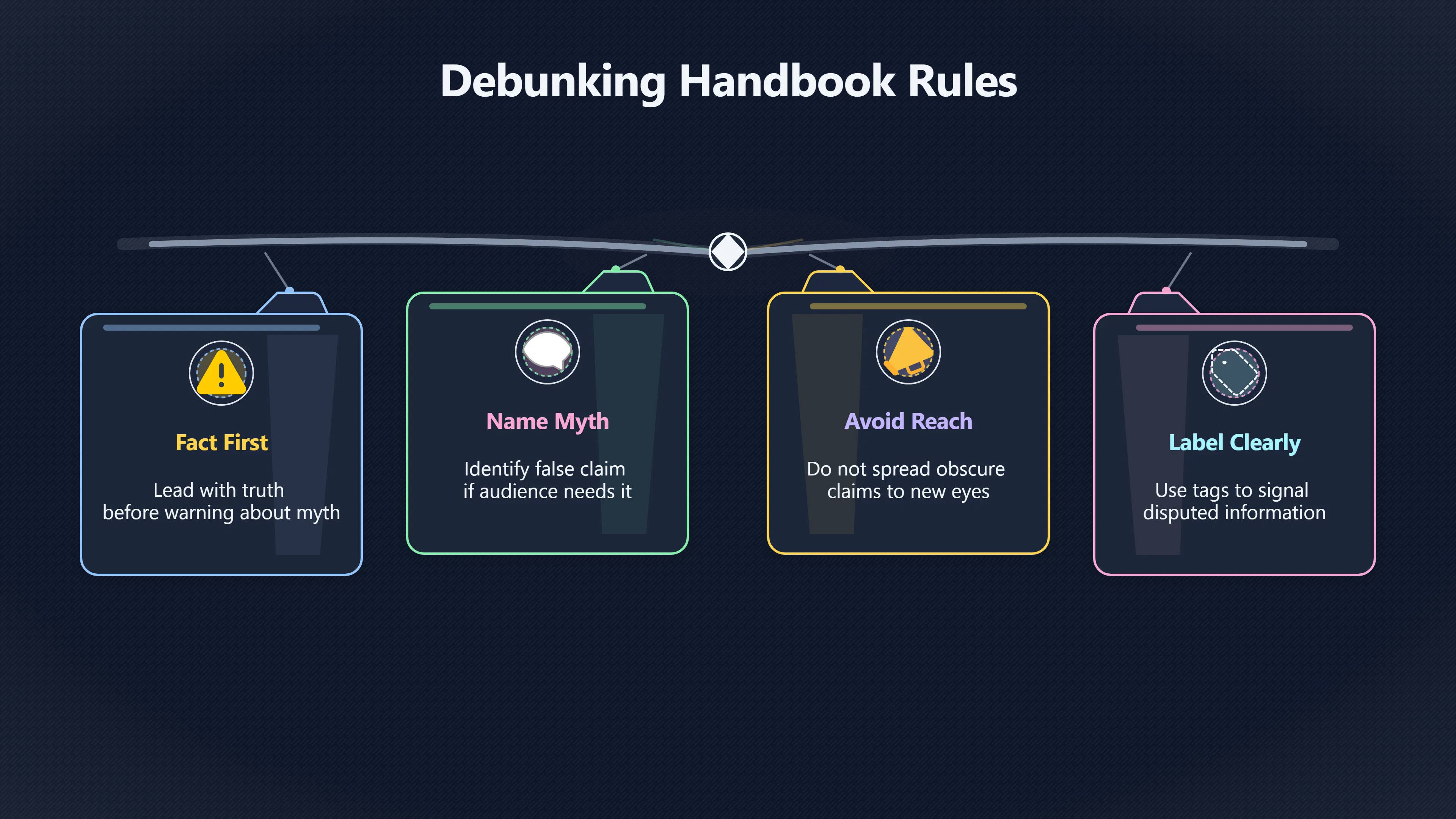
One of the central recommendations in debunking research is that misinformation should be introduced with a clear warning. Rather than presenting the claim as a neutral statement and correcting it later, communicators signal immediately that the reader is about to encounter inaccurate information. The classic guidance is to lead with the fact, warn that a myth follows, and then explain why it is wrong.[Laboratory of Tree-Ring Research]ltrr.arizona.eduLaboratory of Tree-Ring ResearchThe Debunking HandbookNovember 25, 2011 — by S Lewandowsky — To avoid these “backfire effects”, an effect…
This changes the mental frame through which readers process the statement.
Compare these approaches:
- “Many people say the election machines were secretly altered.”
- “False claim: election machines were secretly altered.”
The factual content is similar, but the second version tells readers how to interpret what follows before they process the claim itself.
Warning labels perform several functions:
- They reduce ambiguity about the status of the information.
- They make the correction easier to remember as a correction.
- They help prevent readers from extracting the false claim while forgetting the rebuttal.
- They shift attention towards the evaluation of the statement rather than its novelty.
Recent work on misinformation labels suggests that warning cues can affect how people engage with disputed content, although the exact effects depend on design, context, and audience.[arXiv]arxiv.orgEffects of Automated Misinformation Warning Labels on the Intents to Like, Comment and Share PostsMarch 19, 2024…
This does not mean any warning automatically solves the problem. A weak label attached to a highly memorable rumour can still leave readers remembering the rumour more than the correction. The warning is useful because it changes the reading frame, not because it eliminates all risk.
The familiarity problem is real, but often misunderstood
Much public discussion of debunking has centred on a fear known as the “familiarity backfire effect”: the idea that repeating a myth during correction could strengthen belief in it simply because people have heard it again.
There is good evidence that repetition increases familiarity and that familiarity can increase perceived truth. Studies of the illusory truth effect consistently show that repeated statements often feel more believable than unfamiliar ones.[EBSCO]ebsco.comIllusory truth effect | Psychology | Research StartersThe illusory truth effect is a cognitive phenomenon where repeated exposure to… [3PMC 3Springer]
However, the stronger claim—that well-designed corrections usually backfire and increase belief in the myth—has received much weaker support. More recent reviews and experiments have found little evidence that repeating misinformation inside a clear correction typically causes belief to increase beyond what it would otherwise have been.[ScienceDirect]sciencedirect.comThe illusory truth effect: A review of how repetition…by J Udry · 2024 · Cited by 122 — Overall, the illusory truth effec…[3PMC 3Brown Climate]cssn.orgDB2020paper 1The familiarity backfire effect—corrections that repeat misinformation can ironically strengthen misconceptions—is not a robust phenomeno… Social Science Network](#endnote-19 “Snippet: The familiarity backfire effect—corrections that repeat misinformation can ironically strengthen misconceptions—is not a robust phenomeno”)
That distinction matters.
The risk is not mainly that every correction will convert readers into believers. The risk is that unnecessary repetition can increase familiarity, spread awareness of a rumour to new audiences, or make the false claim easier to recall later than the factual explanation.
This is why modern debunking guidance has become more nuanced than a simple “never repeat myths” rule. Researchers increasingly focus on how misinformation is presented, how often it is repeated, and whether the correction supplies a compelling alternative explanation.[Center for Climate Change Communication]climatechangecommunication.orgCenter for Climate Change CommunicationDebunking HandbookBecause a myth is necessarily repeated when it is debunked, the risk arises that…[PMC]pmc.ncbi.nlm.nih.govillusory truth effect leads to the spread of misinformationby V Vellani · 2023 · Cited by 121 — Repetition of misinformation biased peopl…

When repeating a rumour gives it needless reach
The strongest case against naming a myth appears when the correction itself becomes a distribution channel.
A journalist, public official, or fact-checker may be addressing a rumour that only a small audience has seen. By putting the false claim in a headline, social-media post, or notification, the correction can introduce the rumour to people who would never have encountered it otherwise.
This creates a different problem from belief persistence. Even if the correction is accurate, it increases exposure.
Several warning signs suggest that a correction may be giving a rumour unnecessary reach:
- The false claim is still obscure.
- Readers can understand the correction without seeing the exact wording.
- The myth is more memorable than the factual explanation.
- The headline emphasises the rumour rather than the fact.
- The correction repeats the claim multiple times.
For example, a headline framed as “No, drinking silver solution does not cure disease” may spread a claim that many readers had never heard before. A headline focused on the fact—“No evidence supports silver solution as a disease treatment”—communicates the same correction while reducing emphasis on the myth itself.
The difference can seem subtle, but it changes what becomes familiar. Debunking guidance frequently recommends mentioning the myth only when necessary and reinforcing the factual alternative more than the false claim.[Center for Climate Change Communication]climatechangecommunication.orgCenter for Climate Change CommunicationDebunking HandbookBecause a myth is necessarily repeated when it is debunked, the risk arises that…
A useful rule: name the claim, not the campaign
One practical way to decide whether to repeat a myth is to ask what the reader needs in order to understand the correction.
If the audience requires the exact false claim to recognise what is being corrected, naming it briefly may be justified.
If the audience only needs the factual answer, repeating the rumour often adds little value.
This produces a middle position between two extremes:
- Too little specificity: readers cannot tell what is being corrected.
- Too much repetition: the correction becomes another vehicle for the misinformation.
Effective corrections usually identify the false claim once, label it clearly, explain why it is wrong, and return attention to the fact. They do not build the entire article, headline, or social-media post around the rumour.
The central mechanism is simple. People need enough information to update a mistaken belief, but not so much repetition that the false claim becomes the most memorable part of the message. Research on continued influence, familiarity, and debunking all points toward the same balancing act: corrections work best when they help readers recognise a myth without turning the myth into the main story.[Nature]nature.comThe psychological drivers of misinformation belief and its…by UKH Ecker · 2022 · Cited by 1916 — In this Review, we describe the cogni… [3PMC 3Springer]
Amazon book picks
Further Reading
Books and field guides related to When should a correction repeat the myth?. Use these as the next step if you want deeper reading beyond the article.
Foolproof: Why We Fall for Misinformation and How to Build Im...
Explains familiarity effects and inoculation against false claims.
Calling Bullshit
Provides practical methods for identifying and correcting misleading claims.

eBay marketplace picks
Marketplace Samples
Example marketplace items related to this page. Use the search link to explore similar finds on eBay.

Endnotes
1.
Source: pmc.ncbi.nlm.nih.gov
Link:https://pmc.ncbi.nlm.nih.gov/articles/PMC8116821/
Source snippet
This finding is known as the illusory truth effect...
2.
Source: sciencedirect.com
Link:https://www.sciencedirect.com/science/article/abs/pii/S2352250X23001811
Source snippet
The illusory truth effect: A review of how repetition...by J Udry · 2024 · Cited by 122 — Overall, the illusory truth effec...
3.
Source: pmc.ncbi.nlm.nih.gov
Link:https://pmc.ncbi.nlm.nih.gov/articles/PMC10636596/
Source snippet
illusory truth effect leads to the spread of misinformationby V Vellani · 2023 · Cited by 121 — Repetition of misinformation biased peopl...
4.
Source: pmc.ncbi.nlm.nih.gov
Title: PMCExploring factors that mitigate the continued influence
Link:https://pmc.ncbi.nlm.nih.gov/articles/PMC8627545/
Source snippet
by IP Kan · 2021 · Cited by 27 — The term “continued influence effect” (CIE) refers to the phenomenon that discredited and obsolete in...
5.
Source: arxiv.org
Link:https://arxiv.org/abs/2403.12916
Source snippet
Effects of Automated Misinformation Warning Labels on the Intents to Like, Comment and Share PostsMarch 19, 2024...
Published: March 19, 2024
6.
Source: arxiv.org
Link:https://arxiv.org/abs/2407.02710
Source snippet
WARNING This Contains Misinformation: The Effect of Cognitive Factors, Beliefs, and Personality on Misinformation Warning Tag Attitudes...
7.
Source: link.springer.com
Link:https://link.springer.com/article/10.1186/s41235-021-00301-5
Source snippet
The effects of repetition frequency on the illusory truth effectby A Hassan · 2021 · Cited by 402 — Why do beliefs in myths, misi...
8.
Source: ebsco.com
Link:https://www.ebsco.com/research-starters/psychology/illusory-truth-effect
Source snippet
Illusory truth effect | Psychology | Research StartersThe illusory truth effect is a cognitive phenomenon where repeated exposure to...
9.
Source: pmc.ncbi.nlm.nih.gov
Link:https://pmc.ncbi.nlm.nih.gov/articles/PMC9283209/
Source snippet
The backfire effect after correcting misinformation is strongly...by B Swire-Thompson · 2022 · Cited by 111 — The backfire effect is...
10.
Source: sciencedirect.com
Title: ScienceDirect Familiarity backfire effects?
Link:https://www.sciencedirect.com/science/article/pii/S0167811626000261
Source snippet
Disentangling the competing...by IN Nibat · 2026 — Repetition reliably increases belief in misinformation (illusory truth effect), while...
11.
Source: sciencedirect.com
Link:https://www.sciencedirect.com/science/article/pii/S2211368120300516
Source snippet
Searching for the Backfire Effect: Measurement and Design...by B Swire-Thompson · 2020 · Cited by 398 — A backfire effect is when people...
12.
Source: pmc.ncbi.nlm.nih.gov
Title: PMCCorrection format has a limited role when debunking
Link:https://pmc.ncbi.nlm.nih.gov/articles/PMC8715407/
Source snippet
by B Swire-Thompson · 2021 · Cited by 79 — The current paper investigated how altering the format of corrections influences people's s...
13.
Source: nature.com
Link:https://www.nature.com/articles/s44159-021-00006-y
Source snippet
The psychological drivers of misinformation belief and its...by UKH Ecker · 2022 · Cited by 1916 — In this Review, we describe the cogni...
14.
Source: link.springer.com
Link:https://link.springer.com/article/10.1186/s41235-020-00241-6
Source snippet
corrections spread misinformation to new audiences...by UKH Ecker · 2020 · Cited by 205 — Misinformation often continues to influence in...
15.
Source: sciencedirect.com
Link:https://www.sciencedirect.com/science/article/pii/S0010027723000550
Source snippet
The illusory truth effect leads to the spread of misinformationby V Vellani · 2023 · Cited by 111 — Repetition of misinformation biased p...
16.
Source: journals.sagepub.com
Link:https://journals.sagepub.com/doi/10.1177/0093650219854600
Source snippet
Sage JournalsA Meta-Analytic Examination of the Continued Influence...22 Jun 2019 — A meta-analysis was conducted to examine the extent...
17.
Source: ltrr.arizona.edu
Link:https://www.ltrr.arizona.edu/~katie/kt/natsgc/Debunking_Handbook.pdf
Source snippet
Laboratory of Tree-Ring ResearchThe Debunking HandbookNovember 25, 2011 — by S Lewandowsky — To avoid these “backfire effects”, an effect...
Published: November 25, 2011
18.
Source: climatechangecommunication.org
Link:https://www.climatechangecommunication.org/wp-content/uploads/2023/09/DebunkingHandbook2020.pdf
Source snippet
Center for Climate Change CommunicationDebunking HandbookBecause a myth is necessarily repeated when it is debunked, the risk arises that...
19.
Source: cssn.org
Title: DB2020paper 1
Link:https://cssn.org/wp-content/uploads/2020/10/DB2020paper-1.pdf
Source snippet
The familiarity backfire effect—corrections that repeat misinformation can ironically strengthen misconceptions—is not a robust phenomeno...
20.
Source: cssh.northeastern.edu
Title: backfire effects
Link:https://cssh.northeastern.edu/nulab/backfire-effects/
Source snippet
In other words, instead of belief...Read more...
21.
Source: thedecisionlab.com
Title: Illusory truth effect
Link:https://thedecisionlab.com/biases/illusory-truth-effect
Source snippet
The Decision...The illusory truth effect describes how, when we are repeatedly exposed to misinformation, we are more likely to believe...
22.
Source: Wikipedia
Title: Illusory truth effect
Link:https://en.wikipedia.org/wiki/Illusory_truth_effect
Source snippet
Illusory truth effectMere-exposure effect – Psychological phenomenon; Misconception · Misinformation effect – Effect of later events o...
Additional References
23.
Source: psychologicalscience.org
Link:https://www.psychologicalscience.org/news/repeating-misinformation-doesnt-make-it-true-but-does-make-it-more-likely-to-be-believed.html
Source snippet
Repeating Misinformation Doesn't Make It True, But Does...2 Sept 2020 — Repeating Misinformation Doesn't Make It True, But Does Make It...
24.
Source: facebook.com
Link:https://www.facebook.com/AmericanPsychologicalAssociation/posts/you-keep-seeing-the-same-claim-made-over-and-over-onlineso-it-must-be-true-right/1290086699819665/
Source snippet
American Psychological AssociationThe illusory truth effect is a cognitive bias where repeated exposure to a statement, even if false, in...
25.
Source: merriam-webster.com
Link:https://www.merriam-webster.com/dictionary/continued
Source snippet
CONTINUED Definition & Meaning6 days ago — The meaning of CONTINUED is lasting or extending without interruption. How to use continued in...
26.
Source: emc-lab.org
Link:https://www.emc-lab.org/uploads/1/1/3/6/113627673/chapter_swireecker_revised.pdf
Source snippet
Ecker Memory & Cognition LabMisinformation and its Correctionby B Swire · Cited by 139 — Even after people receive clear and credible cor...
27.
Source: psychologytoday.com
Link:https://www.psychologytoday.com/us/basics/illusory-truth-effect
Source snippet
Illusory Truth EffectBecause the illusory truth effect operates both on information that is true and information... exposure prevents mi...
28.
Source: shapingtomorrowsworld.org
Title: Ideally, avoid mentioning the myth altogether while correcting it. When seeking
Link:https://www.shapingtomorrowsworld.org/debunking-handbook-part-2-familiarity-backfire-effect.html
Source snippet
The Debunking Handbook Part 2: The Familiarity Backfire Effect18 Nov 2011 — How does one avoid causing the Familiarity Backfire Effect?...
29.
Source: archive.thinkprogress.org
Title: the debunking handbook part 1 the first myth about debunking 7f2eac1cb33f
Link:https://archive.thinkprogress.org/the-debunking-handbook-part-1-the-first-myth-about-debunking-7f2eac1cb33f/
Source snippet
Debunking Handbook Part 1: The First Myth About...26 Dec 2011 — The evidence indicates that no matter how vigorously and repeatedly we c...
30.
Source: leadalchemists.com
Link:https://www.leadalchemists.com/marketing-psychology/illusory-truth-effect/
Source snippet
The Illusory Truth Effect poses several significant dangers in the spread of...Read more...
31.
Source: research-information.bris.ac.uk
Title: bris.ac.uk Swire, B., Ecker, UKH, & Lewandowsky, S
Link:https://research-information.bris.ac.uk/ws/files/148088061/JEPLMCinpress.pdf
Source snippet
(2017). The role ofThe present paper investigates whether the continued influence effect is at least partially familiarity-driven, and ho...
32.
Source: pmc.ncbi.nlm.nih.gov
Title: Theoretical accounts of the CIE
Link:https://pmc.ncbi.nlm.nih.gov/articles/PMC10075451/
Source snippet
function and the continued influence of misinformationby P McIlhiney · 2023 · Cited by 13 — Misinformation can continue to influence reas...
Topic Tree