Within Identity
When a myth becomes a loyalty test
Some myths persist because accepting or rejecting them signals loyalty, courage, compassion, scepticism, or belonging.
On this page
- How factual claims become group signals
- Moral framing and identity protection
- Why doubting can carry social costs
Page outline Jump by section
Introduction
False claims do not survive only because people are confused or uninformed. They often survive because accepting them becomes a way of showing loyalty. In families, political movements, religious communities, wellness circles, workplaces and online fandoms, beliefs can function as social signals as much as factual judgments. A claim may start as a question about reality, but over time it can become a test of who belongs, who can be trusted and who is willing to stand with the group when challenged.
 This is one reason myths and misconceptions can feel morally important even when evidence is weak. Rejecting a false claim may come to feel less like correcting a mistake and more like abandoning friends, disrespecting elders, betraying a cause or helping an enemy. Research on identity-protective cognition suggests that people often evaluate information in ways that protect valued social identities rather than simply maximising factual accuracy.[SSRN]papers.ssrn.comMisconceptions, Misinformation, and the Logic of Identity-…by DM Kahan · 2017 · Cited by 582 — The incidence and impact of misconc…
When a factual claim becomes a group signal
Many beliefs begin as ordinary factual questions. Is a medical treatment effective? Did a historical event happen in a particular way? Is a scientific risk serious? Over time, however, these questions can acquire social meaning.
Once a belief becomes associated with a community, accepting or rejecting it sends signals about character and allegiance. The belief itself becomes a badge. People may communicate:
- “I am loyal to this community.”
- “I share our values.”
- “I trust our leaders.”
- “I am not one of them.”
- “I am willing to resist outside pressure.”
Psychologists studying social identity have long argued that people derive part of their self-concept from group membership. Political parties, religious communities, professions, nations and online communities all provide identity, status and belonging. When a disputed claim becomes attached to one of those identities, changing one’s mind may feel like changing sides.[centerconflictcooperation-newsletter.com]centerconflictcooperation-newsletter.comSocial identity shapes your belief in fake newsAugust 3, 2022 — To understand how partisanship works in the mind and brain, we have to return to one of the most fundamental theories in…
This helps explain why arguments over myths often become emotionally charged. The dispute is no longer only about evidence. It is about membership.
Loyalty signals in different communities
The same mechanism appears in very different settings.
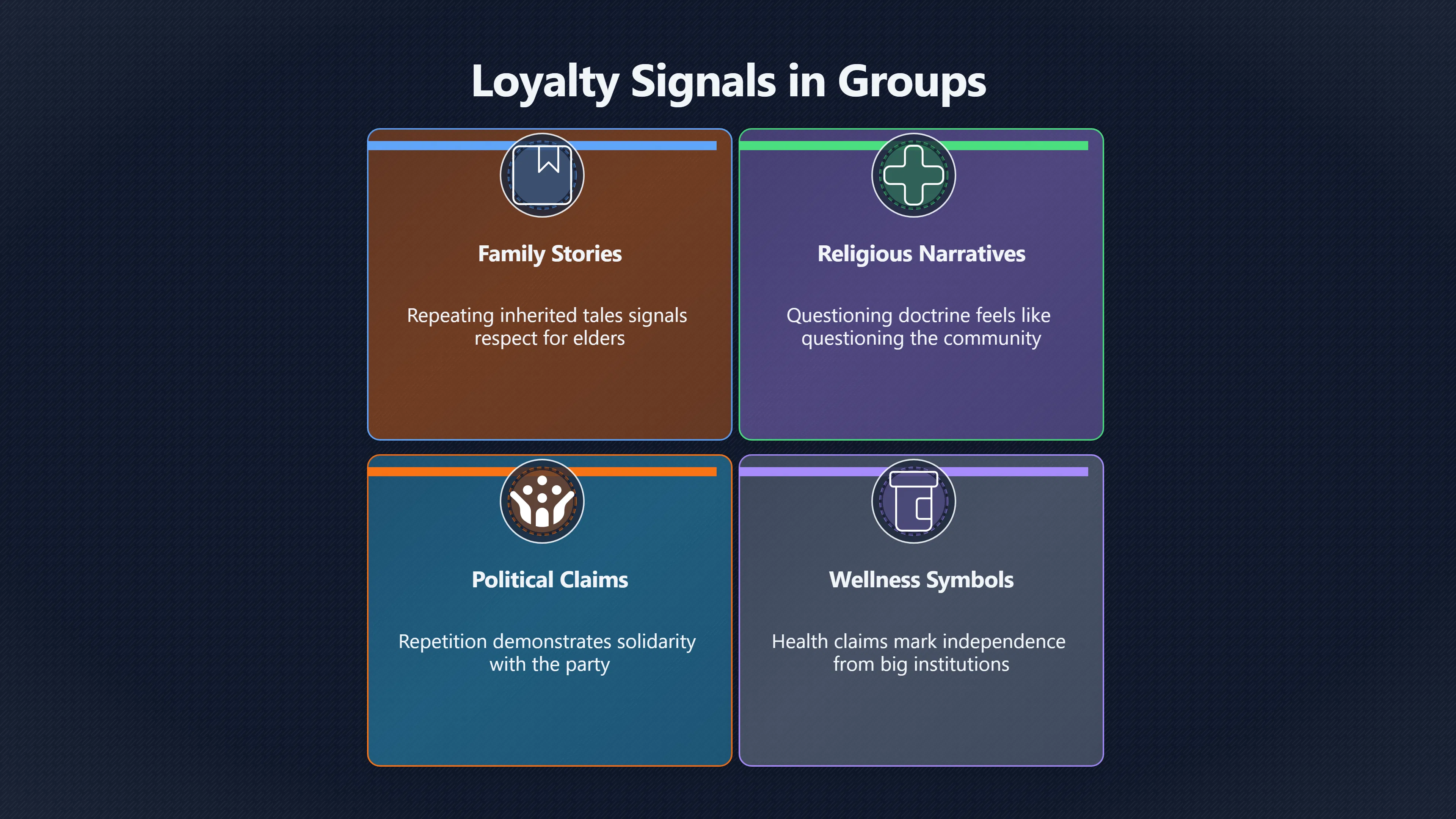
In families, repeating inherited stories can signal respect for parents or grandparents even when the stories are inaccurate.
In some religious settings, questioning a widely accepted narrative may be interpreted as questioning the community itself rather than examining evidence.
In political movements, contested claims can become markers of commitment. People may repeat them not only because they believe them, but because repetition demonstrates solidarity.
In wellness and lifestyle communities, certain claims about food, medicine or health practices can become symbols of independence, natural living or distrust of powerful institutions. Challenging the claim can therefore sound like an attack on the group’s values rather than a factual correction.
The factual content differs across cases, but the social function is remarkably similar.
Moral framing turns belief into a virtue
Group loyalty becomes especially powerful when a belief is attached to moral language.
A claim may come to represent courage, compassion, patriotism, faithfulness, independence or care for vulnerable people. Once that happens, belief is no longer judged primarily on whether it is true. It is judged on whether it expresses the right moral character.
Researchers studying misinformation have found that identity-congruent information is often processed differently from identity-threatening information. People are more likely to accept claims that reinforce important social identities and more likely to resist corrections that appear to threaten those identities.[SSRN]papers.ssrn.comMisconceptions, Misinformation, and the Logic of Identity-…by DM Kahan · 2017 · Cited by 582 — The incidence and impact of misconc…[cambridge]cambridge.orgCambridge University Press & AssessmentIdentity-protective reasoning: an epistemic and political…by C Flores · 2025 · Cited by 5 — Ide… The shift often follows a predictable pattern:
- A claim emerges.
- A community adopts it.
- The claim becomes associated with a valued trait.
- Disagreement becomes morally suspect.
- Evidence is interpreted through the lens of loyalty.
At that point, defending the claim can feel like defending a virtue.
The language of moral obligation
Once beliefs are moralised, disagreement may be interpreted through moral categories rather than factual ones.
A sceptic may be described as:
- Disloyal rather than unconvinced.
- Selfish rather than cautious.
- Weak rather than uncertain.
- Brainwashed rather than persuaded.
- Immoral rather than mistaken.
The result is that factual debate becomes a character judgment. People begin asking not “Is this claim true?” but “What kind of person would reject it?”
That transformation makes correction far more difficult because evidence now competes with moral identity.

Identity protection and the fear of social loss
The theory of identity-protective cognition, associated with the work of Dan Kahan and colleagues, proposes that people often evaluate information in ways that preserve standing within groups they value. On highly polarised topics, individuals may selectively credit or dismiss evidence depending on whether it aligns with the beliefs dominant in their community.[SSRN]papers.ssrn.comMisconceptions, Misinformation, and the Logic of Identity-…by DM Kahan · 2017 · Cited by 582 — The incidence and impact of misconc…[Fondation Descartes]fondationdescartes.orgFondation Descartes False ideas, fake information, and the logic of identityprotection of cultural identity and its impact on the emergence of fake news… research team on major themes related to information and…
This does not necessarily happen consciously.
People rarely think, “I know this is false, but I will believe it anyway.” Instead, the social consequences of belief shape what feels credible in the first place.
From the perspective of everyday life, this can be rational. Losing acceptance within a family, congregation, workplace or political network can carry immediate costs. Being factually correct may provide little benefit if it threatens relationships that matter deeply.
Researchers have argued that identity-protective reasoning can be understood partly as a response to social realities. In some circumstances, preserving group trust may appear more valuable than publicly challenging a shared belief.[Cambridge University Press & Assessment]cambridge.orgCambridge University Press & AssessmentIdentity-protective reasoning: an epistemic and political…by C Flores · 2025 · Cited by 5 — Ide…
The crucial point is that social incentives and truth-seeking incentives do not always point in the same direction.
Why doubting can feel like betrayal
The strongest loyalty-driven myths are often those where doubt itself becomes suspicious.
A community may begin to treat scepticism as evidence of bad motives. Questions that would normally be seen as reasonable become interpreted as signs of weakness, arrogance or disloyalty.
Several mechanisms reinforce this process.
Boundary maintenance. Groups need ways to distinguish insiders from outsiders. Controversial beliefs can become useful markers because they clearly identify who is committed.
Shared sacrifice. If members have invested time, reputation or relationships into defending a claim, abandoning it becomes costly. Continuing to believe can feel like honouring those sacrifices.
Collective memory. Communities often remember past conflicts with rival groups. New factual disputes become linked to older stories about persecution, exclusion or resistance.
Enemy framing. If corrections are associated with distrusted institutions or rival groups, rejecting those corrections becomes a demonstration of loyalty.
These dynamics help explain why evidence sometimes strengthens commitment instead of weakening it. New information is evaluated not only for accuracy but for what accepting it would communicate socially.
Research on conspiracy beliefs has identified similar patterns. Some scholars argue that identity-based motivations encourage people to avoid information that threatens group cohesion, creating self-reinforcing cycles in which belief and selective information exposure support one another.[ScienceDirect]sciencedirect.comA social-psychological model of the self-reinforcing cycle…by T Gkinopoulos · 2025 · Cited by 2 — This avoidance, in turn…
Historical patterns across different eras
The mechanism is older than the internet.
Religious controversies have often involved beliefs that served as markers of communal belonging. Disputes about doctrine were rarely only intellectual disagreements; they also signalled loyalty to institutions, traditions and social networks.
Nationalist movements have frequently attached moral virtue to particular historical narratives. Challenging those narratives could be portrayed as disloyalty to the nation rather than a disagreement about evidence.
Political parties have long used symbolic beliefs to distinguish supporters from opponents. What matters is often not the specific claim but the willingness to affirm it publicly.
The digital age has accelerated these tendencies rather than inventing them. Online communities can rapidly transform factual claims into identity markers because social approval, visibility and group reinforcement operate continuously. Shared beliefs spread through networks where belonging and reputation are constantly on display. Researchers increasingly describe misinformation as deeply connected to social identity processes rather than simply failures of knowledge.[Emerald]emerald.comMisinformation and polarisation as manifestations of social…This study argues that, although social identity is often considere…[Cambridge]cambridge.orgCambridge University Press & AssessmentIdentity-protective reasoning: an epistemic and political…by C Flores · 2025 · Cited by 5 — Ide…
Why facts alone often fail
Many public debates assume that myths survive because people lack information. Sometimes that is true. But loyalty-based beliefs reveal a different problem.
If a belief functions as a signal of belonging, providing contrary evidence may unintentionally raise the social stakes. The correction can be heard as:
- “Your community is foolish.”
- “Your leaders cannot be trusted.”
- “Your values are wrong.”
- “People like you are the problem.”
When corrections carry those implications, resistance becomes more understandable. People are defending social identities as well as factual claims.
Research on misinformation repeatedly finds that successful correction depends not only on accuracy but also on trust, source credibility and identity concerns. Information that threatens a valued identity often encounters stronger resistance than information that merely challenges a factual misunderstanding.[SSRN]papers.ssrn.comMisconceptions, Misinformation, and the Logic of Identity-…by DM Kahan · 2017 · Cited by 582 — The incidence and impact of misconc…[cambridge]cambridge.orgCambridge University Press & AssessmentIdentity-protective reasoning: an epistemic and political…by C Flores · 2025 · Cited by 5 — Ide… This is why myths tied to loyalty can be unusually durable. They are supported by relationships, status and moral commitments, not just mistaken facts.
The deeper reason loyalty can make myths feel moral
At the centre of the process is a basic human need: belonging. People depend on groups for friendship, protection, meaning and identity. Because those needs are powerful, communities often transform beliefs into symbols of trustworthiness and commitment.
When that happens, a false claim can acquire a moral status that has little to do with its factual accuracy. Believing it becomes evidence of loyalty. Repeating it becomes evidence of courage. Defending it becomes evidence of virtue.
The myth survives not because truth has become irrelevant, but because another question has entered the conversation: “What does believing this say about who we are?”
Once that question dominates, correcting the misconception requires more than supplying facts. It requires addressing the social and moral meanings that have become attached to the belief itself.
Amazon book picks
Further Reading
Books and field guides related to When a myth becomes a loyalty test. Use these as the next step if you want deeper reading beyond the article.
Mistakes Were Made (but Not by Me) Third Edition
Shows why people defend group-linked beliefs.

The Righteous Mind
First published 2012. Subjects: Political psychology, Social psychology, Ethics, Religious Psychology, nyt:combined-print-and-e-book-nonf...
eBay marketplace picks
Marketplace Samples
Example marketplace items related to this page. Use the search link to explore similar finds on eBay.

Endnotes
1.
Source: papers.ssrn.com
Link:https://papers.ssrn.com/sol3/papers.cfm?abstract_id=2973067
Source snippet
Misconceptions, Misinformation, and the Logic of Identity-...by DM Kahan · 2017 · Cited by 582 — The incidence and impact of misconc...
2.
Source: centerconflictcooperation-newsletter.com
Title: Social identity shapes your belief in [fake news]({{ ‘fake-news/’ | relative_url }})
Link:https://www.centerconflictcooperation-newsletter.com/p/social-identity-shapes-your-belief
Source snippet
August 3, 2022 — To understand how partisanship works in the mind and brain, we have to return to one of the most fundamental theories in...
Published: August 3, 2022
3.
Source: cambridge.org
Link:https://www.cambridge.org/core/journals/episteme/article/identityprotective-reasoning-an-epistemic-and-political-defense/5C62B4A3FC3F564ADE86BA5B7C5EF2BE
Source snippet
Cambridge University Press & AssessmentIdentity-protective reasoning: an epistemic and political...by C Flores · 2025 · Cited by 5 — Ide...
4.
Source: sciencedirect.com
Link:https://www.sciencedirect.com/science/article/pii/S2352250X25002064
Source snippet
A social-psychological model of the self-reinforcing cycle...by T Gkinopoulos · 2025 · Cited by 2 — This avoidance, in turn...
5.
Source: emerald.com
Link:https://www.emerald.com/jices/article/doi/10.1108/JICES-07-2025-0195/1360204/Misinformation-and-polarisation-as-manifestations
Source snippet
Misinformation and polarisation as manifestations of social...This study argues that, although social identity is often considere...
6.
Source: informalscience.org
Link:https://informalscience.org/identity/dan-kahan/
Source snippet
Identity | Dan KahanDan Kahan's identity-related work has focused on “identity protective cognition”, which refers to the tendency of ind...
7.
Source: repository.cam.ac.uk
Link:https://www.repository.cam.ac.uk/items/fa35a87e-595f-4b64-aa44-3e9f2e8fdd76
Source snippet
bridge RepositoryAccuracy and Social Motivations Shape Judgements of (Mis...by S Rathje · 2022 · Cited by 173 — Some theories focus o...
8.
Source: fondationdescartes.org
Title: Fondation Descartes False ideas, fake information, and the logic of identity
Link:https://www.fondationdescartes.org/en/2020/06/les-idees-fausses-les-fausses-informations-et-la-logique-du-raisonnement-pour-proteger-son-identite/
Source snippet
protection of cultural identity and its impact on the emergence of fake news... research team on major themes related to information and...
9.
Source: repository.cam.ac.uk
Link:https://www.repository.cam.ac.uk/bitstreams/f897d791-4623-494b-8773-600bd44fb858/download
Source snippet
bridge RepositoryThe Social Cognition of Misinformation and Implications for...by CS Traberg · 2025 — To examine the psychological un...
Additional References
10.
Source: researchgate.net
Link:https://www.researchgate.net/publication/377292982_Updating_the_Identity-based_Model_of_Belief_From_False_Belief_to_the_Spread_of_Misinformation
Source snippet
Updating the Identity-based Model of Belief: From False...25 Apr 2026 — The identity-based model suggests that people spread misinformat...
11.
Source: pmc.ncbi.nlm.nih.gov
Link:https://pmc.ncbi.nlm.nih.gov/articles/PMC11575416/
Source snippet
by S Munusamy · 2024 · Cited by 42 — Cognitive biases, emotional appeals, and social identity motivations are believed to play a cruci...
12.
Source: scispace.com
Link:https://scispace.com/pdf/misconceptions-misinformation-and-the-logic-of-identity-mpc3ka7t6o.pdf
Source snippet
individuals to selectively credit and dismiss evi- dence in patterns that reflect the...Read more...
13.
Source: researchgate.net
Link:https://www.researchgate.net/publication/317999685_Misconceptions_Misinformation_and_the_Logic_of_Identity-Protective_Cognition
Source snippet
emphasizes the role of group identity in shaping how individuals process information...Read more...
14.
Source: elizabethsandelmd.com
Title: flying in the face of facts denialism anosognosia and the human brain
Link:https://elizabethsandelmd.com/insights/flying-in-the-face-of-facts-denialism-anosognosia-and-the-human-brain/
Source snippet
This irrational thinking is called motivated reasoning, a kind of reasoning that results...Read more...
15.
Source: pdfs.semanticscholar.org
Link:https://pdfs.semanticscholar.org/69b6/fb97529b86bc3b8f0f65d666aa987a1a91ed.pdf
Source snippet
Role of Emotions and Identity-Protection Cognition...by M Wischnewski · 2021 · Cited by 17 — Previous studies about misinformation accep...
16.
Source: dhi.ac.uk
Title: governance crone connelly 2016
Link:https://www.dhi.ac.uk/san/waysofbeing/data/governance-crone-connelly-2016.pdf
Source snippet
The online presence of ideological groups has enabled the dissemination of group beliefs and ideas through a variety of new media.Read more...
17.
Source: tandfonline.com
Link:https://www.tandfonline.com/doi/full/10.1080/09515089.2024.2358089
Source snippet
Full article: Misinformation, observational equivalence and...by M van Doorn · 2025 · Cited by 3 — Nonetheless, these findings often dep...
18.
Source: tandfonline.com
Link:https://www.tandfonline.com/doi/full/10.1080/10510974.2025.2515032
Source snippet
The Interplay of Social Identity, Moral Framing, and Credibilityby H Song · 2026 · Cited by 1 — Extensive research has highlighted how po...
19.
Source: pmc.ncbi.nlm.nih.gov
Link:https://pmc.ncbi.nlm.nih.gov/articles/PMC10623619/
Source snippet
by Z Adams · 2023 · Cited by 127 — Most studies made reference to the effects of misinformation or fake news in their introduction as...
Topic Tree