Within Learning Styles
When students believe they learn only one way
Students may avoid useful study strategies when a style label becomes part of how they explain success and difficulty.
On this page
- How style labels become study excuses
- Why preferred activities are not always the best practice
- How teachers can redirect pupils toward flexible strategies
Page outline Jump by section
Introduction
Many pupils do not just encounter learning-style labels from teachers, parents or study guides. They often begin applying the labels to themselves. A student may decide, Im a visual learner or Im kinaesthetic, so I need to move around to learn. These descriptions can feel helpful because they offer a simple explanation for why some classroom activities feel easier than others. The problem is that the label can gradually become part of a students identity, shaping how they approach work, interpret setbacks and decide which study methods are worth trying.
 Research does not support the idea that students learn best when teaching is matched to a fixed visual, auditory or kinaesthetic style. Yet self-labelling remains common, and the consequences are often practical rather than theoretical. Students may avoid useful learning strategies, underestimate their ability to adapt, or explain difficulties as evidence that material was presented in the wrong way rather than as a signal to change approach or increase practice.[EEF]educationendowmentfoundation.org.ukuccess is due to their learning styles.Read more…[2onlineteaching.umich.edu]onlineteaching.umich.eduthe myth of learning stylesRoundup on Research: The Myth of 'Learning Styles'10 Jan 2024 No study has shown that teaching to an identified learning style results…
How style labels become study excuses
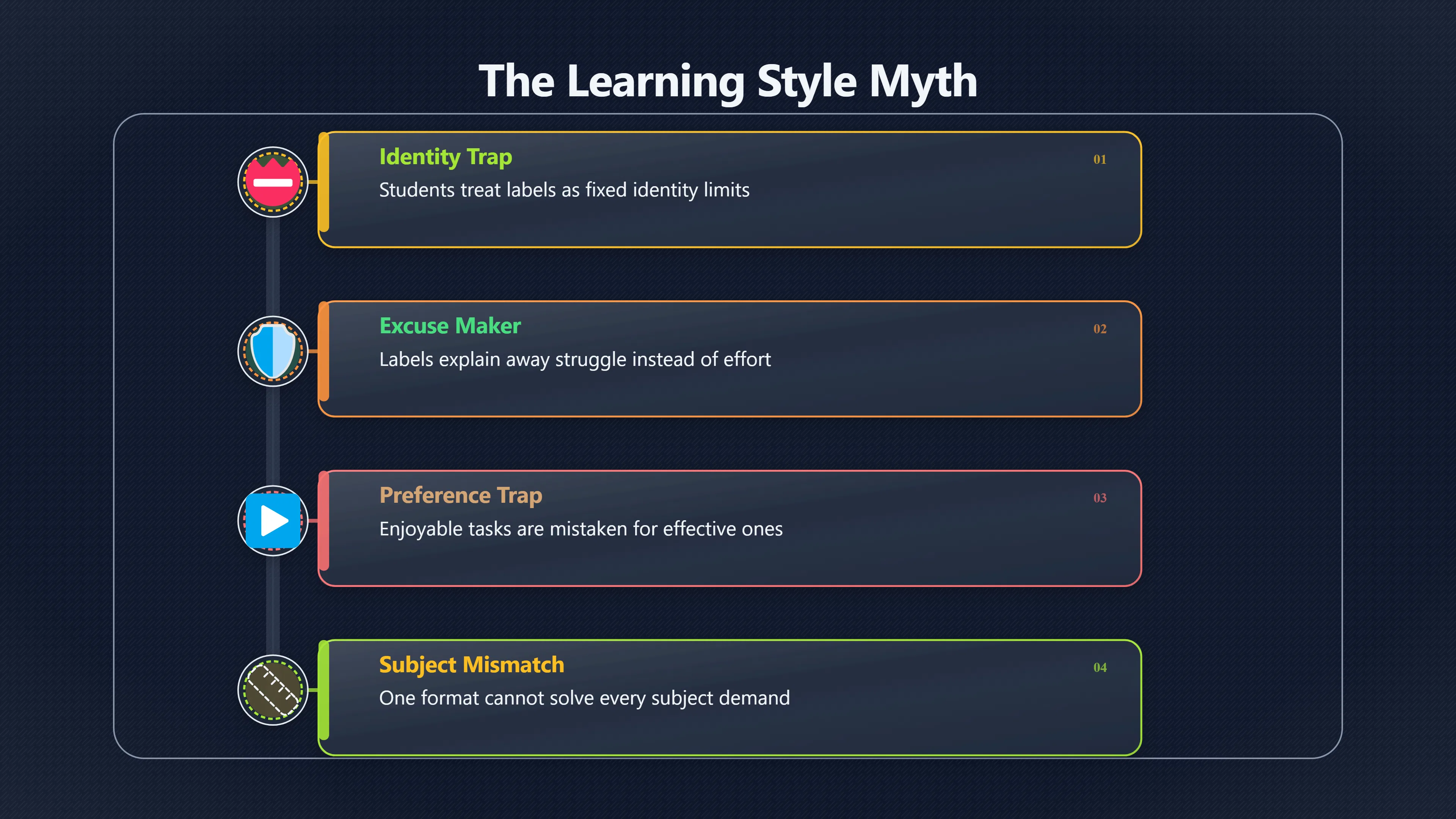
A learning-style label can start as a preference and end as a limitation.
Many pupils genuinely prefer certain kinds of activities. Some enjoy diagrams, colour-coding and videos. Others like practical tasks, demonstrations or discussion. Preference itself is not the problem. The difficulty begins when preference becomes a rule that students believe describes how they are capable of learning.
A pupil who identifies as a visual learner may start rejecting methods that require explanation through text, retrieval practice or verbal reasoning. A self-described kinaesthetic learner may assume that reading, note-making or independent problem-solving are ineffective for them before they have seriously attempted those activities. The label becomes an explanation in advance.
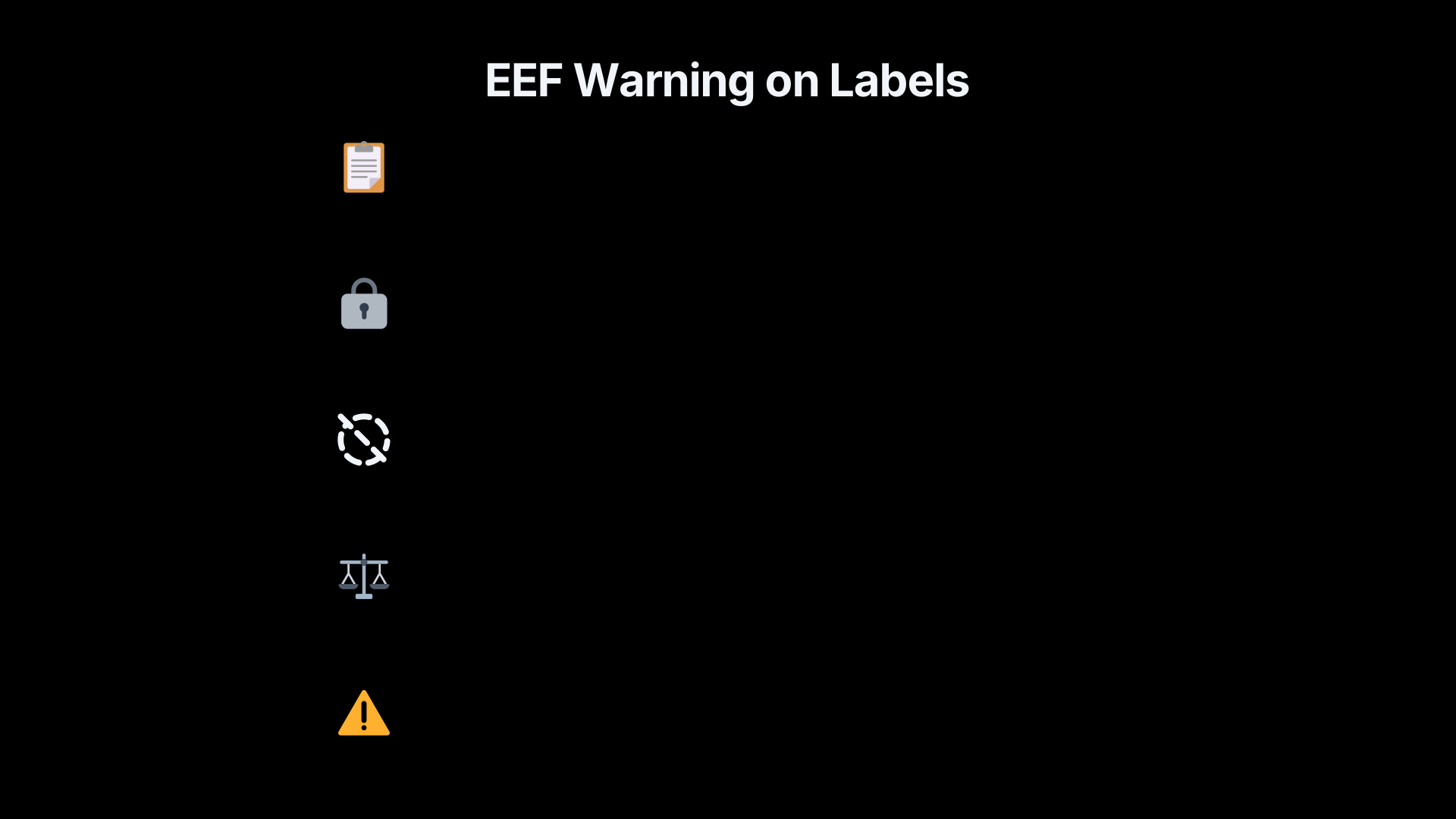
This can be especially damaging when students face challenging material. Instead of thinking, I have not understood this yet, they may think, This was taught in the wrong style for me. The explanation feels reassuring because it protects self-esteem, but it can also reduce persistence. The problem is relocated from strategy and effort to an assumed mismatch between learner and lesson. The Education Endowment Foundation has specifically warned that pupils should not be led to believe that a lack of success is due to their learning style.[EEF]educationendowmentfoundation.org.ukuccess is due to their learning styles.Read more…
Researchers and education specialists have repeatedly noted this risk. When students become convinced they can only learn through one mode, they may stop experimenting with other approaches and narrow their own opportunities to improve.[Tech & Learning]techlearning.comTech & Learning Busting The Myth of Learning StylesDespite its deep-rooted presence in education, numerous studies, including those by Polly R. Husmann and Daniel T. Willingham, have found…
Why the labels feel convincing
The self-labelling process often seems accurate because students are describing a real experience.
A pupil may notice that a diagram helped them understand photosynthesis, or that a practical science activity was memorable. From that observation, it is easy to make a larger leap: I learn best visually or I only learn by doing.
But successful learning experiences usually involve several factors at once:
- The explanation may simply have been clearer.
- The task may have been more engaging.
- The content may naturally suit visual representation.
- The student may have spent more time paying attention.
- The activity may have required deeper thinking.
Students often attribute success to the format while overlooking these other influences. As a result, they may overestimate the importance of the supposed style and underestimate the role of attention, practice, prior knowledge and task design.[onlineteaching.umich.edu]onlineteaching.umich.eduthe myth of learning stylesRoundup on Research: The Myth of 'Learning Styles'10 Jan 2024 No study has shown that teaching to an identified learning style results…[Poorvu Center for Teaching and Learning]poorvucenter.yale.eduPoorvu Center for Teaching and LearningLearning Styles as a Myth - Poorvu Center - Yale UniversityAt a Glance Research indicates that t…
Why preferred activities are not always the best practice
One of the most important misunderstandings in learning-style thinking is the assumption that enjoyable learning and effective learning are the same thing.
They are not always identical.
A student may enjoy watching videos because videos feel fluent and easy to follow. Another may prefer highlighting colourful notes because it creates a sense of organisation. A kinaesthetic learner may enjoy building models or participating in practical demonstrations. These activities can be useful in some circumstances, but preference alone does not prove they are the most effective way to remember or apply knowledge later.
Research reviews have found no reliable evidence that matching instruction to a student’s self-identified learning style improves learning outcomes.[onlineteaching.umich.edu]onlineteaching.umich.eduthe myth of learning stylesRoundup on Research: The Myth of 'Learning Styles'10 Jan 2024 No study has shown that teaching to an identified learning style results…[Poorvu Center for Teaching and Learning]poorvucenter.yale.eduPoorvu Center for Teaching and LearningLearning Styles as a Myth - Poorvu Center - Yale UniversityAt a Glance Research indicates that t…
The distinction matters because many highly effective learning techniques do not always feel comfortable. Retrieval practice, self-testing, spaced repetition and working through difficult questions can feel harder than rewatching a video or rereading notes. Yet the greater difficulty often reflects productive mental effort rather than poor learning.
A student who strongly identifies as visual may therefore reject a method that would actually help them more. If self-testing feels difficult, they may interpret that discomfort as proof that the method does not suit their style. In reality, the difficulty may be exactly what makes the method effective.
Different subjects require different approaches
Another weakness in self-labelling is that school subjects are not all learned in the same way.
Geometry often benefits from visual representation. Pronunciation in languages requires listening and speaking. Writing improves through writing. Science frequently combines diagrams, language, practical work and mathematical reasoning.
The format that best supports learning often depends on the content itself rather than on a student’s declared style. A pupil who insists they are exclusively visual still has to learn through language, discussion, reading and practice in many parts of the curriculum. Likewise, a self-described kinaesthetic learner cannot master algebra simply through movement.
The most successful learners usually adapt their methods to the demands of the task rather than expecting every task to fit a personal category.[Poorvu Center for Teaching and Learning]poorvucenter.yale.eduPoorvu Center for Teaching and LearningLearning Styles as a Myth - Poorvu Center - Yale UniversityAt a Glance Research indicates that t…
How self-labels shape expectations and confidence
Learning-style labels do more than influence study habits. They can also affect how students think about their own abilities.
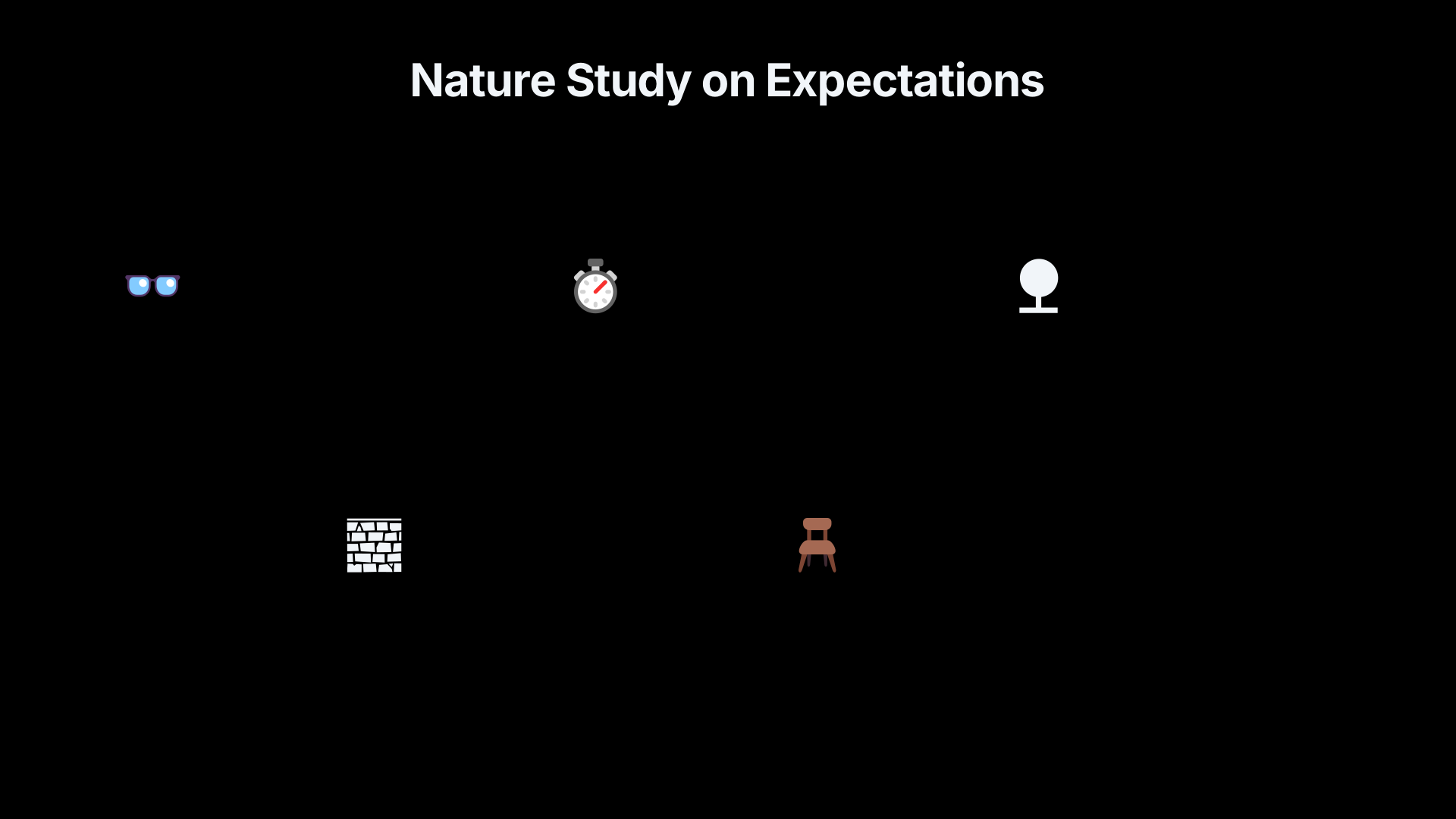
Recent research suggests that descriptions such as visual learner or hands-on learner can influence expectations about what children are naturally good at. In experimental studies, parents and teachers made different assumptions about pupils’ likely strengths depending on the learning-style label attached to them.[Nature]nature.comBeware the myth: learning styles affect parents', children's…by X Sun 2023 Cited by 31 These studies show that learning st…
Students can internalise similar assumptions.
A pupil who identifies as visual may begin to think that success in reading-heavy subjects is less likely for them. A self-described kinaesthetic learner may assume that academic tasks requiring sustained concentration are naturally harder for people like them. Over time, the label can become a story about talent rather than a description of preference.
This is one reason learning-style language can overlap with other unhelpful beliefs about fixed ability. Once students see learning capacity as predetermined, they may become less willing to experiment, struggle or improve through practice. The label starts functioning as an identity category rather than a temporary preference.[Tes]tes.comWhat are learning styles?Our Teaching and Learning Toolkit indicates that there is very little evidence to back up the learning styles…
How teachers can redirect pupils toward flexible strategies
The alternative to learning-style labelling is not treating every learner as identical. Students clearly differ in interests, confidence, background knowledge and strengths. The difference is that these variations are treated as flexible and contextual rather than fixed categories.
Teachers can help pupils move beyond self-labelling in several ways.
Acknowledge preferences without treating them as limits.
A teacher can accept that a student enjoys diagrams or practical work while also emphasising that people can learn through many routes.
Talk about strategies rather than types of learner.
Instead of saying, You are a visual learner, teachers can discuss when diagrams help and when other approaches are more useful.
Normalise adapting methods to the task.
Students benefit from hearing that different subjects require different tools. A single approach is unlikely to work best everywhere.
Explain desirable difficulty.
When effective learning feels effortful, pupils often need reassurance that struggle does not mean failure. It may mean learning is taking place.
Build a wider study toolkit.
Students who practise retrieval, explanation, note-making, questioning, problem-solving and discussion gain multiple ways to approach difficult material. This reduces dependence on a single preferred format.[Tech & Learning]techlearning.comTech & Learning Busting The Myth of Learning StylesDespite its deep-rooted presence in education, numerous studies, including those by Polly R. Husmann and Daniel T. Willingham, have found…[Poorvu Center for Teaching and Learning]poorvucenter.yale.eduPoorvu Center for Teaching and LearningLearning Styles as a Myth - Poorvu Center - Yale UniversityAt a Glance Research indicates that t…
The goal is not to persuade students that preferences do not exist. It is to prevent preferences from hardening into restrictions. When pupils stop asking, What type of learner am I? and start asking, What strategy works best for this task?, they move closer to a more flexible and evidence-based understanding of learning.[EEF]educationendowmentfoundation.org.ukuccess is due to their learning styles.Read more…[2onlineteaching.umich.edu]onlineteaching.umich.eduthe myth of learning stylesRoundup on Research: The Myth of 'Learning Styles'10 Jan 2024 No study has shown that teaching to an identified learning style results…
Amazon book picks
Further Reading
Books and field guides related to When students believe they learn only one way. Use these as the next step if you want deeper reading beyond the article.
Why Don't Students Like School?
Explains learner differences without rigid categories.

eBay marketplace picks
Marketplace Samples
Example marketplace items related to this page. Use the search link to explore similar finds on eBay.

Endnotes
1.
Source: educationendowmentfoundation.org.uk
Link:https://educationendowmentfoundation.org.uk/education-evidence/teaching-learning-toolkit/learning-styles
Source snippet
uccess is due to their learning styles.Read more...
2.
Source: onlineteaching.umich.edu
Title: the myth of learning styles
Link:https://onlineteaching.umich.edu/articles/the-myth-of-learning-styles/
Source snippet
Roundup on Research: The Myth of 'Learning Styles'10 Jan 2024 No study has shown that teaching to an identified learning style results...
3.
Source: tes.com
Link:https://www.tes.com/magazine/tes-explains/what-are-learning-styles
Source snippet
What are learning styles?Our Teaching and Learning Toolkit indicates that there is very little evidence to back up the learning styles...
4.
Source: nature.com
Link:https://www.nature.com/articles/s41539-023-00190-x
Source snippet
Beware the myth: learning styles affect parents', children's...by X Sun 2023 Cited by 31 These studies show that learning st...
5.
Source: poorvucenter.yale.edu
Link:https://poorvucenter.yale.edu/teaching/teaching-resource-library/learning-styles-as-a-myth
Source snippet
Poorvu Center for Teaching and LearningLearning Styles as a Myth - Poorvu Center - Yale UniversityAt a Glance Research indicates that t...
6.
Source: techlearning.com
Title: Tech & Learning Busting The Myth of Learning Styles
Link:https://www.techlearning.com/news/busting-the-myth-of-learning-styles
Source snippet
Despite its deep-rooted presence in education, numerous studies, including those by Polly R. Husmann and Daniel T. Willingham, have found...
Additional References
7.
Source: educationalneuroscience.org.uk
Link:https://educationalneuroscience.org.uk/wordpress/resources/neuromyth-or-neurofact/children-have-different-learning-styles/
Source snippet
Children have different learning stylesTwo major difficulties with the use of learning styles in schools are that labelling children as a...
8.
Source: educationalneuroscience.org.uk
Link:https://www.educationalneuroscience.org.uk/resources/neuromyth-or-neurofact/children-have-different-learning-styles/
Source snippet
Children have different learning stylesThe Education Endowment Foundation Teaching and Learning Toolkit provides an excellent summary of...
9.
Source: kumon.co.uk
Link:https://www.kumon.co.uk/blog/identifying-different-learning-styles-in-children
Source snippet
Identifying different learning stylesCategorising students is also believed to contribute to a 'fixed mindset', leading the child to beli...
10.
Source: educationendowmentfoundation.org.uk
Link:https://educationendowmentfoundation.org.uk/education-evidence/teaching-learning-toolkit/learning-styles/technical-appendix
Source snippet
Learning styles: Technical AppendixThe idea underpinning learning styles is that individuals all have a particular approach to or style o...
11.
Source: qrf.org
Link:https://qrf.org/en/node/pdf/1242/pdf
Source snippet
Queen Rania FoundationLearning Styles Cost Evidence IMPACTIt is particularly important not to label primary age pupils, or for them to be...
12.
Source: api.warwickshire.gov.uk
Link:https://api.warwickshire.gov.uk/documents/WCCC
Source snippet
The SuttonTrust-EEF Teaching and Learning Toolkit. Learning styles. Low impact for very low cost, based on moderate evidence.Read more...
13.
Source: avadolearning.com
Link:https://www.avadolearning.com/blog/the-7-different-learning-styles-and-what-they-mean/
Source snippet
Visual, Kinaesthetic, Aural, Social, Solitary, Verbal, Logical. Author Profile Picture. Avado.Read more...
14.
Source: carlhendrick.substack.com
Link:https://carlhendrick.substack.com/p/the-learning-styles-illusion-[debunking
Source snippet
fferent learning preferences but that students learn better when taught in their...Read more...
15.
Source: rcl.ac.uk
Title: find your ideal study method learning style tips
Link:https://www.rcl.ac.uk/news/find-your-ideal-study-method-learning-style-tips/
Source snippet
How to determine your learning style for effective studying7 Nov 2024 This blog provides a comprehensive guide to understanding and ide...
16.
Source: kumon.ie
Title: Identifying children’s different learning styles
Link:https://www.kumon.ie/blog/identifying-childrens-different-learning-styles
Source snippet
Visual learners tend to recognise words by sight, use lists to organise their thoughts, and benefit from using mind-maps or drawing...
Topic Tree