Within Media Literacy
Why leaving the page can reveal more
Lateral reading helps readers check who is behind a claim before polished design or confident wording makes it feel credible.
On this page
- What lateral reading means in practice
- Why visual credibility can mislead readers
- How fact checkers verify a source quickly
Page outline Jump by section
Introduction
False claims rarely announce themselves as false. More often, they arrive wrapped in professional design, confident language, institutional-sounding names, and selective evidence. In the context of myth prevention, one of the most effective habits is to check who is behind a claim before deciding whether the claim deserves attention. This habit is known as lateral reading.
 Lateral reading reverses a common instinct. Instead of staying on a page and judging its appearance, readers leave the page and investigate the source elsewhere. Research comparing professional fact-checkers with students and academics found that fact-checkers consistently opened new tabs, searched for independent information about a source, and checked reputation before evaluating content. This approach helped them reach more reliable conclusions more quickly.[Sage Journals]journals.sagepub.comSage JournalsReading Less and Learning More When Evaluating Digital…by S Wineburg · 2019 · Cited by 604 — Fact checkers read laterally…
For preventing myths and misconceptions, the timing matters. Source checking works best before trust settles in. Once a source feels credible, people often become less critical of the claims that follow.
What lateral reading means in practice
Lateral reading is a practical verification technique rather than a theory. The central idea is simple: when encountering an unfamiliar source, do not let the source define itself.
A reader using lateral reading might:[cor.inquirygroup.org]cor.inquirygroup.orgteaching lateral readingLateral Reading | CORThese lessons also introduce students to resources they can use when laterally reading: Wikipedia, news stories, and…
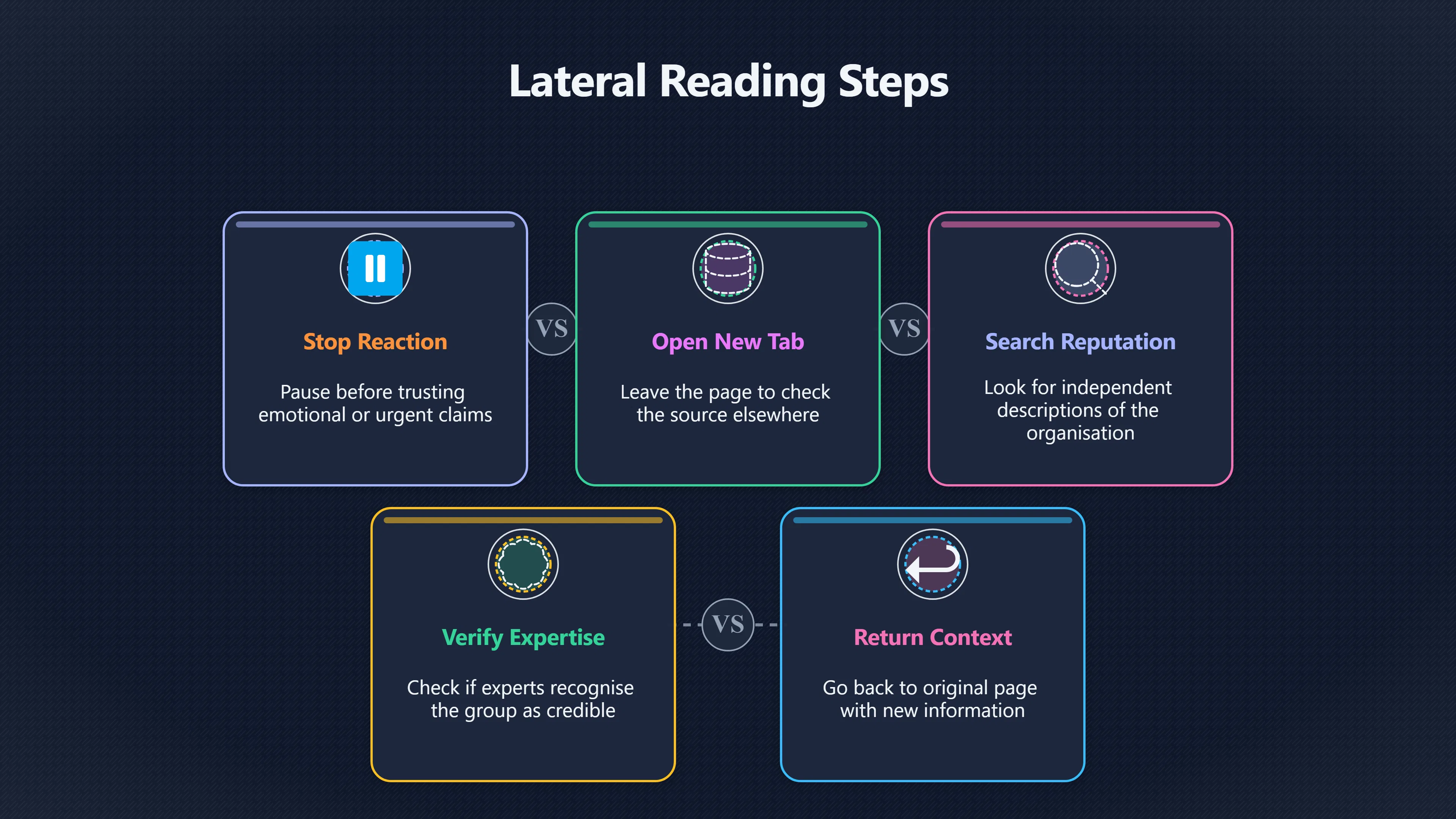
- Open a new tab immediately.
- Search the organisation’s name alongside terms such as “about”, “funding”, “controversy”, or “fact check”.
- Look for independent descriptions from reputable news organisations, academic institutions, professional bodies, or established reference sources.
- Check whether experts in the relevant field recognise the organisation as credible.
- Return to the original page only after gaining context.
This differs from what researchers call “vertical reading”, where people stay on the website and evaluate features such as design quality, logos, mission statements, or the appearance of professionalism. Studies by Sam Wineburg and Sarah McGrew found that many students and even trained historians relied heavily on these on-page signals, while professional fact-checkers quickly moved off the page to investigate the source itself.[Sage Journals]journals.sagepub.comSage JournalsReading Less and Learning More When Evaluating Digital…by S Wineburg · 2019 · Cited by 604 — Fact checkers read laterally… 2stacks.stanford.edu
The practical insight is that credibility is often easier to assess from outside a source than from inside it.
Why visual credibility can mislead readers
Humans are highly responsive to cues that suggest authority. A polished website, sophisticated graphics, official-looking branding, and formal language can create an impression of trustworthiness before any evidence has been examined.
Researchers studying online information evaluation found that participants were frequently influenced by superficial features such as domain names, logos, organisational titles, and professional presentation. Fact-checkers, by contrast, treated these cues as insufficient and sought independent confirmation.[Sage Journals]journals.sagepub.comSage JournalsReading Less and Learning More When Evaluating Digital…by S Wineburg · 2019 · Cited by 604 — Fact checkers read laterally…
This matters because misinformation often imitates the appearance of expertise. Examples include:
- Advocacy groups presenting themselves as neutral research institutes.
- Commercial organisations appearing to be independent educational resources.
- Anonymous websites adopting names that resemble government agencies or scientific bodies.
- Social media accounts using professional graphics to suggest expertise they do not possess.
A reader who remains on the page may see only the source’s self-description. A reader who leaves the page may discover funding relationships, political affiliations, previous fact-checks, or a lack of recognised expertise.
The difference is not merely academic. Many myths spread because audiences evaluate presentation quality instead of source reputation. Lateral reading interrupts that process before credibility becomes attached to the message.
How fact-checkers verify a source quickly
Professional fact-checkers rarely perform exhaustive investigations for every claim. Instead, they use efficient routines that rapidly establish whether a source deserves further attention.
Research from the Stanford History Education Group, now the Digital Inquiry Group, observed that experienced fact-checkers often spent only seconds on an unfamiliar page before opening additional tabs and consulting the wider web.[Stanford News]news.stanford.edufact checkers outperform historians evaluating online informationStanford NewsFact checkers outperform historians when evaluating online…Oct 24, 2017 — Wineburg and McGrew observed that even historia…
Their process commonly includes:
Checking external reputation
Search for independent reporting or background information about the organisation. If reputable outlets consistently identify a group as a lobbying organisation, marketing vehicle, or partisan project, that context matters.[UK Parliament Committees]committees.parliament.ukUK Parliament CommitteesDAD0080 - Evidence on Democracy and Digital…Our approach, in contrast, is based on research we've done with pr…
Looking for expertise
Determine whether the people behind the content possess recognised qualifications or experience relevant to the subject. Expertise is domain-specific; expertise in one field does not automatically transfer to another.
Finding better coverage[pressbooks.pub]pressbooks.pubThe SIFT Method –Investigate the source. Find better coverage. Trace claims, quotes and media to the original context.Read more…
Instead of asking whether a single source is trustworthy, fact-checkers ask whether multiple credible sources report the same information. Independent corroboration is often more informative than evaluating one page in isolation.[guides.lib.uchicago.edu]guides.lib.uchicago.eduThe SIFT MethodEvaluating Resources and Misinformation30 Jun 2025 — The SIFT method is an evaluation strategy developed by digital literacy expert, Mike…[2wisconsin.pressbooks.pub]wisconsin.pressbooks.pubEvaluating Sources – Information Literacy: A Practical GuideDescribe the four steps of the SIFT method (Stop, Investigate the source, Fin…
Tracing claims back to their origin
Statistics, quotations, and images are frequently detached from their original context. Following a claim back to the original study, document, interview, or dataset often reveals omissions or distortions.[pressbooks.pub]pressbooks.pubThe SIFT Method –Investigate the source. Find better coverage. Trace claims, quotes and media to the original context.Read more…
Researchers have described this strategy as one reason professional fact-checkers frequently outperform other highly educated groups when evaluating online information.[SSRN]papers.ssrn.comReading Less and Learning More When Evaluating Digital…by S Wineburg · 2019 · Cited by 79 — Wineburg, Sam and mcgrew, sarah, Later…
The SIFT framework as a practical routine
Digital literacy expert Mike Caulfield developed the SIFT framework as a simple way to apply lateral reading consistently. The framework has been widely adopted in educational and information-literacy programmes.[guides.lib.uchicago.edu]guides.lib.uchicago.eduThe SIFT MethodEvaluating Resources and Misinformation30 Jun 2025 — The SIFT method is an evaluation strategy developed by digital literacy expert, Mike…[2guides.lib.virginia.edu]guides.lib.virginia.eduSIFT - Source Evaluation - LibGuides at UVa LibrarySep 30, 2025 — The SIFT method was developed by digital literacy expert, Mike Caulfiel…
Stop before reacting
Many misleading claims are designed to provoke anger, fear, outrage, or excitement. Pausing prevents emotional reactions from becoming instant trust or immediate sharing.[mediahelpingmedia.org]mediahelpingmedia.orgsift for fact checkingSIFT for fact-checking30 Mar 2025 — It encourages journalists to apply “lateral reading,” which means looking at what other sources say a…
Investigate the source
Find out who is behind the information and what others say about them. This is the core lateral-reading move.[guides.lib.uchicago.edu]guides.lib.uchicago.eduThe SIFT MethodEvaluating Resources and Misinformation30 Jun 2025 — The SIFT method is an evaluation strategy developed by digital literacy expert, Mike…
Find better coverage
Look for reporting or analysis from established sources with transparent editorial standards or recognised expertise.[wisconsin.pressbooks.pub]wisconsin.pressbooks.pubEvaluating Sources – Information Literacy: A Practical GuideDescribe the four steps of the SIFT method (Stop, Investigate the source, Fin…
Trace claims to the original context
Follow quotations, statistics, charts, images, or studies back to their original source before accepting interpretations built on them.[pressbooks.pub]pressbooks.pubThe SIFT Method –Investigate the source. Find better coverage. Trace claims, quotes and media to the original context.Read more…
The strength of SIFT is that it encourages verification before belief rather than correction after belief.
A common misunderstanding: leaving the page is not distrust
Some readers assume lateral reading means rejecting unfamiliar sources automatically. It does not.
The goal is not to dismiss new voices or unconventional information. Many important discoveries, whistle-blower reports, and specialist publications begin outside mainstream awareness. The goal is simply to establish context before granting trust.
[Lateral Reading]scienceofboosting.orgBoosting4 May 2023 — Wineburg and McGrew (2017, 2019) conducted a study with Stanford undergraduates, university professors, and professi… asks questions such as:
- Who created this information?
- What is their track record?
- How do knowledgeable observers describe them?
- Is there independent confirmation of the claim?
A source may prove highly reliable after this process. The difference is that trust is earned through verification rather than appearance.

Why lateral reading helps prevent myths
Myths often gain strength during the brief period between exposure and verification. If a claim appears credible at first glance, people may remember it, share it, or incorporate it into their understanding before checking whether the source deserves confidence.
Lateral reading shortens that vulnerable window. By making source investigation the first step rather than the last, readers are less likely to be influenced by polished presentation, emotionally compelling narratives, or borrowed symbols of authority. Research on civic online reasoning and information evaluation suggests that these habits can be taught and improved, helping people become more effective at identifying questionable sources online.[ed.stanford.edu]ed.stanford.eduIt doesn't take long to learn how to spot misinformation online…19 Apr 2022 — It doesn't take long to learn how to spot misinformation…
Within media literacy, this makes lateral reading a preventive tool rather than a corrective one. It does not require memorising every myth. Instead, it teaches a repeatable method for deciding whether a source has earned the right to be trusted before its claims take hold.
Amazon book picks
Further Reading
Books and field guides related to Why leaving the page can reveal more. Use these as the next step if you want deeper reading beyond the article.
A field guide to lies
First published 2016. Subjects: Critical thinking, Fallacies (Logic), Reasoning, Statistics, Social aspects.
Calling Bullshit: The Art of Skepticism in a Data-Driven World
Provides methods for assessing information credibility.
eBay marketplace picks
Marketplace Samples
Example marketplace items related to this page. Use the search link to explore similar finds on eBay.



Endnotes
1.
Source: papers.ssrn.com
Link:https://papers.ssrn.com/sol3/papers.cfm?abstract_id=3048994
Source snippet
Reading Less and Learning More When Evaluating Digital...by S Wineburg · 2019 · Cited by 79 — Wineburg, Sam and mcgrew, sarah, Later...
2.
Source: stacks.stanford.edu
Title: Wineburg Mc Grew Lateral Reading and the Nature of Expertise
Link:https://stacks.stanford.edu/file/druid%3Ayk133ht8603/Wineburg%20McGrew_Lateral%20Reading%20and%20the%20Nature%20of%20Expertise.pdf
Source snippet
Lateral Reading and the Nature of Expertise28 Jul 2018 — 1 or 2 sentence description of article: This study compares how professional fac...
3.
Source: news.stanford.edu
Title: fact checkers outperform historians evaluating online information
Link:https://news.stanford.edu/stories/2017/10/fact-checkers-outperform-historians-evaluating-online-information
Source snippet
Stanford NewsFact checkers outperform historians when evaluating online...Oct 24, 2017 — Wineburg and McGrew observed that even historia...
4.
Source: committees.parliament.uk
Link:https://committees.parliament.uk/writtenevidence/105805/html/
Source snippet
UK Parliament CommitteesDAD0080 - Evidence on Democracy and Digital...Our approach, in contrast, is based on research we've done with pr...
5.
Source: guides.lib.uchicago.edu
Title: The SIFT Method
Link:https://guides.lib.uchicago.edu/c.php?g=1241077&p=9082322
Source snippet
Evaluating Resources and Misinformation30 Jun 2025 — The SIFT method is an evaluation strategy developed by digital literacy expert, Mike...
6.
Source: wisconsin.pressbooks.pub
Link:https://wisconsin.pressbooks.pub/info-lit/chapter/evaluating-sources/
Source snippet
Evaluating Sources – Information Literacy: A Practical GuideDescribe the four steps of the SIFT method (Stop, Investigate the source, Fin...
7.
Source: mediahelpingmedia.org
Title: sift for fact checking
Link:https://mediahelpingmedia.org/basics/sift-for-fact-checking/
Source snippet
SIFT for fact-checking30 Mar 2025 — It encourages journalists to apply “lateral reading,” which means looking at what other sources say a...
8.
Source: pressbooks.pub
Title: The SIFT Method –
Link:https://pressbooks.pub/introtocollegeresearch/chapter/the-sift-method/
Source snippet
Investigate the source. Find better coverage. Trace claims, quotes and media to the original context.Read more...
9.
Source: guides.lib.virginia.edu
Link:https://guides.lib.virginia.edu/c.php?g=1483059&p=11057026
Source snippet
SIFT - Source Evaluation - LibGuides at UVa LibrarySep 30, 2025 — The SIFT method was developed by digital literacy expert, Mike Caulfiel...
10.
Source: ecampusontario.pressbooks.pub
Title: Lateral Reading – Western Libraries Tutorials SIFT
Link:https://ecampusontario.pressbooks.pub/westernlibrariestutorials/chapter/lateral-reading/
Source snippet
Mike Caulfield (Washington State University) developed the Four Moves or SIFT to support lateral reading evaluation. STOP: stop and take...
11.
Source: ed.stanford.edu
Link:https://ed.stanford.edu/news/it-doesn-t-take-long-learn-how-spot-misinformation-online-stanford-study-finds
Source snippet
It doesn't take long to learn how to spot misinformation online...19 Apr 2022 — It doesn't take long to learn how to spot misinformation...
12.
Source: cor.inquirygroup.org
Link:https://cor.inquirygroup.org/research/lateral-reading-on-the-open-internet/
Source snippet
Lateral Reading on the Open Internet | Civic Online ReasoningStudents practiced the heuristic of lateral reading: leaving an unfamiliar w...
13.
Source: stacks.stanford.edu
Title: Civic Online Reasoning
Link:https://stacks.stanford.edu/file/druid%3Axr124mv4805/COR%20Curriculum%20Evaluation.pdf
Source snippet
Stacks are the StanfordTo develop a roadmap, we observed fact checkers at the nation's leading news outlets and distilled their strategie...
14.
Source: cor.inquirygroup.org
Link:https://cor.inquirygroup.org/
Source snippet
Online Reasoning - Digital Inquiry GroupFree lessons and assessments that help you teach students to evaluate online information that aff...
15.
Source: cor.inquirygroup.org
Title: teaching lateral reading
Link:https://cor.inquirygroup.org/curriculum/collections/teaching-lateral-reading/
Source snippet
Lateral Reading | CORThese lessons also introduce students to resources they can use when laterally reading: Wikipedia, news stories, and...
16.
Source: papers.ssrn.com
Title: SSRN ID4104750 code2785140
Link:https://papers.ssrn.com/sol3/Delivery.cfm/SSRN_ID4104750_code2785140.pdf?abstractid=3936112
Source snippet
Reading Open InternetThe research team introduced the Civic Online Reasoning curriculum and provided teachers with six lesson plans. Afte...
17.
Source: youtube.com
Title: Lateral Reading: How to verify information online
Link:https://www.youtube.com/watch?v=N6O3xm8_9aY
Source snippet
How fact-checkers verify sources...
18.
Source: youtube.com
Title: SIFT: The four moves to digital literacy
Link:https://www.youtube.com/watch?v=h8c1S-qL-wY
Source snippet
Lateral reading: A key strategy for avoiding misinformation...
19.
Source: youtube.com
Title: Lateral reading: A key strategy for avoiding misinformation
Link:https://www.youtube.com/watch?v=0LCzu8pEN4M
Source snippet
Why you should leave the page: The power of lateral reading...
20.
Source: journals.sagepub.com
Link:https://journals.sagepub.com/doi/10.1177/016146811912101102
Source snippet
Sage JournalsReading Less and Learning More When Evaluating Digital...by S Wineburg · 2019 · Cited by 604 — Fact checkers read laterally...
21.
Source: dictionary.cambridge.org
Link:https://dictionary.cambridge.org/dictionary/english/lateral
Source snippet
English meaning - Cambridge DictionaryLATERAL definition: 1. relating to the sides of an object or plant or to sideways movement: 2. A...
22.
Source: nwtc.libguides.com
Link:https://nwtc.libguides.com/evaluating_resources/sift
Source snippet
Resources: SIFT Method13 Apr 2026 — SIFT is a series of actions you can take to determine the validity and reliability of claims and sour...
23.
Source: uscupstate.libguides.com
Link:https://uscupstate.libguides.com/LateralReading/sift
Source snippet
"SIFT" in research stands for "Stop, Investigate, Find, Trace" and is a method developed by digital literacy...Read more...
24.
Source: oprfhs.libguides.com
Link:https://oprfhs.libguides.com/c.php?g=947109&p=6828489
Source snippet
Process: Civic Online Reasoning - Oak ParkMar 9, 2026 — Professional fact checkers do something called lateral reading...
25.
Source: misinforeview.hks.harvard.edu
Link:https://misinforeview.hks.harvard.edu/article/lateral-reading-college-students-learn-to-critically-evaluate-internet-sources-in-an-online-course/
Source snippet
reading: College students learn to critically...23 Feb 2021 — A small body of research suggests that students in face-to-face settings c...
26.
Source: library.nwacc.edu
Link:https://library.nwacc.edu/lateralreading/sift
Source snippet
nwacc.eduLibGuides: Lateral Reading: SIFT It9 Mar 2026 — Lateral reading is a key piece of the SIFT method developed by Mike Caulfield. O...
27.
Source: scienceofboosting.org
Title: Lateral Reading
Link:https://www.scienceofboosting.org/project/lateral-reading/
Source snippet
Boosting4 May 2023 — Wineburg and McGrew (2017, 2019) conducted a study with Stanford undergraduates, university professors, and professi...
Published: May 2023
28.
Source: guides.skylinecollege.edu
Link:https://guides.skylinecollege.edu/fakenews/readinglaterally
Source snippet
Laterally - Evaluating news: [Fake News]({{ 'fake-news/' | relative_url }}) & BeyondJan 28, 2025 — Lateral reading is basically searching for information about a site or an a...
29.
Source: Wikipedia
Link:https://en.wikipedia.org/wiki/Lateral
Source snippet
LateralBiology and healthcare · Lateral (anatomy), a term of location meaning "towards the side" · Lateral cricoarytenoid muscle, an i...
30.
Source: openlearninglibrary.mit.edu
Link:https://openlearninglibrary.mit.edu/courses/course-v1%3AMITx%2B0.504x%2B3T2020/about
Source snippet
Truth From Fiction: Civic Online ReasoningThe Stanford History Education Group has distilled these practices from observations with profe...
31.
Source: kenhub.com
Link:https://www.kenhub.com/en/library/anatomy/lateral
Source snippet
Directional terminologyThe term lateral is a directional term that is used to describe the position of a structure relative to the median...
32.
Source: guides.lib.jmu.edu
Link:https://guides.lib.jmu.edu/caamppadl/lateralreading
Source snippet
jmu.eduCAAMP-PADL Source Evaluation: Lateral ReadingFeb 16, 2026 — In addition to the guiding questions above, you can also use the SIFT...
33.
Source: libguides.cmich.edu
Link:https://libguides.cmich.edu/web_research/lateral
Source snippet
Research: Lateral Reading and SIFT12 Dec 2024 — SIFT stands for Stop; Investigate the source; Find better coverage; and Trace claims, quo...
Additional References
34.
Source: facebook.com
Link:https://www.facebook.com/groups/364346213400333/posts/793834313784852/
Source snippet
Learning lateral reading from credible sourcesStanford's Sam Wineburg and Sarah McGrew observed “10 Ph.D. historians, 10 professional fac...
35.
Source: aft.org
Link:https://www.aft.org/ae/fall2017/mcgrew_ortega_breakstone_wineburg
Source snippet
The Challenge That's Bigger Than Fake NewsSarah McGrew co-directs the Civic Online Reasoning project at the Stanford History Education Gr...
36.
Source: merriam-webster.com
Link:https://www.merriam-webster.com/dictionary/lateral
37.
Source: smu.ca
Title: “SIFT”: A Method for Evaluating Information Sources Read laterally instead
Link:https://www.smu.ca/webfiles/SIFT_Method_final.pdf
Source snippet
This means leaving the source to investigate what others are saying about the source, its author(s), or the publication or organization...
38.
Source: youtube.com
Link:https://www.youtube.com/watch?v=SHNprb2hgzU
Source snippet
Sort Fact from Fiction Online with Lateral ReadingBased on research with professional fact checkers, the Civic Online Reasoning curriculu...
39.
Source: youtube.com
Link:https://www.youtube.com/watch?v=qsrXJGpxwIE
Source snippet
Using SIFT to Evaluate Sources for Credibility TutorialThis tutorial explores evaluating sources for credibility using Mike Caulfield's S...
40.
Source: hendrix.edu
Link:https://www.hendrix.edu/uploadedFiles/Academics/Faculty_Resources/Teaching_and_Learning/EvaluatingDigitalInformation.pdf
Source snippet
In contrast, fact checkers read laterally, leaving a site after a quick scan and...Read more...
41.
Source: researchgate.net
Title: (PDF) Lateral reading: College students learn to critically
Link:https://www.researchgate.net/publication/349535570_Lateral_reading_College_students_learn_to_critically_evaluate_internet_sources_in_an_online_course
Source snippet
Wineburg & McGrew, 2017, 2019). This study. tested... Lateral reading allowed fact checkers to evaluate the credibility of online conten...
42.
Source: collinsdictionary.com
Link:https://www.collinsdictionary.com/dictionary/english/lateral
Source snippet
LATERAL definition and meaning | Collins English DictionaryLateral means relating to the sides of something, or moving in a sideways dire...
43.
Source: getlateral.com
Link:https://getlateral.com/
Source snippet
g Legal, Government, Finance, Contact Center and Collections Departments and...Read more...
Topic Tree