Within Anecdotes
Why one health story can overpower numbers
Health stories can feel more convincing than stronger evidence because fear, pain and hope make single cases easier to trust.
On this page
- Why health choices raise emotional stakes
- How anecdotes shift beliefs about treatments
- When a story should prompt a better question
Page outline Jump by section
Introduction
A single health story can feel more convincing than thousands of patient records. Someone says a treatment cured their pain, a relative describes a frightening side effect, or a social media post shows a dramatic recovery. Even when stronger evidence exists, many people find these stories harder to ignore than statistics.
 This is not simply a failure of logic. Health decisions involve fear, hope, uncertainty and personal risk. When the topic is cancer treatment, vaccines, chronic pain, fertility or a child’s health, people naturally focus on information that feels immediate and human. Research shows that anecdotes often become especially persuasive when emotional engagement is high, including in health-related situations where the stakes feel personal.[ScienceDirect]sciencedirect.comA meta-analysis of the anecdotal biasby TH Freling · 2020 · Cited by 109 — We find anecdotal evidence to be more persuasive…
Understanding why health stories overpower numbers helps explain how misconceptions spread and why personal experience is often overgeneralised into broad claims about what “works” or “doesn’t work”.
Why health choices raise emotional stakes
Health decisions differ from many other decisions because the consequences feel intensely personal. Choosing a treatment is not like choosing a mobile phone or a holiday destination. The outcome may affect pain, disability, quality of life or survival.
When people feel vulnerable, they tend to rely more heavily on information that is emotionally meaningful and easy to imagine. Studies of anecdotal persuasion have found that statistical evidence loses some of its advantage when an issue involves severe threats, health concerns or matters affecting oneself directly. In these situations, stories can become more influential than data.[ScienceDirect]sciencedirect.comA meta-analysis of the anecdotal biasby TH Freling · 2020 · Cited by 109 — We find anecdotal evidence to be more persuasive…
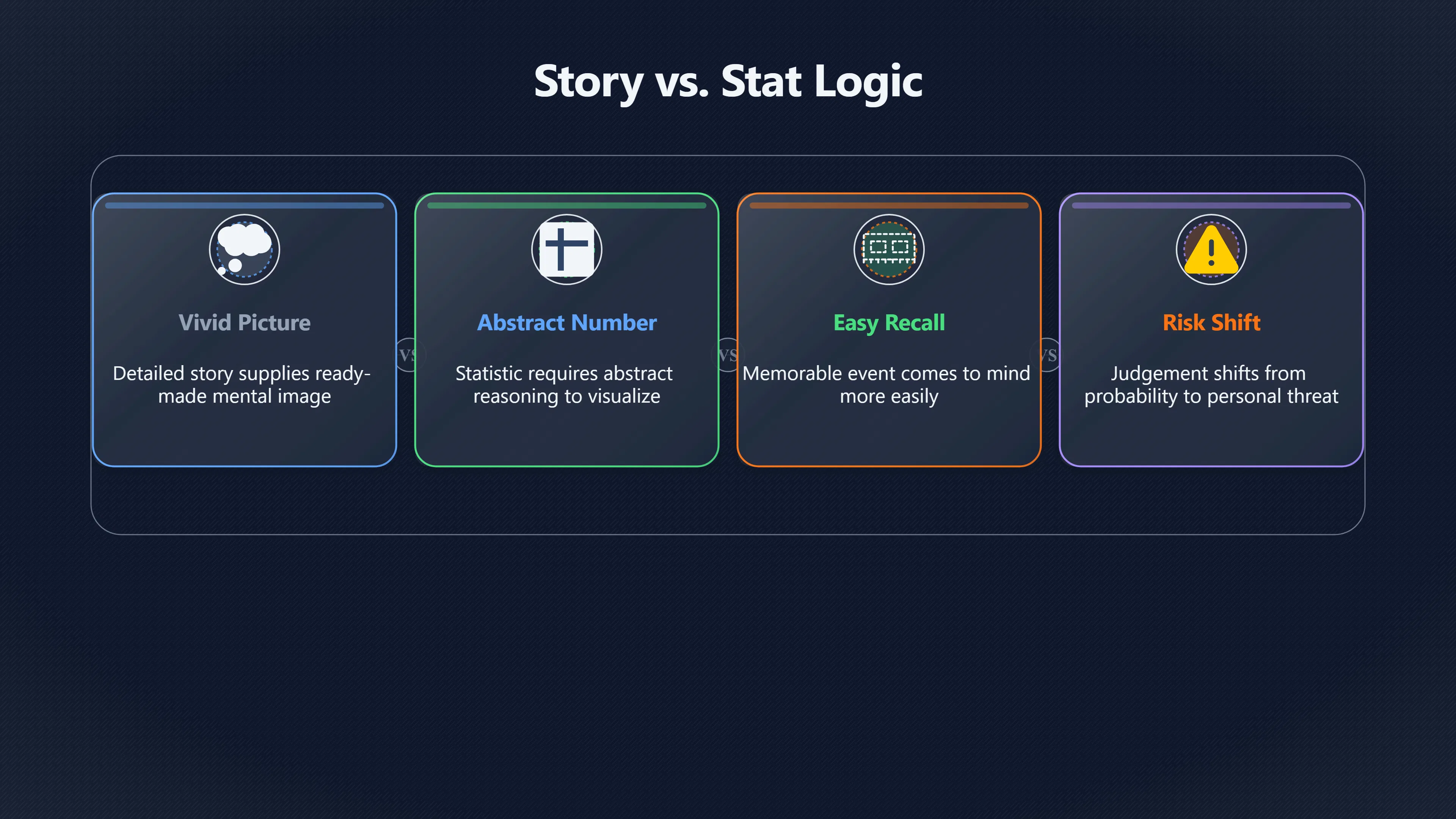
A vivid account also creates a concrete mental image. Readers can imagine the patient, the symptoms and the outcome. A statistic such as “2% experienced this side effect” requires abstract reasoning, while a detailed story supplies a ready-made picture. Cognitive research on risk perception has repeatedly shown that people’s judgements are shaped by feelings and by the ease with which examples come to mind.[PubMed]pubmed.ncbi.nlm.nih.govBecause affect may also increase the availability of risks.Read more…[Sage Journals]journals.sagepub.comSage JournalsHealth Risk Perception and Risk CommunicationAug 24, 2017 — Specifically, we discuss the key role of intuitive processes for…
This helps explain why a rare but memorable medical event can dominate public discussion. If a dramatic outcome is easy to recall, people may treat it as more common than it really is.
The availability effect in health thinking
Psychologists describe this tendency as the availability heuristic: people often judge frequency or probability by how easily examples come to mind. ScienceDirect[PMC]pmc.ncbi.nlm.nih.govPMCHow do People Judge Risk?Availability may Upstage Affect in…by E Efendić · 2021 · Cited by 15 — We found that availability‐by‐recall had a stronger impact in c…
In health contexts, a vivid anecdote is highly available. It has characters, emotions and a clear narrative. A statistical summary may be far more reliable, but it is harder to remember and harder to visualise.
Research on risk judgement suggests that recalling examples can significantly influence how dangerous people believe a risk to be. The more easily people can retrieve examples, the more likely they are to perceive the risk as important or common.[PMC]pmc.ncbi.nlm.nih.govPMCHow do People Judge Risk?Availability may Upstage Affect in…by E Efendić · 2021 · Cited by 15 — We found that availability‐by‐recall had a stronger impact in c…
As a result, one memorable story about a treatment failure may feel more informative than evidence collected from thousands of patients.
How anecdotes shift beliefs about treatments
The influence of anecdotes is not merely theoretical. Experimental research has shown that stories can change medical beliefs even when statistical evidence is presented alongside them.
A 2024 study found that reading anecdotes about medical treatments altered participants’ beliefs about treatment effectiveness. Importantly, negative anecdotes reduced confidence in treatments even when participants were also shown strong statistical evidence from clinical trials. In some cases, a single unfavourable story caused people to discount compelling numerical evidence. PubMed[PMC]pmc.ncbi.nlm.nih.govPMCHow do People Judge Risk?Availability may Upstage Affect in…by E Efendić · 2021 · Cited by 15 — We found that availability‐by‐recall had a stronger impact in c…
This matters because many health misconceptions begin with a true story that is interpreted too broadly. Consider the following pattern:
- A patient takes a treatment and improves.
- The improvement is genuine.
- The patient attributes the improvement entirely to the treatment.
- Others hear the story and treat it as proof that the treatment works for everyone.
The story may be sincere and accurate about that individual’s experience. What it cannot show by itself is whether the same outcome is typical, whether another factor caused the improvement, or whether most patients experience the same result.
The reverse can happen as well. One person may experience a side effect or treatment failure and share a compelling account. Listeners may then conclude that the treatment is generally ineffective or dangerous, despite evidence showing that the experience is uncommon.
Why negative stories often hit harder
Negative anecdotes frequently carry extra persuasive force because people pay closer attention to threats than to reassuring information.
Research on persuasion and public policy has found that negative anecdotes can substantially reduce perceptions of effectiveness and support, even when statistical information is available.[cambridge]cambridge.orgCambridge University Press & AssessmentNegative anecdotes reduce policy support: evidence from…by A Rodger · Cited by 2 — Results show… University Press & Assessment
In medicine, this means a single story about harm may outweigh pages of reassuring evidence. The emotional question shifts from “How likely is this?” to “What if that happened to me?”
That shift is understandable. Patients do not experience risk as a percentage; they experience it as a possible future event in their own lives.
Why numbers often feel less trustworthy than stories
Statistics answer population questions. Anecdotes answer personal questions.
A clinical trial might reveal that a treatment helps 70% of patients. Yet an individual patient naturally wonders whether they will be among the 70% or the 30%. A personal story appears to offer insight into that uncertainty because it describes an actual person rather than an average.
The problem is that anecdotes create an illusion of representativeness. The patient in the story may differ in age, health status, genetics, severity of illness or dozens of other factors. Without comparison groups and larger samples, it is difficult to know whether the outcome reflects the treatment or the unique circumstances of that individual.
Stories also create causal narratives. Humans are naturally drawn to explanations with a beginning, middle and end:
- A symptom appeared.
- A treatment was used.
- The symptom improved.
The sequence feels convincing. Yet many medical conditions fluctuate naturally, improve over time or respond to multiple influences at once. A story can reveal what happened to one person, but it often cannot establish why it happened.
When a story should prompt a better question
Health anecdotes are not worthless. In medicine, unusual patient experiences can reveal new problems, inspire research and highlight questions that deserve investigation.
The mistake is treating a story as the final answer rather than the starting point.
A useful response to a striking health anecdote is not immediately to accept or reject it. Instead, ask:
- Is this experience typical or unusual?
- What do larger studies show?
- Are there comparison groups?
- Could other explanations account for the outcome?
- How often does this happen across many patients?
These questions shift attention from a memorable case to the broader pattern.
That distinction is crucial because the goal of evidence-based medicine is not to dismiss personal experience. It is to place personal experience in context. Individual stories show what can happen. Well-conducted studies help estimate what usually happens. When health decisions carry serious consequences, confusing those two forms of evidence can allow a vivid exception to overpower a more reliable picture of reality.
Amazon book picks
Further Reading
Books and field guides related to Why one health story can overpower numbers. Use these as the next step if you want deeper reading beyond the article.
The Emperor of All Maladies
Illustrates why medical conclusions require more than individual stories.
eBay marketplace picks
Marketplace Samples
Example marketplace items related to this page. Use the search link to explore similar finds on eBay.



Endnotes
1.
Source: sciencedirect.com
Link:https://www.sciencedirect.com/science/article/abs/pii/S0749597819301633
Source snippet
A meta-analysis of the anecdotal biasby TH Freling · 2020 · Cited by 109 — We find anecdotal evidence to be more persuasive...
2.
Source: sciencedirect.com
Title: ScienceDirect Availability Heuristic
Link:https://www.sciencedirect.com/topics/computer-science/availability-heuristic
Source snippet
Availability Heuristic - an overviewThe availability heuristic refers to the tendency to assess the probability of an event...
3.
Source: pmc.ncbi.nlm.nih.gov
Link:https://pmc.ncbi.nlm.nih.gov/articles/PMC10078638/
Source snippet
Behavioral biases and heuristics in perceptions of COVID‐19...by WJW Botzen · 2022 · Cited by 40 — The availability heuristic posits...
4.
Source: pmc.ncbi.nlm.nih.gov
Title: PMCHow do People Judge Risk?
Link:https://pmc.ncbi.nlm.nih.gov/articles/PMC9292208/
Source snippet
Availability may Upstage Affect in...by E Efendić · 2021 · Cited by 15 — We found that availability‐by‐recall had a stronger impact in c...
5.
Source: pmc.ncbi.nlm.nih.gov
Link:https://pmc.ncbi.nlm.nih.gov/articles/PMC11345347/
Source snippet
impact medical decisions even when presented...by EN Line · 2024 · Cited by 8 — We found that reading anecdotes for either artificial or...
6.
Source: cambridge.org
Link:https://www.cambridge.org/core/journals/behavioural-public-policy/article/negative-anecdotes-reduce-policy-support-evidence-from-three-experimental-studies-on-[communicating
Source snippet
Cambridge University Press & AssessmentNegative anecdotes reduce policy support: evidence from...by A Rodger · Cited by 2 — Results show...
7.
Source: sciencedirect.com
Link:https://www.sciencedirect.com/science/article/pii/S0738399125006202
Source snippet
Effectiveness and determinants of narrative-based...by T Okuhara · 2025 · Cited by 3 — Narrative-based [corrections]({{ 'corrections/' | relative_url }}) show the potential fo...
8.
Source: pubmed.ncbi.nlm.nih.gov
Link:https://pubmed.ncbi.nlm.nih.gov/16834623/
Source snippet
Because affect may also increase the availability of risks.Read more...
9.
Source: journals.sagepub.com
Link:https://journals.sagepub.com/doi/10.1177/2372732217720223
Source snippet
Sage JournalsHealth Risk Perception and Risk CommunicationAug 24, 2017 — Specifically, we discuss the key role of intuitive processes for...
10.
Source: thedecisionlab.com
Title: The Decision Lab Availability Heuristic
Link:https://thedecisionlab.com/biases/availability-heuristic
Source snippet
Availability Heuristic - The Decision...The availability heuristic describes our tendency to think that whatever is easiest for us to re...
11.
Source: pubmed.ncbi.nlm.nih.gov
Link:https://pubmed.ncbi.nlm.nih.gov/39183199/
Source snippet
Anecdotes impact medical decisions even when presented...by EN Line · 2024 · Cited by 8 — We found that reading anecdotes for eith...
12.
Source: Wikipedia
Title: Availability heuristic
Link:https://en.wikipedia.org/wiki/Availability_heuristic
Source snippet
Availability heuristicThe availability heuristic, also known as availability bias, is a mental shortcut that relies on immediate examp...
13.
Source: bwgela.com
Title: availability heuristic
Link:https://www.bwgela.com/blog/availability-heuristic
Source snippet
What can we Learn15 Jan 2025 — The availability heuristic is a cognitive shortcut that influences how individuals make judgments and deci...
Additional References
14.
Source: researchgate.net
Link:https://www.researchgate.net/publication/340313878_When_poignant_stories_outweigh_cold_hard_facts_A_meta-analysis_of_the_anecdotal_bias
Source snippet
A meta-analysis of the anecdotal biasThe objective of this paper is to resolve mixed findings about which type of evidence is more persua...
15.
Source: annualreviews.org
Link:https://www.annualreviews.org/doi/pdf/10.1146/annurev.pu.14.050193.001151
Source snippet
RISK PERCEPTION AND COMMUNICATIONEffective risk communications can help people to reduce their health risks... Availability: a heuristi...
16.
Source: researchgate.net
Link:https://www.researchgate.net/publication/360499820_Risk_and_Availability_Heuristic_The_Role_of_Availability_in_Risk_Perception_and_Management
Source snippet
The Role of Availability in Risk Perception and ManagementThe Availability Heuristic Theory describes how individuals make decisions base...
17.
Source: osf.io
Link:https://osf.io/preprints/psyarxiv/sq5c9
Source snippet
or real medical treatments shifted participants' beliefs about the efficacy of a medical...Read more...
18.
Source: premierscience.com
Link:https://premierscience.com/pjph-24-353/
Source snippet
al health risks, especially in networks where peers have a lot of power.Read more...
19.
Source: medicalxpress.com
Title: 2020 04 crisis people facts
Link:https://medicalxpress.com/news/2020-04-crisis-people-facts.html
Source snippet
In crisis, people trust feelings over facts2 Apr 2020 — People are more likely to base decisions on anecdotal information instead of fact...
20.
Source: psychologytoday.com
Title: is statistical evidence the antidote to anecdotes
Link:https://www.psychologytoday.com/us/blog/a-hovercraft-full-of-eels/202004/is-statistical-evidence-the-antidote-to-anecdotes
Source snippet
(2020), though, offers some potential insight. The meta-analysis examined several factors...Read more...
21.
Source: tandfonline.com
Link:https://www.tandfonline.com/doi/full/10.1080/09638288.2024.2420833
Source snippet
Trust, belief and transitions: people's experiences of...by H Lewis · 2025 · Cited by 1 — This study aimed to explore how people with pe...
22.
Source: researchgate.net
Title: 339107956 The impact of anecdotal information on medical decision making
Link:https://www.researchgate.net/publication/339107956_The_impact_of_anecdotal_information_on_medical_decision-making
Source snippet
August 2024 · Cognitive Research...Read more...
Published: August 2024
23.
Source: nature.com
Link:https://www.nature.com/articles/s41598-026-40021-8
Source snippet
Investigating the mediating role of learning engagement in...by G Hamidkholgh · 2026 — This study emphasizes the role of self-efficacy i...
Topic Tree