Within Left Brain
Is creativity really a right brain skill?
Creativity depends on integrated thinking across both hemispheres, not a special right-brain mode teachers can switch on.
On this page
- How creativity became attached to the right brain
- Why creative work needs both structure and imagination
- What better creativity teaching looks like
Page outline Jump by section
Introduction
The idea that creativity comes from the brain’s right hemisphere has become one of the most durable classroom myths. It sounds plausible because some brain functions are more lateralised than others, and creative subjects such as art, music and design are often described as intuitive or visual. But the leap from “some functions are unevenly distributed” to “creativity is a right-brain skill” is not supported by modern neuroscience.
 Research increasingly shows that creative thinking depends on interactions between multiple brain systems involved in imagination, memory, attention, evaluation and self-control. In other words, creativity is not what happens when teachers “switch on” the right hemisphere. It is what happens when different cognitive processes work together. That matters because educational programmes built around right-brain activation can distract from the methods that genuinely help students become more creative: knowledge-building, experimentation, feedback, reflection and practice.[PMC]pmc.ncbi.nlm.nih.govCreativity and the default network: A functional connectivity…by RE Beaty · 2014 · Cited by 677 — The results suggest that the abil…[Nature]nature.comThe default network is causally linked to creative thinkingby B Shofty · 2022 · Cited by 84 — Despite a vast amount of correlative…
How creativity became attached to the right brain
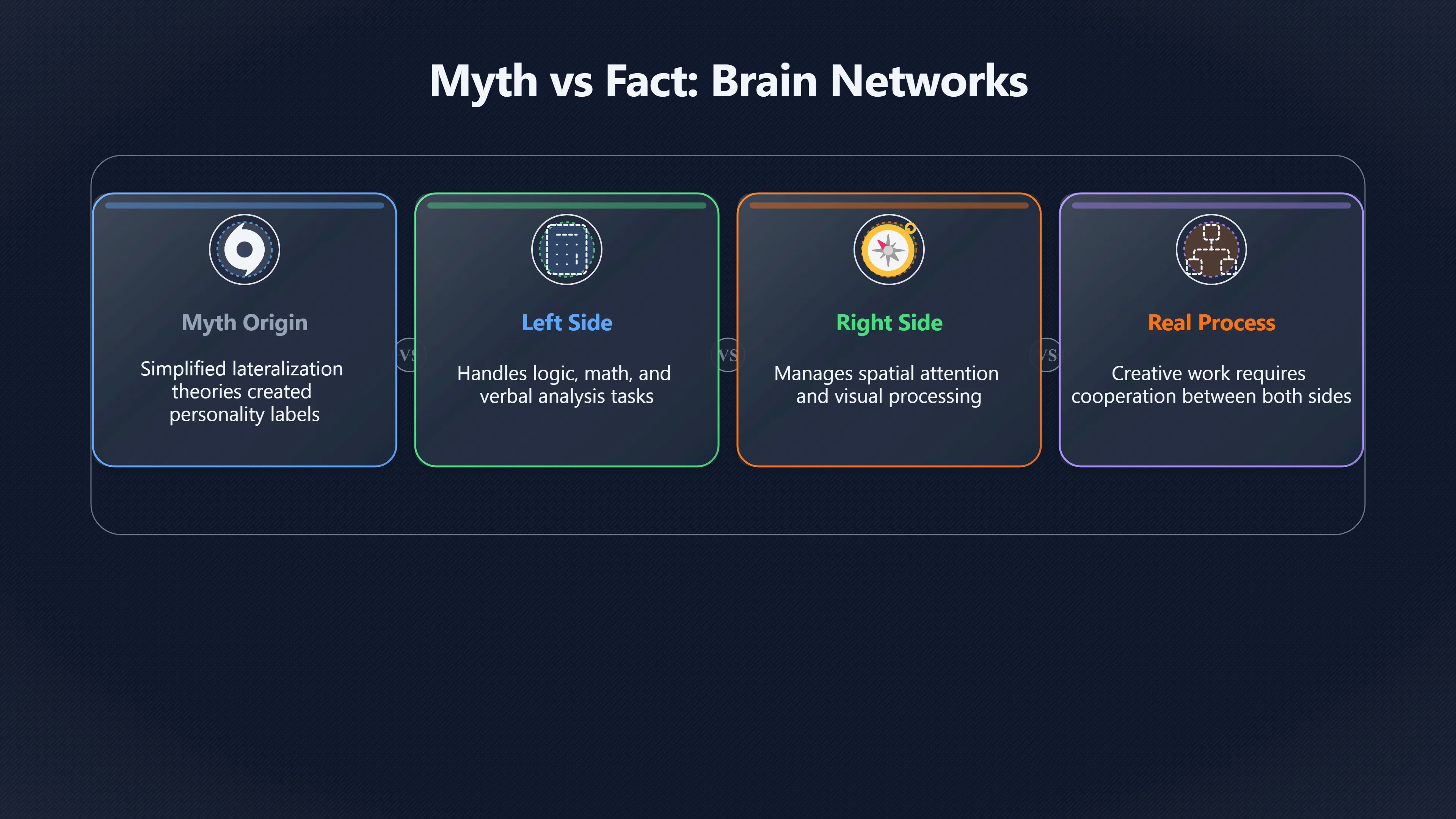
The creativity myth grew out of a simplified version of real neuroscience findings from the twentieth century. Researchers discovered that some functions show hemispheric specialisation. Language processing is often more concentrated in the left hemisphere, while some spatial and attentional functions rely more heavily on the right. Popular books, media reports and commercial training programmes gradually turned these observations into a personality theory.
Under that popular theory, the left hemisphere became associated with logic, mathematics and analysis, while the right hemisphere became associated with creativity, emotion and imagination. Educational products soon followed, promising to unlock creativity by stimulating the “creative side” of the brain.[Educational Neuroscience]educationalneuroscience.org.ukEducational NeuroscienceLeft brain versus right brain thinkersAccording to this view, the left brain is the analytical, logical, verbal h…[Harvard Health]health.harvard.eduright brainleft brain right 2017082512222Harvard HealthRight brain/left brain, right?Mar 24, 2565 BE — Those who are right-brained are supposed to be intuitive and creative free…
The problem is that creativity never fit neatly into that division. Even early creativity researchers argued that original thinking draws on many mental abilities at once. Scientific reviews have repeatedly concluded that creative thought is a whole-brain process rather than a right-hemisphere speciality.[Scientific American]scientificamerican.comis it true that creativitIt is, therefore, "whole brained."Read more…[Psychology Today]psychologytoday.commyths right brained creativityMyths of Right-Brained Creativity23 Mar 2012 — A recent study showed that a function of visual thinking is not solely a function of the r…
Despite this, the myth remains common in schools. Surveys of educators across different countries continue to find widespread belief in left-brain and right-brain learner categories, even though these categories lack scientific support. The appeal is understandable: a simple story is easier to remember than the complexity of modern cognitive science.[PMC]pmc.ncbi.nlm.nih.govby S Dekker · 2012 · Cited by 1276 — The OECD's Brain and Learning project (2002) emphasized that many misconceptions about the brain…[PMC]pmc.ncbi.nlm.nih.govThe Persistence of Neuromyths in the Educational Settingsby M Torrijos-Muelas · 2021 · Cited by 273 — In 2002, the UK's OECD launched…
Why creative work needs both structure and imagination
One reason the right-brain story survives is that people often imagine creativity as pure inspiration. In reality, most creative work combines idea generation with evaluation, revision and organisation.
A composer may imagine a melody but then refine its structure. A novelist may generate unexpected story ideas but still needs planning, editing and narrative control. A scientist proposing a new theory must also test evidence, reject weak explanations and communicate findings clearly. These activities rely on different cognitive processes working together rather than a single creative module.[PMC]pmc.ncbi.nlm.nih.govCreativity and the default network: A functional connectivity…by RE Beaty · 2014 · Cited by 677 — The results suggest that the abil…
Modern brain-imaging research reflects this complexity. Studies increasingly focus on large-scale networks rather than isolated regions. One important network, often called the default mode network, is associated with internally generated thought, memory and imagination. Another, the executive control network, helps with attention, planning and goal-directed thinking. Creative performance appears to depend on cooperation between these systems rather than dominance by one hemisphere. PMC[Scott Barry Kaufman]scottbarrykaufman.comCREATIVE NETWORKS Default and Executive Network…by RE Beaty · Cited by 884 — Such dynamic coupling suggests that divergent thinking in…
This finding is particularly important because imagination alone is not enough for creativity. Creative work requires ideas that are both novel and useful. The imaginative generation of possibilities must be balanced by judgement about which possibilities are worth developing. Researchers studying divergent thinking — the ability to generate many possible ideas — consistently find evidence of interaction between spontaneous and controlled thinking systems.[ScienceDirect]sciencedirect.comThe time course of creativity: Multivariate classification of…by J Lloyd-Cox · 2022 · Cited by 51 — Research indicates th…
Recent work has gone further, suggesting that creativity is linked to the brain’s ability to shift flexibly between different networks depending on task demands. Rather than a fixed “creative hemisphere”, creativity appears connected to dynamic coordination across multiple systems.[Nature]nature.comDynamic switching between brain networks predicts…by Q Chen · 2025 · Cited by 55 — We provide robust evidence across multi-cente…
What right-brain teaching gets wrong
The educational problem is not merely that the science is inaccurate. The bigger issue is that the myth can encourage poor teaching decisions.
When creativity is framed as a right-brain trait, it is often treated as something students either possess or lack. Learners may be labelled as naturally creative, naturally analytical, or somewhere in between. Those labels can narrow expectations. A pupil who enjoys mathematics may be seen as less artistic. A pupil interested in drawing may be treated as less suited to analytical work.
Yet many of the strongest examples of creativity involve exactly the opposite pattern: deep expertise combined with imaginative thinking. Architects combine artistic vision with geometry. Film-makers combine storytelling with technical planning. Designers use creativity alongside constraints such as budgets, materials and usability. Treating creativity as the opposite of structure misrepresents how creative achievement usually develops.[Wharton Executive Education]executiveeducation.wharton.upenn.eduWharton Executive EducationThe Right/Left Brain Myth and More Neuroscience InsightNeuroscience research reveals that there is an “innovat…
The myth also encourages questionable educational products and interventions. Some programmes claim to boost creativity through hemisphere-specific exercises, movement routines or activities supposedly designed to activate the right brain. Reviews of educational neuromyths have repeatedly warned that such claims often overstate what neuroscience can actually support. Evidence that an activity engages a particular brain region does not automatically show that it improves creativity, learning or long-term performance.[OECD ONE]one.oecd.orgOECD ONEUnclassified EDU/CERI/CD(2008)1313 May 2008 — Over the past few years, there has been a growing number of misconceptions circulat…[Landmark College]landmark.eduneuromyths are misconceptions about the brain dangerousLandmark CollegeNeuromyths: are misconceptions about the brain dangerous?31 Jan 2020 — Neuromyths lead teachers to adopt ineffective teac…
Another risk is that teachers may overlook more meaningful explanations for differences in creative performance. Students vary in background knowledge, confidence, motivation, opportunities for practice and exposure to creative models. These factors are observable and teachable. A right-brain label can make those practical influences seem less important than they really are.[PMC]pmc.ncbi.nlm.nih.govby S Dekker · 2012 · Cited by 1276 — The OECD's Brain and Learning project (2002) emphasized that many misconceptions about the brain…
What better creativity teaching looks like
If creativity is not a right-brain skill, then creativity education needs a different foundation.
A stronger approach treats creativity as a set of learnable abilities that develop through experience. Students benefit from building domain knowledge, because people create more effectively when they have material to work with. Creative breakthroughs often emerge from combining existing ideas in new ways rather than producing ideas from nowhere.[PubMed]pubmed.ncbi.nlm.nih.govIndividual Creativity and Associative Priming in the Right…by KC Aberg · 2017 · Cited by 51 — The idea that creativity resides i…
Effective creativity teaching also combines freedom with constraint. Open-ended tasks can encourage exploration, but structure helps students refine and improve their ideas. Classrooms that support creativity typically include:
- Opportunities to generate multiple solutions to a problem.
- Feedback that focuses on revision rather than first attempts.
- Exposure to high-quality examples and models.
- Reflection on how creative choices are made.
- Collaboration that allows students to build on others’ ideas.
These methods align more closely with current understanding of creative cognition because they engage both imaginative and evaluative processes.[PMC]pmc.ncbi.nlm.nih.govThe Persistence of Neuromyths in the Educational Settingsby M Torrijos-Muelas · 2021 · Cited by 273 — In 2002, the UK's OECD launched…[ScienceDirect]sciencedirect.comThe time course of creativity: Multivariate classification of…by J Lloyd-Cox · 2022 · Cited by 51 — Research indicates th…
Importantly, this approach avoids dividing students into fixed cognitive types. A learner can become more inventive without being a “right-brained person”. Equally, analytical skills and creative skills often strengthen each other. The ability to compare alternatives, identify patterns and test ideas is part of creative success, not the opposite of it.[Wharton Executive Education]executiveeducation.wharton.upenn.eduWharton Executive EducationThe Right/Left Brain Myth and More Neuroscience InsightNeuroscience research reveals that there is an “innovat…
Why the creativity myth persists
The right-brain creativity story survives partly because it contains a grain of truth. Some tasks do involve stronger activity in particular regions or networks, and creative people often describe experiences of intuition or sudden insight. Those experiences feel different from deliberate analysis, making the idea of a separate creative mode seem convincing.
But neuroscience has moved beyond simple hemisphere labels. Researchers now study creativity through networks, connectivity and flexible coordination across the brain. The picture that emerges is more complicated than the old myth, but also more useful. Creativity is not locked inside one side of the brain waiting to be activated. It emerges from the interaction of imagination, memory, knowledge, attention and critical evaluation. Nature[Paris Brain Institute]parisbraininstitute.orgCreativityThere are two main networks. The first, the executive control network, is usually involved in cognitive control processes that…
That conclusion changes the educational message. Rather than searching for techniques that awaken a hidden right-brain talent, teachers are better served by helping students build skills, knowledge and habits that support creative thinking across many contexts. Creativity is not the property of a hemisphere. It is a capacity that develops through whole-brain learning. PMC[Taylor & Francis Online]tandfonline.comTaylor & Francis OnlineBeyond Left and Right: Learning Is a Whole-Brain Processby DD Shin · 2022 · Cited by 12 — The OECD website outline…
Amazon book picks
Further Reading
Books and field guides related to Is creativity really a right brain skill?. Use these as the next step if you want deeper reading beyond the article.
The Creative Brain
First published 2006. Subjects: Creative ability, Genius, Neurosciences, Gifted persons, Physiology.
Creative Confidence
First published 2013. Subjects: Creative ability, BUSINESS & ECONOMICS / Decision-Making & Problem Solving, BUSINESS & ECONOMICS / Career...
Imagine
First published 2012. Subjects: Creative ability, Creative thinking, Imagination, Creativeness, Kognitiv psykologi.
eBay marketplace picks
Marketplace Samples
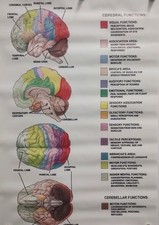
Example marketplace items related to this page. Use the search link to explore similar finds on eBay.

Endnotes
1.
Source: pmc.ncbi.nlm.nih.gov
Link:https://pmc.ncbi.nlm.nih.gov/articles/PMC4410786/
Source snippet
Creativity and the default network: A functional connectivity...by RE Beaty · 2014 · Cited by 677 — The results suggest that the abil...
2.
Source: nature.com
Link:https://www.nature.com/articles/s41380-021-01403-8
Source snippet
The default network is causally linked to creative thinkingby B Shofty · 2022 · Cited by 84 — Despite a vast amount of correlative...
3.
Source: health.harvard.edu
Title: right brainleft brain right 2017082512222
Link:https://www.health.harvard.edu/blog/right-brainleft-brain-right-2017082512222
Source snippet
Harvard HealthRight brain/[left brain]({{ 'left-brain/' | relative_url }}), right?Mar 24, 2565 BE — Those who are right-brained are supposed to be intuitive and creative free...
4.
Source: pmc.ncbi.nlm.nih.gov
Link:https://pmc.ncbi.nlm.nih.gov/articles/PMC3475349/
Source snippet
by S Dekker · 2012 · Cited by 1276 — The OECD's Brain and Learning project (2002) emphasized that many misconceptions about the brain...
5.
Source: pmc.ncbi.nlm.nih.gov
Link:https://pmc.ncbi.nlm.nih.gov/articles/PMC7835631/
Source snippet
The Persistence of Neuromyths in the Educational Settingsby M Torrijos-Muelas · 2021 · Cited by 273 — In 2002, the UK's OECD launched...
6.
Source: sciencedirect.com
Link:https://www.sciencedirect.com/science/article/pii/S0010945222002404
Source snippet
The time course of creativity: Multivariate classification of...by J Lloyd-Cox · 2022 · Cited by 51 — Research indicates th...
7.
Source: nature.com
Link:https://www.nature.com/articles/s42003-025-07470-9
Source snippet
Dynamic switching between brain networks predicts...by Q Chen · 2025 · Cited by 55 — We provide robust evidence across multi-cente...
8.
Source: sciencedirect.com
Link:https://www.sciencedirect.com/science/article/abs/pii/S2352154625000701
Source snippet
Early work laid the foundations for this understanding.Read more...
9.
Source: one.oecd.org
Link:https://one.oecd.org/document/EDU/CERI/CD%282008%2913/en/pdf
Source snippet
OECD ONEUnclassified EDU/CERI/CD(2008)1313 May 2008 — Over the past few years, there has been a growing number of misconceptions circulat...
Published: May 2008
10.
Source: landmark.edu
Title: neuromyths are misconceptions about the brain dangerous
Link:https://www.landmark.edu/research-and-training/blog/neuromyths-are-misconceptions-about-the-brain-dangerous
Source snippet
Landmark CollegeNeuromyths: are misconceptions about the brain dangerous?31 Jan 2020 — Neuromyths lead teachers to adopt ineffective teac...
11.
Source: oecd.org
Link:https://www.oecd.org/content/dam/oecd/en/publications/reports/2007/06/understanding-the-brain-the-birth-of-a-learning-science_g1gh76fd/9789264029132-en.pdf
Source snippet
Understanding the Brain: The Birth of a Learning ScienceThis has led to the instigation of many national initiatives in OECD countries to...
12.
Source: oecd.org
Link:https://www.oecd.org/en/publications/2007/06/understanding-the-brain-the-birth-of-a-learning-science_g1gh76fd.html
Source snippet
Understanding the Brain: The Birth of a Learning ScienceThis book provides new insights about learning by synthesising existing and emerg...
13.
Source: oecd.org
Link:https://www.oecd.org/en/publications/understanding-the-brain-the-birth-of-a-learning-science_9789264029132-en.html
Source snippet
Understanding the Brain: The Birth of a Learning ScienceThis book provides new insights about learning by synthesising existing and emerg...
14.
Source: sciencedirect.com
Link:https://www.sciencedirect.com/science/article/abs/pii/S0742051X2600020X
Source snippet
Neuromyths in education: Comparing perceptions between...by E Wauthia · 2026 — Some of the most widespread neuromyths include statements...
15.
Source: sites.harvard.edu
Link:https://sites.harvard.edu/schacter-memory/files/2022/01/b978-0-12-809790-8.00010-8.pdf
Source snippet
harvard.eduCreativity, Self-Generated Thought, and the Brain's Default...by RE Beaty · 2017 · Cited by 19 — one such study explored the...
16.
Source: nature.com
Link:https://www.nature.com/articles/srep10964
Source snippet
Default and Executive Network Coupling Supports Creative...by RE Beaty · 2015 · Cited by 890 — A growing body of research suggests that...
17.
Source: parisbraininstitute.org
Link:https://parisbraininstitute.org/brain-function-cards/creativity
Source snippet
CreativityThere are two main networks. The first, the executive control network, is usually involved in cognitive control processes that...
18.
Source: educationalneuroscience.org.uk
Link:https://educationalneuroscience.org.uk/wordpress/resources/neuromyth-or-neurofact/left-brain-versus-right-brain-thinkers/
Source snippet
Educational NeuroscienceLeft brain versus right brain thinkersAccording to this view, the left brain is the analytical, logical, verbal h...
19.
Source: scientificamerican.com
Title: is it true that creativit
Link:https://www.scientificamerican.com/article/is-it-true-that-creativit/
Source snippet
It is, therefore, "whole brained."Read more...
20.
Source: psychologytoday.com
Title: myths right brained creativity
Link:https://www.psychologytoday.com/gb/blog/tracking-wonder/201203/myths-right-brained-creativity
Source snippet
Myths of Right-Brained Creativity23 Mar 2012 — A recent study showed that a function of visual thinking is not solely a function of the r...
21.
Source: pubmed.ncbi.nlm.nih.gov
Link:https://pubmed.ncbi.nlm.nih.gov/27655932/
Source snippet
Individual Creativity and Associative Priming in the Right...by KC Aberg · 2017 · Cited by 51 — The idea that creativity resides i...
22.
Source: scottbarrykaufman.com
Link:https://scottbarrykaufman.com/wp-content/uploads/2015/05/Beaty-et-al.-in-press-Creative-Networks.pdf
Source snippet
CREATIVE NETWORKS Default and Executive Network...by RE Beaty · Cited by 884 — Such dynamic coupling suggests that divergent thinking in...
23.
Source: executiveeducation.wharton.upenn.edu
Link:https://executiveeducation.wharton.upenn.edu/thought-leadership/wharton-at-work/2023/05/insights-from-neuroscience/
Source snippet
Wharton Executive EducationThe Right/Left Brain Myth and More Neuroscience InsightNeuroscience research reveals that there is an “innovat...
24.
Source: tandfonline.com
Link:https://www.tandfonline.com/doi/abs/10.1080/00405841.2022.2096386
Source snippet
Taylor & Francis OnlineBeyond Left and Right: Learning Is a Whole-Brain Processby DD Shin · 2022 · Cited by 12 — The OECD website outline...
25.
Source: psychologytoday.com
Link:https://www.psychologytoday.com/au/blog/the-athletes-way/202503/right-brain-vs-whole-brain-how-creativity-really-works
Source snippet
Where Creativity Actually Happens in the Brain1 Mar 2025 — The "right brain = creativity" equation is a myth; creativity involves the who...
26.
Source: educationalneuroscience.org.uk
Link:https://educationalneuroscience.org.uk/wordpress/resources/neuromyth-or-neurofact/
Source snippet
Common misconceptions about the brainCommon misconceptions about the brain · Left brain versus right brain thinkers · Fish oils improve l...
Additional References
27.
Source: medium.com
Link:https://medium.com/%40Gbgrow/unlocking-the-brains-creativity-how-1fd8f8861a2c
28.
Source: thomasramsoy.com
Title: creativity mind wandering and the default mode network of the brain
Link:https://thomasramsoy.com/index.php/2024/08/26/creativity-mind-wandering-and-the-default-mode-network-of-the-brain/
Source snippet
Creativity, Mind-Wandering, and the Default Mode Network...26 Aug 2024 — What's the link between the Default Mode Network and creativity...
29.
Source: irejournals.com
Link:https://www.irejournals.com/formatedpaper/1707069.pdf
Source snippet
e brain functions as a whole, with interconnections across both hemispheres (Nielsen et...Read more...
30.
Source: youtube.com
Title: [Debunking]({{ ‘debunking/’ | relative_url }}) the Myth of the Left and Right Brain | Matthew Wang | TEDx Youth@MVHS
Link:http://www.youtube.com/watch?v=95lXUp3S3gw
Source snippet
Neuroscience of creativity debunking right brain myth Truth or Myth: People are either right-brained, creative thinkers, or left-brained...
31.
Source: arno.uvt.nl
Link:https://arno.uvt.nl/show.cgi?fid=161948
Source snippet
httpby JMM Van Eekeren · 2023 — Although the concept creativity is multi-dimensional, researchers largely use divergent thinking as the m...
32.
Source: cis.org.au
Link:https://www.cis.org.au/publication/knowledge-is-power-what-do-teachers-believe-about-learning/
Source snippet
so very common globally, and held by around half of Australian teachers.Read more...
33.
Source: ed.ted.com
Title: the left brain vs right brain myth elizabeth waters
Link:https://ed.ted.com/lessons/the-left-brain-vs-right-brain-myth-elizabeth-waters
Source snippet
left brain vs. right brain myth - Elizabeth Waters24 Jul 2017 — The left side controls logic and the right side controls creativity. And...
34.
Source: facebook.com
Link:https://www.facebook.com/MinddBox/posts/psychologist-says-neuroscience-suggests-creativity-and-certain-mental-health-str/1149727751548864/
Source snippet
ork, the salience network, and the executive control network—that...Read more...
35.
Source: facebook.com
Link:https://www.facebook.com/radionational/posts/youve-probably-been-told-youre-either-left-brain-analytical-or-right-brain-creat/1276901630772373/
Source snippet
You've probably been told you're either left brain: analytical...The left brain is analytical, numerical, logical, scientific, systemati...
36.
Source: bigthink.com
Link:https://bigthink.com/surprising-science/study-right-brainleft-brain-is-a-myth-creativity-exists-in-both-hemispheres/
Source snippet
Right-Brain/Left-Brain is a Myth, Creativity Exists in Both...22 Nov 2014 — It turns out that creativity resides within your brain's lef...
Topic Tree