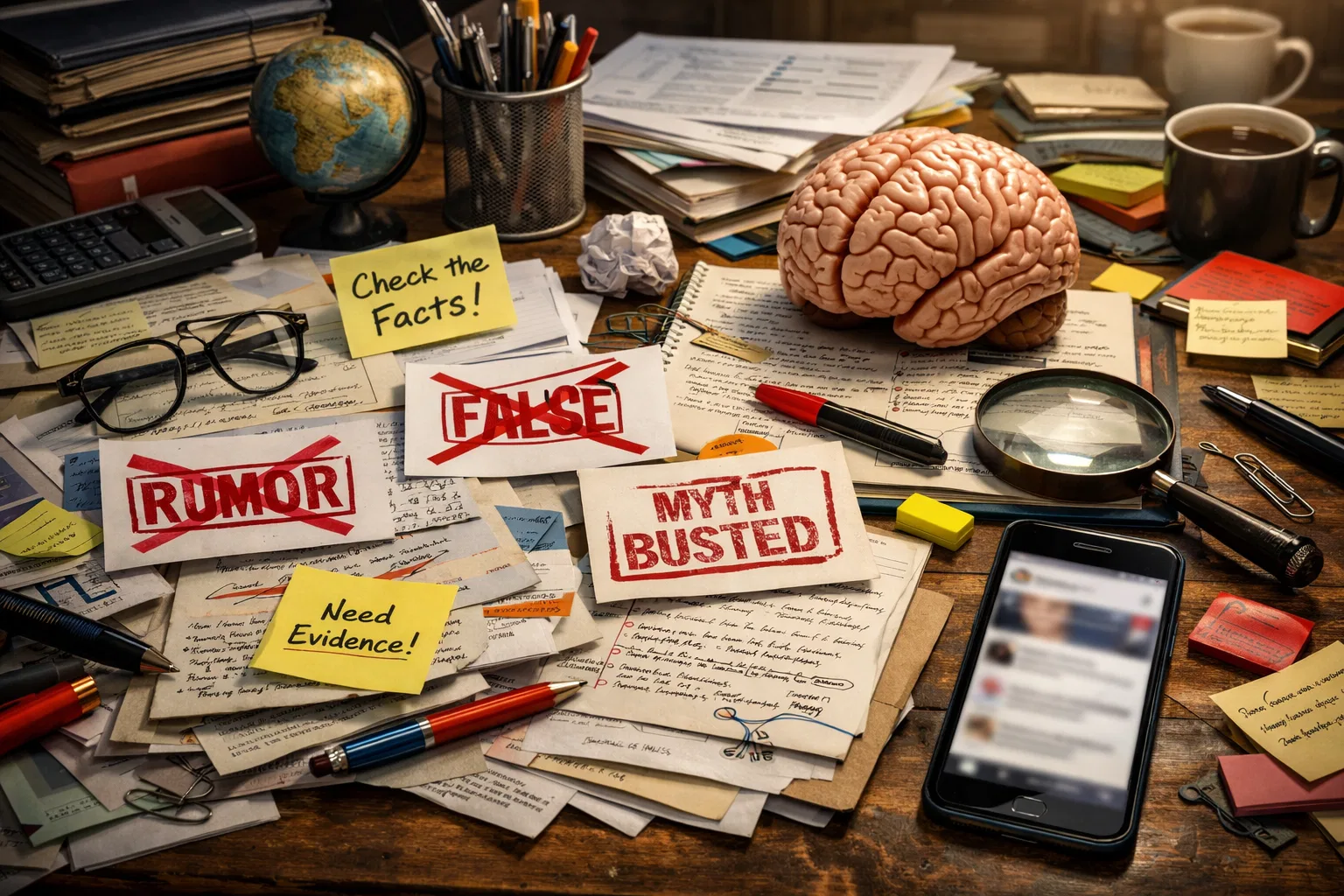
Myths and misconceptions are not just “wrong facts”. They are durable stories, shortcuts or explanations that feel true enough to survive correction.
Page outline Jump by section
Introduction
The important lesson is practical: myths persist because they often meet a real need. They simplify uncertainty, fill gaps in a story, flatter existing identities, or offer a memorable rule of thumb. Correcting them is possible, but the best corrections do more than say “that is false”. They explain why the myth seemed plausible, what the better evidence says, and what replacement explanation the reader should use instead. [Nature]nature.comNatureThe psychological drivers of misinformation belief and its…by UKH Ecker · 2022 · Cited by 1916 — In this Review, we describe the…
Why myths feel true even when they are wrong
Many misconceptions survive because they are cognitively useful. A simple claim such as “people only use 10 per cent of their brain” is vivid, easy to repeat and emotionally appealing because it suggests hidden human potential. A more accurate explanation of brain function is less slogan-friendly. The same pattern appears in education, health, politics and science: myths often win attention before evidence has time to catch up.
Psychology research points to several reasons false beliefs become sticky. Familiar information can feel more fluent and therefore more credible. People also rely on mental models: once a story explains an event, removing one piece of it leaves a gap. If a correction does not provide a replacement explanation, the old claim can continue to shape reasoning even after it has been discredited. This is known as the continued influence effect. [ScienceDirect]sciencedirect.comSource details in endnotes.
Identity matters too. People do not assess every claim as detached fact-checkers. They often ask, consciously or not, whether a claim fits their community, values, past experiences or trusted sources. A myth repeated by a teacher, parent, doctor, influencer or political leader may be more resilient than the same myth encountered anonymously.
Myth, misconception, misinformation and disinformation are not the same
These terms are often used interchangeably, but the differences matter.
A myth is a widely circulated belief or story that is false or unsupported. It may be old, culturally familiar and repeated without a clear original source.
A misconception is a mistaken understanding. It can come from partial knowledge, poor teaching, misleading analogies or overgeneralising from personal experience. Someone can hold a misconception honestly and still be open to correction.
Misinformation is false or inaccurate information. It does not require malicious intent. A person may share a false health claim because they believe it is helpful. UNESCO defines misinformation as false information shared inadvertently, while the APA describes it as getting the facts wrong. [UNESCO]unesco.orgUNESCOWhat is Misinformation? Meaning, Definition.Misinformation is false information that is shared inadvertently, without meaning to ca…
Disinformation is false information spread with the intention to mislead or manipulate. This is why responses to disinformation often require more than individual correction: platform design, political incentives, organised influence campaigns and media systems can all shape how it spreads. [Media Defence]mediadefence.orgSource details in endnotes.
The correction myth: does debunking make false beliefs stronger?
One popular claim about misinformation is itself a misconception: the idea that correcting a myth usually “backfires” and makes people believe it more strongly. Early discussions of the “backfire effect” made this fear influential, especially among communicators who worried that repeating a false claim would make it more familiar. Later evidence is more reassuring. Reviews and replication work suggest that strong backfire effects are not common, and that clear corrections usually reduce false beliefs rather than strengthen them. [PMC]pmc.ncbi.nlm.nih.govSource details in endnotes. [PNAS]pnas.orgOpen source on pnas.org.
That does not mean debunking is effortless. Poor corrections can fail, especially when they are confusing, condescending, too late, or do not replace the false explanation with a better one. The practical lesson from the Debunking Handbook and later research is not “never mention the myth”. It is to mention it carefully, warn that it is false, avoid needless repetition, lead with the accurate explanation, and give people a coherent alternative. [Center for Climate Change Communication]climatechangecommunication.orgCenter for Climate Change Communication Debunking HandbookCenter for Climate Change Communication Debunking Handbook
A useful correction usually has three parts:
- The fact: state the accurate claim clearly.
- The warning: signal that a false belief is about to be discussed.
- The explanation: show why the myth is wrong and what better account replaces it.
For example, rather than only saying “vaccines do not cause autism”, a stronger correction explains that the original MMR-autism claim was based on discredited research, that later large-scale evidence has not supported the link, and that autism’s signs often become noticeable around the same early-childhood period when routine vaccines are given. [Ecker Memory & Cognition Lab]emc-lab.orgEcker Memory & Cognition Lab Misinformation and its CorrectionEcker Memory & Cognition Lab Misinformation and its Correction
Why education myths are especially persistent
Education provides a clear example of how misconceptions can thrive even among well-intentioned professionals. “Learning styles” is one of the most widely known cases: the belief that students learn better when teaching is matched to a preferred visual, auditory or kinaesthetic style. Many people do have preferences, but the stronger claim — that matching instruction to a supposed style improves learning — lacks the support its popularity implies.
A systematic review of belief in learning styles among educators found high self-reported belief across international studies, with a weighted percentage of 89.1 per cent endorsing matching instruction to learning styles. The same review found that interventions explaining the lack of evidence were associated with a substantial drop in belief, which shows that even entrenched myths can be reduced when corrections are specific and evidence-based. [Frontiers]frontiersin.orgFrontiers How Common Is Belief in the Learning Styles NeuromythFrontiers How Common Is Belief in the Learning Styles Neuromyth
Neuromyths spread partly because they borrow the language of neuroscience. Claims about “left-brain” and “right-brain” learners, unused brain capacity or rigid learning styles sound scientific even when they oversimplify or distort the evidence. Research on neuromyths among teachers has found that educators may believe a substantial share of such claims, especially when the myths are connected to commercial programmes or professional training materials. [PMC]pmc.ncbi.nlm.nih.govSource details in endnotes.
The lesson is not that teachers are unusually gullible. It is that myths become harder to challenge when they are packaged as practical, compassionate and professional. A teacher who wants to reach every pupil may find “teach to their learning style” more appealing than the less glamorous advice to vary instruction, check understanding, build knowledge, practise retrieval and adapt teaching to the task rather than to a fixed learner type.
Why “common sense” can be a poor test of truth
Many misconceptions survive because they match everyday intuition. It feels obvious that a heavier object should fall faster than a lighter one, that memory works like a recording, or that confidence is a reliable sign of accuracy. In each case, the intuitive story has some emotional or experiential force, but that does not make it true.
Science education research has long shown that misconceptions are not always random mistakes. Learners often hold coherent but incorrect models of how the world works. If teaching simply adds facts without confronting the mistaken model, the old idea may remain available and return under pressure. This is why conceptual change often requires making the misconception visible, creating dissatisfaction with it, and offering a clearer explanation that can do the same explanatory work more accurately. [Center for the Advancement of Teaching]teaching.fsu.eduCenter for the Advancement of Teaching From Misconceptions to Conceptual ChangeCenter for the Advancement of Teaching From Misconceptions to Conceptual Change
This matters beyond classrooms. In public debates, people often treat “it makes sense to me” as a substitute for evidence. But many myths feel sensible because they compress a complicated topic into a memorable pattern. The more useful question is not “does this sound plausible?” but “what would I expect to see if this were true, and do reliable sources actually show that?”
How myths spread in modern information systems
Myths have always spread through families, schools, newspapers, books and popular culture. Digital platforms change the speed, scale and incentives. False or misleading claims can be shaped for emotional impact, repeated by multiple accounts, detached from their original context and recommended to new audiences by engagement-driven systems.
The problem is not only that false claims exist. It is that misleading information can be cheap to produce and expensive to correct. Fact-checking often requires time, expertise and careful explanation, while a false claim can be posted in seconds. Policy research has therefore argued that fact-checking cannot be the whole answer; it has to be combined with media literacy, better access to trustworthy information, platform design choices and, where relevant, responses to organised disinformation. [Carnegie Endowment]carnegieendowment.orgCarnegie Endowment Countering Disinformation Effectively: An Evidence-BasedCarnegie Endowment Countering Disinformation Effectively: An Evidence-Based
Recent platform changes have also made the correction environment more contested. Meta announced in 2025 that it would end its US third-party fact-checking programme and move towards a community-notes model, a change reported by AP as part of a wider debate about moderation, trust and political bias. That kind of shift matters because myths are not corrected only by individual scepticism; they are also shaped by the systems that decide what gets amplified, labelled, downranked or contextualised. [AP News]apnews.comSource details in endnotes.
What actually helps correct misconceptions
The strongest corrections are usually clear, respectful and explanatory. They do not assume that people are stupid for believing a myth. Instead, they recognise why the myth was attractive and then give the reader a better way to understand the issue.
Effective approaches include:
- Lead with the truth. Start with the accurate claim before introducing the myth.
- Avoid needless repetition. Mention the false claim only as much as needed to identify it.
- Explain the mechanism. Show why the accurate account works better.
- Replace the story. Do not leave a gap where the myth used to be.
- Use trusted messengers. Corrections are more persuasive when they come from sources the audience sees as credible.
- Address the concern beneath the claim. A health myth may be driven by fear, a school myth by care for children, and a political myth by distrust.
Research on correction effects in science-relevant misinformation finds that corrections can work, though effectiveness depends on the claim, audience, source and correction design. A correction is more likely to fail when the misinformation has been repeated often, came from a trusted source, or fits strongly with prior beliefs. [The Social Action Lab]socialactionlab.orgSource details in endnotes.
Prebunking can also help. Instead of waiting for a false claim to spread, prebunking warns people in advance about common manipulation tactics, such as scapegoating, false dilemmas, conspiracy framing or impersonation of expertise. Studies of psychological inoculation suggest that exposing people to weakened examples of misleading tactics can improve resistance to later misinformation. [Taylor & Francis Online]tandfonline.comSource details in endnotes. [Misinformation Review]misinforeview.hks.harvard.eduglobal vaccination badnewsglobal vaccination badnews
A practical test for spotting a likely myth
A claim deserves extra scrutiny when it has several of these features:
- It is unusually neat. It reduces a complex issue to one simple cause, villain or trick.
- It is highly shareable. It sounds like a slogan, secret or shocking reversal.
- It flatters the audience. It implies that “people like us” know the truth while outsiders are fooled.
- It lacks a traceable source. It is repeated often but rarely linked to strong evidence.
- It sells something. The claim conveniently supports a product, course, supplement, ideology or service.
- It survives by shifting form. When one version is disproved, a slightly altered version appears.
- It confuses possibility with probability. Something could happen, therefore people imply that it probably did happen.
A useful verification habit is to pause before sharing, check whether several reliable sources independently support the claim, look for the original evidence, and ask whether the correction would change your mind if it went against your preference. UNICEF’s public guidance on misinformation gives similar practical advice: diversify sources, assess credibility, check whether reliable outlets are reporting the same thing, and be cautious before amplifying doubtful material. [UNICEF]unicef.orgquick guide spotting misinformationquick guide spotting misinformation

The most important misconception about myths
The biggest misconception is that myths are mainly a problem of ignorance. Ignorance plays a part, but many myths persist because they are meaningful, useful or socially reinforced. They may offer certainty during confusion, identity during conflict, or an easy action when the real solution is complex.
That is why the best response is not ridicule. Ridicule can entertain people who already agree, but it rarely helps someone revise a belief tied to trust, fear or identity. Better correction combines accuracy with explanation: name the myth, show why it fails, give the stronger account, and make the truth easier to remember than the falsehood.
Amazon book picks
Further Reading
Books and field guides related to Myths and misconcept. Use these as the next step if you want deeper reading beyond the article.
Factfulness
Shows how reliable evidence can overcome common misconceptions and biases.
Mistakes Were Made (but Not by Me) Third Edition
Explains resistance to correction and self-justification.
eBay marketplace picks
Marketplace Samples
Example marketplace items related to this page. Use the search link to explore similar finds on eBay.

Endnotes
-
Source: unesco.org
Link: https://www.unesco.org/en/query-list/m/misinformationSource snippet
UNESCOWhat is Misinformation? Meaning, Definition.Misinformation is false information that is shared inadvertently, without meaning to ca...
-
Source: apa.org
Link: https://www.apa.org/topics/journalism-facts/misinformation-disinformationSource snippet
Disinformation is false information which is deliberately intended to mislead...Read more...
-
Source: nature.com
Link: https://www.nature.com/articles/s44159-021-00006-ySource snippet
NatureThe psychological drivers of misinformation belief and its...by UKH Ecker · 2022 · Cited by 1916 — In this Review, we describe the...
-
Source: sciencedirect.com
Link: https://www.sciencedirect.com/science/article/abs/pii/S0010027720302729 -
Source: pmc.ncbi.nlm.nih.gov
Link: https://pmc.ncbi.nlm.nih.gov/articles/PMC9283209/ -
Source: pnas.org
Link: https://www.pnas.org/doi/10.1073/pnas.1912440117 -
Source: pmc.ncbi.nlm.nih.gov
Link: https://pmc.ncbi.nlm.nih.gov/articles/PMC3475349/ -
Source: pmc.ncbi.nlm.nih.gov
Link: https://pmc.ncbi.nlm.nih.gov/articles/PMC10498317/ -
Source: unicef.org
Title: quick guide spotting misinformation
Link: https://www.unicef.org/eca/stories/quick-guide-spotting-misinformation -
Source: sciencedirect.com
Link: https://www.sciencedirect.com/science/article/pii/S2352250X23001574 -
Source: sciencedirect.com
Link: https://www.sciencedirect.com/science/article/pii/S1364661321000516 -
Source: sciencedirect.com
Link: https://www.sciencedirect.com/science/article/pii/S095947522400118X -
Source: sciencedirect.com
Link: https://www.sciencedirect.com/science/article/pii/S004727272500043X -
Source: sciencedirect.com
Link: https://www.sciencedirect.com/science/article/abs/pii/S2211949325000183 -
Source: nature.com
Link: https://www.nature.com/articles/s41599-025-05470-y -
Source: nature.com
Link: https://www.nature.com/articles/s41562-024-02086-1 -
Source: pnas.org
Link: https://www.pnas.org/doi/10.1073/pnas.2104235118 -
Source: mediadefence.org
Link: https://www.mediadefence.org/ereader/publications/modules-on-litigating-freedom-of-expression-and-digital-rights-in-south-and-southeast-asia/module-8-false-news-misinformation-and-propaganda/misinformation-disinformation-and-mal-information/ -
Source: climatechangecommunication.org
Title: Center for Climate Change Communication Debunking Handbook
Link: https://www.climatechangecommunication.org/wp-content/uploads/2023/09/DebunkingHandbook2020.pdf -
Source: emc-lab.org
Title: Ecker Memory & Cognition Lab Misinformation and its Correction
Link: https://www.emc-lab.org/uploads/1/1/3/6/113627673/chapter_swireecker_revised.pdf -
Source: socialactionlab.org
Link: https://socialactionlab.org/wp-content/uploads/2024/01/Chan_A-meta-analysis-of-correction-effects-in-science-relevant-misinformation_2023.pdf -
Source: frontiersin.org
Title: Frontiers How Common Is Belief in the Learning Styles Neuromyth
Link: https://www.frontiersin.org/journals/education/articles/10.3389/feduc.2020.602451/full -
Source: teaching.fsu.edu
Title: Center for the Advancement of Teaching From Misconceptions to Conceptual Change
Link: https://teaching.fsu.edu/wp-content/uploads/2018/01/tst1104_34.pdf -
Source: carnegieendowment.org
Title: Carnegie Endowment Countering Disinformation Effectively: An Evidence-Based
Link: https://carnegieendowment.org/russia-eurasia/research/2024/01/countering-disinformation-effectively-an-evidence-based-policy-guide -
Source: apnews.com
Link: https://apnews.com/article/bb814cfc5e8d29a1ecc058f836de9580 -
Source: apnews.com
Title: AP News No more fact-checking for Meta. How will this change media
Link: https://apnews.com/article/00bc57b4a3c348a1363610c1cbbfd8ca -
Source: tandfonline.com
Link: https://www.tandfonline.com/doi/full/10.1080/10463283.2021.1876983 -
Source: misinforeview.hks.harvard.edu
Title: global vaccination badnews
Link: https://misinforeview.hks.harvard.edu/article/global-vaccination-badnews/ -
Source: facebook.com
Link: https://www.facebook.com/unesco.pakistan/posts/-think-before-you-share%EF%B8%8F-disinformation-disinformation-is-generally-used-to-refe/1030883275851844/ -
Source: ltrr.arizona.edu
Title: Debunking Handbook
Link: https://www.ltrr.arizona.edu/~katie/kt/natsgc/Debunking_Handbook.pdf -
Source: science.org
Link: https://www.science.org/doi/10.1126/sciadv.abo6254
Additional References
-
Source: psychologicalscience.org
Link: https://www.psychologicalscience.org/topics/myths-and-misinformation -
Source: researchgate.net
Link: [https://www.researchgate.net/publication/391015007To_be_continued_misinformation%27s_bizarre_adventure_beyond_memory_failures-exploring_non-memory-based_mechanisms_driving_the_continued_influence_effect_CIE](https://www.researchgate.net/publication/391015007_To_be_continued_misinformation%27s_bizarre_adventure_beyond_memory_failures-_exploring_non-memory-based_mechanisms_driving_the_continued_influence_effect_CIE) -
Source: gdoc.pub
Link: https://gdoc.pub/doc/e/2PACX-1vSYLiQNF3XCdGSl-Axe-Da_0qaJxayn0oy4YXm4gCitzLXIMJ7FiFyAUlKcRMJi_H03WjtF8hLUAyb_ -
Source: emerald.com
Link: https://www.emerald.com/books/edited-volume/18670/chapter/102341928/How-Attempting-to-Reduce-Misconceptions-in -
Source: stratcomcoe.org
Link: https://stratcomcoe.org/publications/download/Inoculation-theory-and-Misinformation-FINAL-digital-ISBN-ebbe8.pdf -
Source: thescienceteacher.co.uk
Link: https://thescienceteacher.co.uk/misconceptions-in-science-education/ -
Source: humanrights.ca
Link: https://humanrights.ca/resource-guide/misinformation-disinformation-and-malinformation -
Source: shapingtomorrowsworld.org
Link: https://www.shapingtomorrowsworld.org/debunking-handbook-part-1-first-myth-about-debunking.html -
Source: researchgate.net
Link: https://www.researchgate.net/publication/370712520_To_Debunk_or_Not_to_Debunk_Correcting_MisInformation -
Source: facebook.com
Link: https://www.facebook.com/groups/sharingbestpractice/posts/2584757098524452/
Topic Tree